

P0463 on 2002-2010 Mercury Mountaineer: Fuel Gauge High Input, Causes and Fixes
On a 2002-2010 Mountaineer, P0463 almost always means the fuel level sending unit in the gas tank has failed, often due to sulfur contamination. This is a well-known issue also affecting its platform-mate, the Ford Explorer, and was addressed by Ford TSBs. The fix is to replace the sending unit, which is part of the fuel pump module. Expect to pay $250-$450 for a quality OEM part, plus labor to drop the fuel tank.
- P0463 on a Mountaineer is almost certainly a failed fuel level sending unit inside the gas tank.
- The cause is a known issue documented by Ford TSBs: sulfur in fuel contaminates the sensor contacts.
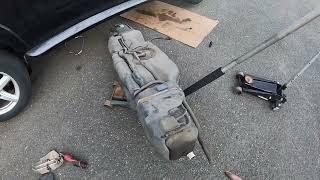
- The fix requires dropping the fuel tank to replace the entire fuel pump module assembly.
- Do not replace the instrument cluster; the problem is at the fuel tank.
- Due to the risk of running out of fuel, it's best to fix this issue promptly even though it doesn't harm the engine.
What's Unique About the 2002-2010 Mercury Mountaineer
This is a very common and well-documented issue on the Mercury Mountaineer and its twin, the Ford Explorer. Ford issued Technical Service Bulletins (TSBs) specifically for this problem. TSB 06-17-10 states that for 2004-2007 models, the cause is often sulfur contamination from gasoline building up on the fuel sender's resistor card, creating high resistance or an open circuit. An earlier TSB (05-21-3) also addresses similar fuel gauge issues on 2002-2006 models, confirming this is a persistent problem for this platform. The issue is so prevalent that it is one of the most frequently discussed problems for this vehicle on repair forums.
Generation note: This year range covers two generations of the Mountaineer: the second generation (2002-2005) and the third generation (2006-2010). The P0463 code and its primary cause—a faulty fuel sending unit due to sulfur contamination—are a known issue on both generations, as confirmed by Ford TSBs that cover model years from both. The platform mates, the Ford Explorer and Lincoln Aviator, share this exact problem across the same generations.
Symptoms You May Notice
- Check Engine Light is on
- Fuel gauge reads empty, full, or fluctuates erratically
- Low fuel warning light may be on, even with a full tank
- Difficulty predicting fuel consumption
- Replacing the instrument cluster without first diagnosing the fuel sending unit and its wiring.
- Replacing just the fuel pump motor when the issue is with the integrated sending unit.
- Assuming the problem is a wiring issue without testing the sending unit directly, which is the most common failure point on this vehicle.
Most Likely Causes
- Faulty Fuel Level Sending Unit 🔴 High Probability → Shop Fuel Tank Sending Unit As documented in Ford TSB 06-17-10, the sender's resistor card is highly susceptible to sulfur contamination from fuel, which causes an open or high-resistance reading. This is the most common point of failure for this code on this platform.
How to confirm: Perform a resistance sweep test on the sending unit with a multimeter. The resistance should change smoothly as the float arm is moved. For this platform, the expected range is approximately 10-15 Ohms when the tank is full and up to 160-180 Ohms when empty. An infinite (OL) reading or erratic jumps indicate a bad sender. This test requires removing the fuel pump module from the tank.
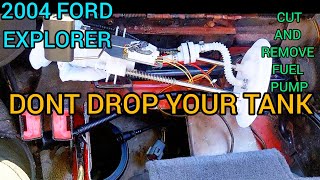
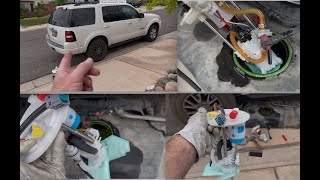
Typical fix: Replace the fuel level sending unit. On this vehicle, the sender is typically part of the complete fuel pump module assembly. The fuel tank must be removed to access it. 🎬 Watch: Complete guide to replacing the fuel pump and sender. Some owners on forums have cut an access panel in the floor above the tank to avoid dropping it, but this is not a recommended procedure. 🎬 Watch: How to access the fuel pump without dropping the tank.
Est. part cost: $250-$450 for an OEM Motorcraft assembly - Damaged Wiring or Corroded Connector 🟡 Medium Probability The wiring harness connector on top of the fuel tank is exposed to the elements, making it susceptible to corrosion, especially in regions with road salt. This can create a high-resistance or open circuit, mimicking a sender failure.
How to confirm: Visually inspect the wiring harness and connector (C423 on some diagrams) on top of the fuel tank for any signs of corrosion, damage, or loose pins. Test for the reference voltage (typically 5V) and a good ground at the connector with a multimeter.
Typical fix: Clean the connector terminals or repair/replace the damaged section of the wiring harness. In some cases, a new connector pigtail may be needed.
Est. part cost: $15-$50 - Poor Ground Connection ⚪ Low Probability
How to confirm: Locate the chassis ground point for the fuel pump module and check for corrosion or looseness. Test the resistance between the ground pin at the fuel pump connector (often a Black or Black/Orange wire) and a clean chassis ground; it should be less than 1 ohm.
Typical fix: Clean the ground connection point to bare metal and secure the ground wire.
Est. part cost: $0-$5
Rare But Worth Checking
- Faulty Instrument Cluster: → Shop Instrument Cluster This is very rare. Before suspecting the cluster, all components of the fuel sender circuit must be tested and confirmed to be working correctly.
- Faulty Powertrain Control Module (PCM): This is extremely rare and should only be considered after every other possibility has been exhausted by a professional.
Diagnosis Steps
- Retrieve the DTC using an OBD-II scanner to confirm P0463 is the primary code.
- Refer to Ford TSB 06-17-10 for the official diagnostic procedure if applicable to your model year.
- Check for less common causes first: inspect the fuse for the fuel pump/gauge circuit in the under-dash fuse panel.
- Visually inspect the wiring harness and connector on top of the fuel tank for corrosion or damage.
- Using a multimeter, check for the reference signal (typically 5-volt) and a good ground at the fuel pump connector.
- If power and ground are good, the next step is to test the sending unit itself. This requires removing the fuel tank to access the fuel pump module.
- Once the module is removed, measure the resistance across the sender's two terminals while manually moving the float arm up and down. The resistance should change smoothly from ~15 Ohms (Full) to ~160 Ohms (Empty) without any dropouts or open-circuit (OL) readings.
- If the sender fails the resistance test, it is faulty and the fuel pump/sender assembly should be replaced.
- If the sender tests good, the problem lies in the wiring between the tank and the PCM, which will require further circuit tracing.
Parts You'll Likely Need
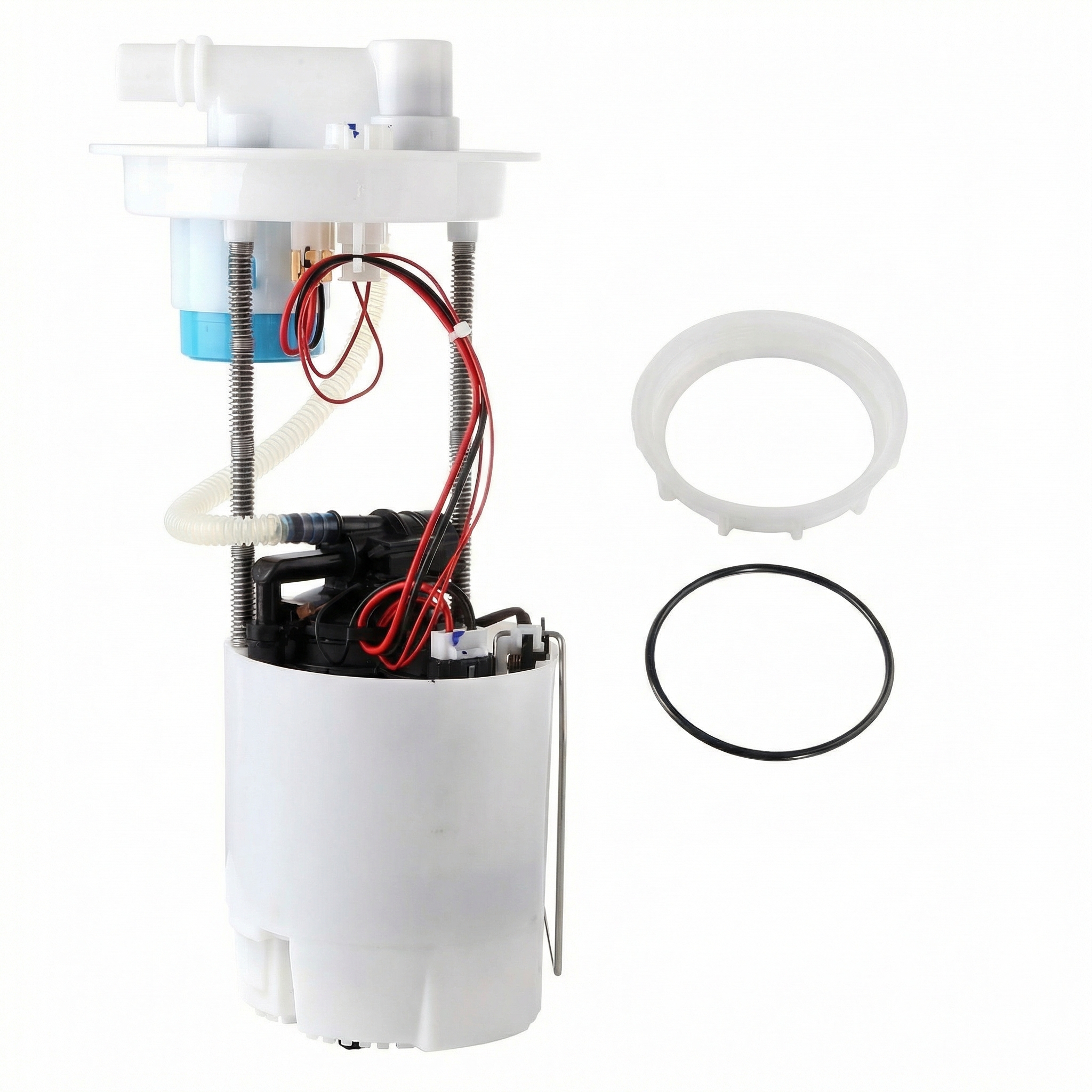
- Fuel Pump and Sender Assembly
(OEM #Motorcraft PFS-381 (for 2006-2009 models), Motorcraft PFS-418 (for 2004-2005 models). Note: Part numbers vary by year, always verify with VIN.)— This is the most common failure point, as documented by Ford TSBs. The sending unit fails due to contamination, and it is integrated into the fuel pump module.
Trusted brands: Motorcraft, Delphi, Bosch, Carter
OEM price range: $250-$450
Aftermarket price range: $150-$300
Technical Service Bulletins (TSBs) & Recalls
- TSB 06-17-10: MIL ON with DTC P0463 or Erratic Fuel Gauge Operation. Addresses sulfur contamination on the fuel sender card for 2004-2007 models.
- TSB 05-21-3: MIL ON with PCM DTC P0463 and/or IC DTC B1201—Fuel Gauge Drops to Empty or Slow to Update After Refueling. Covers 2002-2006 models.
Platform-Specific Known Issues
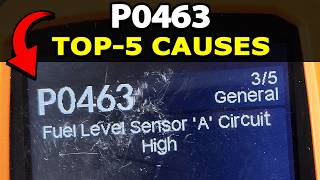
- Ford TSB 06-17-10 specifically identifies sulfur contamination on the fuel sender card as the primary cause of P0463 on 2004-2007 Mountaineer models. 🎬 See how to diagnose and fix the P0463 engine code.
- Ford TSB 05-21-3 addresses related fuel gauge issues (slow to update, drops to empty) on 2002-2006 models, which can also be associated with P0463.
- Owner forums like ExplorerForum.com are filled with threads from Mountaineer and Explorer owners detailing their experience with P0463, almost all of which conclude with replacing the fuel pump assembly.
Mechanic-Grade Diagnostic Values
- Fuel Level Sending Unit Resistance — expected: Approx. 10-15 Ohms at Full, and 160-180 Ohms at Empty. The reading should sweep smoothly between these values.. Failure: An Open Loop (OL) reading, or erratic jumps in resistance as the float arm is moved.
- Fuel Level Sensor Signal Wire Voltage (at connector, key on) — expected: Approx. 5 volts (reference voltage from PCM).. Failure: 0 volts or significantly lower than 5 volts may indicate a wiring issue between the PCM and the connector.
- Fuel Level Sensor Ground Wire Resistance — expected: Less than 1 Ohm between the ground pin at the connector and a clean chassis ground.. Failure: High resistance indicates a poor ground connection, which can cause the P0463 code.
Wiring & Ground Locations
- Inertia Fuel Shutoff Switch — At the base of the right 'A' pillar, typically in the front passenger footwell area.. While this switch cuts power to the pump and typically causes a no-start, issues with its wiring could potentially affect the circuit. It's a key safety component in the fuel system.
- Fuel Pump Driver Module — At the right 'D' pillar (rear of the vehicle).. This module controls the fuel pump. While not directly part of the sender circuit, its wiring is bundled nearby and it shares a common ground path, making it a relevant location for inspection.
- Fuel Pump Module Connector (C4329/C423) — On top of the fuel tank, connecting the vehicle harness to the fuel pump assembly.. This is the primary connection point for the fuel level sender. The sender signal wire (often Yellow/White) and ground wire (often Black/Orange) pass through here. Corrosion at this connector is a common cause of P0463.
- Fuel System Ground — A specific ground point (G-number) is not consistently documented, but it is typically a wire bolted to the frame rail near the fuel tank.. A corroded or loose ground is a classic cause for a 'Circuit High' code, as it creates an open in the sender's path to ground, causing the signal voltage to read maximum.
Real Owner Repair Stories
- Go-Parts / 2CarPros.com owner report (2005 Ford Explorer 6 Cyl, 28,000 miles) — Fuel gauge suddenly read 'below empty' with a 3/4 full tank. Check Engine Light on with code P0463.
❌ Tried (didn't work) Initial diagnosis pointed towards the common fuel sending unit failure.
✅ What actually fixed it The problem was a blown fuse located in the fuse panel under the driver's side dash. Replacing the fuse resolved all symptoms. - YouTube user comment/forum consensus (2005 Ford Explorer) — P0463 code, no start condition, and non-working fuel gauge.
✅ What actually fixed it To avoid the labor of dropping the fuel tank, the owner cut an access panel in the vehicle floor directly above the fuel pump module to replace it. This fixed the fuel gauge issue. - Go-Parts owner report (2000 Ford Explorer) — Intermittent fuel system issues, including P0463 and erratic gauge behavior.
❌ Tried (didn't work) Initial checks of the pump and sender unit.
✅ What actually fixed it The issue was traced to a bad ground connection at the fuel tank. Cleaning and securing the ground wire to the chassis resolved the problem.
Model Year Variations Within This Range
- 2002-2005 vs 2006-2010: The primary difference is the specific fuel pump module part number. For example, 2004-2005 models often use Motorcraft PFS-418, while 2006-2009 models may use PFS-381. The diagnostic and repair procedure (dropping the tank) remains fundamentally the same across both generations.
Diagnostic Flowchart
Other Known Issues on This Vehicle
Issues unrelated to this code that are worth knowing about as an owner of this generation:
- Cracked Rear Liftgate Panel 🟠 Medium — Extremely common on 2002-2005 models. The plastic applique below the rear window develops a crack, often near the brand emblem. (Ref: No recall was issued for the crack itself, but it was the subject of class-action lawsuits. A related recall (04V-442) addressed the rear glass hinge which could fail due to moisture ingress from the crack.)
- 4.0L SOHC V6 Timing Chain Rattle 🔴 High — Very common, especially on earlier 1997-2004 models. A rattling noise is heard from the engine, particularly on a cold start or under acceleration around 2500 RPM. This is caused by failing timing chain tensioners and plastic guides. (Ref: Multiple TSBs were issued, including 99-26-05 and 04-15-4, which recommended replacing tensioners and other components. Failure to address this can lead to catastrophic engine damage.)
- 5R55W/S/E Automatic Transmission Failure 🔴 High — Common across all model years. Symptoms include harsh shifting, slipping, or complete failure to engage gears. Issues often stem from a worn servo bore in the transmission case or solenoid failure.
- Heater Blend Door Actuator Failure 🟡 Low — A common complaint where the HVAC system gets stuck on hot or cold due to a broken plastic blend door or failed actuator motor.
Used vs. New Parts: Buying Guide for This Vehicle
When a used part is the smart pick: For this specific P0463 repair, using a part from a salvage or junkyard vehicle is STRONGLY DISCOURAGED. The primary cause of failure is wear and contamination on the sender's resistor card from sulfur in fuel, a problem documented by Ford TSBs. A used part is highly likely to have the same issue or fail shortly after installation.
What to inspect on the donor part:
- Not applicable, as a used part is not recommended regardless of condition.
OEM-only on this vehicle (don't cheap out):
- Fuel Pump and Sender Assembly: Given that the failure mode is a specific material degradation (sulfur contamination), the OEM Motorcraft part is the most reliable choice as it is designed to the original specifications that later TSBs were based on. While some premium aftermarket brands may be sufficient, budget brands risk using materials that are not resistant to this known issue.
Aftermarket brands forum-validated for this vehicle:
- While Motorcraft (OEM) is most recommended, brands like Delphi and Bosch generally have a good reputation for fuel system components, though specific validation for this P0463 issue on forums is sparse.
Brands owners have reported issues with on this vehicle:
- Avoid unbranded, 'white-box', or suspiciously cheap fuel pump assemblies from online marketplaces. These often use lower-quality materials for the sending unit resistor card, making them highly prone to premature failure with this specific code.
Real Owner Stories
Aggregated from forums and TSBs cited above. Mileages and costs reflect what owners reported in those sources.
2005 Ford Explorer (Platform Twin)
Symptoms: The fuel gauge was reading 'below empty' and the vehicle had a P0463 code stored.
What fixed it: Replacement of the fuel sending unit as confirmed by the diagnostic procedures in TSB 06-17-10.
Source hint: 2CarPros.com: A user with a 2005 Ford Explorer experiencing a gauge reading 'below empty' with a P0463 code
2002-2010 Mercury Mountaineer
Symptoms: Owners detailed experiences with the P0463 code and erratic fuel gauge readings.
What fixed it: Replacing the fuel pump assembly.
Source hint: ExplorerForum.com: This forum is a major resource with numerous threads where owners of 2002-2010 Explorers and Mountaineers discuss the P0463 code
Related OBD-II Codes
Frequently Asked Questions
Does TSB 06-17-10 apply to my 2005 Mercury Mountaineer?
My fuel gauge is slow to update after I fill the tank; is this related to P0463?
Can I use a used fuel pump from a salvage yard to fix the P0463 code?
Is there an access panel to reach the fuel sender without removing the tank?
What is the correct resistance range for the fuel sending unit on a 2002-2010 Mountaineer?
Besides the fuel sender, what else should I check on my Mountaineer for this code?
Helpful Videos
Used OEM Parts in Stock
New Aftermarket Parts Available


The information in this article is provided for general reference and educational purposes only. Vehicle specifications, procedures, and part compatibility can vary by production date, trim level, and region. Always consult your vehicle's factory service manual and verify part numbers before purchasing or performing repairs. Safety-critical components such as airbags, seat belts, and braking systems should be installed by a qualified professional.
- Mercury Mountaineer:
- 🧭 Diagnostic Flowchart
- 🎬 Helpful Videos
- 🛍️ Shop This Part
- What's Unique About the 2002-2010 Mercury Mountaineer
- Symptoms You May Notice
- Most Likely Causes
- Rare But Worth Checking
- Diagnosis Steps
- Parts You'll Likely Need
- Technical Service Bulletins (TSBs) & Recalls
- Platform-Specific Known Issues
- Mechanic-Grade Diagnostic Values
- Wiring & Ground Locations
- Real Owner Repair Stories
- Model Year Variations Within This Range
- Other Known Issues on This Vehicle
- Used vs. New Parts: Buying Guide for This Vehicle
- Real Owner Stories
- 2005 Ford Explorer (Platform Twin)
- 2002-2010 Mercury Mountaineer
- Related OBD-II Codes
- Frequently Asked Questions
- 🎟️ Get 5% Off