

P0463 on 2016-2017 Nissan JUKE: Fuel Level Sensor Circuit High Causes and Fixes
On a 2016-2017 Nissan JUKE, code P0463 almost always means the fuel level sensor in the gas tank has failed. Your fuel gauge will be stuck or inaccurate, typically on full. Nissan issued a bulletin (NTB22-026) confirming the sensor can be replaced separately from the entire fuel pump, making the repair much cheaper. It is critical to get the correct sensor for your vehicle's drivetrain (AWD vs. 2WD).
- P0463 on your JUKE means the fuel level sensor circuit has a fault, almost always due to a failed sensor.
- Your primary symptom will be an incorrect fuel gauge, which can leave you stranded if you run out of gas.
- Do not replace the entire fuel pump assembly. Nissan issued a TSB (NTB22-026) stating that only the sensor needs to be replaced, saving you hundreds of dollars.
- This repair involves working with the fuel tank and is a fire hazard, so professional service is strongly recommended.
- The most likely part you'll need is the Fuel Level Sensor, OEM part number 25060-1KM1A.
What's Unique About the 2016-2017 Nissan JUKE
For the Nissan JUKE and many other 2016-2022 Nissan models (including the Versa, Sentra, and Rogue), this code is a well-documented, widespread issue. Nissan released a Technical Service Bulletin (TSB), NTB22-026, that directly addresses P0463 and related codes. The bulletin's key takeaway is that technicians should replace only the faulty fuel level sensor, not the entire, more expensive fuel pump assembly. This is a significant cost-saving measure and a direct acknowledgment from the manufacturer of a common failure point. The bulletin explicitly states that warranty claims for replacing the whole assembly for this issue will be charged back.
Diagnostic Flowchart
Tap your situation to follow the diagnostic path that matches what you're seeing on this vehicle.
Symptoms You May Notice
- Fuel gauge is inaccurate, fluctuating, or stuck (usually on full)
- Check Engine Light is on
- Low fuel warning light may be on or flash incorrectly
- Unexpectedly running out of fuel
- Replacing the entire fuel pump assembly. Nissan's TSB NTB22-026 specifically warns against this, as only the fuel level sensor typically needs replacement. This is a common mistake that significantly increases repair costs.
Most Likely Causes
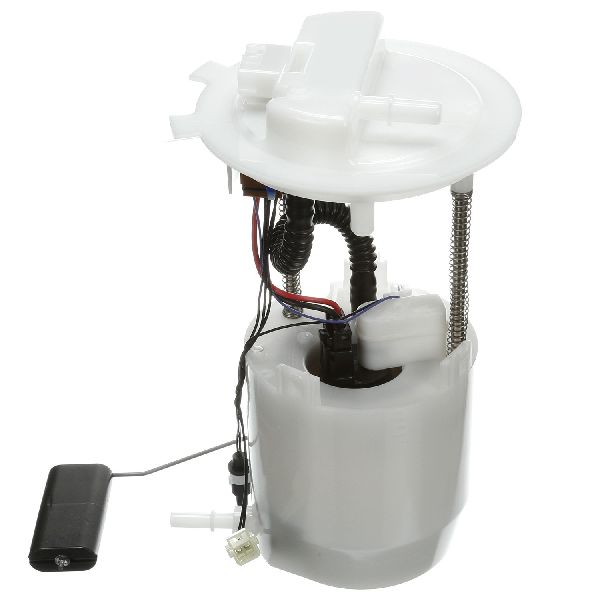
- Failed Fuel Level Sensor (Sending Unit) 🔴 High Probability → Shop Fuel Tank Sending Unit This is a known failure point acknowledged by Nissan in TSB NTB22-026, which affects many models from this era. The internal variable resistor wears out or fails, creating an open circuit that the ECM reads as high voltage. 🎬 Watch: Understanding the causes and fixes for code P0463
How to confirm: Use a multimeter to test the sensor's resistance as you move the float arm. The resistance should change smoothly from low ohms (full) to high ohms (empty). If it shows an open circuit (infinite resistance or 'OL') or has dead spots where the reading jumps erratically, it has failed.
Typical fix: Replace the fuel level sensor. Per TSB NTB22-026, the sensor can be replaced separately from the fuel pump assembly. The access panel is under the rear seat cushion. A new sealing ring/gasket should also be installed.
Est. part cost: $110-$150 - Wiring or Connector Issue 🟡 Medium Probability The wiring harness connector on top of the fuel tank is exposed to moisture and road debris, which can lead to corrosion or damage over time, causing an open or short circuit. Forum users have reported fixing the issue by cleaning corroded contacts on this connector.
How to confirm: Visually inspect the wiring and connector on top of the fuel tank for any signs of corrosion (green or white powder), damage, or loose pins. Test for continuity and proper voltage at the connector using a multimeter and a vehicle-specific wiring diagram.
Typical fix: Clean the corroded connector terminals with electrical contact cleaner or repair/replace the damaged section of the wiring harness.
Est. part cost: $10-$50 - Poor Ground Connection ⚪ Low Probability The fuel tank's ground strap can corrode or become loose, creating high resistance in the sensor's circuit, which the ECM can interpret as a high voltage signal.
How to confirm: Locate the fuel tank ground strap and test the resistance between the connection point and a clean chassis ground. The reading should be very low (under 5 ohms).
Typical fix: Clean the contact points and re-secure the ground strap, or replace the strap if it is broken.
Est. part cost: $15-$30
Rare But Worth Checking
- Instrument Cluster Failure: → Shop Instrument Cluster While rare, a fault within the instrument cluster itself can cause incorrect gauge readings and may sometimes be associated with this code. This should only be considered after the sensor and wiring have been thoroughly checked.
- Powertrain Control Module (PCM) Fault: This is extremely unlikely. The PCM is a robust component, and it should be the last item to be diagnosed. All other possibilities must be ruled out first.
Diagnosis Steps
- Use an OBD-II scanner to confirm P0463 is the primary code and check for other related codes like P0460, P0461, or P0462.
- Gain access to the fuel pump assembly by lifting out the rear seat cushion.
- Inspect the wiring harness and connector on top of the fuel pump assembly. Look for any visible signs of corrosion, damage, or loose connections.
- Check the fuel tank ground strap for corrosion or a loose connection.
- Using a scan tool that can read live data, observe the fuel level sensor voltage. A reading stuck at or near 5 volts confirms a high input/open circuit condition.
- If the wiring appears intact, access the fuel level sensor. Disconnect it and test the resistance across the sensor pins with a multimeter while manually moving the float arm. 🎬 See how to test and replace the fuel level sensor The resistance should change smoothly. An infinite (OL) reading indicates a failed sensor.
- If the sensor tests good, perform a continuity and voltage drop test on the signal and ground wires between the sensor connector and the ECM to rule out a wiring fault.
Parts You'll Likely Need
- Fuel Level Sensor (for AWD models)
(OEM #25060-1KM1A)— This is the specific sensor for All-Wheel Drive Juke models and is the most common cause of P0463, as confirmed by TSB NTB22-026.
Trusted brands: Nissan (OEM), Hitachi
OEM price range: $140-$200
Aftermarket price range: $90-$150 - Fuel Level Sensor (for 2WD models)
(OEM #25060-1KM0A)— This is the specific sensor for Two-Wheel Drive Juke models. Ordering the wrong part for your drivetrain will result in fitment issues.
Trusted brands: Nissan (OEM), Hitachi
OEM price range: $120-$170
Aftermarket price range: $80-$130 - Fuel Pump Assembly Seal / Gasket
(OEM #17342-EM30A)— This rubber seal should always be replaced when the fuel pump assembly is removed from the tank to prevent fuel leaks and vapor smells. It is cheap insurance.
Trusted brands: Nissan (OEM)
OEM price range: $25-$40
Aftermarket price range: $15-$25
Related Codes That Often Appear With This One
- P0460 — This code indicates an erratic signal from the fuel level sensor. It is listed in the same Nissan TSB (NTB22-026) and points to the same root cause.
- P0461 — This code indicates the sensor's performance is out of range. It is also listed in TSB NTB22-026 and is caused by a failing fuel level sensor.
- P0462 — This code is for 'Fuel Level Sensor Circuit Low Input,' the opposite of P0463. Seeing both could indicate an intermittent wiring problem or a completely failed sensor. It is also covered by TSB NTB22-026.
Technical Service Bulletins (TSBs) & Recalls
- NTB22-026: Service Information for Fuel Gauge Inaccurate with DTCs Stored in ECM. Confirms that for P0463, the fuel level sensor can and should be replaced independently of the fuel pump assembly across many 2016-2022 Nissan models.
Platform-Specific Known Issues
- Nissan Technical Service Bulletin NTB22-026 was issued for multiple Nissan vehicles, including the 2016-2017 JUKE, for inaccurate fuel gauges with DTCs P0460, P0461, P0462, or P0463. The bulletin explicitly states that the fuel level sensor can be replaced separately, and warns that warranty claims for replacing the entire fuel pump assembly for this issue will be rejected.
- The fuel pump and level sensor assembly is accessed through a panel under the rear seat cushion, which must be removed.
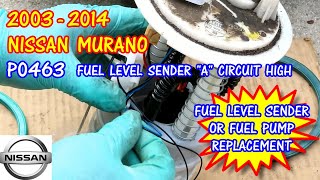
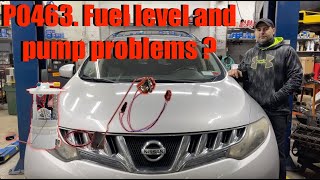
- A special lock ring tool is recommended for removing the fuel pump assembly from the tank, though many technicians and DIYers successfully use a brass punch or a flat-head screwdriver and hammer. 🎬 Watch a mechanic replace a Nissan fuel sending unit
Mechanic-Grade Diagnostic Values
- Fuel Level Sensor Voltage (Live Data) — expected: Approx. 0.5V (Empty) to 4.5V (Full). Should be around 2.5V at half a tank.. Failure: A voltage reading stuck at or above 5V confirms the 'Circuit High' condition seen with P0463.
- Fuel Level Sensor Resistance (Multimeter) — expected: Resistance should change smoothly as the float arm is moved. While exact OEM specs for the Juke are not published in general repair manuals, a typical Nissan sensor of this era would show low resistance when full (e.g., ~4 ohms) and high resistance when empty (e.g., ~34-80 ohms).. Failure: An 'OL' (Open Loop/infinite resistance) reading on the multimeter at any point in the float's travel indicates a failed sensor, which is the direct cause of P0463.
- Sensor Ground Circuit Voltage Drop — expected: Less than 0.1 volts (100 millivolts) when tested between the sensor connector's ground pin and the negative battery terminal.. Failure: A high voltage reading (e.g., approaching battery voltage) indicates a bad ground connection, which can cause a floating voltage and trigger a P0463 code.
Scan Tool Commands That Help
- Manual Procedure: Instrument Cluster Self-Diagnostic Mode — To rule out a faulty fuel gauge motor or instrument cluster problem. This test sweeps all the gauges (speedometer, tachometer, fuel, temp) to their maximum and minimum positions. If the fuel gauge needle moves correctly during this test, the cluster itself is likely good, pointing the diagnosis back to the sensor or wiring.
OEM Part Supersession History
25060-1KM1A→25060-1KM1B— Standard part revision by the manufacturer. No specific reason is publicly documented, but it usually involves minor improvements in materials or design.
Heads up: 25060-1KM1B is the direct replacement for 25060-1KM1A and is fully compatible for AWD models.
Helpful Videos


Used OEM Parts in Stock
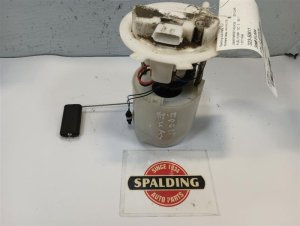
New Aftermarket Parts Available


The information in this article is provided for general reference and educational purposes only. Vehicle specifications, procedures, and part compatibility can vary by production date, trim level, and region. Always consult your vehicle's factory service manual and verify part numbers before purchasing or performing repairs. Safety-critical components such as airbags, seat belts, and braking systems should be installed by a qualified professional.
- Nissan JUKE:
- 🧭 Diagnostic Flowchart
- 🎬 Helpful Videos
- 🛍️ Shop This Part
- What's Unique About the 2016-2017 Nissan JUKE
- Symptoms You May Notice
- Most Likely Causes
- Rare But Worth Checking
- Diagnosis Steps
- Parts You'll Likely Need
- Related Codes That Often Appear With This One
- Technical Service Bulletins (TSBs) & Recalls
- Platform-Specific Known Issues
- Mechanic-Grade Diagnostic Values
- Scan Tool Commands That Help
- OEM Part Supersession History
- 🎟️ Get 5% Off