

P0463 on 2016-2020 Nissan NV: Fuel Level Sensor Circuit High Input Causes and Fixes
P0463 on a 2016-2020 Nissan NV indicates a high voltage signal from the fuel level sensor, causing an inaccurate fuel gauge. The most common cause is a faulty fuel level sensor itself, which can be replaced separately from the fuel pump assembly, per Nissan TSB NTB22-026. This is a known issue on the Nissan truck and van platform.
- P0463 means your Nissan NV's fuel gauge is unreliable due to a high voltage signal from the fuel level sensor.
- The most likely cause is a failed fuel level sensor, which is a known issue on this platform and its relatives like the Nissan Titan.
- Per Nissan TSB NTB22-026, you should only replace the sensor, not the entire expensive fuel pump assembly.
- Repair requires dropping the fuel tank, making it a moderately difficult DIY job.
What's Unique About the 2016-2020 Nissan NV
For the Nissan NV, this code is specifically addressed by a Technical Service Bulletin (TSB NTB22-026). The key takeaway from this bulletin is that technicians should not replace the entire fuel pump assembly for this issue. Nissan explicitly states that the fuel level sensor can and should be replaced as a separate component, which can save significant money on parts. The TSB also notes that warranty claims for replacing the entire fuel pump assembly for this issue will be charged back, underscoring that sensor-only replacement is the correct procedure. This suggests that sensor failure is a known issue, and replacing the whole pump is a common, but incorrect, upsell or misdiagnosis.
Diagnostic Flowchart
Tap your situation to follow the diagnostic path that matches what you're seeing on this vehicle.
Symptoms You May Notice
- Check Engine Light is on
- Fuel gauge reading is inaccurate (e.g., stuck on full, stuck on empty, or fluctuates wildly)
- Low fuel warning light may be on constantly, even with a full tank
- Risk of running out of fuel unexpectedly because the gauge is unreliable
- Fuel gauge takes a very long time to drop from 'Full' after a fill-up.
- Replacing the entire fuel pump assembly. Nissan TSB NTB22-026 explicitly warns against this, stating that only the fuel level sensor needs to be replaced.
- Replacing the instrument cluster fuel gauge. The gauge only displays the information it's given; the problem is almost always with the sensor or the wiring that provides the signal.
Most Likely Causes
- Faulty Fuel Level Sensor (Sending Unit) 🔴 High Probability → Shop Fuel Tank Sending Unit Nissan issued TSB NTB22-026 specifically advising that the sensor can be replaced separately, indicating it's a common failure point across multiple models, including the NV. The sensor's internal variable resistor can wear out or develop an open spot, causing the signal voltage to spike.
How to confirm: Access the sensor and test its resistance with a multimeter. For many Nissan models, the resistance should be around 4-5 Ohms when full and around 80-85 Ohms when empty. A reading of infinite resistance (open circuit) or a failure to change smoothly when moving the float arm confirms a bad sensor.
Typical fix: Replace the fuel level sensor. Per TSB NTB22-026, the entire fuel pump assembly should not be replaced.
Est. part cost: $100-$250 - Damaged Wiring or Connectors 🟡 Medium Probability As a commercial work van, the NV may be subject to harsher conditions. Wiring running along the frame rail to the fuel tank can be damaged by road debris, moisture, or corrosion, leading to a short to power, which would cause a 'high input' reading.
How to confirm: Visually inspect the wiring harness from the fuel tank to the main body. Check for chafed wires, corrosion in connectors, or loose pins, particularly at the connector on top of the fuel pump assembly. Use a multimeter to check for a short to voltage on the signal wire.
Typical fix: Repair or replace the damaged section of the wiring harness. Clean or replace corroded connectors.
Est. part cost: $10-$100 - Poor Ground Connection ⚪ Low Probability The ground for the fuel pump and sensor circuit can corrode or become loose. On many Nissan vehicles, the fuel pump control unit provides the ground path, and issues with this module or its own chassis ground can cause erratic signals.
How to confirm: Locate the ground point for the fuel pump assembly or fuel pump control module. Inspect for rust or looseness. Test for high resistance between the ground wire at the pump connector and a clean spot on the chassis using a multimeter.
Typical fix: Clean the ground connection point to bare metal and secure the ground wire. In some cases, running a new ground wire is necessary.
Est. part cost: $1-$5
Rare But Worth Checking
- Stuck Fuel Level Float: The float arm can become mechanically stuck in the 'full' position due to debris in the tank or a bent arm, causing a constant high reading. This is less common than electrical failure but possible, especially if the tank has been deformed.
- Faulty Engine Control Module (ECM) or Instrument Cluster: → Shop Instrument Cluster This is very rare, but the module that interprets the sensor's signal can fail internally. This should only be considered after all other possibilities, including wiring and the sensor itself, have been exhaustively tested and ruled out.
Diagnosis Steps
- Read the DTCs with an OBD-II scanner to confirm P0463 and check for any other related codes.
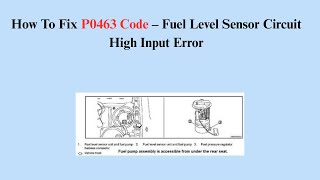
- Use the scanner's live data function to observe the fuel level sensor voltage. A reading stuck at a high voltage (e.g., near 5V) confirms the 🎬 See this guide on fixing the P0463 high input error. 'high input' condition.
- Inspect fuses related to the fuel system (often labeled 'FUEL PUMP') and instrument cluster. A blown fuse for the pump can sometimes cause this code on certain vehicles.
- Perform a visual inspection of the wiring harness leading to the fuel tank. Look for any obvious damage, corrosion, or loose connections.
- Inspect the fuel tank ground strap for corrosion or damage.
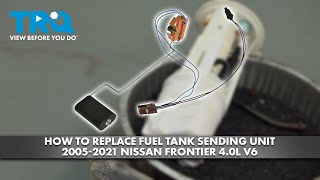
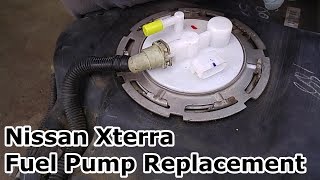
- If wiring appears okay, access the top of the fuel tank to disconnect the fuel level sensor connector. On the NV, this requires lowering the fuel tank. 🎬 Watch: How to safely remove the fuel tank and pump.
- With the key on, check the voltage on the signal wire in the harness. If high voltage is still present with the sensor disconnected, the fault is in the wiring (short to power) or the ECM.
- If the wiring checks out, test the sensor itself. Use a multimeter set to Ohms. For many Nissans, a full tank should read low resistance (approx. 4-5 Ohms) and an empty tank should read high resistance (approx. 80-85 Ohms). Measure the resistance across the sensor's pins as you manually move the float arm. The resistance should change smoothly. A sudden jump to infinity (open) or a fixed reading indicates a failed sensor.
- If the sensor and wiring are good, the problem may be with the instrument cluster or ECM, which would require more advanced diagnostics.
Parts You'll Likely Need
- Fuel Level Sensor
(OEM #25060-9SM0A)— This is the most common failure point for P0463, as confirmed by Nissan's TSB. The internal resistor fails, causing an incorrect signal. This part number supersedes older versions like 25060-3LM0A and 25060-3LM0B.
Trusted brands: Nissan (OEM), Hitachi, Spectra Premium
OEM price range: $105-$150
Aftermarket price range: $80-$130
Related Codes That Often Appear With This One
- P0460 — This code relates to 'Fuel Level Sensor Circuit' and can be triggered along with P0463 if the signal is erratic or nonsensical to the ECM. This code is also listed in TSB NTB22-026.
- P0461 — This code indicates a performance/range issue with the sensor circuit, often a precursor or companion to the 'high input' fault. This code is also listed in TSB NTB22-026.
- P0462 — This is the opposite of P0463, indicating a 'low input'. Seeing both could point to severe wiring issues or a failing sensor that is fluctuating between open and shorted states.
Technical Service Bulletins (TSBs) & Recalls
- NTB22-026: States that for P0463 and related codes, the fuel level sensor can be replaced separately from the fuel pump assembly. It warns that warranty claims for replacing the entire assembly will be charged back.
Platform-Specific Known Issues
- Nissan issued Technical Service Bulletin NTB22-026 on April 5, 2022, for 2016-2022 models, including the NV. It explicitly states that if DTC P0463, P0460, P0461, or P0462 is present due to a faulty fuel level sensor, only the sensor should be replaced, not the entire fuel pump assembly.
- Accessing the fuel pump assembly on the NV requires dropping the fuel tank, as there is no interior access panel under the seats or floor unlike in some other vans or SUVs.
Mechanic-Grade Diagnostic Values
- Fuel Level Sensor Resistance — expected: Approximately 3-5 Ohms (Full) to 80-85 Ohms (Empty).. Failure: A reading of infinite resistance (Open/OL), zero resistance (short), or values that do not change smoothly as the float arm is moved.
- Fuel Pump Fuse — expected: Fuse should have continuity.. Failure: A blown fuse will show no continuity. On a 2019 NV2500, this was fuse #18 (15A) in the IPDM (Intelligent Power Distribution Module).
Scan Tool Commands That Help
- Nissan CONSULT or advanced generic scanner: Instrument Cluster Self-Test / Actuator Test — After confirming the sensor and wiring are good, a cluster self-test can be used to command the gauges to sweep through their full range of motion. If the fuel gauge moves correctly during the test but not during normal operation, it suggests the gauge itself is functional and the issue lies with the signal it's receiving (or the cluster's processor), ruling out a physically stuck needle.
Wiring & Ground Locations
- Fuel Pump Connector — On top of the fuel pump assembly, which is accessed by lowering the fuel tank on the Nissan NV.. This is the primary connection point for the fuel level sensor. Corrosion or damage to the pins and wiring at this connector is a common cause of circuit faults like P0463. On some Nissan models, the signal wire is white and the power supply is blue.
- Fuel Pump Fuse (F18) — Located in the Intelligent Power Distribution Module (IPDM) in the engine compartment. For a 2019 NV, it was a 15A fuse labeled for the fuel pump.. While a blown fuse typically causes a no-start (P0090, P0087), intermittent power loss or voltage spikes due to a failing fuse or poor connection in the IPDM could potentially trigger circuit codes like P0463 before total failure.
- Chassis Ground — A wire or strap connecting the fuel tank or fuel pump assembly to the vehicle's frame/chassis.. A corroded, loose, or broken ground connection increases resistance in the circuit. The computer interprets this high resistance as a high voltage signal, directly causing a P0463 code.
Real Owner Repair Stories
- YouTube user Irfan Chaudhry (2019 Nissan NV2500) — Crank, no start. No fuel pressure.
❌ Tried (didn't work) Confirmed no fuel was being delivered by disconnecting the fuel line.
✅ What actually fixed it The 15A fuel pump fuse (fuse #18 in the IPDM) was blown. Replacing the fuse restored power to the fuel pump and the vehicle started.
OEM Part Supersession History
25060-3LM0A, 25060-3LM0B→25060-9SM0A— Part revision or manufacturer change. Often done to improve reliability or address a known failure mode.
Helpful Videos


The information in this article is provided for general reference and educational purposes only. Vehicle specifications, procedures, and part compatibility can vary by production date, trim level, and region. Always consult your vehicle's factory service manual and verify part numbers before purchasing or performing repairs. Safety-critical components such as airbags, seat belts, and braking systems should be installed by a qualified professional.
- Nissan NV:
- 🧭 Diagnostic Flowchart
- 🎬 Helpful Videos
- What's Unique About the 2016-2020 Nissan NV
- Symptoms You May Notice
- Most Likely Causes
- Rare But Worth Checking
- Diagnosis Steps
- Parts You'll Likely Need
- Related Codes That Often Appear With This One
- Technical Service Bulletins (TSBs) & Recalls
- Platform-Specific Known Issues
- Mechanic-Grade Diagnostic Values
- Scan Tool Commands That Help
- Wiring & Ground Locations
- Real Owner Repair Stories
- OEM Part Supersession History
- 🎟️ Get 5% Off