

P0480 on 2004-2008 Chrysler Pacifica: Cooling Fan Circuit Malfunction Causes and Fixes
This code indicates a problem in the cooling fan control circuit. The most common cause on a Pacifica is a failed cooling fan relay/module (OEM Part #4868332AE), followed by a bad fan motor or wiring issues. Expect to pay $40-$80 for a new relay module or $150-$300 for a complete fan assembly.
- P0480 on a 2004-2008 Pacifica points to an electrical fault in the cooling fan circuit.
- The most likely culprit is the cooling fan control module (relay) located behind the front grille.
- Before buying parts, test the fan motors directly by applying 12V power and check all related fuses and wiring for damage, especially connector C105.
- Driving with this fault is risky as the engine can overheat, leading to expensive damage. Monitor your temperature gauge carefully.
What's Unique About the 2004-2008 Chrysler Pacifica
The 2004-2008 Pacifica uses a specific cooling fan control module (often called a relay) that is a very common failure point. Unlike some vehicles where the relay is a simple cube in the fuse box, the Pacifica's relay is a larger, finned module mounted behind the front grille on the bumper beam, making it susceptible to road debris and moisture. Owners frequently report that this module fails, causing the fans to either not run at all or run constantly, even with the engine off, draining the battery. This same design and failure pattern is seen on platform-mate Chrysler/Dodge minivans of the era.
Symptoms You May Notice
- Engine overheating, especially at idle or in slow-moving traffic.
- Check Engine Light is on.
- Air conditioning performance is poor or non-existent, particularly when the vehicle is not moving.
- Cooling fans do not turn on when the engine is hot or when the A/C is activated.
- Cooling fans run continuously and do not shut off, potentially draining the battery.
- Replacing the fan assembly when only the fan control module (relay) was bad.
- Replacing the fan control module when a corroded wire in the harness (at connector C105 or the module pigtail) was the actual problem.
Most Likely Causes
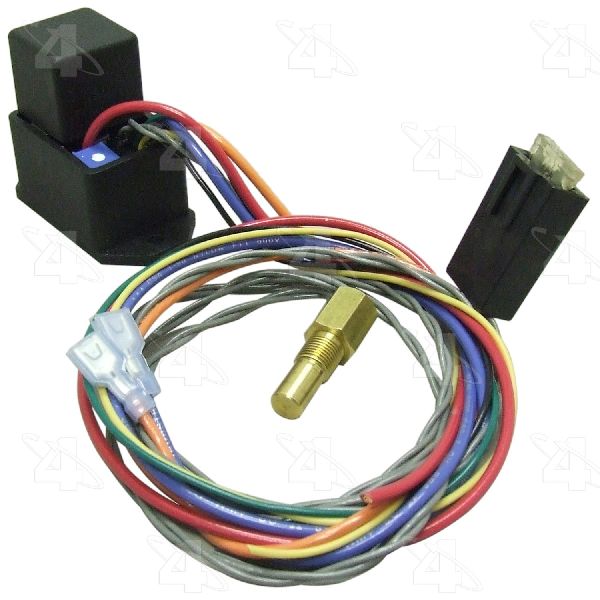
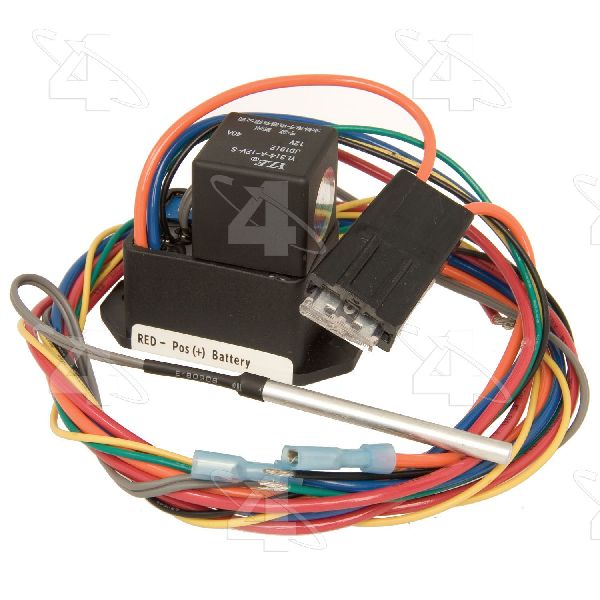
- Faulty Cooling Fan Relay / Control Module 🔴 High Probability → Shop Engine Cooling Fan Blade The fan control module on the Pacifica is a well-documented, high-failure item. Its location behind the grille exposes it to the elements, and internal components are known to fail, causing either an open circuit (no fan) or a shorted circuit (fan always on). This is the most common cause for P0480 on this vehicle.
How to confirm: Locate the module on the bumper support behind the driver's side headlight. Check for 12V power going into the module on the Red/Orange wire and for a command signal from the PCM on the Brown/Violet wire. A common test is to use a jumper wire to bypass the relay and send power directly to the fans. If the fans run with the jumper but not with the relay connected, the relay is the primary suspect.
Typical fix: Replace the cooling fan control module. The original part is riveted to the bumper beam and must be drilled or chiseled out. Many replacement kits, like the popular Dorman 902-310, come with a bolt to make future service easier.
Est. part cost: $40 - $100 - Failed Cooling Fan Motor(s) 🟡 Medium Probability → Shop Engine Cooling Fan Blade Electric motors wear out over time. The brushes can fail, or the motor can seize, causing an open circuit or an over-current condition that blows a fuse.
How to confirm: Disconnect the fan's electrical connector and apply 12V power and ground directly from the battery to the fan motor terminals. If the fan does not spin, the motor is dead. A healthy fan motor should draw between 15 to 25 amps when running.
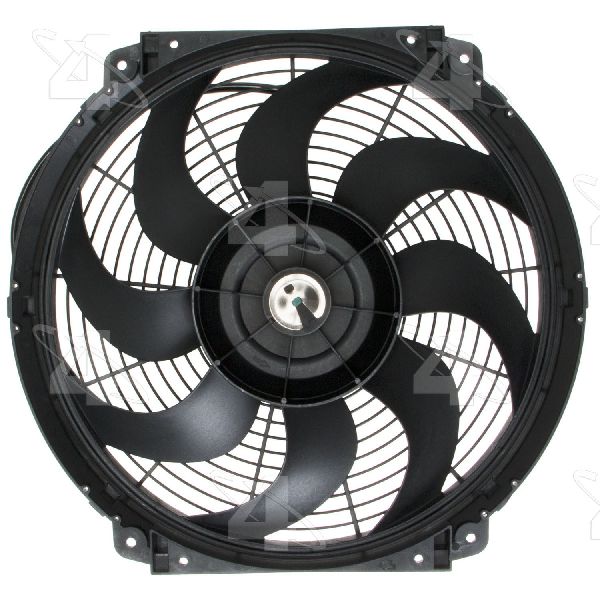
Typical fix: Replace the entire cooling fan assembly. It is critical to order the correct assembly for your specific engine (3.5L/3.8L vs. 4.0L), as the shrouds and mounting points differ.
Est. part cost: $150 - $300 - Damaged Wiring or Corroded Connectors 🟡 Medium Probability The wiring harness for the fan assembly runs in an exposed area. A specific gray connector, C105, located behind the driver-side headlamp assembly, is a known point of corrosion that can cause an open in the fan control signal wire. Wires can also break right at the fan control module connector due to vibration and exposure.
How to confirm: Visually inspect all wiring to and from the fan assembly and relay. Pay close attention to the main connector on the fan shroud and connector C105 behind the headlight for any green or white corrosion, melted plastic, or broken wires. One owner reported finding a broken wire at the relay connector itself, which solved the P0480 code after repair.
Typical fix: Repair the broken or corroded section of wire. This may involve cleaning the connector pins or splicing in a new section of wire with solder and heat shrink. Some aftermarket relay kits include a new pigtail connector for this purpose.
Est. part cost: $5 - $20 - Blown Fuse ⚪ Low Probability A fuse is a protective device. It will blow if there's a short circuit or if a failing fan motor is drawing too much current.
How to confirm: Check the large 40A cartridge fuse for the cooling fans in the under-hood fuse box (Integrated Power Module). A visual inspection or continuity test will show if it's blown.
Typical fix: Replace the fuse. However, a blown fuse is often a symptom of another problem (like a failing fan motor drawing too much current), so further diagnosis is required if the new fuse also blows.
Est. part cost: $1 - $5
Rare But Worth Checking
- Faulty Powertrain Control Module (PCM): This is rare. The PCM is the last thing to suspect. Before condemning the PCM, all other possibilities, including wiring, relays, and the fan motors themselves, must be exhaustively tested and ruled out. Manufacturer service bulletins such as TSB #18-052-16 and TSB #18-022-17 REV. A note that P0480 can be associated with PCM software enhancements or internal shutdown timer rationality issues on related Chrysler platforms.
- Defective Coolant Temperature Sensor (ECT): While a bad ECT sensor can prevent the fans from turning on, it usually triggers its own specific trouble codes (like P0117 or P0118). It's less likely to be the sole cause of a P0480 circuit code.
- Faulty Totally Integrated Power Module (TIPM): → Shop Fuse Box The under-hood fuse box, known as the TIPM on Chrysler products, can fail internally. Corrosion on its internal circuit board or at its main ground connection (G103) can interrupt power to the fan control module circuit, even if the 40A fuse appears good.
Diagnosis Steps
- Verify the Symptom: Start the engine and let it warm up to operating temperature. Turn the A/C on high. The cooling fans should activate. If they do not, the fault is active.
- Check the Fuses: Inspect the 40A fuse for the radiator fans located in the Integrated Power Module (fuse box) under the hood. Replace if blown.
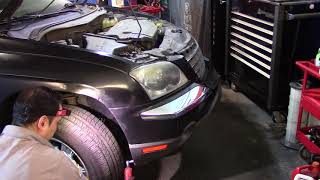
- Test the Fan Motors Directly: Disconnect the main electrical connector at the fan shroud. Use jumper wires to apply 12V power directly from the battery to the fan motor pins. If the fans spin, the motors are good. 🎬 Watch this video to see a hands-on cooling fan test. If not, the fan assembly needs replacement.
- Inspect the Fan Control Module/Relay: Locate the fan control module mounted on the bumper support behind the driver's side headlight. Check its connector for corrosion, melted plastic, or broken wires.
- Test the Relay Circuit: If the fans work when powered directly, the issue is in the control circuit. Check for constant power (over 11.0V) on the Red/Orange wire at the relay connector. A common test is to jump the two large terminals in the relay's connector. If the fans turn on, it confirms the main power and ground wiring is good and strongly points to a failed relay. 🎬 See this quick guide on checking your fan and relay.
- Inspect Wiring Harness: If a new relay doesn't solve the problem, carefully inspect the wiring. A forum user detailed checking continuity on the Brown/Violet wire from the fan relay connector (terminal 4) to the PCM connector C3 (terminal 6). Also, physically remove the driver's side headlight to inspect the gray connector C105 for corrosion.
- Check for PCM Command: Using a capable scan tool, command the cooling fan relay 'on'. With a multimeter or oscilloscope on the Brown/Violet signal wire, verify the PCM is sending the PWM signal (grounding the circuit) when commanded. If the scan tool shows the command is being sent but the fan doesn't run, and all wiring/relays/motors are confirmed good, it could point to a rare PCM driver failure. Manufacturer documentation like TSB #1805116 highlights P0480 as a "Cooling Fan 1 Control Circuit/Open" condition often addressed during electrical system diagnostics.
Parts You'll Likely Need
- Cooling Fan Control Module / Relay
(OEM #4868332AE)— This is the most frequent point of failure for the P0480 code on this specific vehicle.
Trusted brands: Dorman (902-310), Standard Motor Products (SMP), Gates
OEM price range: $70-$120
Aftermarket price range: $40-$80 - Radiator Cooling Fan Assembly
(OEM #5102428AA (For 3.5L/3.8L Engines))— If one or both fan motors have failed, the entire assembly is typically replaced as a unit for reliability. Must be matched to the engine size.
Trusted brands: TYC, Four Seasons, Replacement, GPD
OEM price range: $350-$500
Aftermarket price range: $150-$300
Technical Service Bulletins (TSBs) & Recalls
- While no Pacifica-specific TSBs exclusively target P0480, Chrysler has issued several bulletins for related electrical and powertrain systems (such as TSB #18-052-16 and TSB #18-022-17 REV. A) that list P0480 as a relevant diagnostic code for "Cooling Fan 1 Control Circuit/Open." The most prominent service actions for this vehicle relate to engine cradle corrosion.
Platform-Specific Known Issues
- The cooling fan relay/module is riveted to the front bumper beam and requires drilling or chiseling the rivet for replacement. A replacement bolt is often included with aftermarket kits.
- Connector C105, a gray connector located behind the driver-side headlamp, is a known weak point for corrosion that can interrupt the fan control signal from the PCM.
- The wiring right at the fan control module connector can become brittle and break, causing an open circuit. This should be checked before replacing the module.
Mechanic-Grade Diagnostic Values
- Voltage at Fused B+ Feed to Fan Control Module — expected: > 11.0 Volts. Failure: Voltage below 11.0V indicates a problem with the power supply from the 40A fuse or the TIPM.
- PCM Command Signal Voltage (Key On, Engine Off) — expected: ~12 Volts (on Brown/Violet wire). Failure: 0V suggests an open circuit. This is a pull-down circuit; the PCM grounds this wire to command the fan on.
- Cooling Fan Motor Current Draw — expected: 15 to 25 Amps. Failure: Significantly higher current indicates a failing motor at risk of blowing a fuse. No current draw when powered directly indicates a dead motor.
Scan Tool Commands That Help
- Chrysler DRBIII / wiTECH: Actuate Radiator Fan Relay / Cooling Fan Control — This bidirectional command is used to manually turn the cooling fan on and off via the scan tool. It directly tests the integrity of the control circuit from the PCM through the relay to the fan, bypassing the temperature sensors. If the fan runs with this command, the relay, fan motor, and their wiring are likely good.
Wiring & Ground Locations
- G102 — At the left side of the engine compartment, on the chassis frame rail.. This is a primary chassis ground for multiple front-end components. Corrosion here can cause a variety of electrical issues, including intermittent fan operation.
- G103 — At the left front of the engine compartment.. This is a specific ground point for the Totally Integrated Power Module (TIPM/fuse box). A bad ground here can affect power delivery to the fan relay circuit.
- Connector C105 — A gray electrical connector located in the plastic housing behind the driver's side headlamp assembly.. This connector is a known weak point where the Brown/Violet fan control signal wire from the PCM can corrode, causing an open circuit and triggering P0480.
- PCM Connector C3, Pin 6 — The third connector from the bottom on the Powertrain Control Module (PCM), located under the left front fender.. This is the specific pin on the PCM that sends the PWM control signal to the fan relay module via the Brown/Violet wire. It is the starting point for continuity testing the control circuit.
- Fan Control Module Connector, Pin 4 — The 4-pin connector at the fan control module itself, mounted on the front bumper beam.. This is the terminal where the Brown/Violet control signal wire arrives from the PCM. Testing for signal or continuity here is a key diagnostic step.
Real Owner Repair Stories
- ChryslerForum.com user 'kingkohlmn' (2005 Pacifica, 123,xxx miles) — P0480 code, fans not working correctly.
❌ Tried (didn't work) Initial checks showed fans worked when powered directly, and the relay connector had 12V power.
✅ What actually fixed it The user traced the issue to a lack of sufficient current (amperage) on the main power feed to the relay. The final suspicion, though not explicitly confirmed in the thread, was a corroded power wire at the bottom of the fuse box (IPM), highlighting that voltage can be present but a bad connection can prevent the necessary current from flowing. - ChryslerForum.com user 'Steven Pangilinan' (Chrysler Pacifica (year not specified)) — Fans would only turn on with A/C active, but not based on engine temp alone.
❌ Tried (didn't work) Replacing the fan control module/relay. This surprisingly caused a P0480 code to appear when there wasn't one before.
✅ What actually fixed it The issue mysteriously resolved itself after the user replaced the upper motor mount on the belt-drive side of the engine. Reassembling the airbox and moving wiring harnesses around in the process apparently fixed a poor connection or ground issue that was the true root cause. This points to intermittent wiring faults being a possible cause. - AutoZone Reviewer 'Mike' (2007 Chrysler Town & Country (shares same fan control system)) — Cooling fans would not shut off, draining the battery.
❌ Tried (didn't work) N/A
✅ What actually fixed it Replacing the failed fan control module with a Dorman 902-310 kit fixed the problem, returning the fans to normal operation. This is a classic failure mode (shorted closed). - NHTSA ODI #10374868 — An owner of a platform-mate vehicle reported a P0480 code noting a problem with the cooling fan system. After researching the code, the owner decided to perform the diagnosis and repair themselves to address the cooling system failure.
OEM Part Supersession History
4868332AE→68023333AA, 68041017AB— Part revision and consolidation by the manufacturer.
Heads up: These part numbers are generally interchangeable for the application, with aftermarket parts like the Dorman 902-310 cross-referencing to all of them.
Model Year Variations Within This Range
- 2007-2008: Models equipped with the 4.0L V6 engine use a different cooling fan assembly (shroud, motors, mounting points) than the 3.5L and 3.8L V6 engines used from 2004-2008. The fan control module/relay, however, remains the same across all engine types for the entire 2004-2008 model run.
Diagnostic Flowchart
Other Known Issues on This Vehicle
Issues unrelated to this code that are worth knowing about as an owner of this generation:
- Engine Cradle / Subframe Rust and Corrosion 🔴 High — Very common, especially in 'Salt Belt' states. Can become structurally unsound, leading to a risk of the engine shifting or dropping. Numerous NHTSA complaints have been filed. (Ref: Chrysler issued a limited warranty extension and service bulletin, but it only covered a very small production window of 2004 models, leading to a class-action lawsuit.)
- Premature Motor Mount Failure 🟠 Medium — Commonly reported across all model years, often starting around 65,000 miles. Symptoms include excessive vibration at idle and a 'clunking' noise when shifting between drive and reverse.
- Engine Ticking Noise (Rocker Arm Shaft) 🟠 Medium — A widely reported issue on the 3.5L, 3.8L, and 4.0L engines, typically occurring around 104,000 miles. Caused by a broken retaining pin on the rocker arm shaft, which blocks oil flow.
- Carbon Buildup on Valves 🟡 Low — Common on high-mileage (around 130,000 miles) 3.5L and 4.0L engines, often triggering misfire codes alongside a Check Engine Light. (Ref: Chrysler acknowledged the issue and advised that a combustion chamber cleaning can resolve it.)
Used vs. New Parts: Buying Guide for This Vehicle
When a used part is the smart pick: For the complete cooling fan assembly (motors and shroud), a used part from a low-mileage donor vehicle can be a cost-effective option. For the fan control module/relay, buying used is NOT recommended due to its extremely high failure rate.
Donor-vehicle mileage cap: roughly under 80000 miles for the part to have meaningful remaining life.
What to inspect on the donor part:
- For a fan assembly, inspect the plastic shroud for any cracks or brittleness, especially around mounting points.
- Spin both fan blades by hand to ensure they move freely with no bearing noise or seizure.
- If possible, bring a 12V battery source to test the fan motors directly at the junkyard before purchase.
- Check the donor vehicle's engine size to ensure it matches yours (3.5L/3.8L vs. 4.0L).
Aftermarket brands forum-validated for this vehicle:
- Dorman (902-310) for the fan control module/relay is widely used and recommended by DIYers; it includes a bolt to replace the factory rivet, simplifying installation.
- TYC, Four Seasons, and GPD are commonly cited brands for the complete fan assembly.
Brands owners have reported issues with on this vehicle:
- No specific brands are consistently reported as poor quality, but ultra-low-cost, unbranded parts from online marketplaces may have questionable longevity.
Real Owner Stories
Aggregated from forums and TSBs cited above. Mileages and costs reflect what owners reported in those sources.
2004-2008 Chrysler Pacifica
Symptoms: The user was diagnosing a P0480 'cooling fan 1 control circuit malfunction' and found the fan was not working.
What fixed it: The problem was traced to corrosion in the gray C105 connector located behind the driver-side headlamp, which was interrupting the fan control signal.
Source hint: ChryslerForum.com: 'P0480 cooling fan 1 control circuit malfunction'
2004-2008 Chrysler Pacifica
Symptoms: A P0480 code was present after other components were checked or replaced.
What fixed it: The issue was resolved by repairing a broken wire found directly at the fan control module's electrical connector.
Source hint: Owner report mentioned in diagnostic context for damaged wiring.
Related OBD-II Codes
Frequently Asked Questions
Where is the cooling fan relay on my 2004-2008 Pacifica? I can't find it in the fuse box.
My Pacifica's cooling fans are stuck on and drained the battery. What's the most likely cause?
I replaced the fan control module, but the fans still don't work. What should I check next?
Are there any recalls or TSBs for the P0480 code on the Chrysler Pacifica?
I need to replace the entire fan assembly. Is it the same part for all Pacifica engines?
What aftermarket part is recommended for the fan control module replacement?
Helpful Videos
Used OEM Parts in Stock
New Aftermarket Parts Available

The information in this article is provided for general reference and educational purposes only. Vehicle specifications, procedures, and part compatibility can vary by production date, trim level, and region. Always consult your vehicle's factory service manual and verify part numbers before purchasing or performing repairs. Safety-critical components such as airbags, seat belts, and braking systems should be installed by a qualified professional.
- Chrysler Pacifica:
- 🧭 Diagnostic Flowchart
- 🎬 Helpful Videos
- 🛍️ Shop This Part
- What's Unique About the 2004-2008 Chrysler Pacifica
- Symptoms You May Notice
- Most Likely Causes
- Rare But Worth Checking
- Diagnosis Steps
- Parts You'll Likely Need
- Technical Service Bulletins (TSBs) & Recalls
- Platform-Specific Known Issues
- Mechanic-Grade Diagnostic Values
- Scan Tool Commands That Help
- Wiring & Ground Locations
- Real Owner Repair Stories
- OEM Part Supersession History
- Model Year Variations Within This Range
- Other Known Issues on This Vehicle
- Used vs. New Parts: Buying Guide for This Vehicle
- Real Owner Stories
- 2004-2008 Chrysler Pacifica
- 2004-2008 Chrysler Pacifica
- Related OBD-II Codes
- Frequently Asked Questions
- 🎟️ Get 5% Off