

P0480 on 2017-2019 Ford Escape: Cooling Fan Circuit Malfunction Causes and Fixes
For a 2017-2019 Ford Escape with the 1.5L or 2.0L engine, code P0480 is almost always caused by a blown 10A fuse in location F34 of the engine bay fuse box. This is a well-documented issue per Ford's Technical Service Bulletins. Replacing the fuse is the immediate fix, but the underlying cause of the short circuit must be found to prevent it from blowing again. Common culprits for the short are the cooling fan assembly itself or chafed wiring, as specified in TSB SSM 48895.
- Always check the 10A fuse in position F34 in the engine bay fuse box first. This is the most likely cause.
- If P0480 appears with a long list of other codes (like P0245, P0645, P2681), it strongly points to the F34 fuse issue.
- If the F34 fuse blows repeatedly, the cooling fan assembly is the most probable cause of the short circuit.
- Do not drive the vehicle if the engine is overheating, as this can cause catastrophic engine damage.
What's Unique About the 2017-2019 Ford ESCAPE
On the 2017-2019 Ford Escape with 1.5L and 2.0L engines, P0480 is rarely an isolated cooling fan problem. Instead, it is a key symptom of a widely documented electrical issue. Ford Technical Service Bulletins (TSBs) confirm that a blown fuse in position F34 is the direct cause of P0480, often appearing with a dozen other seemingly unrelated codes. This fuse powers multiple components, including the cooling fan, A/C clutch relay, and turbocharger wastegate solenoid. A short in any one of them can trigger this specific group of codes, making diagnosis unique to this platform.
Diagnostic Flowchart
Tap your situation to follow the diagnostic path that matches what you're seeing on this vehicle.
Symptoms You May Notice
- Check Engine Light is on
- Engine temperature gauge rising higher than normal or into the red zone
- Engine overheating, especially when idling or in slow traffic
- Air conditioning performance is poor or non-functional
- Audible cooling fan not turning on when the engine is hot
- AWD (All-Wheel Drive) fault warning message may appear on the dash, as noted in TSBs SSM 48895, SSM 47575, and SSM 47086.
- Traction Control (TC) light may be illuminated.
- Replacing only the cooling fan relay without checking fuse F34.
- Replacing the coolant temperature sensor, which is rarely the cause for this specific code on this vehicle and would typically set other codes like P0117 or P0118.
- Assuming the car needs a new engine or has major electrical failure due to the large number of codes that appear at once, without realizing they all stem from the single F34 fuse.
Most Likely Causes
- Blown Fuse F34 (10A) 🔴 High Probability Per Ford TSBs SSM 48895, SSM 47575, and SSM 47086, this fuse is on a circuit with multiple components that can develop shorts, causing the fuse to blow and triggering P0480 along with other codes. This is the most common immediate fault found.
How to confirm: Visually inspect the 10-amp mini fuse in location F34 of the engine compartment fuse box. A multimeter can also be used to check for continuity.
Typical fix: Replace the blown 10A fuse. If the fuse blows again immediately or shortly after, it indicates a persistent short circuit in one of the components powered by that fuse, which requires further diagnosis.
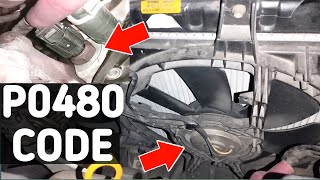
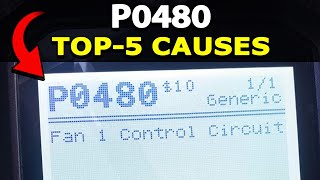
Est. part cost: $1-$5 - Faulty Cooling Fan Assembly or Control Module 🟡 Medium Probability → Shop Engine Cooling Fan Blade The cooling fan motor or the integrated control module can fail, 🎬 Watch: Top 5 reasons your cooling fan circuit is malfunctioning. causing an electrical short that blows fuse F34. This is a very common root cause for the fuse blowing repeatedly.
How to confirm: If fuse F34 repeatedly blows, disconnect the main electrical connector to the cooling fan assembly. Replace the fuse and start the engine. If the fuse no longer blows, the fan assembly is the likely culprit. A scan tool can also be used to command the fan on and check for a response.
Typical fix: Replace the entire cooling fan assembly, which typically includes the fan motor, shroud, and control module.
Est. part cost: $150-$400 - Damaged Wiring Harness 🟡 Medium Probability TSB SSM 48895 specifically calls out that wiring harness retainers may not have been installed correctly from the factory. This allows the harness (part number 12A690 for 1.5L or 12C508 for 2.0L) to chafe against engine or chassis components, leading to a short circuit that blows fuse F34.
How to confirm: Visually inspect the wiring harness leading from the battery junction box (fuse box) to the PCM and cooling fan. Pay close attention to areas where the harness may rub against sharp edges or hot components. Check for continuity and shorts using a multimeter.
Typical fix: Repair the damaged section of the wiring harness and secure it properly with new retainers or zip ties to prevent future chafing.
Est. part cost: $10-$100 - Shorted Turbocharger Wastegate Solenoid ⚪ Low Probability → Shop Turbocharger The turbocharger wastegate solenoid is also powered by the same F34 fuse circuit (related to code P0245). An internal short in this solenoid can blow the fuse, leading to P0480 and other related codes.
How to confirm: If the fuse still blows with the cooling fan disconnected, the next step is to disconnect the wastegate solenoid. If the fuse then holds, the solenoid is the source of the short.
Typical fix: Replace the turbocharger wastegate solenoid.
Est. part cost: $60-$120
Rare But Worth Checking
- Faulty A/C Clutch Relay: The A/C clutch relay control circuit (related to code P0645) is also on the F34 fuse. While less common than a fan or wiring short, a faulty relay could theoretically cause this issue. It can be tested by swapping with an identical relay from a non-critical circuit (like the horn).
- Faulty Powertrain Control Module (PCM): This is very rare. The PCM should only be considered after all other possibilities, including all components on the F34 circuit, have been thoroughly tested and ruled out.
Diagnosis Steps
- Scan the vehicle for all stored trouble codes. Note if P0480 is present with any of the codes listed in the 'often_seen_with_codes' section, as this strongly points to the F34 fuse.
- Locate the engine compartment fuse box, which is on the right side of the engine bay. 🎬 Watch: Locate your fuse box and identify specific fuse diagrams.
- Inspect the 10A mini fuse in position F34. If it is blown, this is the immediate cause.
- Replace the F34 fuse with a new 10A fuse.
- Start the engine and turn on the air conditioning to command the cooling fan on. Observe if the fan operates and if the fuse blows again.
- If the fuse blows again immediately, a persistent short circuit exists. Turn off the vehicle.
- Disconnect the main electrical connector at the cooling fan assembly.
- Replace the F34 fuse again. Start the engine. If the fuse does not blow, the cooling fan assembly is faulty and needs replacement.
- If the fuse still blows with the fan disconnected, the short is elsewhere. Disconnect the turbocharger wastegate solenoid. Replace the fuse and re-test. If the fuse holds, the wastegate solenoid is the culprit.
- If the fuse continues to blow, a wiring diagram is required to trace the F34 circuit. Per TSB SSM 48895, carefully inspect the 12A690 (1.5L) or 12C508 (2.0L) wiring harness for chafing, especially between the fuse box and PCM.
- Once the faulty component or wiring is identified and repaired/replaced, clear all DTCs and perform a drive cycle to ensure the repair is complete.
Parts You'll Likely Need
- Mini Fuse (10 Amp) — This is the first and most common point of failure, as documented in multiple Ford TSBs.
Trusted brands: Bussmann, Littlefuse
OEM price range: $1-$5
Aftermarket price range: $1-$5 - Cooling Fan Assembly
(OEM #CV6Z-8C607-P (Motorcraft))— If the fan motor or its integrated control module shorts out, it will repeatedly blow fuse F34. This is the most common component to fail on the circuit. This part number supersedes CV6Z-8C607-K, CV6Z-8C607-G, and CV6Z-8C607-B.
Trusted brands: Motorcraft, Four Seasons, TYC, Dorman
OEM price range: $250-$400
Aftermarket price range: $150-$250 - Turbocharger Wastegate Solenoid
(OEM #BL3Z-9K378-A (Motorcraft SOL-2))— A less common but documented cause for the F34 fuse to short. If disconnecting the fan doesn't stop the fuse from blowing, this is a likely next culprit.
Trusted brands: Motorcraft, Pierburg, Dorman
OEM price range: $60-$120
Aftermarket price range: $40-$80
Related Codes That Often Appear With This One
- P0034 — Turbo/Super Charger Bypass Valve 'A' Control Circuit Low - Shares the F34 fuse circuit, as documented in Ford TSBs SSM 48895, SSM 47575, and SSM 47086.
- P023A — Charge Air Cooler Coolant Pump Control Circuit/Open - Shares the F34 fuse circuit.
- P0245 — Turbo/Super Charger Wastegate Solenoid 'A' Low - Shares the F34 fuse circuit.
- P0481 — Fan 2 Control Circuit Malfunction - Shares the F34 fuse circuit.
- P0645 — A/C Clutch Relay Control Circuit - Shares the F34 fuse circuit.
- P06A0 — Variable A/C Compressor Control Circuit - Shares the F34 fuse circuit.
- P06DB — Engine Oil Pressure Control Circuit/Stuck Off - Shares the F34 fuse circuit.
- P2681 — Engine Coolant Bypass Valve Control Circuit/Open - Shares the F34 fuse circuit.
Technical Service Bulletins (TSBs) & Recalls
- SSM 48895: Notes that 1.5L or 2.0L engines may exhibit fuse F34 open with DTC P0480 and other codes. Specifically directs technicians to inspect the 12A690 (1.5L) or 12C508 (2.0L) wiring harness for chafing due to incorrectly installed retainers.
- SSM 47575: An earlier bulletin describing the same issue of fuse F34 opening on 1.5L and 2.0L engines, causing P0480 and a host of other codes.
- SSM 47086: The earliest TSB cited, covering the 2.0L engine, which identifies the open fuse F34 issue and the associated list of DTCs.
Platform-Specific Known Issues
- TSB Confirmed Wiring Harness Chafing: A known issue documented by Ford in TSB SSM 48895 involves fuse F34 opening due to a short on the circuit. The TSB specifically points to improperly installed wiring harness retainers, allowing the main engine harness to rub through and short to ground. This single blown fuse can cause P0480 along with numerous other DTCs, making it appear like a catastrophic failure when it's often a single component or wiring short.
- Owner Experience: Fan Assembly Failure: On forums like fordescape.org, many owners of 2017-2019 models report experiencing the cluster of codes related to fuse F34. A common repair story involves replacing the fuse, only for it to blow again. Following the diagnostic procedure of disconnecting the cooling fan assembly, the fuse stops blowing, confirming the fan motor or its integrated controller has shorted internally. Replacing the entire fan assembly (OEM part CV6Z-8C607-P) permanently resolves the issue.
Mechanic-Grade Diagnostic Values
- Turbocharger Wastegate Solenoid Coil Resistance — expected: 28 to 30 ohms at 20°C (68°F). Failure: A reading significantly outside this range indicates a faulty solenoid coil.
- PCM Command Signal to Fan Control Module — expected: A Pulse Width Modulated (PWM) signal, variable duty cycle.. Failure: No signal or a fixed voltage (not a PWM signal) when the fan should be active points to a PCM or wiring issue.
Scan Tool Commands That Help
- Ford IDS (Integrated Diagnostic System): Active Commands > Cooling Fan Control — This bidirectional control allows a technician to command the cooling fan on at various speeds (e.g., 25%, 50%, 100%) to test the functionality of the fan motor and control module directly, bypassing the temperature sensor inputs. If the fan responds correctly, the fan assembly is likely good.
- High-End Aftermarket Scanners (e.g., Autel, FOXWELL): Active Test / Bi-Directional Control > Cooling Fan Relay / Fan Speed Control — Similar to IDS, this function commands the fan circuit on to verify its operation. This is a critical step to perform after replacing fuse F34 but before extensive wiring diagnosis, as it can quickly confirm if the cooling fan assembly itself is the source of the short.
Wiring & Ground Locations
- F34 Fuse — In the Battery Junction Box (engine compartment fuse box), located on the right side (driver's side) of the engine bay.. This 10A fuse is the central failure point documented in Ford TSBs. Its failure causes P0480 and a host of other codes simultaneously.
- G104 / G108 — These are primary engine/transmission area grounds. G104 is often located on the top rear of the transmission, while G108 is at the right rear of the engine. A critical PCM ground is also located under the air-box assembly, near the battery.. A loose or corroded PCM ground can cause erratic behavior, including random stalling and a wide array of inconsistent trouble codes, mimicking the symptoms of the F34 fuse issue. Ensuring this ground is clean and tight is a crucial step if symptoms persist after addressing the F34 circuit.
- Cooling Fan Assembly Connector (C1617H) — Directly on the cooling fan shroud/motor assembly, behind the radiator.. This is the main connector to disconnect when trying to isolate a short. If fuse F34 stops blowing after this connector is unplugged, the fault is within the cooling fan assembly.
- Engine Wiring Harness (12A690 / GV6T-12A690) — This harness runs across the engine bay, connecting the PCM to various components.. TSB SSM 48895 specifically mentions that this harness can chafe and short out if not properly secured, causing fuse F34 to blow. Inspecting its routing for contact with sharp metal edges is a key diagnostic step.
Real Owner Repair Stories
- Reddit user post in r/fordescape (2017 Ford Escape SE) — Car would randomly die when accelerating from a stop. The engine would stall, and battery/oil pressure lights would illuminate. It would restart immediately. Threw a wide variety of inconsistent codes between failures, eventually settling on a PCM de-energizing code.
❌ Tried (didn't work) Checking basic connections, fuses, battery, alternator, and high-pressure fuel pump.
✅ What actually fixed it The primary PCM ground wire, located under the air-box, was slightly loose and not making good contact with the chassis. The user suspects it was bumped during a previous battery change. Tightening the ground connection resolved all symptoms.
OEM Part Supersession History
CV6Z-8C607-B, CV6Z-8C607-G, CV6Z-8C607-K→CV6Z-8C607-P— Part has been updated by the manufacturer over time to improve reliability or address known failure modes.
Heads up: CV6Z-8C607-P is the current, correct replacement for the earlier part numbers on this vehicle.
Model Year Variations Within This Range
- 2017-2019: The 2017 model year marked a significant facelift for the Escape, including revised front-end styling and new engine options (1.5L EcoBoost replaced the 1.6L). While the TSBs for the F34 fuse issue cover 2017-2019 models with the 1.5L and 2.0L engines, be aware that wiring harnesses and component locations may have subtle differences from the pre-facelift (2013-2016) models.
Helpful Videos

Used OEM Parts in Stock
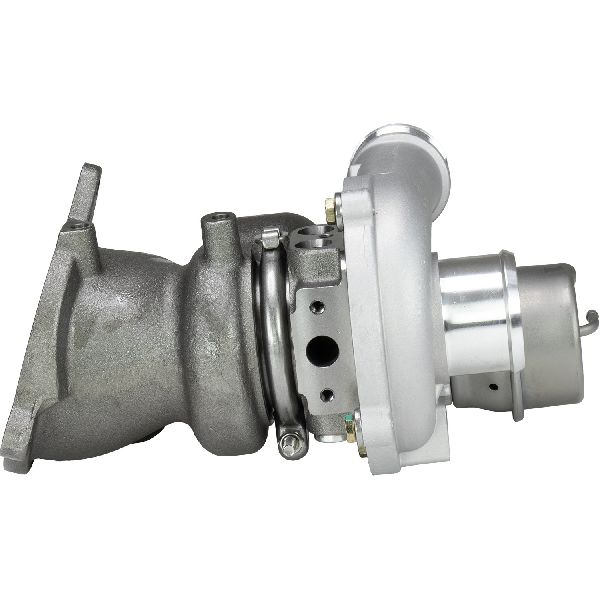
New Aftermarket Parts Available


The information in this article is provided for general reference and educational purposes only. Vehicle specifications, procedures, and part compatibility can vary by production date, trim level, and region. Always consult your vehicle's factory service manual and verify part numbers before purchasing or performing repairs. Safety-critical components such as airbags, seat belts, and braking systems should be installed by a qualified professional.
- Ford ESCAPE:
- 🧭 Diagnostic Flowchart
- 🎬 Helpful Videos
- 🛍️ Shop This Part
- What's Unique About the 2017-2019 Ford ESCAPE
- Symptoms You May Notice
- Most Likely Causes
- Rare But Worth Checking
- Diagnosis Steps
- Parts You'll Likely Need
- Related Codes That Often Appear With This One
- Technical Service Bulletins (TSBs) & Recalls
- Platform-Specific Known Issues
- Mechanic-Grade Diagnostic Values
- Scan Tool Commands That Help
- Wiring & Ground Locations
- Real Owner Repair Stories
- OEM Part Supersession History
- Model Year Variations Within This Range
- 🎟️ Get 5% Off