

P0496 on 2017-2020 Chevrolet Impala 3.6L: EVAP Purge Flow Fault Causes and Fixes
For a 2017-2020 Impala, code P0496 almost always means the vapor canister purge valve (solenoid) is stuck open. This is a very common issue, causing a check engine light and hard starting after refueling. A new OEM valve (updated PN 12737252) costs around $25-$50 and can be replaced in under 30 minutes with basic tools.
- P0496 on a 2017-2020 Impala is almost certainly a bad vapor canister purge valve.
- The most telling symptom is the car struggling to start right after you fill the gas tank.
- This is a very easy and cheap DIY fix, requiring only basic hand tools (10mm socket, T30 Torx) and about 15-30 minutes.
- For 2020 models, check with a GM dealer, as this repair may be covered for free under a special coverage program (N222369620).
- Using an OEM ACDelco part (updated PN 12737252) is strongly recommended, as some aftermarket parts have been reported to fail prematurely.
What's Unique About the 2017-2020 Chevrolet Impala
This issue is extremely common across many GM vehicles that use the 3.6L V6 engine, including the Impala. The failure of the purge valve is so frequent that GM issued a Special Coverage Adjustment (N222369620) for the 2020 Impala, extending the warranty on this specific part to 15 years or 150,000 miles. This indicates a known high failure rate for the original part. A similar bulletin (17-NA-409) was issued for 2014-2018 models with aluminum camshaft covers, linking the valve failure to oil contamination from the cam cover gasket.
Symptoms You May Notice
- Check Engine Light is on
- Difficulty starting the engine immediately after refueling (long crank time, stumbles before starting).
- Rough or unstable idle.
- Slight decrease in fuel economy.
- A 'whoosh' sound from the gas tank when opening the cap may be absent, due to the constant vacuum leak.
- Replacing the gas cap. A bad gas cap typically causes a small or large leak code (P0442, P0455), not a P0496 flow code.
- Replacing the EVAP vent solenoid. The vent solenoid is located near the fuel tank and is responsible for sealing the system for pressure tests. While it can fail (often causing a P0446 or P0449), it does not cause an incorrect purge flow into the engine.
Most Likely Causes
- Faulty Vapor Canister Purge Valve (Solenoid) 🔴 High Probability → Shop Vapor Canister This part has a known high failure rate on many GM models. The valve's internal diaphragm can fail or get stuck with debris/oil, causing it to remain open and create a constant vacuum leak. GM has issued special coverage adjustments for this part on certain model years.
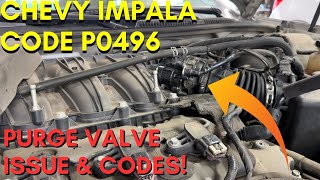
How to confirm: Remove the purge valve from the engine (it's held by one 10mm bolt). With the valve disconnected, try to blow through it. If any air passes through, the valve is stuck open and has failed. 🎬 Watch: A quick 3-minute guide to diagnosing and fixing this code. Alternatively, with the engine cold and running, disconnect the hose leading from the valve to the EVAP canister and place your finger over the valve's port; if you feel any suction, the valve is stuck open and is bad.
Typical fix: Replace the vapor canister purge valve. It is located on the top/rear of the engine. For 2017-2018 models, if oil contamination is found, TSB 17-NA-409 recommends also replacing the camshaft cover gasket (PN 12688703) to prevent repeat failure. Manufacturer TSB Bulletin #PIP6037A also notes that damaged purge solenoid valve O-rings can contribute to P0496 failures.
Est. part cost: $25-$50
Rare But Worth Checking
- Short in Purge Valve Wiring: → Shop Vapor Canister This is uncommon, but if a new purge valve doesn't fix the code, check the wiring harness and connector for damage or a short that could be holding the valve open electrically. A multimeter can be used to check for constant voltage at the connector with the engine running.
- Faulty Engine Control Module (ECM): → Shop Engine Control Module (ECM) This is extremely rare. The ECM would have to be commanding the valve to stay open incorrectly. All other possibilities, including wiring, should be exhausted before considering the ECM as the cause.
Diagnosis Steps
- Confirm the P0496 code is present using an OBD-II scanner.
- The most common symptom is difficulty starting after refueling. If this is present, the purge valve is the prime suspect.
- Locate the purge valve on the rear of the 3.6L V6 engine. You will need to remove the plastic engine cover, which may require a T30 Torx bit for the oil filler neck screw.
- Remove the single 10mm bolt holding the valve in place.
- Disconnect the electrical connector and the two EVAP hoses. The hose connectors may have a green or white plastic clip that needs to be slid or depressed.
- With the valve removed, attempt to blow air through either port. If air can pass through, the valve is faulty and must be replaced. A new, functioning valve will be completely sealed.
- As an alternative test, reconnect the electrical connector and start the engine. Disconnect the inlet hose (from the canister) and check for vacuum at the valve's port with your finger. There should be no vacuum at idle on a cold start. If there is, the valve is stuck open.
- If the valve passes the test, inspect the electrical connector for constant voltage, which would indicate a wiring short holding the valve open. This is rare.
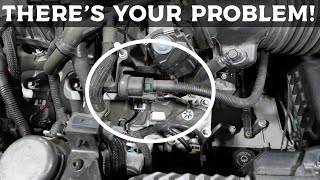
- Install the new purge valve, reconnect the hoses and electrical connector, and clear the trouble codes with the scanner. Ensure you do not overtighten the 10mm bolt into the plastic intake. 🎬 See this step-by-step walkthrough for replacing the valve on your Impala.
- If the code persists after standard diagnostics, manufacturer TSB Bulletin #PIP5284A suggests evaluating the customer's drive cycle as a potential contributing factor.
Parts You'll Likely Need
- Vapor Canister Purge Valve / Solenoid
(OEM #12737252 (supersedes 12690512, 12661763, 12610560))— This is the component that almost always fails, getting stuck open and causing the P0496 code and associated symptoms. The original part number 12690512 has been updated by GM. 🎬 Watch: How to swap out the purge valve on a 3.6L engine.
Trusted brands: ACDelco (GM Genuine), Standard Motor Products, Wells
OEM price range: $25-$50
Aftermarket price range: $20-$40 - Camshaft Cover Gasket (Right Side)
(OEM #12688703)— Only needed on 2017-2018 models if diagnosis per TSB 17-NA-409 finds that oil contamination from the original gasket caused the purge valve to fail. This is a preventative part to stop repeat failures.
Trusted brands: ACDelco (GM Genuine)
OEM price range: $20-$35
Aftermarket price range: $15-$25
Related Codes That Often Appear With This One
- P0442 — A stuck-open purge valve is a type of vacuum leak, which the system can sometimes interpret as a 'Small EVAP Leak,' triggering code P0442.
- P0171 / P0174 — A stuck-open purge valve creates a vacuum leak, allowing unmetered air (and fuel vapor) into the intake manifold. This can make the engine run lean, triggering 'System Too Lean' codes for one or both banks.
- P0455 — Similar to P0442, the constant open state of the purge valve can sometimes be interpreted by the system as a 'Large EVAP Leak'.
Technical Service Bulletins (TSBs) & Recalls
- N222369620: Special Coverage Adjustment for the EVAP Purge Valve on 2020 models. Confirms coverage for 15 years/150k miles and lists related DTCs that may be set.
- 17-NA-409: Malfunction Indicator Lamp (MIL) Illuminated - DTC P0442, P0496 and/or P0455 Set, related to oil contamination from the cam cover gasket causing purge valve failure on models with aluminum cam covers.
- Bulletin #PIP6037A: Notes that DTC P0496 can fail due to damaged purge solenoid valve O-rings.
- Bulletin #PIP5284A: Advises that if P0496 continues to set after standard diagnostics, the customer's drive cycle should be reviewed as a contributing factor.
Platform-Specific Known Issues
- Special Coverage Adjustment N222369620: For 2020 Impala and 2019 Cadillac XTS models, GM extended the warranty for the evaporative emissions purge valve to 15 years or 150,000 miles. If the vehicle has this code (or P0442, P0455, P0171, P0174), a dealer will diagnose and replace the part for free if it is found to be the cause.
- TSB 17-NA-409: For 2017-2018 models (and earlier) with aluminum cam covers, this bulletin notes that oil contamination from the right-side cam cover gasket can cause the purge valve to fail. The official fix involves replacing both the purge valve and the updated cam cover gasket (PN 12688703) to prevent recurrence.
Mechanic-Grade Diagnostic Values
- EVAP Purge Valve Solenoid Coil Resistance — expected: 15-30 Ohms. Failure: A reading significantly outside this range, or an open/short circuit, indicates a failed coil.
- EVAP Purge Valve Connector Voltage (Ignition On, Engine Off) — expected: One pin should have 12V (battery voltage), the other is the ground-side switched control pin from the ECM.. Failure: No voltage on the power pin indicates a wiring or fuse issue upstream.
- Fuel Tank Pressure (FTP) Sensor Voltage (Scan Tool) — expected: Should be around 1.5V-2.5V with engine off and gas cap removed (at atmospheric pressure).. Failure: The P0496 code sets when the ECM detects a vacuum (voltage rising towards 4.9V) for several seconds when the purge valve is commanded closed.
- EVAP System Vacuum (DTC Trigger Threshold) — expected: Less than 10 inches of H2O.. Failure: The ECM will set code P0496 if it detects a vacuum of more than 10 inches of water (H2O) in the EVAP system when the purge solenoid is commanded closed.
Scan Tool Commands That Help
- GDS2 / Tech2 (or equivalent professional scanner): EVAP Purge Solenoid Valve Control / Purge/Seal — This is a bidirectional control that allows a technician to manually command the purge valve open (e.g., 50%) and closed (0%). To diagnose P0496, command the purge valve to 0% and monitor the FTP sensor. If a vacuum still develops, it confirms the valve is physically stuck open or leaking internally. You should also hear an audible click from the valve when cycling it.
Wiring & Ground Locations
- EVAP Canister Purge Valve Control Pin — On older, similar GM models, this is Pin 76 (DK GRN/WHT wire) on the C1 PCM connector. This should be verified for the specific 2017-2020 Impala, but provides a starting point for circuit testing.. If a new purge valve does not fix the code, a technician may need to test for continuity and voltage on the control wire between the valve's connector and the PCM to rule out a wiring fault.
- Purge Valve Connector — On the purge valve itself, located on the top rear of the engine.. This is the primary point for electrical testing. It's a 2-pin connector. One pin is ignition voltage (Pink/Black wire on some GM models) and the other is the control ground from the PCM (Dark Green/White wire on some GM models).
Real Owner Repair Stories
- YouTube - Falcon's Garage (2012 Chevrolet Impala 3.6L V6) — Check Engine Light with codes P0174 (Lean Bank 2), P0300 (Random Misfire), P0443 (Purge Circuit), and P0496 (Incorrect Purge Flow).
❌ Tried (didn't work) The technician immediately suspected the purge valve based on the combination of codes.
✅ What actually fixed it The technician confirmed the purge valve was stuck open by feeling for vacuum at the port while the engine was running. Replacing the faulty vapor canister purge valve cleared all four codes (P0174, P0300, P0443, and P0496). - Reddit r/AskAMechanic (2018 Chevy Impala) — Struggles to start only after getting gas.
❌ Tried (didn't work) Owner was asking for advice before trying any repairs.
✅ What actually fixed it Multiple mechanics in the thread confirmed this is a classic symptom of a stuck-open purge valve. The recommended fix was to test for vacuum at the valve's inlet port with the engine running; if vacuum is present, the valve is bad and needs replacement. This was presented as the definitive cause for this specific symptom. - NHTSA ODI #11606943: An owner reported a rough idle and code P0496 for "evap flow during non purge." Replacing the purge solenoid improved the condition, though the owner noted the engine still did not feel 100 percent fixed.
- NHTSA ODI #11088522: A report describes a stuck open EVAP purge solenoid setting a light with codes P0300 and P0496. In this instance, diagnosis also found Bank 1 injectors out of specification.
- NHTSA ODI #11710113: An owner experienced rough running and a suite of codes including P0171, P0300, P0442, and P0496; the vehicle eventually displayed "Engine Power Reduced" while driving uphill.
OEM Part Supersession History
12610560, 12661763, 12690512→12737252— GM has updated this part multiple times, likely to improve durability and prevent the common sticking failure.
Heads up: The newest part number (12737252) is the recommended replacement and is fully compatible with the specified vehicle range.
Model Year Variations Within This Range
- 2017-2018: These model years may be affected by TSB 17-NA-409, which points to oil contamination from a faulty camshaft cover gasket as the root cause of purge valve failure. The fix requires replacing both the purge valve and an updated gasket (PN 12688703).
- 2020: This model year is explicitly covered by Special Coverage Adjustment N222369620, extending the warranty on the purge valve to 15 years or 150,000 miles.
Diagnostic Flowchart
Other Known Issues on This Vehicle
Issues unrelated to this code that are worth knowing about as an owner of this generation:
- Premature Timing Chain Wear/Stretch 🔴 High — More common on earlier 3.6L versions, but still a known issue for the LFX engine, often linked to extended oil change intervals. Can occur from 70,000 miles onward. Listen for a rattling noise on cold starts. (Ref: Multiple TSBs for earlier engine versions (pre-LFX), but no specific recall for 2017-2020 Impala. Codes P0008, P0017, P0019 are strong indicators.)
- Transmission Shudder (Torque Converter) 🟠 Medium — A shudder or vibration felt at low speeds (20-40 mph) under light acceleration, especially uphill, is a common complaint. It is often attributed to the torque converter clutch or contaminated transmission fluid. (Ref: TSB 18-NA-355 and 23-NA-072 address shudder issues on similar GM platforms, often recommending a fluid flush or torque converter replacement.)
- Oil Leak from Camshaft Cover Gasket 🟡 Low — A known issue on 2014-2018 models with aluminum cam covers where oil can seep and contaminate the nearby EVAP purge valve, causing it to fail and trigger a P0496 code. (Ref: TSB 17-NA-409.)
Used vs. New Parts: Buying Guide for This Vehicle
When a used part is the smart pick: Never. The vapor canister purge valve is a known high-failure-rate part with an inexpensive new OEM replacement. A used part has no known history and is highly likely to either be already faulty or fail shortly after installation. The cost savings are negligible compared to the risk and labor of a repeat repair.
What to inspect on the donor part:
- Not applicable as a used part is not recommended.
OEM-only on this vehicle (don't cheap out):
- Vapor Canister Purge Valve / Solenoid
Aftermarket brands forum-validated for this vehicle:
- While some aftermarket brands like Standard Motor Products or Wells exist, multiple forum and video sources strongly recommend using the ACDelco (GM Genuine) part to avoid premature failure. Given the small price difference, OEM is the wisest choice.
Brands owners have reported issues with on this vehicle:
- Unbranded or 'white box' parts from online marketplaces are frequently cited as failing quickly, sometimes within weeks or months.
Real Owner Stories
Aggregated from forums and TSBs cited above. Mileages and costs reflect what owners reported in those sources.
2017 Chevy Impala 3.6L V6
Symptoms: Multiple codes including P0496, P0171, P0174, P0300, and P0442.
What fixed it: The owner was seeking to fix the issue on their own starting with the P0496 code.
Source hint: Reddit r/MechanicAdvice
2014 Chevy Impala LTZ 3.6L V6 — ~85000 miles
Symptoms: Check Engine Light with code P0496.
What fixed it: Replacement of the EVAP Canister/Emission system purge valve.
Cost: $30-$30
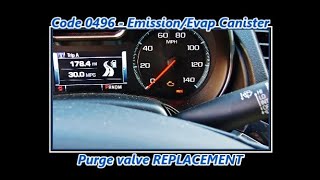
Source hint: YouTube - 'EVAP Canister/Emission system purge valve replacement 2014-2019 CHEVY IMPALA LTZ | Code P0496' by Ed Hatmaker
2016 Chevy Impala 3.6L V6
Symptoms: Hard start only after refueling.
What fixed it: Replacing the purge valve with an OEM part.
Source hint: Reddit r/Impala - Thread 'Hard start aftrer refuel'
Related OBD-II Codes
Frequently Asked Questions
Is there a warranty extension for the purge valve on my 2020 Chevrolet Impala?
My 2017 Impala has P0496 and oil seeping near the engine; does TSB 17-NA-409 apply?
Why does my Impala struggle to start only after I fill up the gas tank?
Can I test the purge valve on my 3.6L V6 myself before buying a new one?
Should I use an aftermarket purge valve for this repair?
What tools do I need to replace the purge valve on my 2017-2020 Impala?
Helpful Videos
Used OEM Parts in Stock
New Aftermarket Parts Available


The information in this article is provided for general reference and educational purposes only. Vehicle specifications, procedures, and part compatibility can vary by production date, trim level, and region. Always consult your vehicle's factory service manual and verify part numbers before purchasing or performing repairs. Safety-critical components such as airbags, seat belts, and braking systems should be installed by a qualified professional.
- Chevrolet Impala:
- 🧭 Diagnostic Flowchart
- 🎬 Helpful Videos
- 🛍️ Shop This Part
- What's Unique About the 2017-2020 Chevrolet Impala
- Symptoms You May Notice
- Most Likely Causes
- Rare But Worth Checking
- Diagnosis Steps
- Parts You'll Likely Need
- Related Codes That Often Appear With This One
- Technical Service Bulletins (TSBs) & Recalls
- Platform-Specific Known Issues
- Mechanic-Grade Diagnostic Values
- Scan Tool Commands That Help
- Wiring & Ground Locations
- Real Owner Repair Stories
- OEM Part Supersession History
- Model Year Variations Within This Range
- Other Known Issues on This Vehicle
- Used vs. New Parts: Buying Guide for This Vehicle
- Real Owner Stories
- 2017 Chevy Impala 3.6L V6
- 2014 Chevy Impala LTZ 3.6L V6 — ~85000 miles
- 2016 Chevy Impala 3.6L V6
- Related OBD-II Codes
- Frequently Asked Questions
- 🎟️ Get 5% Off