

P0500 on 2008-2012 Ford Escape: Causes and Fixes for Vehicle Speed Sensor Malfunction
On a 2008-2012 Ford Escape, code P0500 is most often caused by a faulty Output Shaft Speed (OSS) sensor on the transmission or a bad ABS wheel speed sensor/tone ring. If it's an ABS sensor issue, the fix is easy and under $100. If it's the internal OSS sensor on the 6F35 transmission (2009+ models), the repair is complex and can cost over $500, as the transmission's valve body must be removed for access.
- P0500 on a 2008-2012 Escape means there's a problem with the vehicle speed signal, which can come from the transmission's Output Shaft Speed (OSS) sensor or one of the four ABS wheel speed sensors.
- The first diagnostic step is crucial: use a scanner that can read ABS codes and live data to see if a wheel sensor has failed. This is often a simple and cheap fix.
- If no ABS codes are present, the problem is likely the OSS sensor on the transmission. Be aware that replacing this sensor can be a very labor-intensive job, potentially costing hundreds of dollars at a shop.
- Symptoms like an erratic speedometer and harsh shifting are serious safety concerns and should be addressed promptly to avoid further transmission damage.
What's Unique About the 2008-2012 Ford Escape
Unlike newer Escapes (2013+) that rely solely on ABS sensors for vehicle speed, the 2008-2012 generation uses a hybrid approach. It has both transmission-mounted speed sensors (Input/TSS and Output/OSS) and four ABS wheel speed sensors. The critical difference in diagnosing P0500 on this vehicle is determining which sensor system is at fault. A major complication, primarily on 2009 and later models with the 6F35 transmission, is that replacing the Output Shaft Speed (OSS) sensor is a very involved repair. It requires removing the transmission's internal valve body and sometimes the entire molded lead frame, dramatically increasing labor costs.
Symptoms You May Notice
- Inoperative or erratic speedometer
- Harsh, erratic, or delayed transmission shifting
- ABS and/or Traction Control warning light illuminated
- Check Engine Light illuminated
- Cruise control will not function
- Flashing Overdrive 'O/D OFF' light on the gear shifter in some cases
- Replacing the transmission fluid. While old fluid can cause shifting problems, it will not cause a P0500 code.
- Replacing the wrong speed sensor. It is crucial to diagnose whether the fault lies with the transmission's OSS sensor or one of the ABS wheel speed sensors before buying parts. A capable scanner that reads both ABS and TCM live data is essential.
- Replacing the OSS sensor when the internal molded lead frame wiring is the actual fault.
Most Likely Causes
- Failed Output Shaft Speed (OSS) Sensor or Molded Lead Frame 🔴 High Probability On models with the 6F35 transmission (2009+), the OSS sensor and the internal wiring harness (molded lead frame) are known failure points. TSB 10-1-7 specifically addresses this for P0720, which is often set with P0500. The internal location exposes the electronics to heat and fluid, leading to failure. A class-action lawsuit has also been filed concerning defects in the 6F35 transmission for 2009-2021 Escapes.
How to confirm: Use a scan tool that can read live data from the Transmission Control Module (TCM). Monitor the OSS PID while driving. If the speed reads zero, is erratic, or drops out while the ABS wheel speeds read correctly, the OSS or its internal circuit is the fault. The presence of code P0720 almost guarantees this is the cause.
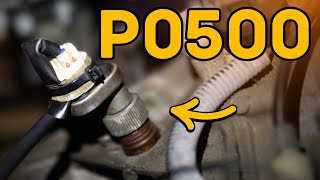
Typical fix: Replace the Output Shaft Speed (OSS) sensor and/or the entire molded lead frame assembly. WARNING: This sensor is located inside the transmission side cover, making replacement a complex, multi-hour job that requires draining the transmission fluid and removing the valve body itself. This is not considered a typical DIY repair. 🎬 Watch: Locate the OSS sensor on a 2009 Escape
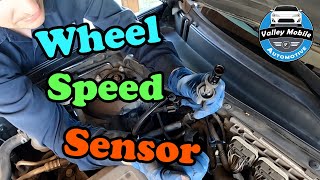
Est. part cost: $40-$150 - Failed ABS Wheel Speed Sensor or Broken Tone Ring 🟡 Medium Probability → Shop ABS Wheel Speed Sensor The ABS sensors and the tone rings on the CV axles are exposed to water, dirt, and road debris. The tone rings are known to rust, crack, and break, which provides a faulty signal to the sensor. A bad signal from one wheel speed sensor will conflict with the other sensors and the OSS sensor, triggering P0500.
How to confirm: Use a scan tool that can read the ABS module. Check for ABS-specific codes (e.g., C-codes). Monitor the live data for all four wheel speed sensors while driving. The faulty sensor will read 0 MPH or have an erratic signal compared to the others. Visually inspect the tone rings on the front CV axles for cracks or breaks; they should not spin freely on the axle shaft.
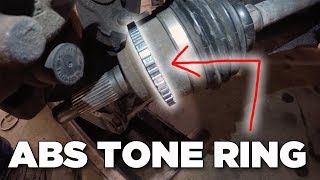
Typical fix: Replace the faulty ABS wheel speed sensor and/or its wiring pigtail. If the tone ring is broken, the CV axle must be replaced or a new tone ring pressed on. 🎬 See how to install a new ABS tone ring Aftermarket heavy-duty tone rings are available.
Est. part cost: $30-$80 for a sensor, $80-$200 for a CV axle - Damaged Wiring or Connectors ⚪ Low Probability Wiring to both the transmission sensors and wheel speed sensors can be damaged by road debris, heat from the exhaust, or corrosion. Forum users have reported finding wires chewed by rodents or melted by a cutting torch near the transmission sensor.
How to confirm: Visually inspect the wiring harnesses leading to the OSS sensor on the transmission and each of the four ABS wheel speed sensors. Look for chafed, broken, or corroded wires and loose or damaged connectors. Perform a continuity test on the wires with a multimeter if a visual fault is not obvious.
Typical fix: Repair or replace the damaged section of the wiring harness or the connector pigtail.
Est. part cost: $15-$50
Rare But Worth Checking
- Faulty Powertrain Control Module (PCM) or ABS Module: → Shop ABS Control Module This is very rare. All other possibilities, especially sensors, tone rings, and wiring, should be exhaustively ruled out before considering a module replacement, which requires special programming.
- Faulty Instrument Cluster: → Shop Instrument Cluster In some Ford systems, the VSS signal from the transmission is routed through the instrument cluster before being sent to the PCM. A failure in the cluster's internal circuitry can interrupt this signal, causing a P0500 code even if the speedometer appears to work correctly. This is often accompanied by transmission shifting problems.
Diagnosis Steps
- Scan for all codes in all modules (PCM, ABS, TCM) using a capable OBD-II scanner. Note any codes besides P0500, especially P0720 or any C-codes.
- If ABS codes are present, use the scanner's live data function to monitor all four wheel speed sensors while driving. Identify any sensor that reads differently from the others. Visually inspect that sensor's tone ring for cracks or damage.
- If P0720 is present, the Output Shaft Speed (OSS) sensor or its internal wiring/lead frame is the primary suspect.
- If no other codes are present, use the scanner to monitor both the OSS PID from the transmission module and the individual wheel speed sensor PIDs from the ABS module while driving. Compare the readings to isolate the faulty system.
- Visually inspect the wiring harnesses for all relevant sensors (OSS and all four ABS sensors). Look for obvious signs of damage, corrosion, or loose connections, as reported by other owners.
- If a sensor is confirmed to be faulty, determine its exact location and the procedure for replacement. Be aware that the OSS sensor on 6F35 transmissions requires significant labor to access.
- After repair, clear all codes and perform a test drive to ensure the problem is resolved. If the transmission or valve body was serviced, the transmission's adaptive tables may need to be cleared and a relearn procedure performed.
Parts You'll Likely Need
- ABS Wheel Speed Sensor
(OEM #ALS1875)— A common failure due to its exposed location at the wheel hub. A fault here or with its corresponding tone ring will cause a disagreement in speed readings, triggering P0500.
Trusted brands: Motorcraft, Duralast, Standard Motor Products, NTK
OEM price range: $70-$90
Aftermarket price range: $30-$75 - Output Shaft Speed (OSS) Sensor
(OEM #Motorcraft DY-1215)— This is the primary transmission sensor for vehicle speed. Its failure is a very common cause of P0500 and associated P0720/shifting problems on 6F35-equipped models.
Trusted brands: Motorcraft, Rostra, Dorman
OEM price range: $80-$110
Aftermarket price range: $40-$70 - Transmission Molded Leadframe Connector
(OEM #9L8Z-7G276-A (superseded by FD8Z-7G276-B))— For 6F35 transmissions, TSBs indicate the entire internal wiring assembly can fail, causing an open circuit to the OSS sensor. It is often replaced along with the sensor during the valve body service.
Trusted brands: Motorcraft
OEM price range: $100-$150
Related Codes That Often Appear With This One
- P0720 — P0720 specifically indicates a fault in the Output Speed Sensor circuit. If you see this code with P0500, the OSS sensor or the internal transmission lead frame is almost certainly the problem.
- C-codes (e.g., C0031-C003A) — Any C-prefix code indicates a fault in the Chassis system, such as the ABS. If you have a C-code related to a wheel speed sensor, it points to that specific sensor or its tone ring as the likely cause of P0500.
- P1500 — This Ford-specific code indicates a Vehicle Speed Sensor Intermittent fault. Seeing this alongside P0500 reinforces that the PCM is receiving an unstable or erratic speed signal, pointing towards a failing sensor or wiring issue.
Technical Service Bulletins (TSBs) & Recalls
- TSB 10-1-7: Addresses codes P0720 and P0722 on 2009-2010 Escape/Mariner with the 6F35 transmission. Points to an open circuit in the OSS sensor or the main control lead frame, recommending replacement of either the sensor or the entire lead frame.
- TSB 10-21-9: For 2009-2010 models with the 6F35, this TSB addresses harsh shifting and flares after a cold soak by reprogramming the PCM. While not directly for P0500, it relates to the known transmission control issues on this platform.
Platform-Specific Known Issues
- The difficulty of replacing the Output Shaft Speed (OSS) sensor is the most significant issue for this platform. On models with the 6F35 transmission (2009+), the sensor is located inside the transmission side cover, requiring removal of the valve body for access. This turns a simple sensor swap into a major repair.
- A broken or cracked front ABS tone ring is a frequent cause of speed-related codes and ABS faults on this generation Escape and should be inspected carefully before replacing sensors.
Mechanic-Grade Diagnostic Values
- 6F35 Transmission Shift/TCC/LPC Solenoid Resistance — expected: 4.00 - 5.89 Ohms at 68-86°F (20-30°C). Failure: A resistance reading outside this range indicates a faulty solenoid. This is a key test performed when the valve body is removed to access the OSS sensor.
- 6F35 Transmission On/Off Shift Solenoid E (SSE) Resistance — expected: 19.05 - 27.95 Ohms at 68-86°F (20-30°C). Failure: A resistance reading outside this range indicates a faulty SSE solenoid.
- Sensor Power Supply Voltage (at sensor connector) — expected: Approximately 5 Volts (Reference Voltage). Failure: Voltage significantly below 5V or absent points to a wiring or PCM fault, not a sensor failure.
Hidden / Shadow Codes Worth Checking
- P1500: Vehicle Speed Sensor Intermittent. This is a Ford-specific DTC that often accompanies P0500, indicating the signal from the VSS is unstable or dropping out, rather than being completely absent. (see via Should be visible with most professional-grade OBD-II scanners that can read manufacturer-specific codes.)
Scan Tool Commands That Help
- Ford IDS / FORScan: Live Data Monitoring (PIDs: VSS, OSS_SRC, WSS_LF, WSS_RF, etc.) — Essential first step. Used to simultaneously watch the speed signals from the transmission's OSS sensor and all four ABS wheel speed sensors while driving to see which signal is dropping out or disagreeing with the others.
- Ford IDS / FORScan: Transmission Adaptive Tables Reset — After replacing the OSS sensor, molded lead frame, or performing any major transmission service. This command clears the transmission's learned shift strategies, forcing it to relearn shift points with the new components, which can resolve harsh shifting.
Wiring & Ground Locations
- C175B — The main Powertrain Control Module (PCM) connector, located at the center rear of the firewall.. This is the primary connector where signals from the various speed sensors arrive at the PCM. Testing for signal presence and continuity at the pins in this connector is a key step to determine if a wiring break exists between a sensor and the PCM.
- G100 / G101 — Main engine bay ground points, typically on the fender aprons or near the battery tray.. The PCM and its related sensors rely on these grounds for a stable return path. A corroded or loose ground at G100 or G101 can cause erratic behavior in multiple systems, including generating false sensor codes like P0500.
- G201 — An interior ground point located on the right side of the dash.. This ground serves interior modules, which can include the ABS module or instrument cluster. A fault here could interrupt the speed signal communication between modules.
- ABS Module Connector — The main connector at the Anti-lock Brake System (ABS) module, located in the engine compartment, typically on the driver's side.. This is where all four wheel speed sensor signals converge. It's a critical test point for diagnosing issues with the ABS sensors or their wiring before the signal is sent to the PCM.
Real Owner Repair Stories
- YouTube user comment (2009 Ford Escape) — Vehicle would not shift properly, Check Engine Light with P0720.
❌ Tried (didn't work) Initial diagnosis was unclear until research pointed to internal transmission sensors.
✅ What actually fixed it Replacement of the internal Output Speed Sensor (OSS) as per TSB 10-1-7. The user noted this fixed the P0720 code, which is the direct companion to P0500 when the transmission sensor is the cause. - YouTube video by 'Abnormal Garage' (2008 Ford Escape) — ABS light illuminated.
❌ Tried (didn't work) Scanning for codes pointed to a wheel speed signal issue.
✅ What actually fixed it The ABS tone ring on the passenger side CV axle was found to be cracked and spinning freely on the shaft. Replacing the tone ring (a sub-$10 part) resolved the ABS fault, which would also resolve a P0500 code caused by the same issue. - YouTube video by 'Repairs and Stuff' (2009 Ford Escape) — Check Engine Light with codes P0720 and P0722. Transmission would kick hard when put into gear and would not shift, staying in 'limp mode'.
❌ Tried (didn't work) Checked transmission fluid level and condition (was okay). Erasing codes provided only a temporary fix before the problem returned when hot.
✅ What actually fixed it The Output Shaft Speed (OSS) sensor was faulty. The video documents the complex process of removing the transmission side cover and valve body to access and replace the internally-mounted sensor. - NHTSA ODI #11553968 — An owner of a Ford vehicle reported that a mechanic retrieved DTC code P0500 and related the failure to a wheel speed sensor failure.
- NHTSA ODI #10069274 — A Ford owner reported experiencing a P0500 code (faulty speed sensor) while also noting that the transmission kicks in and out.
OEM Part Supersession History
9L8Z-7G276-A→FD8Z-7G276-B— Updated design for the 6F35 transmission molded lead frame (connector) to improve durability and prevent open circuits that cause speed sensor codes.
Heads up: FD8Z-7G276-B replaces multiple previous part numbers, including the original 9L8Z-7G276-A. It is the correct service part.
Model Year Variations Within This Range
- 2008: The 2008 model year primarily used the 4-speed CD4E automatic transmission. On these models, the Vehicle Speed Sensor (VSS) is typically an external sensor mounted on the transmission case, making it much easier to access and replace than on later models.
- 2009-2012: These model years use the 6-speed 6F35 automatic transmission. The critical Output Shaft Speed (OSS) sensor is located *inside* the transmission and requires removing the valve body for replacement. This is a major design difference that dramatically increases the labor and complexity of the repair for P0500/P0720 codes.
Diagnostic Flowchart
Other Known Issues on This Vehicle
Issues unrelated to this code that are worth knowing about as an owner of this generation:
- Electronic Power Steering (EPS) Failure 🔴 High — Very common across 2008-2011 models. Can result in a sudden loss of power assist, making the vehicle difficult to steer at low speeds. (Ref: Recall 14S05 / NHTSA 14V284 was issued to reprogram the PSCM and, in some cases, replace the steering torque sensor or entire steering column. Many owners report failures even after the recall was performed.)
- 6F35 Transmission Failure & Harsh Shifting 🔴 High → Shop Transmission Assembly — Common in 2009-2012 models equipped with the 6F35 6-speed automatic. Symptoms include harsh shifts, flares, and eventual failure. Problems are often linked to the internal lead frame, valve body, or lack of maintenance. (Ref: TSB 10-21-9 and TSB 11-12-10 were issued for harsh shifting/flares, involving a PCM reprogram and potential valve body modifications.)
- Electronic Throttle Body (ETB) Failure 🟠 Medium — Widespread on 2009-2012 models with 2.5L and 3.0L engines. Can cause the vehicle to enter a 'limp home' mode with drastically reduced power. (Ref: Ford issued Customer Satisfaction Program 13N03, extending the warranty on the ETB. It was not a formal recall, but acknowledged the defect.)
- Broken ABS Tone Ring 🟡 Low — A common issue where the front ABS tone ring on the CV axle cracks or breaks, causing ABS/Traction Control lights and erratic ABS activation at low speeds.
- Rusted Rear Quarter Panels and Shock Towers 🔴 High — Very common in regions that use road salt. Rust can perforate the rear wheel wells and, more critically, the rear shock absorber mounting towers, which is a major safety concern.
Used vs. New Parts: Buying Guide for This Vehicle
When a used part is the smart pick: A used CV axle from a low-mileage donor vehicle can be a cost-effective way to replace a broken ABS tone ring, as you get the entire axle assembly. A used ABS module could be considered if a new one is prohibitively expensive, but it must be from an identical vehicle and may require programming.
Donor-vehicle mileage cap: roughly under 80000 miles for the part to have meaningful remaining life.
What to inspect on the donor part:
- For a CV axle: Check for torn or leaking boots. Ensure the tone ring is intact, free of cracks, and not covered in heavy rust.
- For an electronic module: Inspect connectors for corrosion or bent pins. Ask for the donor vehicle's VIN to verify compatibility.
- For any used part: Prefer sellers from dry, salt-free climates to minimize corrosion risk.
OEM-only on this vehicle (don't cheap out):
- Transmission Molded Leadframe: Due to high failure rates and subsequent design updates, using a new OEM (Motorcraft) part (FD8Z-7G276-B) is strongly recommended to ensure you get the latest, most reliable revision. A used part may have the same defect as the one you are replacing.
Aftermarket brands forum-validated for this vehicle:
- ABS Wheel Speed Sensors: NTK, Standard Motor Products (SMP), and Duralast are generally considered reliable aftermarket choices.
- ABS Tone Rings: Dorman offers replacement tone rings, including heavy-duty versions that some owners prefer over the stock design.
Brands owners have reported issues with on this vehicle:
- Avoid unbranded, 'white-box' electronic sensors from online marketplaces. Failure rates are high, and while the initial cost is low, the labor to re-do the job (especially for an internal OSS sensor) makes it a poor value.
Real Owner Stories
Aggregated from forums and TSBs cited above. Mileages and costs reflect what owners reported in those sources.
2009 Ford Escape
Symptoms: A wiring break was found between the ABS module and the PCM; the owner used an AE (AutoEnginuity) tool to isolate the fault after the sensor itself was found to be okay.
What fixed it: Repairing the wiring break between the ABS module and the PCM.
Source hint: Ford Truck Enthusiasts Forums: A user thread titled 'P0500-VSS fault fixed with help of AE'
Documented NHTSA Reports
An owner reported through NHTSA ODI #11553968 that their vehicle was diagnosed with DTC code P0500, which the mechanic related to a wheel speed sensor failure. Another report, NHTSA ODI #10069274, describes a Ford owner experiencing a P0500 code (faulty speed sensor) while noting the transmission kicks in and out.
Related OBD-II Codes
Frequently Asked Questions
Does TSB 10-1-7 apply to my 2010 Ford Escape with the 6F35 transmission?
Can a cracked tone ring on my front axle cause the P0500 code?
Is the Output Shaft Speed (OSS) sensor replacement a DIY-friendly job on the 2009+ Escape?
Why is my 'O/D OFF' light flashing along with the Check Engine Light?
Could my Electronic Power Steering (EPS) issue be related to P0500?
What should I check first if I have P0500 and ABS lights on?
Helpful Videos
We Have This Part in Stock

The information in this article is provided for general reference and educational purposes only. Vehicle specifications, procedures, and part compatibility can vary by production date, trim level, and region. Always consult your vehicle's factory service manual and verify part numbers before purchasing or performing repairs. Safety-critical components such as airbags, seat belts, and braking systems should be installed by a qualified professional.
- Ford Escape:
- 🧭 Diagnostic Flowchart
- 🎬 Helpful Videos
- 🛍️ Shop This Part
- What's Unique About the 2008-2012 Ford Escape
- Symptoms You May Notice
- Most Likely Causes
- Rare But Worth Checking
- Diagnosis Steps
- Parts You'll Likely Need
- Related Codes That Often Appear With This One
- Technical Service Bulletins (TSBs) & Recalls
- Platform-Specific Known Issues
- Mechanic-Grade Diagnostic Values
- Hidden / Shadow Codes Worth Checking
- Scan Tool Commands That Help
- Wiring & Ground Locations
- Real Owner Repair Stories
- OEM Part Supersession History
- Model Year Variations Within This Range
- Other Known Issues on This Vehicle
- Used vs. New Parts: Buying Guide for This Vehicle
- Real Owner Stories
- 2009 Ford Escape
- Documented NHTSA Reports
- Related OBD-II Codes
- Frequently Asked Questions
- 🎟️ Get 5% Off