

P0500 on 2012-2018 Ford Focus: Vehicle Speed Sensor Causes and Fixes
For a 2012-2018 Ford Focus, code P0500 usually points to either a faulty Transmission Output Speed Sensor or a failed ABS wheel speed sensor. If the ABS light is also on, suspect a wheel speed sensor; otherwise, the transmission sensor is more likely. A replacement sensor costs between $25 and $70. This is a common issue, often discussed in owner forums.
- P0500 on a 2012-2018 Focus means there's a problem with the vehicle speed signal.
- The first step is to scan for other codes; if you have ABS codes, start by inspecting the corresponding wheel speed sensor and its wiring.
- If only P0500 is present, the Transmission Output Speed Sensor (OSS) is the most likely culprit.
- A scan tool with live data is the most effective tool for diagnosis, as it allows you to see what each sensor is reporting in real-time.
- Do not drive the vehicle for an extended period with this fault, as it compromises safety by disabling ABS and can cause transmission damage.
What's Unique About the 2012-2018 Ford Focus
On the 2012-2018 Ford Focus, the vehicle speed signal is not derived from a single, traditional VSS on the gearbox. The system uses data from both the transmission-mounted speed sensors (Input TSS and Output OSS) and the four ABS wheel speed sensors. The PCM cross-references these signals for plausibility. A P0500 code is often set when the signal from the primary sensor, typically the Transmission Output Speed Sensor (OSS) on automatic models, is lost or conflicts with the data coming from the ABS module. This is confusing because while many modern cars *only* use ABS sensors for VSS data, this Focus generation uses a blended system, and the fault could be in either the transmission sensor circuits or the wheel sensor circuits.
Symptoms You May Notice
- Check Engine Light is on
- Inoperative or erratic speedometer and odometer
- ABS and/or Traction Control warning lights are illuminated
- Harsh, erratic, or delayed automatic transmission shifts, a common complaint with the DPS6 transmission even when healthy.
- Cruise control will not engage
- The engine may feel sluggish or have a reduced RPM limit
- Hesitation during acceleration
- Replacing the Transmission Input Speed Sensor (TSS) when the Output Speed Sensor (OSS) is the actual cause. They are located next to each other and look identical.
- Replacing the Powertrain Control Module (PCM) when the fault lies in a sensor or wiring.
- Replacing a wheel speed sensor without checking its wiring harness and connector pigtail for damage first.
- Replacing the transmission sensors when the actual fault is a broken wire in the ABS sensor harness.
Most Likely Causes
- Faulty Transmission Output Speed Sensor (OSS) 🔴 High Probability → Shop Transmission Assembly The sensor is an electronic component exposed to heat and vibration on the transmission housing, making it a common failure point over time. On the DPS6 automatic, there are two sensors on top of the transmission; the OSS and TSS are often confused.
How to confirm: Scan for codes. If P0500 is present without any ABS-specific 'C' codes, the OSS is the primary suspect. A scan tool with live data can monitor the OSS signal (PID) while driving. The OSS is located on top of the transmission, closer to the driver's side.
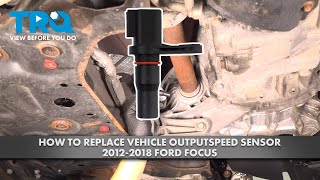
Typical fix: Replace the Transmission Output Speed Sensor. On the DPS6, this involves removing the airbox for access. 🎬 Watch: Step-by-step guide to replacing the transmission output speed sensor. Many owners replace both the Input (TSS) and Output (OSS) sensors at the same time as they are failure-prone and located next to each other.
Est. part cost: $30-$70 - Faulty ABS Wheel Speed Sensor 🔴 High Probability → Shop ABS Wheel Speed Sensor Wheel speed sensors are located at the wheel hubs, where they are exposed to water, dirt, and potential damage from road debris, leading to failure or wiring issues. The wiring pigtail connector is also a common point of corrosion.
How to confirm: Scan the ABS module for codes (e.g., C-codes) that pinpoint a specific wheel sensor. Use a scan tool to monitor live data from all four wheels while driving; the faulty sensor will show a reading of 0 mph or a signal that doesn't match the others.
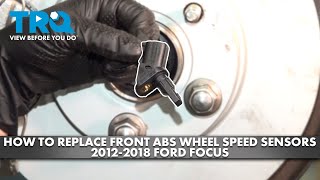
Typical fix: Replace the faulty ABS wheel speed sensor 🎬 See this walkthrough for replacing a front wheel speed sensor. and inspect its wiring harness and connector for damage or corrosion.
Est. part cost: $25-$60 - Damaged Wiring or Connectors 🟡 Medium Probability Wiring to either the transmission sensors or wheel speed sensors can become frayed, corroded, or damaged by heat from the exhaust or road debris. A known issue on some Focus models is a poor body ground connection near the battery, which can cause a host of electrical issues, including sensor malfunctions.
How to confirm: Visually inspect the wiring harness and connectors leading to the suspect sensor (either the OSS or a specific wheel speed sensor). Check for breaks, corrosion, or melted plastic. Test for continuity and proper voltage with a multimeter.
Typical fix: Repair or replace the damaged section of the wiring harness or the connector. Clean and secure any corroded ground connections.
Est. part cost: $10-$50 - Faulty ABS Control Module ⚪ Low Probability → Shop ABS Control Module
How to confirm: This is diagnosed by exclusion. If all speed sensors and their wiring have been tested and are confirmed to be good, the ABS module itself may be the issue. This is often accompanied by network communication codes (U-codes like U0073 or U0415) and multiple, seemingly unrelated warning lights.
Typical fix: Replace the ABS control module, which often requires programming by a dealer or a specialized shop. Some companies offer repair services for these modules.
Est. part cost: $400-$1000
Rare But Worth Checking
- Incorrectly Installed Wheel Bearing/Hub Assembly: A wheel bearing with an integrated magnetic tone ring for the ABS sensor can be installed backward. If this happens, the ABS sensor cannot get a reading, which can trigger a P0500 code. This is most likely to occur immediately after a wheel bearing has been replaced.
- Faulty Transmission Control Module (TCM): → Shop Transmission Assembly The TCM for the DPS6 transmission is a known high-failure item. While it usually produces specific transmission codes, a failing TCM can sometimes disrupt communication and contribute to a P0500 code, especially if accompanied by other 'U' codes and severe shifting problems. 🎬 Watch: How to diagnose common DPS6 transmission and TCM issues. Ford extended the warranty on these TCMs to 10 years or 150,000 miles.
Diagnosis Steps
- Scan for Codes: Use an OBD-II scanner to read codes from all available modules (PCM, ABS, TCM). Note any codes besides P0500, especially 'C' (Chassis/ABS) or 'U' (Network) codes.
- Analyze Codes: If ABS codes are present, they will point to a specific wheel sensor circuit. Begin your diagnosis there. If only P0500 is present, the transmission output speed sensor (OSS) is a more likely suspect.
- Live Data Monitoring: Use a scan tool capable of reading live data. While driving, monitor the vehicle speed reported by the PCM and compare it to the individual speeds from all four ABS wheel speed sensors. Also, monitor the Transmission Output Speed Sensor (OSS) PID if available.
- Identify the Faulty Signal: Look for a sensor that reads 0 mph, has an erratic signal, or does not match the other sensors' readings. A discrepancy between the OSS and the average of the wheel speed sensors is a key indicator.
- Visual Inspection: Inspect the sensor identified in the previous step and its wiring. For ABS sensors, pay close attention to the harness where it flexes near the suspension and the connector for corrosion. For the OSS, check the connector on top of the transmission for secure seating and clean contacts.
- Circuit Test: Using a multimeter, check for proper voltage and ground at the sensor connector. Test the sensor's signal according to the vehicle's service manual. This can confirm if the fault is the sensor itself or the wiring/PCM.
- Component Replacement: If the sensor is faulty, replace it. If the wiring is damaged, repair or replace it. For the automatic transmission, consider replacing both the TSS and OSS sensors at the same time due to their proximity and similar failure rates.
- Clear Codes and Test Drive: After the repair, clear all diagnostic trouble codes and perform a test drive to ensure the speedometer, transmission, and cruise control function correctly and the codes do not return. For the DPS6 transmission, a TCM adaptive learning procedure may be required.
Parts You'll Likely Need
- Transmission Output Speed Sensor (for DPS6 Automatic)
(OEM #DY-1222 (Motorcraft))— This sensor is a primary source for the vehicle speed signal sent to the PCM and is a common failure point for the P0500 code when no ABS lights are present.
Trusted brands: Motorcraft, Standard Motor Products (SC506), Wells
OEM price range: $50-$90
Aftermarket price range: $30-$70 - ABS Wheel Speed Sensor
(OEM #BRAB631 (Motorcraft, Rear))— If the P0500 code is accompanied by ABS and traction control lights, a faulty wheel speed sensor or its wiring is the most likely cause.
Trusted brands: Motorcraft, Dorman, Standard Motor Products, NTK
OEM price range: $40-$70
Aftermarket price range: $25-$60
Related Codes That Often Appear With This One
- C1xxx — ABS-specific codes (e.g., C102A for 'Rear Wheel Speed Sensor Circuit Fault') will often appear alongside P0500, helping to pinpoint which wheel speed sensor is the root cause.
- U0415 — This code means 'Invalid Data Received From Anti-Lock Brake System Control Module.' It indicates a communication problem and can be set along with P0500 if the ABS module is failing or cannot provide a reliable speed signal to the PCM.
- P07A3 — This is a common DPS6 transmission code for 'Transmission Friction Element A Stuck On'. While not directly a speed sensor code, its presence alongside P0500 strongly points towards a more serious internal transmission or TCM issue rather than a simple sensor failure.
Technical Service Bulletins (TSBs) & Recalls
- TSB 13-9-4: Addresses intermittent transmission clutch shudder on the DPS6 transmission. While not directly for P0500, it highlights the complex software and mechanical interactions within the transmission that can be affected by sensor data.
Platform-Specific Known Issues
- Confusion with DPS6 Transmission Input Speed Sensor (TSS): → Shop Transmission Assembly The DPS6 automatic transmission has both an Input (TSS) and Output (OSS) speed sensor located next to each other on top of the case. They are visually identical. P0500 is related to the vehicle speed, which is primarily derived from the OSS and ABS sensors. It's crucial to identify and replace the correct sensor (OSS, typically the one closer to the driver's side) to fix a P0500 code.
Mechanic-Grade Diagnostic Values
- Transmission Input/Output Speed Sensor Bolt Torque — expected: 89 inch-pounds. Failure: N/A - This is an installation specification.
- Wheel Lug Nut Torque — expected: 100 ft-lbs. Failure: N/A - This is an installation specification for re-installing the wheel after sensor access.
Scan Tool Commands That Help
- FORScan: TCM Adaptive Learning Reset — Required after replacing the TCM, clutch, or clutch actuators on the DPS6 transmission. It can also resolve shifting issues. The process involves clearing learned values and then performing a specific drive cycle.
- FORScan: Shift Drum Learn — This calibrates the shift drum actuators so the TCM knows the correct gear positions. It is part of the main Clutch Adaptive Learn but can be run separately for diagnostics if the main routine fails.
- Ford IDS: Clear Transmission Adaptive Tables — This is the dealer-level equivalent of the FORScan reset. After clearing, a specific, multi-step drive cycle must be performed to allow the transmission to relearn shift points and clutch engagement.
Wiring & Ground Locations
- Instrument Cluster Connector — Behind the instrument cluster in the dashboard.. On some Ford models, a CAN bus error (like U0001) can be caused by poorly soldered connections in the instrument cluster. Since the speed signal is passed over the CAN bus, a faulty cluster could theoretically interrupt the signal and contribute to a P0500 code.
- TCM Location — Mounted on the side of the gearbox, typically on the driver's side under the battery housing.. The TCM is the brain of the DPS6 transmission. Knowing its location is critical for inspection of its connectors for corrosion or damage, which can cause communication faults and codes like P0500.
- Rear ABS Wheel Speed Sensor — Located in the middle of the rear wheel hub, accessible from the back side without removing the tire, though raising the vehicle is necessary.. This is a primary source of vehicle speed data. A fault here will often set P0500 along with ABS lights. The sensor is held in by a single T25 Torx bolt.
Real Owner Repair Stories
- Tacoma World forum user (Toyota Tacoma (similar logic applies)) — P0500 code, but speedometer worked fine and no shifting issues.
❌ Tried (didn't work) Checking wheel speed sensors (ruled out because speedometer worked), Checking transmission sensors
✅ What actually fixed it The instrument cluster was faulty. It was receiving the speed signal and displaying it correctly, but it was failing to forward that signal to the ECM. Replacing the instrument cluster resolved the P0500 code. - Ford Owner Report (NHTSA ODI #11553968): An owner of a similar Ford model reported that after a P0500 code was retrieved, a dealer mechanic related the failure specifically to a wheel speed sensor failure.
- Ford Owner Report (NHTSA ODI #10069274): A manufacturer report describes a vehicle experiencing a P0500 code (faulty speed sensor) while the transmission was kicking in and out.
OEM Part Supersession History
AE8Z-7Z369-B, D, E→AE8Z-7Z369-F— Multiple revisions of the DPS6 Transmission Control Module (TCM) were released to address high failure rates.
Heads up: While TCMs from 2012-2018 are physically interchangeable, their programming (calibration) differs. A TCM from a 2015-2018 Focus installed in a 2012-2014 model without reprogramming may cause harsh shifts. It's best to match the year range or have the unit programmed with the correct calibration for the vehicle.
Model Year Variations Within This Range
- 2012-2014 vs 2015-2018: The stock TCM calibration changed in 2015. Using a used TCM from a different year group without reprogramming can lead to poor shift quality. For example, using a '15-'18 TCM on a '12-'14 car might cause firm shifts into 4th gear.
- 2011-2016: Ford issued Customer Satisfaction Program 14M02, extending the warranty on the DPS6 TCM to 10 years or 150,000 miles for certain 2011-2015 Fiesta and 2012-2016 Focus models due to high failure rates causing symptoms like loss of engagement or no-start conditions.
Diagnostic Flowchart
Other Known Issues on This Vehicle
Issues unrelated to this code that are worth knowing about as an owner of this generation:
- DPS6 PowerShift Transmission Failure 🔴 High → Shop Transmission Assembly — Extremely common on 2012-2016 models. Symptoms include shuddering, hesitation, jerky shifts, and complete loss of engagement. Failures can occur at low mileage. (Ref: Multiple TSBs (e.g., 13-9-4) and warranty extensions were issued, but no universal recall for all issues.)
- Electric Power Assist Steering (EPAS) Failure 🔴 High — Particularly noted on 2012-2014 models. Can result in a sudden loss of power steering assist, making the vehicle very difficult to steer at low speeds. (Ref: Ford issued service bulletins and a recall (15S18) for some vehicles to update the PSCM software, but problems persist for many owners.)
- Prematurely Failing Engine Mounts 🟠 Medium — Common across all model years. The passenger-side hydraulic mount is the most frequent failure point, leading to excessive vibration at idle and clunking noises.
- Faulty Canister Purge Valve 🟠 Medium — Affects 2.0L GDI engines, causing stalling after refueling, rough idle, and difficulty starting. (Ref: Subject of recalls (e.g., NHTSA 18V735000) and customer satisfaction programs.)
- Faulty Door Latch Assembly 🔴 High — Widespread issue where a spring in the latch mechanism breaks, potentially allowing the door to open while driving. (Ref: Covered by multiple recalls (e.g., NHTSA 16V643000).)
Used vs. New Parts: Buying Guide for This Vehicle
When a used part is the smart pick: A used ABS module or a complete wheel hub assembly from a low-mileage donor can be a cost-effective option. A used TCM can also be used, but it is critical to match the part number and year range (2012-2014 vs 2015-2018) to avoid programming issues.
Donor-vehicle mileage cap: roughly under 75000 miles for the part to have meaningful remaining life.
What to inspect on the donor part:
- Check for corrosion on all electrical connectors.
- Inspect wiring pigtails for any signs of fraying, brittleness, or previous repairs.
- For hub assemblies, ensure the tone ring is not damaged or packed with metallic debris.
- Verify the part number on the used TCM exactly matches the required part for your vehicle's year range.
OEM-only on this vehicle (don't cheap out):
- Transmission Control Module (TCM) - While used OEM is an option, aftermarket TCMs for the DPS6 are not widely available or trusted. A remanufactured OEM unit from a reputable source like UpFix or a new OEM unit is the safest bet.
Aftermarket brands forum-validated for this vehicle:
- Motorcraft (OEM)
- Standard Motor Products (SMP)
- NTK
- Bosch
- Delphi
- Beck/Arnley (often repackaged OEM)
Brands owners have reported issues with on this vehicle:
- Dorman - While they make a wide variety of parts, some technicians and owners report a higher-than-average failure rate for their electronic components and have quality control complaints.
- Unbranded/white-box parts from online marketplaces - Quality can be extremely inconsistent.
Real Owner Stories
Aggregated from forums and TSBs cited above. Mileages and costs reflect what owners reported in those sources.
2011-2016 Ford Fiesta (DPS6 Transmission)
Symptoms: The owner experienced a P0500 code and related shifting issues on the shared DPS6 platform.
What fixed it: The owner found a more specific code for 'LEFT FRONT WHEEL SPEED SENSOR: SIGNAL INVALID' using a capable scanner and addressed the wheel speed sensor issue.
Source hint: Ford Fiesta Forum (fiestafaction.com) thread 'p-0500-code-fixed'
2012-2018 Ford Focus
Symptoms: ABS light came on and the speedometer stopped working.
What fixed it: The owner followed technical instructions to check for OSS (Output Speed Sensor) DTCs after ruling out other ABS inputs.
Source hint: PassionFord (passionford.com) thread 'ABS light and speedo stopped'
2012-2018 Ford Focus
Symptoms: OBD Code P0500 present; confusion over whether it was a traditional VSS or ABS related.
What fixed it: Confirmed that on modern Fords, the code is more likely related to an ABS sensor or wire because the system calculates speed from wheel rotation.
Source hint: Ford Owners Club (fordownersclub.com) thread 'Obd Code P0500'
Related OBD-II Codes
Frequently Asked Questions
My 2012-2018 Ford Focus has the DPS6 automatic transmission; which sensor should I check first for a P0500?
Does TSB 13-9-4 explain why my speedometer is erratic and throwing a P0500 code?
Why is my Focus showing a P0500 code along with ABS and Traction Control lights?
Can a bad battery ground cause a P0500 code on a Ford Focus?
Do I need to do anything special after replacing the speed sensor on my Focus automatic?
Helpful Videos
We Have This Part in Stock


The information in this article is provided for general reference and educational purposes only. Vehicle specifications, procedures, and part compatibility can vary by production date, trim level, and region. Always consult your vehicle's factory service manual and verify part numbers before purchasing or performing repairs. Safety-critical components such as airbags, seat belts, and braking systems should be installed by a qualified professional.
- Ford Focus:
- 🧭 Diagnostic Flowchart
- 🎬 Helpful Videos
- 🛍️ Shop This Part
- What's Unique About the 2012-2018 Ford Focus
- Symptoms You May Notice
- Most Likely Causes
- Rare But Worth Checking
- Diagnosis Steps
- Parts You'll Likely Need
- Related Codes That Often Appear With This One
- Technical Service Bulletins (TSBs) & Recalls
- Platform-Specific Known Issues
- Mechanic-Grade Diagnostic Values
- Scan Tool Commands That Help
- Wiring & Ground Locations
- Real Owner Repair Stories
- OEM Part Supersession History
- Model Year Variations Within This Range
- Other Known Issues on This Vehicle
- Used vs. New Parts: Buying Guide for This Vehicle
- Real Owner Stories
- 2011-2016 Ford Fiesta (DPS6 Transmission)
- 2012-2018 Ford Focus
- 2012-2018 Ford Focus
- Related OBD-II Codes
- Frequently Asked Questions
- 🎟️ Get 5% Off