

P0500 on 2010-2018 Kia Forte: Vehicle Speed Sensor Malfunction Causes and Fixes
For 2010-2013 models, this code usually means a bad Vehicle Speed Sensor (VSS) on the transmission (~$40-$110 part). For 2014-2018 models, it's almost always a faulty ABS wheel speed sensor (~$40-$150 part), which also provides the vehicle speed signal. Check for ABS-specific codes (like C0030-C0055) to identify which wheel sensor has failed.
- The fix for P0500 on a Kia Forte depends entirely on the model year.
- For 2010-2013 models, suspect the Vehicle Speed Sensor (VSS) on the transmission.
- For 2014-2018 models, the cause is almost always a faulty ABS wheel speed sensor. Check for ABS codes first!
- Symptoms include a dead speedometer, erratic shifting, and no cruise control.
- This is a DIY-friendly repair with a difficulty of 2 out of 5.
What's Unique About the 2010-2018 Kia Forte
The 2010-2018 Kia Forte spans two generations with different systems for measuring vehicle speed. The first generation (2010-2013, 'TD' platform) typically uses a traditional Vehicle Speed Sensor (VSS) on the transmission. The second generation (2014-2018, 'YD' platform) primarily relies on the ABS wheel speed sensors to provide vehicle speed data to the engine computer. This distinction is critical, as the cause and the part needing replacement are completely different depending on your vehicle's year.
Generation note: This guide covers two generations of the Kia Forte: - First Generation (TD): 2010-2013: These models typically use a dedicated Vehicle Speed Sensor (VSS) on the transmission to report vehicle speed to the PCM. - Second Generation (YD): 2014-2018: These models derive the vehicle speed signal from the ABS wheel speed sensors. A failure in one of these sensors or the ABS module is the most common cause of a P0500 code.
Symptoms You May Notice
- Check Engine Light is on
- ABS and/or Traction Control (ESC) warning light may be on
- Speedometer is erratic, reads 0 mph, or is not working at all
- Cruise control will not engage
- Harsh, erratic, or delayed automatic transmission shifting
- Possible hesitation during acceleration
- Odometer may not be functional
- Replacing the transmission output speed sensor on a 2014-2018 model. While these sensors exist for transmission function, they are not the source of the 'Vehicle Speed' signal for the PCM on these later models; that comes from the ABS system.
- Replacing a wheel speed sensor without first checking the wiring harness for damage. A broken wire can mimic the symptoms of a failed sensor.
Most Likely Causes
- Faulty ABS Wheel Speed Sensor (2014-2018 models) 🔴 High Probability → Shop ABS Wheel Speed Sensor On second-generation Fortes, the PCM relies on the ABS module for speed data. The wheel speed sensors are exposed to harsh road conditions (water, debris, heat), making them a common failure point. Wiring to these sensors is also vulnerable to damage.
How to confirm: Scan the ABS module for codes (C-codes). A code like C0035, for example, would point to a specific wheel speed sensor. Using a scan tool with live data, monitor the speed of all four wheels while driving; the faulty sensor will read 0 mph or have an erratic signal compared to the others.
Typical fix: Replace the faulty ABS wheel speed sensor. The sensor is located at the wheel hub behind the brake rotor. This is a common DIY repair.
Est. part cost: $40-$150 - Faulty Vehicle Speed Sensor (VSS) (2010-2013 models) 🔴 High Probability → Shop Drive Shaft Sensor On first-generation Fortes, a dedicated sensor on the transmission provides the speed signal. This sensor can fail electronically or its internal components can wear out over time, leading to a loss of signal.
How to confirm: Locate the sensor on the transaxle. Use a scan tool's live data to view 'Vehicle Speed'. If it reads 0 mph while driving, the VSS is the primary suspect. You can also test the sensor's output with a multimeter while safely rotating the drive wheels.
Typical fix: Replace the Vehicle Speed Sensor on the transmission. This may require removing the air cleaner assembly for access.
Est. part cost: $40-$110 - Damaged Wiring or Corroded Connector 🟡 Medium Probability Wiring to both wheel speed sensors and transmission sensors is susceptible to damage from road debris, heat from exhaust components, and moisture intrusion. Connectors can become corroded or filled with dirt, causing a poor connection.
How to confirm: Visually inspect the wiring harness leading to the suspect sensor (either the VSS on the transmission or the relevant ABS sensor). Look for frayed wires, melted insulation, or green/white corrosion inside the connector plug. Perform a wiggle test on the harness while monitoring live data to see if the signal cuts out.
Typical fix: Repair the damaged section of the wiring harness or clean/replace the corroded connector. Dielectric grease should be applied to the new connector to prevent future moisture intrusion.
Est. part cost: $5-$50
Rare But Worth Checking
- Faulty ABS Control Module (2014-2018 models): → Shop ABS Control Module If a wheel speed sensor has been replaced and the wiring is confirmed to be good, but the P0500 code persists (often with communication-related U-codes), the ABS module itself may be at fault. This is an expensive part and should be the last item to be considered after all other diagnostics have failed. Replacement requires programming ('Variant Coding').
- Faulty Powertrain Control Module (PCM): This is extremely rare. Before condemning the PCM, all other possibilities, including sensors, wiring, and other control modules, must be exhaustively ruled out.
- Incorrect Tire Size: If the vehicle's tires have been changed to a size that is significantly different from the original equipment without recalibrating the PCM, it can cause a discrepancy between the VSS readings and other sensors, potentially triggering a P0500 code.
Diagnosis Steps
- Connect an OBD-II scanner capable of reading ABS codes. Check for any other codes, especially in the ABS control module ('C' codes) and transmission module ('P07xx' codes). Note any C-codes, as they will point you to the root cause on later models.
- For 2014-2018 models: If an ABS code is present, proceed with diagnosing that specific wheel speed sensor. If no ABS code is present, use the scanner's live data function to monitor all four wheel speed sensors while driving. The sensor that reads differently from the others is the faulty one.
- For 2010-2013 models: Use the scanner's live data to view 'Vehicle Speed'. If it reads 0 mph while driving, the VSS on the transmission is the primary suspect.
- Visually inspect the wiring and connector for the suspect sensor (either the ABS sensor at the wheel or the VSS on the transmission). Look for any signs of physical damage, corrosion, or loose connections. Pay close attention to areas where the harness may rub against suspension or chassis components.
- If wiring appears intact, test the sensor itself. For a VSS, this may involve checking for a voltage signal with a multimeter while spinning the wheels. For an ABS sensor, replacement is often the most straightforward test if it's pinpointed by a code or live data.
- Check for blown fuses related to the ABS or ECU circuits.
- If a sensor and its wiring check out, the problem may lie with the control module (ABS module for 2014-2018, PCM for 2010-2013), but this is uncommon and should be professionally diagnosed.
Parts You'll Likely Need
- ABS Wheel Speed Sensor (2014-2018)
(OEM #Front Left: 59810-A7300; Front Right: 59830-A7300)— This is the most common failure for P0500 on 2014-2018 Forte models, as it's the source of the vehicle speed signal.
Trusted brands: Mando, Bosch, Standard Motor Products (SMP), Genuine Kia/Hyundai
OEM price range: $90-$160
Aftermarket price range: $40-$100 - Vehicle Speed Sensor (Transmission Mounted, 2010-2013)
(OEM #96420-4D600 (Varies by transmission type, verify with VIN))— This is the most likely failed part for P0500 on 2010-2013 Forte models.
Trusted brands: Duralast, Beck/Arnley, Genuine Kia/Hyundai
OEM price range: $70-$120
Aftermarket price range: $40-$80
Related Codes That Often Appear With This One
- C0030-C0055 range — On 2014-2018 models, a specific ABS wheel speed sensor fault code (like C0035 for a front right sensor) is often the root cause and will be stored in the ABS control module, triggering the P0500 in the PCM.
- P0720, P0722 — These codes relate to the Output Speed Sensor circuit. On older models that use a transmission-mounted VSS, these codes can sometimes appear alongside P0500, indicating a broader issue with speed sensing at the transmission.
Platform-Specific Known Issues
- On 2014-2018 YD platform Fortes, the front wheel speed sensor harnesses are somewhat exposed and can be damaged by road debris or improper servicing (e.g., during a brake job). Owners on forums often report finding a frayed or broken wire near the sensor connector as the true cause of the P0500 code.
Mechanic-Grade Diagnostic Values
- Vehicle Speed Sensor (VSS) Power (2010-2013) — expected: ~5V or ~12V depending on sensor type (consult vehicle-specific diagram).. Failure: 0V indicates a wiring issue or blown fuse, not necessarily a bad sensor.
- Vehicle Speed Sensor (VSS) Signal (2010-2013) — expected: A fluctuating AC voltage or a digital square wave when wheels are rotated (best viewed on an oscilloscope).. Failure: No change in voltage or a flat line on the scope indicates a failed sensor or mechanical drive issue (e.g., stripped gear).
- ABS Wheel Speed Sensor Resistance (2014-2018) — expected: Typically 1.0kΩ - 2.5kΩ (check service manual for exact spec).. Failure: A reading of OL (open loop) or 0Ω (short circuit) indicates a failed sensor.
Scan Tool Commands That Help
- Kia GDS (Global Diagnostic System): Live Data / Data Analysis — To monitor individual wheel speeds from the ABS module in real-time while driving. This is the definitive way to identify which sensor on a 2014-2018 model is failing, as it will show a speed of 0 or an erratic reading compared to the other three.
- Kia GDS (Global Diagnostic System): Vehicle S/W Management -> Resetting Adaptive Values — After replacing a major component like the PCM or ABS module, this function can be used to reset learned values. For a P0500, this is less common but may be required if other codes are present or if a module was replaced.
- Kia GDS (Global Diagnostic System): Variant Coding — This is mandatory when replacing the ABS control module on a 2014-2018 Forte. The new module must be coded to the vehicle's VIN and specific options to function correctly and communicate with the PCM.
Wiring & Ground Locations
- VSS Connector (2010-2013) — On the top or side of the transaxle housing, often below the air intake tube.. This is the main connection point for the VSS. Pin 1 is typically Ground, Pin 2 is the Signal wire to the PCM, and Pin 3 is the power supply. Testing voltage and signal at these pins can diagnose the sensor vs. wiring.
- ABS Wheel Speed Sensor Connector (2014-2018) — In the wheel well, where the sensor harness connects to the main body harness. Access often requires removing or pulling back the fender liner.. This 2-pin connector is a common point of failure due to moisture and debris. Inspecting for corrosion or damage here is a critical step before replacing the sensor itself.
Real Owner Repair Stories
- Forum discussions and mechanic reports (2014-2018 Kia Forte (YD)) — P0500, ABS light, ESC light, speedometer at 0 mph.
❌ Tried (didn't work) Replacing the front wheel speed sensor that seemed most likely to fail.
✅ What actually fixed it The actual cause was a damaged tone ring on the CV axle. A rock or debris had bent one of the teeth on the ring, causing an erratic signal that the ABS module couldn't interpret, leading to the P0500. The sensor itself was fine; the axle needed replacement to fix the integrated tone ring. - Kia-Forums.com user report (2011 Kia Forte (TD) with automatic transmission) — P0500, speedometer dead, harsh shifting.
❌ Tried (didn't work) Testing the VSS sensor with a multimeter (it showed correct resistance).
✅ What actually fixed it The plastic drive gear on the end of the Vehicle Speed Sensor was stripped. The sensor was electronically functional, but it wasn't being spun by the transmission. Replacing the VSS with a new unit (which included a new gear) resolved the issue. - Reddit r/MechanicAdvice post (2016 Kia Forte EX) — P0500 and C0045 (Left Rear Wheel Speed Sensor Circuit).
❌ Tried (didn't work) Replacing the left rear wheel speed sensor.
✅ What actually fixed it The wiring harness leading to the rear sensor had been chewed by a rodent. The damage was several inches up from the connector, hidden behind the wheel well liner. Repairing the chewed wires with new wire and heat-shrink tubing fixed the problem without needing another new sensor.
OEM Part Supersession History
59830-A7300→No official supersession, but multiple aftermarket interchanges exist.— N/A
Heads up: An eBay seller noted they bought part 59830-A7300 for their 2014 Forte and it was 'incompatible', highlighting the importance of verifying the correct part for the specific VIN, as mid-year production changes can occur.
Model Year Variations Within This Range
- 2014-2018: While all 2014-2018 models use ABS sensors for speed, there can be different part numbers for front vs. rear, and left vs. right sensors. Furthermore, some models with multi-link rear suspension may use a different rear sensor setup than those with a torsion beam axle. Always verify the part number with the vehicle's VIN.
Diagnostic Flowchart
Other Known Issues on This Vehicle
Issues unrelated to this code that are worth knowing about as an owner of this generation:
- Engine Failure (Theta II and Nu Engines) 🔴 High — Widespread on 2010-2015 models with 2.0L/2.4L Theta II and 1.8L/2.0L Nu engines. Can occur at various mileages, often starting with knocking or excessive oil consumption. (Ref: Multiple recalls and a class-action lawsuit settlement exist, offering extended warranties (e.g., Lifetime Warranty for connecting rod bearing failure after KSDS update).)
- Steering Coupler Failure 🟠 Medium — Very common across the 2010-2018 range. A clicking or knocking sound is heard from the steering column when turning the wheel. The flexible rubber coupler inside the electronic power steering motor disintegrates. (Ref: TSB CHA-074 provides repair instructions for replacing the flexible coupler (Part #56315-2K000-FFF).)
- Brake Pedal Stopper Pad Deterioration 🟡 Low — Common on 2012-2014 models. The small plastic pad on the brake pedal arm crumbles, which can cause brake lights to stay on or allow the vehicle to be shifted out of Park without pressing the brake. (Ref: Kia Recall SC158)
- Faulty Ignition Coils 🟡 Low — Reported frequently, especially on 2017 models, leading to misfires, rough idling, and stalling.
- No Sound From Speakers 🟡 Low — A common complaint where the factory radio/head unit powers on, but no audio comes from the speakers. Often requires a head unit replacement or repair.
Used vs. New Parts: Buying Guide for This Vehicle
When a used part is the smart pick: A used wiring harness pigtail is a smart choice if only the connector is damaged. A complete used ABS module can be a cost-effective alternative to a new one, but only if it comes with a warranty and you have a plan for programming.
Donor-vehicle mileage cap: roughly under 80000 miles for the part to have meaningful remaining life.
What to inspect on the donor part:
- For wiring: Check for flexibility (not brittle), intact connector tabs, and no signs of corrosion on the pins.
- For ABS modules: Ensure the part number matches EXACTLY. Look for a donor vehicle from a dry climate to minimize chances of internal corrosion. Avoid modules from vehicles with front-end collision damage.
OEM-only on this vehicle (don't cheap out):
- ABS Control Module - While used is an option, aftermarket modules for this system are not widely available or trusted. A new OEM or a professionally repaired original module is the safest bet.
Aftermarket brands forum-validated for this vehicle:
- Standard Motor Products (SMP)
- Bosch
- Beck/Arnley
- Mando (often the OEM supplier)
Brands owners have reported issues with on this vehicle:
- Unbranded, no-name sensors from online marketplaces often have high failure rates or produce noisy signals that can cause intermittent issues.
Real Owner Stories
Aggregated from forums and TSBs cited above. Mileages and costs reflect what owners reported in those sources.
2014 Kia Forte
Symptoms: P0500 code accompanied by ABS and ESC warning lights being on.
What fixed it: Diagnosed using a scanner with live data to identify a faulty wheel speed sensor, which was then replaced.
Source hint: forteforums.com thread titled '2014 Forte P0500, ABS, ESC lights on - forteforums.com'
2012 Kia Forte
Symptoms: The speedometer stopped working entirely and the P0500 code was triggered.
What fixed it: Replacement of the transmission-mounted Vehicle Speed Sensor (VSS).
Source hint: kia-forums.com thread titled '2012 Kia Forte Speedometer Not Working - P0500 - kia-forums.com'
2015 Kia Forte
Symptoms: Frayed or broken wire found near the sensor connector, causing a loss of speed signal.
What fixed it: Repairing the damaged section of the wiring harness and applying dielectric grease to the connector.
Source hint: vehicle_specific_issues section regarding YD platform front wheel speed sensor harnesses
Documented NHTSA Reports
In addition to owner forum reports, NHTSA records highlight how the P0500 code can appear alongside multiple engine performance issues. For instance, NHTSA ODI #11645566 describes a situation involving multiple misfires and several diagnostic codes, including P0500, P062E, P0300, P0303, P0302, P0267, P0264, and P050B.
Related OBD-II Codes
Frequently Asked Questions
My 2014 Kia Forte has the P0500 code along with ABS and ESC lights. Is this a common issue?
I have a 2012 Forte and my speedometer just stopped working. Is the fix the same as the newer models?
Can road debris cause the P0500 code on my 2017 Kia Forte?
Is there a specific part number I should look for if I hear clicking in my steering while dealing with this code?
Could a blown fuse cause my speedometer to stop working and trigger P0500?
My 2013 Forte is shifting harshly and showing P0500. Are these related?
Helpful Videos
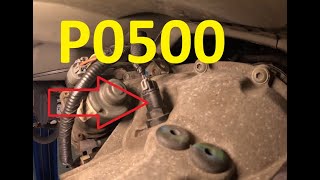

We Have This Part in Stock



The information in this article is provided for general reference and educational purposes only. Vehicle specifications, procedures, and part compatibility can vary by production date, trim level, and region. Always consult your vehicle's factory service manual and verify part numbers before purchasing or performing repairs. Safety-critical components such as airbags, seat belts, and braking systems should be installed by a qualified professional.
- Kia Forte:
- 🧭 Diagnostic Flowchart
- 🎬 Helpful Videos
- 🛍️ Shop This Part
- What's Unique About the 2010-2018 Kia Forte
- Symptoms You May Notice
- Most Likely Causes
- Rare But Worth Checking
- Diagnosis Steps
- Parts You'll Likely Need
- Related Codes That Often Appear With This One
- Platform-Specific Known Issues
- Mechanic-Grade Diagnostic Values
- Scan Tool Commands That Help
- Wiring & Ground Locations
- Real Owner Repair Stories
- OEM Part Supersession History
- Model Year Variations Within This Range
- Other Known Issues on This Vehicle
- Used vs. New Parts: Buying Guide for This Vehicle
- Real Owner Stories
- 2014 Kia Forte
- 2012 Kia Forte
- 2015 Kia Forte
- Documented NHTSA Reports
- Related OBD-II Codes
- Frequently Asked Questions
- 🎟️ Get 5% Off