

P0500 on 2009-2013 Toyota Corolla: Vehicle Speed Sensor Causes and Fixes
On a 2009-2013 Corolla, P0500 is usually caused by a faulty ABS wheel speed sensor or its wiring. However, a faulty instrument cluster or ABS module can also be the culprit, even if the speedometer works. Diagnosis requires a scan tool that can read data from the ABS, cluster, and engine computer.
- P0500 on this Corolla means the Engine Control Module (ECM) isn't getting a speed signal.
- The most likely cause is a bad ABS wheel speed sensor or its wiring.
- DO NOT assume the system is OK just because the speedometer works. The instrument cluster itself can fail and stop sending the signal to the ECM.
- A proper diagnosis requires a scan tool that can read live data from the ABS module, instrument cluster, and ECM to find where the signal is lost.
- Start by checking for ABS codes (C-codes), as they will often lead you directly to the faulty wheel speed sensor.
What's Unique About the 2009-2013 Toyota Corolla
The key challenge with the P0500 code on this Corolla is its complex signal path. The speed signal travels from the ABS wheel speed sensors, through the ABS module, to the instrument cluster, and finally to the engine computer (ECM). A failure at any point in this chain can trigger the code. A common and confusing scenario is when the speedometer works perfectly, but the P0500 code is present. This happens because the instrument cluster is receiving the speed signal (to run the speedometer) but has failed internally and is no longer sending the signal to the ECM, leading to a misdiagnosis if you only focus on the traditional speed sensor.
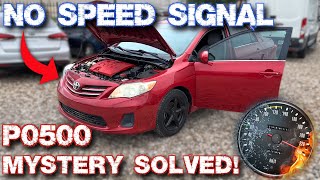
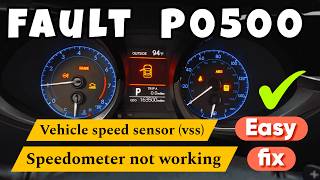
🎬 Watch a helpful breakdown of P0500 causes and common fixes.Symptoms You May Notice
- Check Engine Light is on
- ABS warning light is on
- Traction Control (VSC) warning light is on
- Speedometer works intermittently or not at all
- Speedometer works correctly, but the Check Engine Light is still on
- Harsh or erratic automatic transmission shifting
- Cruise control does not function
- Vehicle may feel like it is in 'limp mode' with limited power
- Replacing a transmission speed sensor when the vehicle uses the ABS sensors for its speed signal.
- Assuming the speed sensor system is fine because the speedometer is working. The fault can be in the instrument cluster's output circuit to the ECM.
- Replacing the ECM. While a faulty ECM is a theoretical cause, it is extremely rare compared to sensor, wiring, or cluster failures.
Most Likely Causes
- Faulty ABS Wheel Speed Sensor or Wiring 🔴 High Probability → Shop ABS Wheel Speed Sensor Sensors and wiring at the wheels are exposed to harsh conditions, moisture, and debris, making them common failure points. The wiring can become brittle and break, or connectors can corrode. Rust buildup on the hub can also push the sensor away from the tone ring, causing a bad reading.
How to confirm: Use a scan tool to monitor the speed of all four wheels simultaneously while driving. The faulty sensor will show an erratic reading, a speed that doesn't match the others, or 0 MPH. Visually inspect the sensor's wiring for breaks, corrosion, or damage from road debris. These are active sensors and cannot be accurately tested with a simple resistance check; they must be tested by observing the voltage or current signal with an oscilloscope or advanced multimeter while spinning the wheel.
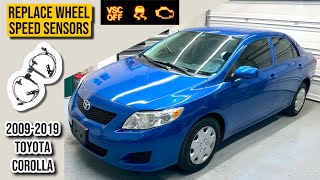
Typical fix: Replace the faulty wheel speed sensor and inspect the wiring harness for damage. Clean any rust from the sensor mounting surface on the steering knuckle. Ensure the connector is clean and secure. 🎬 See this step-by-step walkthrough for replacing your wheel speed sensors.
Est. part cost: $40-$150 - Faulty Instrument Cluster (Combination Meter) 🟡 Medium Probability → Shop Instrument Cluster The cluster contains an internal circuit that processes the speed signal from the ABS module and relays it to the ECM. This electronic component can fail due to age or heat, breaking the signal chain even if the speedometer needle itself continues to function.
How to confirm: With a professional scan tool, monitor the vehicle speed data PID from the Instrument Cluster and the ECM. If the cluster shows a speed reading but the ECM shows 0 mph, the cluster has failed to send the signal. This is a classic symptom for this platform. 🎬 Watch this real-world diagnosis and fix for the P0500 code.
Typical fix: The instrument cluster must be repaired by a specialist or replaced. Replacement often requires programming to the vehicle to retain mileage and key information. Some owners source used clusters from junkyards, but this requires mileage reprogramming.
Est. part cost: $200-$700 - Faulty ABS Module (Skid Control ECU) ⚪ Low Probability → Shop ABS Control Module
How to confirm: Using a scan tool, confirm all four wheel speed sensors are sending correct signals to the ABS module, but the ABS module is not outputting a vehicle speed signal to the instrument cluster. This requires a scan tool that can read live data PIDs from the ABS system.
Typical fix: Replace the ABS module. This is an expensive part and requires professional installation, including bleeding of the entire brake system using a specific procedure to purge air from the new module.
Est. part cost: $700-$1000 - Damaged Wiring Harness ⚪ Low Probability Rodents can chew on wiring harnesses, especially in the engine bay or on top of the transmission where harnesses are routed. Wires can also chafe against engine or chassis components over time, leading to shorts or open circuits.
How to confirm: Visually inspect the wiring between the ABS module, instrument cluster, and ECM. Check for continuity on the signal wires using a digital multimeter and a wiring diagram. Pay close attention to the harness sections near the firewall and under the dashboard.
Typical fix: Repair the damaged section of the wiring harness using solder and heat shrink or appropriate connectors.
Est. part cost: $10-$50 in materials
Rare But Worth Checking
- Faulty Transmission-Mounted Vehicle Speed Sensor (VSS): → Shop Drive Shaft Sensor While most 2009-2013 Corollas use the ABS system for speed data, some very early, base, or non-ABS models might have a traditional VSS on the transmission. This is uncommon for this generation but should be verified if the vehicle does not have ABS warning lights or a scan tool shows no communication with an ABS module.
Diagnosis Steps
- Connect a high-quality OBD-II scanner capable of reading live data from the Engine (ECM), Brakes (ABS), and Instrument Cluster (Combination Meter). A basic code reader will not be sufficient.
- Scan all systems for any trouble codes. Pay close attention to any ABS/VSC codes (C-codes), as they often pinpoint the root cause, such as a specific wheel speed sensor.
- Set up the scanner to display live data for 'Vehicle Speed' from the ECM, ABS module, and Instrument Cluster simultaneously. Also, display the individual speeds for all four wheel sensors (LF, RF, LR, RR).
- Safely drive the vehicle. Observe the data. If one wheel speed sensor reads 0 or is erratic while the others read correctly, that sensor or its wiring is the problem.
- If all wheel sensors read correctly but the 'Vehicle Speed' from the ABS module is 0, suspect a faulty ABS module.
- If the ABS module and Instrument Cluster both show a correct speed, but the ECM shows 0, the problem is either the instrument cluster's output circuit or the wiring between the cluster and the ECM. This is a common failure pattern on this platform.
- If the speedometer is not working at all, the problem is likely between the wheel sensors and the instrument cluster.
- Perform a visual inspection of the wiring harnesses to all wheel speed sensors and the ABS module for any signs of damage, corrosion, or rodent activity.
Parts You'll Likely Need
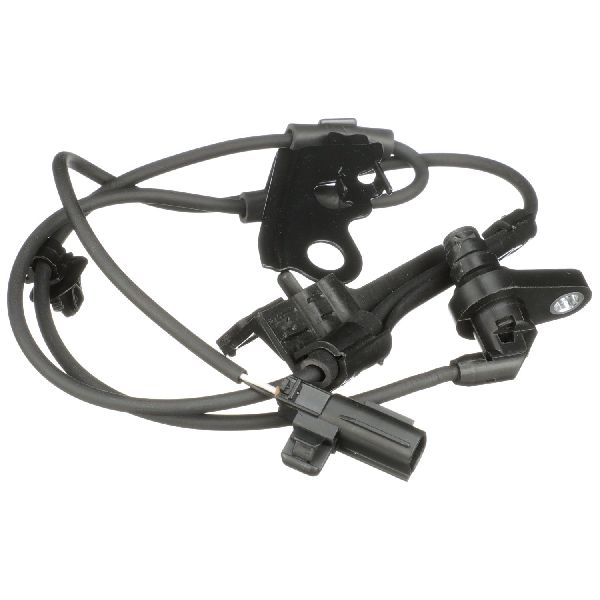
- ABS Wheel Speed Sensor
(OEM #Front Right: 89542-02090 (superseded by 89542-02150); Front Left: 89543-02090 (superseded by 89543-02150))— This is the most common failure point. The signal for vehicle speed originates here, and the sensor is exposed to the elements. Part numbers are side-specific.
Trusted brands: Denso, NTK, Standard Motor Products (SMP), Genuine Toyota
OEM price range: $150-$250
Aftermarket price range: $40-$120 - Instrument Cluster (Combination Meter)
(OEM #Varies by trim and model year (e.g., 83800-02F20))— A common but tricky failure point where the internal circuit that sends the speed signal to the ECM fails, even if the speedometer still works. Part number must be matched exactly to the original.
Trusted brands: Genuine Toyota
OEM price range: $500-$800 - ABS Modulator
(OEM #Varies by vehicle options (e.g., 44050-02260))— A less common but possible cause where the module fails to process the wheel speed signals into a vehicle speed signal. Note that part numbers vary by vehicle configuration (with/without stability control).
Trusted brands: Aisin, Advics, Genuine Toyota
OEM price range: $700-$1000
Aftermarket price range: $400-$700
Related Codes That Often Appear With This One
- C12xx — C-codes are chassis codes. Since the P0500 is often caused by a faulty ABS wheel speed sensor, you will likely see a corresponding ABS code (e.g., C1225 for LF sensor circuit) pointing to the specific sensor or circuit that has failed.
Platform-Specific Known Issues
- Instrument Cluster Failure with Working Speedometer: → Shop Instrument Cluster A well-documented issue in forums where a P0500 code is present, but the speedometer appears to function normally. This points directly to a failure in the cluster's internal circuitry that communicates with the ECM. Owners often confirm this by swapping in a known-good cluster or sending theirs for repair.
Mechanic-Grade Diagnostic Values
- VSP1 Signal Voltage (ABS to Cluster) with Key On, Engine Off — expected: ~9 Volts DC. Failure: 0 Volts indicates a problem with the instrument cluster power supply or the wiring.
- VSP1 Signal Waveform (ABS to Cluster) while driving — expected: A square wave, pulsing between ~9V and 0V.. Failure: A flat line at 9V indicates the ABS module is not pulsing the signal to ground. A flat line at 0V indicates an open or short in the circuit.
- Active Wheel Speed Sensor Test (Current) — expected: Signal switches between ~7mA and ~14mA when the wheel is rotated and a magnet is passed over the sensor.. Failure: No change in current or an open circuit reading indicates a faulty sensor. This test requires a multimeter capable of reading milliamps and back-probing the connector.
Scan Tool Commands That Help
- Toyota Techstream: Active Test: ABS Motor Relay / Solenoid — To verify the ABS module is electronically responsive. The user can command the ABS pump motor and individual solenoids to turn on and off, confirming the module has power and basic functionality.
- Toyota Techstream: Data List: Vehicle Speed (from ABS, Combination Meter, ECM) — This is the primary diagnostic step. It allows a technician to view the speed signal as seen by each module in the chain simultaneously to pinpoint where the signal is being lost.
- Toyota Techstream: Utility: Zero Point Calibration — This is required after replacing the ABS module on vehicles with Vehicle Stability Control (VSC). It calibrates the steering angle sensor and yaw rate sensor to the new module.
Wiring & Ground Locations
- ABS Module Connector Pin 11 — On the main connector for the ABS actuator assembly in the engine compartment.. This is the output pin for the vehicle speed signal (VSP1) going to the instrument cluster. The wire is typically violet.
- Combination Meter Connector Pin 35 — On the main connector at the back of the instrument cluster.. This is the input pin that receives the speed signal from the ABS module. The wire is typically violet.
- Combination Meter Connector Pin 36 — On the main connector at the back of the instrument cluster.. This is the output pin that sends the processed speed signal to the ECM.
- ECM Connector Pin 38 — On the main connector for the Engine Control Module (ECM), typically located in the engine bay.. This is the final input pin where the ECM receives the speed signal from the instrument cluster. If a signal is present at Pin 36 of the cluster but not here, there is a wiring fault between the two.
- Ground Point E1 / E2 — Located in the driver's side kick panel area, bolted to the chassis.. This is a primary ground point for the Instrument Panel Junction Block and Main Body ECU. A poor ground here can cause a variety of electrical issues, including problems with the instrument cluster's ability to process and relay the speed signal.
Real Owner Repair Stories
- YouTube: ADVANCED LEVEL AUTO (2013 Toyota Corolla) — Check Engine Light and Traction Control light were on. P0500 code stored. Speedometer was working correctly.
❌ Tried (didn't work) Initial assumption was a faulty instrument cluster, as this is the most common cause when the speedometer works.
✅ What actually fixed it The technician used a scan tool to graph live data and found the ABS module and Instrument Cluster were receiving a speed signal, but the ECM was not. Further testing with an oscilloscope showed the signal from the ABS module to the cluster was present, but the signal from the cluster to the ECM was missing. However, after injecting a test signal, it was determined the cluster's output circuit was actually functional. The root cause was an intermittent failure of the ABS module itself, which was not correctly processing and sending the signal under all conditions. Replacing the ABS module resolved the P0500 code. - NHTSA ODI #11139910 — An owner reported that their speedometer and odometer stopped working at random, with diagnostic trouble codes P0500 and B2283 being stored.
OEM Part Supersession History
89543-02090→89543-02150— Standard part revision/update by Toyota.
Heads up: The new part number is a direct replacement for the original.89542-02090→89542-02150— Standard part revision/update by Toyota.
Heads up: The new part number is a direct replacement for the original.
Model Year Variations Within This Range
- 2010-2013: Vehicle Stability Control (VSC) became standard on all U.S. models starting in the 2010 model year. For 2009 models, it was optional. This is critical because the ABS module is different for cars with and without VSC. The correct module must be sourced for the specific vehicle configuration.
Diagnostic Flowchart
Other Known Issues on This Vehicle
Issues unrelated to this code that are worth knowing about as an owner of this generation:
- Excessive Oil Consumption (2ZR-FE & 2AZ-FE engines) 🔴 High — Common on 2009 models with the 2.4L 2AZ-FE engine and can occur at higher mileage on the 1.8L 2ZR-FE. The 2AZ-FE issue was due to faulty piston rings. (Ref: T-SB-0094-11 addresses the 2AZ-FE engine oil consumption.)
- Water Pump Failure 🟠 Medium — A well-known weak point on this platform, often failing prematurely between 60,000 and 100,000 miles. Symptoms include a whining/grinding noise from the passenger side of the engine and pink coolant residue.
- Starter Motor Failure 🟡 Low — Failures are common at higher mileage (over 100,000 miles), leading to a no-start condition. It's a relatively common repair for this generation.
- Alternator Failure 🟡 Low — Particularly noted on early models (2009-2010), the alternator with an internal clutch was prone to premature failure.
- Rattling Noise on Cold Start (VVT Gear) 🟠 Medium — A brief rattle from the 2ZR engine on a cold start can indicate a failing VVT camshaft timing gear assembly. (Ref: T-SB-0087-09)
Used vs. New Parts: Buying Guide for This Vehicle
When a used part is the smart pick: A used instrument cluster from a junkyard can be a cost-effective solution if the original has failed, as new OEM units are expensive. Used ABS wheel speed sensors are also a viable option if they are from a low-mileage donor and tested.
Donor-vehicle mileage cap: roughly under 100000 miles for the part to have meaningful remaining life.
What to inspect on the donor part:
- For an instrument cluster, ensure the plastic lens is not cracked or heavily scratched and that all connector pins are straight and free of corrosion.
- For a wheel speed sensor, inspect the wiring for any brittleness, cracking, or previous repairs. Ensure the sensor head is not physically damaged.
- Check the donor vehicle's VIN to confirm it had the same options (e.g., VSC or no VSC) to ensure module compatibility.
OEM-only on this vehicle (don't cheap out):
- ABS Modulator (Skid Control ECU). Due to the complexity, safety-critical nature, and need for specific bleeding procedures and calibration, using a new or professionally remanufactured OEM unit is strongly advised over a junkyard part.
Aftermarket brands forum-validated for this vehicle:
- Denso
- NTK
- Standard Motor Products (SMP)
Brands owners have reported issues with on this vehicle:
- Unbranded, 'white-box' sensors sold on online marketplaces often have high failure rates and may not produce a clean signal, leading to persistent codes.
Real Owner Stories
Aggregated from forums and TSBs cited above. Mileages and costs reflect what owners reported in those sources.
2013 Toyota Corolla
Symptoms: Check Engine Light is on; customer complaint involves a P0500 code.
What fixed it: Diagnosed and fixed by addressing the speed signal communication path, specifically looking at the signal between the ABS, cluster, and ECM.
Source hint: YouTube: Advanced Level Auto - Toyota Corolla Check Engine Light P0500 – Diagnosed & Fixed!
2009-2013 Toyota Corolla
Symptoms: P0500 code is present, but the speedometer appears to function normally.
What fixed it: Repairing the instrument cluster's internal circuitry or swapping in a known-good cluster.
Source hint: vehicle_specific_issues: Instrument Cluster Failure with Working Speedometer
2009-2013 Toyota Corolla
Symptoms: Speedometer and odometer stopped working at random; DTCs P0500 and B2283 were present.
What fixed it: Investigation into the electrical system and speed signal circuit as described in NHTSA ODI #11139910.
Source hint: NHTSA ODI #11139910
Related OBD-II Codes
Frequently Asked Questions
My speedometer is working fine, but I still have a P0500 code on my 2013 Corolla. How is that possible?
Can I test the wheel speed sensors on my 2009 Corolla with a standard resistance check?
Is there a TSB for the rattling noise I hear on cold starts in my 1.8L Corolla?
Does the 2009-2010 Pontiac Vibe suffer from the same P0500 issues as the Corolla?
Is there a TSB for the excessive oil consumption on my 2009 2.4L Corolla?
Why is my Corolla shifting harshly and losing cruise control along with the Check Engine Light?
Helpful Videos

We Have This Part in Stock


The information in this article is provided for general reference and educational purposes only. Vehicle specifications, procedures, and part compatibility can vary by production date, trim level, and region. Always consult your vehicle's factory service manual and verify part numbers before purchasing or performing repairs. Safety-critical components such as airbags, seat belts, and braking systems should be installed by a qualified professional.
- Toyota Corolla:
- 🧭 Diagnostic Flowchart
- 🎬 Helpful Videos
- 🛍️ Shop This Part
- What's Unique About the 2009-2013 Toyota Corolla
- Symptoms You May Notice
- Most Likely Causes
- Rare But Worth Checking
- Diagnosis Steps
- Parts You'll Likely Need
- Related Codes That Often Appear With This One
- Platform-Specific Known Issues
- Mechanic-Grade Diagnostic Values
- Scan Tool Commands That Help
- Wiring & Ground Locations
- Real Owner Repair Stories
- OEM Part Supersession History
- Model Year Variations Within This Range
- Other Known Issues on This Vehicle
- Used vs. New Parts: Buying Guide for This Vehicle
- Real Owner Stories
- 2013 Toyota Corolla
- 2009-2013 Toyota Corolla
- 2009-2013 Toyota Corolla
- Related OBD-II Codes
- Frequently Asked Questions
- 🎟️ Get 5% Off