

P0501 on 2010-2014 Audi S4: Vehicle Speed Sensor Fault Guide
On the 2010-2014 Audi S4, code P0501 almost always points to a failure of the internal sensor module (G676) on the printed circuit board (PCB) within the DL501 S-Tronic transmission's mechatronics unit. This is not a simple external wheel speed sensor. It is a complex, expensive repair requiring transmission disassembly and is best left to a professional or highly experienced DIYer.
- P0501 on a 2010-2014 Audi S4 is not a simple wheel speed sensor issue; it points to a known problem inside the S-Tronic transmission.
- The most common cause is a failed sensor module on the mechatronics unit's circuit board.
- This is a serious issue that can affect shifting and drivability, and it should be addressed promptly.
- Repair is complex and expensive, requiring transmission removal and specialized knowledge. This is not a typical DIY job.
- Diagnosis should be confirmed by a professional using an Audi-specific scan tool, referencing TSB A351619 2032211-.
What's Unique About the 2010-2014 Audi S4
Unlike many vehicles where P0501 points to an inexpensive, easy-to-replace external wheel speed sensor, on the B8/B8.5 Audi S4, it's a well-documented platform issue tied to the DL501 S-Tronic transmission's mechatronics unit. An official Audi Technical Service Bulletin (TSB) groups P0501 with other internal transmission sensor codes, confirming the problem lies deep within the gearbox. The failure is specifically on a printed circuit board that houses the speed sensors, which is known to fail due to heat and vibration over time. The fix is not a simple sensor swap but a more involved repair of the transmission's internal circuit board and sensor module.
Diagnostic Flowchart
Tap your situation to follow the diagnostic path that matches what you're seeing on this vehicle.
Generation note: This guide covers the B8 generation (2010-2012) and the B8.5 facelift (2013-2014) Audi S4. Both use the same DL501 S-Tronic transmission, and this fault is common to both, though some forum users note it seems more prevalent in the earlier B8 models.
Symptoms You May Notice
- Check Engine Light is on
- "Gearbox malfunction: you can continue driving" message on the driver information display.
- Transmission defaults to 'limp mode'
- Erratic, harsh, or delayed gear shifts, sometimes described as a violent jerk when coming to a stop or during slow traffic maneuvers.
- Incorrect or non-functional speedometer
- PRNDS indicator flashing or lit up.
- Car may get stuck in one gear, or refuse to select Reverse.
- Excessive lowering of engine RPMs when downshifting to 1st or selecting D/R.
- Replacing a wheel speed sensor. On this platform, P0501 is almost never caused by an ABS wheel speed sensor. Misdiagnosing this will waste time and money as the fault lies within the transmission. The ABS sensors provide wheel speed, but P0501 on the DL501 refers to the transmission's own output speed sensor.
Most Likely Causes
- Internal Mechatronics Sensor Module Failure 🔴 High Probability This is a known weak point in the DL501 S-Tronic transmission. The internal printed circuit board (PCB) and its integrated sensors are prone to failure from thermal stress and vibrations over time, as documented in Audi TSB A351619 2032211-.
How to confirm: A professional diagnosis with an Audi-specific scan tool (like VCDS) is required. The technician will look for P0501 in conjunction with other transmission-specific codes like P2159, P0716, or P2765, as listed in the TSB. The presence of this specific cluster of codes is a strong confirmation of internal PCB failure.
Typical fix: Replace the sensor module and its associated printed circuit board inside the transmission. This is sold as a 'Mechatronics Repair Kit'. The repair requires removing the transmission pan and mechatronics unit to access the boards.
Est. part cost: $600-$900
Rare But Worth Checking
- Wiring Harness Damage: While less common than internal failure, the wiring harness leading to the transmission's main connector could be damaged by road debris or improper servicing. A thorough visual inspection of the harness from the TCM to the transmission case is a prudent step before ordering expensive internal parts.
- Powertrain Control Module (PCM) or Transmission Control Module (TCM) Failure: → Shop Engine Control Module (ECM) The TCM is integrated into the mechatronics unit. While the sensor board is the most common failure point, a failure of the main logic board is also possible, though less frequent for this specific code. This should only be considered after the sensor board and wiring have been thoroughly checked by a specialist.
- Low Battery Voltage / Improper Battery Coding: These vehicles are highly sensitive to battery health. An old battery or an improperly coded new battery can cause a cascade of seemingly unrelated communication faults across various modules, including the transmission. If dozens of errors appear at once, investigate the battery state and coding before condemning the transmission.
Diagnosis Steps
- Scan the vehicle for all fault codes using an advanced scanner capable of reading Audi-specific transmission codes (e.g., VCDS by Ross-Tech, OBDeleven).
- Confirm if P0501 is present along with other codes listed in TSB A351619 2032211- (e.g., P2159, P0716, P2765). The presence of the specific DFCC codes mentioned in the TSB is key.
- If the specific combination of codes from the TSB is present, the cause is confirmed as the internal sensor module/PCB.
- Before ordering parts, inspect the main transmission wiring harness and connector for any visible damage, corrosion, or loose pins.
- Check vehicle battery health and ensure it is correctly coded in the gateway module, as low voltage can cause spurious communication errors.
- If wiring and battery are confirmed good, proceed with the transmission repair. This involves draining the ATF, removing the transmission pan, and carefully removing the mechatronics unit.
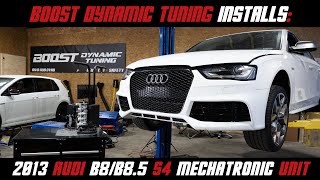
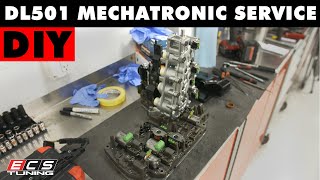
- Disassemble the mechatronics unit on a clean bench to replace the internal sensor module/circuit board (often sold as a kit, P/N 0B5398009F 🎬 See these helpful tips for using the mechatronic repair kit).
- After reassembly, the transmission must be refilled with the correct specification ATF fluid to the precise level at a specific temperature (30-40°C). A basic settings/adaptation procedure must then be performed with a diagnostic tool.
Parts You'll Likely Need
- Mechatronics Repair Kit (Sensor Module/PCB)
(OEM #0B5398009F)— This is the component that fails internally, causing the P0501 code. This kit contains the printed circuit boards with the integrated speed sensors. The main PCB itself is often part number 0B5927156K or a later revision.
Trusted brands: Audi Genuine Parts
OEM price range: $700-$950
Aftermarket price range: $500-$700 - Transmission Pan Gasket
(OEM #0B5321371F)— This must be replaced anytime the transmission pan is removed for the mechatronics repair.
Trusted brands: Audi Genuine Parts, Elring
OEM price range: $50-$80
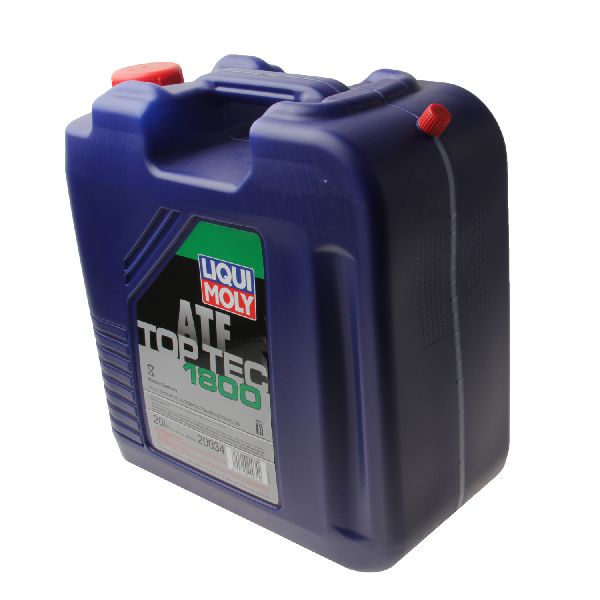
Aftermarket price range: $30-$50 - S-Tronic Transmission Fluid (ATF)
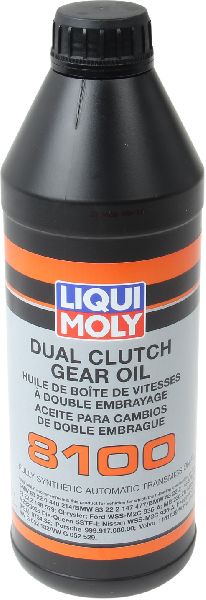
(OEM #G052529A2)— The DL501 has two fluid chambers. The ATF (Automatic Transmission Fluid) side for the mechatronics and clutches must be drained for this repair. Approximately 7 liters are needed.
Trusted brands: Audi Genuine Parts, Pentosin FFL-2, Liqui Moly 8100
OEM price range: $30-$40 per liter
Aftermarket price range: $20-$30 per liter - S-Tronic Gear Oil (MTF)
(OEM #G052513A2)— While not strictly required for the mechatronics repair, many owners choose to service the separate gear oil (MTF - Manual Transmission Fluid) side of the transmission at the same time. This chamber holds the differentials and gears. Approx 4.5 liters are needed.
Trusted brands: Audi Genuine Parts
OEM price range: $40-$55 per liter
Aftermarket price range: $25-$40 per liter - External Transmission Filter
(OEM #0B5325330A)— This filter for the ATF circuit should be replaced during the service.
Trusted brands: Audi Genuine Parts, Mahle
OEM price range: $80-$120
Aftermarket price range: $40-$70
Related Codes That Often Appear With This One
- P2159 — Vehicle Speed Sensor 'B' Range/Performance. This code is often logged with P0501 as they relate to the same internal sensor module (G676) within the transmission, as noted in TSB A351619 2032211-.
- P0716 — Input/Turbine Speed Sensor 'A' Circuit Range/Performance. This is another sensor on the same internal circuit board, and its failure is commonly associated with P0501.
- P2765 — Input/Turbine Speed Sensor 'B' Circuit. Like the others, this points to a failure of the integrated sensor module inside the S-Tronic mechatronics unit.
- P179E — Drive Position Sensor Electrical Error. This is another fault related to the mechatronics unit that can appear alongside speed sensor codes, indicating a broader failure of the internal electronics.
Technical Service Bulletins (TSBs) & Recalls
- A351619 2032211- (and its revisions like 2032211/4, /5): Gearbox warning light on, with DTCs P0501, P2159, P0716, P2765 and others, caused by a faulty internal sensor module (G676) on the printed circuit board in the S-Tronic transmission.
Platform-Specific Known Issues
- The 2010-2014 Audi S4 is equipped with the DL501 (0B5) 7-speed S-Tronic dual-clutch transmission, which is known for mechatronics failures.
- Audi released TSB A351619 2032211- specifically addressing this issue, which lists P0501 as a key fault code pointing to the internal sensor module. This TSB is the primary diagnostic guide for this problem.
- Owner experiences on forums like AudiWorld and Audizine show dealer repair quotes ranging from $3,000 to over $7,000 for a full mechatronics unit replacement, while independent shops using a repair kit can perform the job for significantly less.
Mechanic-Grade Diagnostic Values
- Resistance of VFS Clutch Solenoids (N436, N440) — expected: 4.8 Ω (± 0.1 Ω) at 25°C; 5.4 Ω (± 0.1 Ω) at 70°C. Failure: Readings outside of this range indicate a failing solenoid coil.
- Resistance of Clutch Oil Pressure Solenoids (N435, N439) - Gen 1 — expected: 16.0 Ω (± 0.1 Ω) at 25°C; 18.6 Ω (± 0.1 Ω) at 70°C. Failure: Readings outside of this range indicate a failing solenoid coil. Note that Gen 2 valve bodies have different values.
- Resistance of Main Pressure & Cooling Solenoids (N472, N471) — expected: 4.2 Ω (± 0.1 Ω) at 25°C; 4.8 Ω (± 0.1 Ω) at 70°C. Failure: Readings outside of this range indicate a failing solenoid coil.
- Resistance of Transmission Temperature Sensor (G509) — expected: ~1.13 kΩ at 30°C; ~1.38 kΩ at 100°C. Failure: A significant deviation from these values suggests a faulty temperature sensor, which can affect shifting behavior.
Hidden / Shadow Codes Worth Checking
- DFCC 8098: This is an Audi-specific Diagnostic Fault Code Context number that is displayed with the main P-code. For TSB A351619 2032211- to apply, P0501 must be accompanied by DFCC 8098. (see via Advanced Audi-specific scan tools like VCDS or ODIS will display the DFCC code alongside the primary DTC.)
Scan Tool Commands That Help
- VCDS (or equivalent like ODIS): Basic Settings: Erase counter for start and stop processes — This is one of the first steps in the adaptation procedure after replacing the mechatronics repair kit. It resets learned values.
- VCDS (or equivalent like ODIS): Basic Settings: Clutch valve calibration — This must be run with the engine on, after replacing mechatronics components, to calibrate the new valves.
- VCDS (or equivalent like ODIS): Basic Settings: Distance sensor calibration — This calibrates the gear selector distance sensors. Clunking noises from the transmission are normal during this process.
- VCDS (or equivalent like ODIS): Basic Settings: Clutch engagement point adaptation — This is the final step, where the car is driven to allow the TCU to learn the 'kiss point' of the new clutches/components for smooth takeoffs.
Wiring & Ground Locations
- T16r Gearbox Connector — The main round electrical connector on the transmission housing.. This is the single point of communication and power for the entire mechatronics unit. Corrosion or pin damage here can cause P0501 and many other faults. A partial pinout includes Pin 9 for CAN Low.
Real Owner Repair Stories
- DIY forum post on 'Nihalot.com' (Audi Q5 with 0B5/DL501 Transmission) — Not specified, but involved mechatronic failure.
❌ Tried (didn't work) The owner noted that simply replacing the internal harness with a new Audi part would likely lead to the same failure over time.
✅ What actually fixed it The owner diagnosed a failure of the plastic wiring harness inside the mechatronic unit where the plastic had become conductive. They built a custom, more robust wiring harness using high-temperature wires to replace the faulty factory part. The car was reported to be running fine 2000km after the repair. - YouTube channel 'Arkeyfix' (2013 Audi S5 (with DL501 transmission)) — "Transmission Malfunction" message on the dash, with codes pointing to the G676 sensor.
❌ Tried (didn't work) The videos document the diagnostic and repair process, not a series of failed attempts.
✅ What actually fixed it The owner performed a complete DIY replacement of the G676 sensor, which is part of the same assembly that causes P0501. This required full transmission disassembly to access the sensor located in the rear casing, demonstrating the complexity of the job.
OEM Part Supersession History
0B5398009A, 0B5398009B, 0B5398009C, 0B5398009D, 0B5398009E→0B5398009F— The part has been revised multiple times by Audi, likely to improve the durability of the internal printed circuit boards and wiring that are known to fail from heat and vibration.
Model Year Variations Within This Range
- 2010-2012 (B8) vs 2013-2014 (B8.5): The earlier B8 models are more prone to mechatronics failure. The B8.5 models (2013+) received updated mechatronics components and revised circuit boards, making them less susceptible to this specific failure, although it can still occur.
Helpful Videos

We Have This Part in Stock




The information in this article is provided for general reference and educational purposes only. Vehicle specifications, procedures, and part compatibility can vary by production date, trim level, and region. Always consult your vehicle's factory service manual and verify part numbers before purchasing or performing repairs. Safety-critical components such as airbags, seat belts, and braking systems should be installed by a qualified professional.
- Audi S4:
- 🧭 Diagnostic Flowchart
- 🎬 Helpful Videos
- 🛍️ Shop This Part
- What's Unique About the 2010-2014 Audi S4
- Symptoms You May Notice
- Most Likely Causes
- Rare But Worth Checking
- Diagnosis Steps
- Parts You'll Likely Need
- Related Codes That Often Appear With This One
- Technical Service Bulletins (TSBs) & Recalls
- Platform-Specific Known Issues
- Mechanic-Grade Diagnostic Values
- Hidden / Shadow Codes Worth Checking
- Scan Tool Commands That Help
- Wiring & Ground Locations
- Real Owner Repair Stories
- OEM Part Supersession History
- Model Year Variations Within This Range
- 🎟️ Get 5% Off