

P0501 on 2009-2014 Ford F-150: Vehicle Speed Sensor Range/Performance Explained
On a 2009-2014 Ford F-150, code P0501 is most often caused by a failed Output Shaft Speed (OSS) sensor, which is part of the internal transmission molded lead frame. This is a complex repair requiring transmission pan removal. A less common cause is a faulty ABS wheel speed sensor.
- For the 2009-2014 F-150, P0501 is very often caused by a failed molded lead frame inside the 6R80 transmission.
- This is not a simple external sensor swap; it requires removing the transmission pan and valve body.
- A key symptom is a sudden, dangerous downshift to first gear, which prompted multiple recalls.
- Always check for ABS codes first, as a faulty wheel speed sensor is a less common but possible cause.
- Check your VIN for open recalls or extended warranties before paying for the repair.
What's Unique About the 2009-2014 Ford F-150
Unlike earlier F-150s that had an easy-to-access external speed sensor, the 2009-2014 models with the 6-speed 6R80 automatic transmission have the critical Output Shaft Speed (OSS) sensor integrated into a component called the molded lead frame. This lead frame is located inside the transmission oil pan and is attached to the valve body, making its replacement a significantly more involved and costly repair. This design is a well-documented failure point, leading to several recalls for sudden, dangerous downshifts.
Symptoms You May Notice
- Erratic or non-functional speedometer
- Harsh, delayed, or unpredictable automatic transmission shifting
- Sudden, unexpected downshift to first gear, even at high speeds
- Check Engine Light illuminated
- ABS and/or Traction Control warning lights illuminated
- Cruise control not working
- Wrench light illuminated on the dashboard
- Replacing only an external speed sensor, which this vehicle does not use for the primary speed reading.
- Replacing the instrument cluster to fix the speedometer without first diagnosing the sensor inputs.
- Assuming the transmission itself has failed mechanically when the issue is electronic (the lead frame).
Most Likely Causes
- Failed Molded Lead Frame (Internal OSS Sensor) 🔴 High Probability → Shop Transmission Valve Body The 6R80 transmission's internal lead frame, which houses the Output Shaft Speed (OSS) sensor, is a known high-failure part, leading to multiple Ford recalls and customer satisfaction programs. The issue was prevalent enough that Ford extended the warranty on this specific part for certain model years.
How to confirm: A professional scan tool can monitor the Output Shaft Speed (OSS) PID. If the signal drops out, is erratic, or doesn't match wheel speed sensor data, the lead frame is the likely culprit. Often accompanied by codes P0720 or P0722.
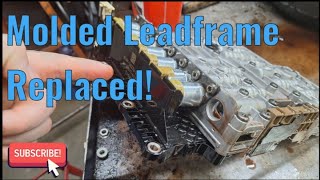
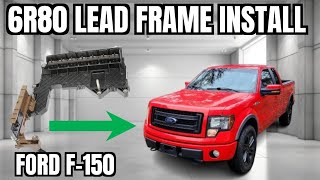
Typical fix: Replace the entire molded lead frame assembly inside the transmission. This involves draining the fluid, dropping the transmission pan, and removing the valve body to access the part. The bulkhead sleeve connector seal should also be replaced at the same time. 🎬 Watch: Step-by-step 6R80 lead frame replacement tutorial
Est. part cost: $150-$300 - Faulty ABS Wheel Speed Sensor 🟡 Medium Probability → Shop ABS Wheel Speed Sensor
How to confirm: Scan the ABS module for codes. A specific wheel speed sensor code (e.g., C0035) alongside P0501 strongly points to that sensor being the root cause. Use a scan tool to graph the output of all four wheel speed sensors while driving to identify the one that is dropping out or reading incorrectly.
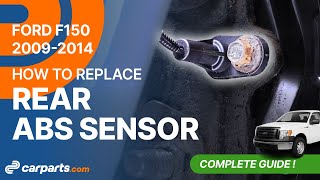
Typical fix: Replace the faulty wheel speed sensor at the corresponding wheel hub. 🎬 See how to replace the rear ABS sensor
Est. part cost: $40-$80 - Damaged Wiring or Connectors ⚪ Low Probability Wiring to the wheel speed sensors is exposed to road debris, moisture, and potential physical damage.
How to confirm: Visually inspect the wiring harnesses leading to each wheel speed sensor and the main transmission connector for any signs of fraying, corrosion, or damage. Perform a continuity and resistance test on the sensor circuits.
Typical fix: Repair or replace the damaged section of the wiring harness or the connector.
Est. part cost: $20-$100
Rare But Worth Checking
- Damaged ABS Tone Ring: A cracked, rusted, or debris-covered tone ring on the axle or wheel hub can cause an erratic signal from the wheel speed sensor, triggering a P0501 code.
- Faulty Powertrain Control Module (PCM): → Shop Engine Control Module (ECM) This is extremely rare and should only be considered after all other possibilities, including sensors and wiring, have been exhaustively tested and ruled out.
Diagnosis Steps
- Scan for all codes in both the PCM and the ABS control module. Note any codes that accompany P0501.
- If ABS codes are present, diagnose the specific wheel speed sensor indicated by the code first. Inspect its wiring and connector.
- If no ABS codes are present, use a scan tool with live data capability to monitor the Vehicle Speed (VSS) and Output Shaft Speed (OSS) PIDs.
- Compare the scan tool speed reading to the vehicle's speedometer and a GPS-based speed app on a phone.
- If the speed reading is erratic or drops to zero while driving, the issue is likely with the OSS sensor in the transmission lead frame. 🎬 Watch: How to test a bad speed sensor
- Visually inspect the wiring harnesses to all four wheel speed sensors for any obvious damage.
- If the lead frame is suspected, confirm with a technician, as replacement is an involved process. Check for open recalls or customer satisfaction programs related to this part before authorizing repair.
Parts You'll Likely Need
- Transmission Molded Lead Frame Assembly
(OEM #AL3Z-7G276-D)— This is the most common failure point on the 6R80 transmission that causes P0501. It contains the integrated Output Shaft Speed (OSS) sensor.
Trusted brands: Motorcraft, Dorman
OEM price range: $200-$300
Aftermarket price range: $150-$250 - ABS Wheel Speed Sensor — A faulty wheel speed sensor can provide conflicting data to the PCM, triggering the P0501 code.
Trusted brands: Motorcraft, Bosch, Standard Motor Products
OEM price range: $60-$100
Aftermarket price range: $40-$80
Related Codes That Often Appear With This One
- P0720 — Output Speed Sensor Circuit Malfunction. This code directly points to an issue with the OSS sensor circuit, which is part of the lead frame.
- P0722 — Output Speed Sensor No Signal. This indicates a complete loss of signal from the OSS sensor, also pointing to a failed lead frame.
- C0035 - C0050 — These are ABS codes that point to a fault in a specific wheel speed sensor circuit. If one of these is present with P0501, the ABS sensor is the most likely cause.
Platform-Specific Known Issues
- Ford Safety Recalls: Ford issued recalls (e.g., NHTSA Campaign 16V-248, also known as Ford recall 16S19) for 2011-2012 F-150s due to the OSS sensor on the lead frame failing, which could cause an abrupt downshift to first gear at any speed, potentially causing a loss of vehicle control. The dealer fix often involves a PCM software update to prevent the downshift and, if necessary, replacement of the lead frame. Ford also extended warranty coverage on the lead frame for certain vehicles under Customer Satisfaction Program 16N02.
Mechanic-Grade Diagnostic Values
- ABS Wheel Speed Sensor Resistance — expected: Typically between 800 and 2,500 Ohms, but the key is that sensors on the same axle should have very similar readings.. Failure: A reading of infinite resistance (open circuit) or a value significantly different from the sensor on the opposite wheel.
- ABS Wheel Speed Sensor AC Voltage Output — expected: Should generate an AC voltage signal that increases with wheel speed. A reading above 100 millivolts (0.1V AC) while spinning the wheel by hand is a good indicator.. Failure: No AC voltage produced when the wheel is spun, or a very weak/erratic signal.
Scan Tool Commands That Help
- Ford IDS / FORScan: PID Data Monitoring (OSS_SRC) — During a test drive, monitor the Output Shaft Speed (OSS) PID. An erratic signal, or one that drops to zero unexpectedly while the vehicle is in motion, is a primary confirmation of a failing sensor on the molded lead frame before removing the transmission pan.
- Ford IDS / FORScan: Clear Transmission Adaptive Tables — This must be performed after replacing the molded lead frame or valve body. It resets the transmission's learned shift strategies, allowing it to adapt to the new components and ensure smooth shifting.
- Ford IDS / FORScan: ABS Module Self-Test — This command forces the ABS module to check all its inputs and outputs. It's useful after replacing a wheel speed sensor to confirm the repair and ensure no other faults are present in the ABS system.
Wiring & Ground Locations
- G104 — On the passenger side fender, behind the battery.. A poor ground at this location can cause a variety of electrical issues in the engine bay, potentially affecting sensor readings and module communication.
- G202 / G203 — Located behind the passenger side kick panel, near the Central Junction Box (fuse box).. These are major interior grounds. Corrosion or looseness here is a known issue that can cause bizarre electrical behavior, including problems with modules that process speed sensor data.
- Transmission Bulkhead Connector (C175T) — The main electrical connector on the passenger side of the 6R80 transmission case.. This is the pass-through for all internal transmission electronics, including the OSS sensor signal from the lead frame. The OSS signal wire (typically Brown/Green) is at pin 14. Checking for a clean signal here can differentiate between an internal (lead frame) and external (wiring/PCM) problem.
Real Owner Repair Stories
- TexAgs forum user '1agswitchin4lanes' (2013 Ford F-150 5.0L) — Wrench light and check engine light illuminated, speedometer intermittently stops working, code P0720 stored (often precedes or accompanies P0501).
❌ Tried (didn't work) The user went straight to investigating the known common cause rather than trying other fixes first.
✅ What actually fixed it The user identified that the symptoms and code were covered under Ford's extended warranty (19N01) for the molded lead frame. The confirmed fix was dealer replacement of the lead frame and a simultaneous software update recall to prevent future sudden downshifts. - NHTSA ODI #11449362 — An owner reported that after a PCM reprogram failed to resolve issues, the transmission slammed hard and triggered code P0501. The owner noted the vehicle was within the guidelines for the Customer Satisfaction Program (CSP) for the lead frame.
OEM Part Supersession History
AL3Z-7G276-A, AL3Z-7G276-B→AL3Z-7G276-D— Revision to improve durability and address the high failure rate of the integrated sensors and circuitry.
Heads up: The 'D' revision is the latest and most reliable version and is backward compatible with earlier models within the 2009-2014 range that use this style of lead frame.
Model Year Variations Within This Range
- 2011-2014: For the 2011 model year, Ford updated the 6R80 transmission. A key change was removing the Transmission Control Module (TCM) from the lead frame assembly inside the pan and integrating its functions into the main Powertrain Control Module (PCM). This simplified the lead frame but also coincided with the period where lead frame failures became a more prominent issue.
- 2009-2010: The earliest 6R80 transmissions in this generation (2009-2010) used a more complex lead frame assembly, often called a Mechatronic unit, which had the TCM integrated onto it. While these can still fail, the specific widespread failure pattern and recalls are more commonly associated with the 2011+ non-TCM lead frame design.
Diagnostic Flowchart
Other Known Issues on This Vehicle
Issues unrelated to this code that are worth knowing about as an owner of this generation:
- Electronic Throttle Body (ETB) Failure 🔴 High — Common across all engines of this generation. Can cause sudden 'limp mode' where the truck loses power.
- Rear Window Defroster Failure 🟠 Medium — Widespread issue where the rear defroster stops working, often due to a broken connection in the sliding rear window assembly. In some cases, the window can shatter when the defroster is activated in cold weather.
- Electronic Power Assist Steering (EPAS) Failure 🔴 High — Affects 2011-2014 models. Can result in a sudden loss of power steering, making the vehicle very difficult to steer. A recall (14S09) was issued for a small batch of 2014 models, but failures are reported on other years as well. (Ref: NHTSA 14V316000)
- 5.0L V8 Engine Knock / Misfire 🟠 Medium — Some early 2011-2012 5.0L engines had issues with out-of-round cylinders causing a knock. Later 2011-2014 models can suffer from excessive intake valve wear, leading to misfires.
- 5.4L 3V Cam Phaser / Timing Chain Issues 🔴 High — A carry-over issue for the 2009-2010 models with the 5.4L Triton V8. Can cause rattling noises, rough idle, and eventually engine failure if not addressed.
- Aluminum Hood/Body Panel Corrosion 🟡 Low — Corrosion and bubbling paint can appear on aluminum body panels, particularly the hood. Ford addressed this with TSB 16-0028. (Ref: TSB 16-0028)
Used vs. New Parts: Buying Guide for This Vehicle
When a used part is the smart pick: For this specific repair, using a used part is almost never a good idea. The primary cause, the molded lead frame, has a very high failure rate, and a used part is likely to fail again. A used ABS wheel speed sensor from a low-mileage, non-corroded donor vehicle could be a viable budget option, but new sensors are inexpensive enough that it's usually not worth the risk.
Donor-vehicle mileage cap: roughly under 50000 miles for the part to have meaningful remaining life.
What to inspect on the donor part:
- For an ABS sensor, ensure the wiring pigtail is not brittle, cracked, or repaired.
- Check the sensor head for physical damage or excessive corrosion.
- Verify the donor vehicle has no stored ABS codes.
OEM-only on this vehicle (don't cheap out):
- Transmission Molded Lead Frame
Aftermarket brands forum-validated for this vehicle:
- Motorcraft (for all parts)
- Bosch (for ABS sensors)
- Standard Motor Products (for ABS sensors)
Brands owners have reported issues with on this vehicle:
- Dorman (for the molded lead frame) - Some owners have reported premature failure of aftermarket lead frames, requiring the labor-intensive job to be done a second time. While Dorman offers many quality parts, for this specific high-failure, high-labor component, OEM is the safest choice.
Real Owner Stories
Aggregated from forums and TSBs cited above. Mileages and costs reflect what owners reported in those sources.
2014 Ford F-150
Symptoms: Owner sought quotes for a molded lead frame replacement.
What fixed it: Replacement of the molded lead frame.
Cost: $1082.72-$1082.72
Source hint: f150forum.com: 'What has everyone paid for a molded lead frame replacement?'
2013 Ford F-150 — 99000 miles
Symptoms: Owner discussed proactive replacement of the lead frame to avoid failure.
What fixed it: Proactive replacement of the lead frame.
Cost: $900-$900
Source hint: CarKiller.com: 'Ford F150 6R80 Lead Frame TSB'
2011-2012 Ford F-150
Symptoms: Abrupt downshift to first gear at any speed, potentially causing a loss of vehicle control.
What fixed it: PCM software update to prevent the downshift and replacement of the lead frame if necessary.
Source hint: Ford Safety Recall 16S19 (NHTSA Campaign 16V-248)
Ford F-150
Symptoms: An owner reported that their transmission slammed really hard and the check engine light came on with code P0501 after a PCM reprogram failed to fix the issue.
What fixed it: The owner identified the issue was within the guidelines of the 10-year Customer Satisfaction Program for the lead frame.
Source hint: NHTSA ODI #11449362
Related OBD-II Codes
Frequently Asked Questions
Is there a recall for the 2011-2012 F-150 regarding the speed sensor and sudden downshifting?
Does Ford offer any extended warranty for the transmission lead frame on my F-150?
Can I use a Dorman brand lead frame to fix my P0501 code?
What is the estimated cost to have a dealer replace the lead frame on a 2013-2014 F-150?
My speedometer is erratic and the wrench light is on; could this be the lead frame?
If I have P0501 and an ABS code like C0035, which should I fix first?
Helpful Videos

We Have This Part in Stock

The information in this article is provided for general reference and educational purposes only. Vehicle specifications, procedures, and part compatibility can vary by production date, trim level, and region. Always consult your vehicle's factory service manual and verify part numbers before purchasing or performing repairs. Safety-critical components such as airbags, seat belts, and braking systems should be installed by a qualified professional.
- Ford F-150:
- 🧭 Diagnostic Flowchart
- 🎬 Helpful Videos
- 🛍️ Shop This Part
- What's Unique About the 2009-2014 Ford F-150
- Symptoms You May Notice
- Most Likely Causes
- Rare But Worth Checking
- Diagnosis Steps
- Parts You'll Likely Need
- Related Codes That Often Appear With This One
- Platform-Specific Known Issues
- Mechanic-Grade Diagnostic Values
- Scan Tool Commands That Help
- Wiring & Ground Locations
- Real Owner Repair Stories
- OEM Part Supersession History
- Model Year Variations Within This Range
- Other Known Issues on This Vehicle
- Used vs. New Parts: Buying Guide for This Vehicle
- Real Owner Stories
- 2014 Ford F-150
- 2013 Ford F-150 — 99000 miles
- 2011-2012 Ford F-150
- Ford F-150
- Related OBD-II Codes
- Frequently Asked Questions
- 🎟️ Get 5% Off