

P0501 on 2001-2005 Honda Civic 1.7L CTDi: VSS vs ABS Fault Guide
For the 2001-2005 Honda Civic with the 1.7L Isuzu diesel engine (4EE-2/CTDi), code P0501 most often indicates a fault with the front left ABS wheel speed sensor, not a transmission-mounted Vehicle Speed Sensor (VSS). The ECU uses the ABS signal to determine vehicle speed. The issue is typically the sensor itself, the wiring, or the magnetic ring on the wheel bearing. On rare models without ABS, a traditional transmission-mounted VSS is the cause.
- **DIESEL-SPECIFIC INFO:** For the 1.7L CTDi engine, P0501 is most likely an ABS system fault, not a transmission sensor fault.
- Always scan the ABS module for codes in addition to the engine module. A wheel speed sensor code will pinpoint the problem.
- The front left ABS sensor is the most likely culprit. Inspect its wiring and connector carefully for damage before replacing the sensor.
- Only on rare, non-ABS versions of this car would the cause be the traditional Vehicle Speed Sensor (VSS) on the transmission.
- Symptoms include a dead or bouncing speedometer, no cruise control, and an illuminated ABS light.
What's Unique About the 2001-2005 Honda Civic
This guide is for the 7th generation Honda Civic with the Isuzu-sourced 4EE-2 1.7L CTDi diesel engine, primarily sold in Europe and other markets outside North America. Unlike the gasoline-powered models of the same generation which use a dedicated Vehicle Speed Sensor (VSS) on the transmission, this diesel variant most commonly derives its road speed signal from the front left ABS wheel speed sensor. Therefore, diagnosing P0501 requires inspecting the ABS system first. Only rare, base models without ABS would have a traditional VSS on the transmission. This is a critical distinction from the more widely documented gasoline engine repair procedures.
Symptoms You May Notice
- Inoperative or erratically bouncing speedometer needle
- Check Engine Light is on
- ABS warning light is on
- Cruise control does not work
- Odometer may not be working
- Harsh or improper shifting on the rare automatic transmission models
- Replacing the transmission-mounted VSS on a vehicle equipped with ABS, when the actual fault lies with an ABS wheel speed sensor.
- Replacing the entire instrument cluster before checking the ABS system and wiring.
- Assuming the transmission itself has failed mechanically due to a speed signal issue.
Most Likely Causes
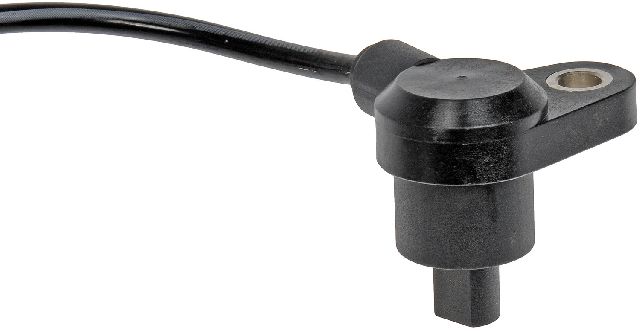
- Faulty ABS Wheel Speed Sensor (Front Left) 🔴 High Probability → Shop ABS Wheel Speed Sensor The speed signal for the ECU originates from the ABS system on this platform. The front left sensor is the primary input. These sensors are exposed to the elements and can fail due to contamination, internal shorts, or physical damage.
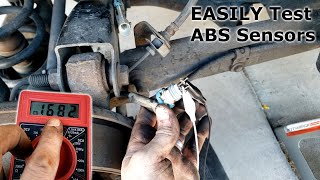
How to confirm: Scan the ABS control module for codes. A code for the front left wheel speed sensor is a strong confirmation. Test the sensor's resistance and signal output with a multimeter while spinning the wheel. 🎬 Watch: How to test ABS sensor resistance and AC voltage
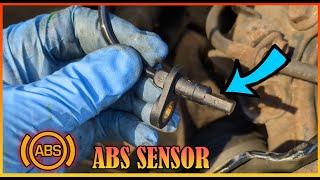
Typical fix: Replace the front left ABS wheel speed sensor. Ensure the hub's magnetic encoder ring is clean and undamaged. 🎬 See this step-by-step Honda Civic ABS sensor replacement
Est. part cost: $30-$90 - Damaged Wiring or Corroded Connector to ABS Sensor 🟡 Medium Probability The wiring harness leading to the wheel hub is subject to constant movement and exposure to road debris, water, and salt, which can cause wires to break or connectors to corrode.
How to confirm: Visually inspect the wiring from the ABS sensor up into the engine bay for breaks, chafing, or corrosion at the connector plugs. Perform a continuity test on the wires from the sensor plug to the ABS module connector.
Typical fix: Repair the broken wire or replace the corroded connector pigtail. Clean the terminals thoroughly.
Est. part cost: $15-$40 - Failed Vehicle Speed Sensor (VSS) on Transmission (Non-ABS models only) ⚪ Low Probability → Shop Drive Shaft Sensor On the very rare models without ABS, a traditional transmission-mounted VSS is used. Like on the gasoline models, this is a known failure point due to age and heat cycles.
How to confirm: Confirm the vehicle does not have ABS. Locate the sensor on the transmission. Unplug it; if the speedometer stops bouncing, the sensor is faulty. Test sensor output with a multimeter.
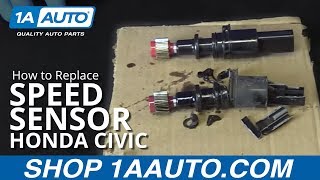
Typical fix: Replace the Vehicle Speed Sensor on the transmission. 🎬 Watch: How to replace the transmission-mounted speed sensor
Est. part cost: $20-$60 - Blown Fuse ⚪ Low Probability
How to confirm: Check fuses related to the ABS and instrument cluster in the under-dash and under-hood fuse boxes. On some Honda models, fuse #15 (7.5A) in the under-dash box is related to the VSS circuit.
Typical fix: Replace the blown fuse. If it blows again, there is a short circuit in the wiring that must be found and repaired.
Est. part cost: $1-$5
Rare But Worth Checking
- Faulty ABS Control Module: The ABS module itself can fail, preventing it from sending a valid speed signal to the ECM. This is uncommon and should be considered only after sensors and wiring are confirmed to be good.
- Damaged Wheel Bearing/Encoder Ring: The ABS sensor reads off a magnetic encoder ring that is often integrated into the wheel bearing or hub. If this ring is cracked, damaged, or heavily rusted, it can produce an erratic signal.
- Faulty Instrument Cluster: The instrument cluster can sometimes fail internally, causing it to process the speed signal incorrectly. This is rare and should only be considered after the sensors, wiring, and ABS module have been ruled out.
- Faulty ECM: An internal failure of the Engine Control Module is very rare but possible. This is the last resort after all other possibilities have been exhausted.
Diagnosis Steps
- Read codes from both the Engine Control Module (ECM) and the ABS Control Module with a capable OBD-II scanner. Note if any ABS sensor codes are present alongside P0501.
- Observe the speedometer while driving. Note if it is dead, reads inaccurately, or bounces erratically.
- If ABS codes are present (especially for the front left wheel), locate the corresponding ABS wheel speed sensor at the wheel hub.
- Visually inspect the sensor and its wiring harness for any signs of physical damage, chafing, or corrosion at the connector.
- Inspect the wheel bearing and hub area for excessive rust or damage to the sensor's magnetic encoder ring.
- If no obvious damage is found, test the resistance of the suspect ABS sensor and compare it to specifications. Test for a signal while spinning the wheel.
- If the vehicle is confirmed to NOT have ABS, locate the Vehicle Speed Sensor (VSS) on the transmission housing and inspect its wiring and connector for corrosion, which is a common failure point.
- Check relevant fuses for the ABS system and instrument panel in the fuse boxes.
- If a sensor and its wiring test good, the fault may lie with the ABS control module or, more rarely, the instrument cluster or ECM.
Parts You'll Likely Need
- ABS Wheel Speed Sensor (Front Left)
(OEM #57455-S5D-013)— On models with ABS, this sensor is the source of the vehicle speed signal for the ECU. Its exposed location makes it the most common failure point for P0501.
Trusted brands: Bosch, NTK, Delphi
OEM price range: $120-$180
Aftermarket price range: $30-$90
Related Codes That Often Appear With This One
- ABS-specific codes (e.g., for front left wheel speed sensor circuit)
Platform-Specific Known Issues
- On gasoline models, the VSS is held in by a single 10mm or 12mm bolt that can be difficult to access without removing the air intake. The bolt can sometimes seize and break during removal.
- A common point of failure is corrosion inside the VSS or ABS sensor electrical connector, sometimes causing a pin to break off inside the plug.
Mechanic-Grade Diagnostic Values
- Front ABS Wheel Speed Sensor Resistance — expected: 800 - 1,700 Ohms (Ω). A common reading is around 1.5 kΩ.. Failure: A reading of 0 Ohms indicates a short circuit. An infinite or 'OL' reading indicates an open circuit (broken wire). A reading outside the specified range suggests a faulty sensor coil.
- Front ABS Wheel Speed Sensor AC Voltage Output — expected: A pulsing AC voltage that increases in frequency and amplitude as the wheel is spun faster. The exact voltage is less important than its presence and correlation with wheel speed.. Failure: No AC voltage signal when the wheel is spinning indicates a dead sensor or a large air gap.
- ABS Wheel Speed Sensor Air Gap — expected: 0.4 - 1.0 mm (0.016 - 0.039 inches) between the sensor tip and the encoder ring.. Failure: An excessive gap can cause a weak or non-existent signal. Contact between the sensor and ring will cause damage.
Scan Tool Commands That Help
- Honda HDS (or equivalent professional scanner): Live Data Monitoring / Data List — Use this function to view the vehicle speed as reported by each of the four wheel speed sensors in real-time while driving. This is the most effective way to confirm if the front left sensor is dropping out, reading erratically, or not matching the other sensors.
Wiring & Ground Locations
- G305 — The specific location for the 7th gen Civic is not pictured, but main body grounds are typically found on the chassis rails in the engine bay or behind interior kick panels.. This is the primary ground point for the ABS control unit. A corroded or loose connection here can cause a variety of ABS faults, including an inability to communicate or send a valid speed signal to the ECM.
- G101 — Typically located on or near the thermostat housing on the engine.. This is a critical logic ground for the PCM/ECM. A poor connection here can cause numerous seemingly unrelated engine codes and performance issues, potentially including incorrect processing of the VSS signal.
- ABS Module Connector — The ABS modulator-control unit is located in the engine bay, typically on the passenger side firewall.. The signal wire from the front left ABS sensor terminates here. On similar Honda models, the signal wire for the front left sensor is often Brown (BRN). Testing for the AC signal at this connector pin can determine if the fault is in the wiring or the sensor itself.
OEM Part Supersession History
57455-S5D-003→57455-S5D-013— Part revision or manufacturer change.
Heads up: These parts are generally interchangeable for the specified vehicle. However, some sources indicate 57455-S5D-013 is now discontinued, making aftermarket or New Old Stock (NOS) the primary options.
Diagnostic Flowchart
Other Known Issues on This Vehicle
Issues unrelated to this code that are worth knowing about as an owner of this generation:
- Premature Turbocharger Failure 🔴 High — Very common on the 1.7L CTDi engine. Failures were so frequent that Honda reportedly extended the warranty on the turbo for a period. Can occur at various mileages. (Ref: No official recall found, but warranty extension was widely reported by owners.)
- Dual Mass Flywheel (DMF) Failure 🔴 High — Common on manual transmission models, typically after 80,000 miles. Symptoms include a rattling/knocking noise at idle or when shutting off the engine, clutch pedal vibration, and shuddering on takeoff.
- EGR Valve Carbon Buildup 🟠 Medium — The EGR valve and passages can become clogged with carbon, leading to poor performance, hesitation, and EGR-related fault codes (like P0401). Cleaning is often required.
- Crankshaft Position Sensor Failure 🟠 Medium — Can fail and cause the engine to cut out intermittently, often after 10-20 minutes of driving. This will typically set a P1331 code.
Used vs. New Parts: Buying Guide for This Vehicle
When a used part is the smart pick: For this repair, a used part is generally not recommended for the ABS sensor or wheel bearing due to their exposure to wear and the elements. However, if a rare failure of the ABS Control Module or Instrument Cluster is confirmed, a tested, used unit from a reputable salvage yard is a cost-effective alternative to a new part.
Donor-vehicle mileage cap: roughly under 80000 miles for the part to have meaningful remaining life.
What to inspect on the donor part:
- For a used wheel hub/bearing: Check for any play or roughness when spinning it by hand. Inspect the magnetic encoder ring on the seal for any cracks, dents, or heavy rust.
- For a used sensor/module: Inspect connectors for corrosion, bent pins, or cracks in the housing. Ask the seller if the part has been tested or if it comes from a running vehicle.
- Verify the part numbers match exactly, especially for electronic modules.
OEM-only on this vehicle (don't cheap out):
- No parts are strictly OEM-only, but caution is advised with budget brands for sensors and bearings.
Aftermarket brands forum-validated for this vehicle:
- Bosch
- NTK / NGK
- Delphi
- SKF (for wheel bearings)
- Timken (for wheel bearings)
Brands owners have reported issues with on this vehicle:
- Unbranded, 'white-box' parts from online marketplaces have a high failure rate according to forum discussions.
- Some budget brands like NTY have been reported to have mixed reliability.
Real Owner Stories
Aggregated from forums and TSBs cited above. Mileages and costs reflect what owners reported in those sources.
2001-2005 Honda Civic 1.7L Diesel
Symptoms: The speedometer stopped working or would bounce around erratically while driving.
What fixed it: Unplugging the faulty sensor; if the speedometer stops bouncing, it confirms the sensor is faulty and needs replacement.
Source hint: ScegliAuto.com insight regarding the platform-mate Opel Astra G and speed signal derivation.
2001-2005 Honda Civic 1.7L Diesel
Symptoms: Experienced issues with an aftermarket speed sensor not fitting the vehicle correctly.
What fixed it: Verifying the correct sensor type and ensuring it matches the specific diesel platform requirements.
Source hint: Honda-Tech.com user experiences with VSS failure
Related OBD-II Codes
Frequently Asked Questions
My speedometer is bouncing erratically on my 1.7L diesel Civic; is this likely the transmission sensor?
Is there a specific fuse I should check for P0501 on my Honda Civic?
I heard Honda extended the warranty for parts on the 1.7L CTDi engine; does this cover the speed sensor?
Can I use a speed sensor from a gasoline Civic on my 1.7L diesel model?
Why is my ABS light on at the same time as the P0501 code?
Helpful Videos
We Have This Part in Stock




The information in this article is provided for general reference and educational purposes only. Vehicle specifications, procedures, and part compatibility can vary by production date, trim level, and region. Always consult your vehicle's factory service manual and verify part numbers before purchasing or performing repairs. Safety-critical components such as airbags, seat belts, and braking systems should be installed by a qualified professional.
- Honda Civic:
- 🧭 Diagnostic Flowchart
- 🎬 Helpful Videos
- 🛍️ Shop This Part
- What's Unique About the 2001-2005 Honda Civic
- Symptoms You May Notice
- Most Likely Causes
- Rare But Worth Checking
- Diagnosis Steps
- Parts You'll Likely Need
- Related Codes That Often Appear With This One
- Platform-Specific Known Issues
- Mechanic-Grade Diagnostic Values
- Scan Tool Commands That Help
- Wiring & Ground Locations
- OEM Part Supersession History
- Other Known Issues on This Vehicle
- Used vs. New Parts: Buying Guide for This Vehicle
- Real Owner Stories
- 2001-2005 Honda Civic 1.7L Diesel
- 2001-2005 Honda Civic 1.7L Diesel
- Related OBD-II Codes
- Frequently Asked Questions
- 🎟️ Get 5% Off