

P0502 on 2000-2006 Chevrolet Suburban: Vehicle Speed Sensor Causes and Fixes
On a 2000-2006 Suburban, P0502 almost always means the Vehicle Speed Sensor (VSS) on the transmission or transfer case has failed or its wiring is damaged. Expect to pay $20-$50 for a new sensor, which is a common and straightforward DIY fix. Before buying parts, check that the sensor's connector hasn't been knocked loose by road debris.
- P0502 on your Suburban means the main Vehicle Speed Sensor (VSS) has a problem, not the wheel sensors.
- Before buying parts, get under the truck and check if the sensor's electrical connector on the transmission (2WD) or transfer case (4WD) has simply been knocked loose.
- The most likely fix is replacing the VSS itself, which is an inexpensive part (ACDelco 213-4529) and a very easy DIY job requiring basic hand tools.
- Symptoms are impossible to ignore: your speedometer will read zero and the transmission will shift very hard.
- If a new sensor doesn't fix it, check for damaged wiring, especially near the sensor and also near the MAP sensor on top of the engine as per TSB PIP4409F.
What's Unique About the 2000-2006 Chevrolet Suburban
For the GMT800 platform, which includes the 2000-2006 Suburban, the P0502 code points directly to the output speed sensor on the drivetrain. Unlike many modern vehicles where this code could be ambiguous and relate to ABS wheel speed sensors, on these trucks, the diagnosis is more focused. The sensor's location on the transmission or transfer case makes its wiring vulnerable to road debris, heat, and physical damage, making a simple wiring check a crucial first step. In some cases, the connector can simply be unplugged by road debris, which was the confirmed fix for some owners.
Symptoms You May Notice
- Speedometer reads 0 MPH at all times. 🎬 Watch: How to solve shifting issues and a dead speedometer.
- Harsh, erratic, or delayed automatic transmission shifting, particularly a hard 1-2 shift.
- Check Engine Light is on.
- Cruise control is inoperative.
- ABS or Traction Control warning light may be illuminated.
- Transmission may not shift into the highest gear (overdrive).
- Replacing one or more ABS wheel speed sensors. The P0502 code on this platform specifically refers to the main VSS on the transmission/transfer case, not the wheel sensors.
- Replacing the transmission. While shifting is affected, the problem is almost always the sensor signal that the transmission relies on, not an internal transmission failure.
Most Likely Causes
- Failed Vehicle Speed Sensor (VSS) 🔴 High Probability → Shop Drive Shaft Sensor The sensor is exposed to high heat from the transmission/transfer case and contamination from the road, leading to electronic failure over time. It is a very common replacement part. Some aftermarket sensors have been reported to fail prematurely. Manufacturer service bulletins for other Chevrolet models, such as Bulletin #PI11489B, have noted that P0502 can also be caused by water intrusion into the output speed sensor.
How to confirm: Test the sensor with a multimeter. Resistance across the two pins should be between 976 and 2,354 ohms for a 4WD model. Alternatively, with the meter set to AC volts and the driveshaft spinning, it should generate at least 0.5V. A known good sensor should produce over 6V AC at highway speeds.
Typical fix: Replace the Vehicle Speed Sensor. On 2WD models, it's on the tail housing of the transmission. On 4WD models, it's on the rear of the transfer case.
Est. part cost: $20-$50 - Damaged or Unplugged VSS Connector/Wiring 🟡 Medium Probability The sensor and its wiring are located underneath the truck and are susceptible to being hit by road debris, which can unplug the connector or damage the wires. Several owners have fixed the P0502 code simply by finding and reconnecting a loose VSS connector.
How to confirm: Visually inspect the VSS connector and wiring harness. Ensure the connector is fully seated and look for any signs of chafing, breaks, or corrosion on the wires leading to it. A case study on a Silverado showed a previous shop had swapped the VSS connector with another nearby, causing the code. 🎬 Watch: A case study on misrouted VSS wiring and connectors.
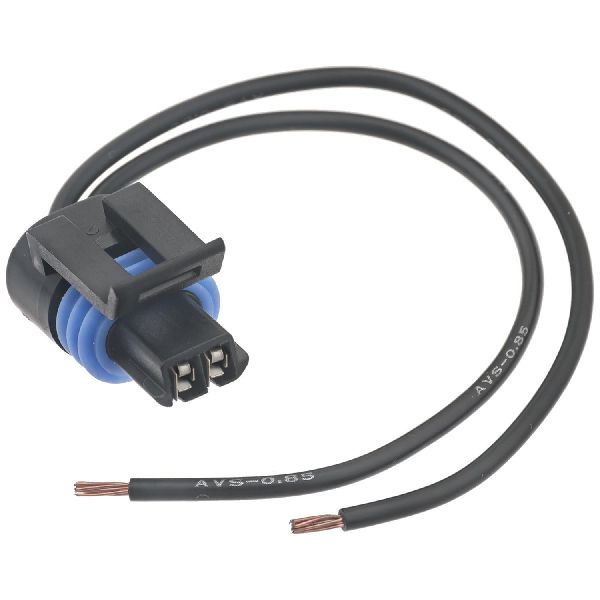
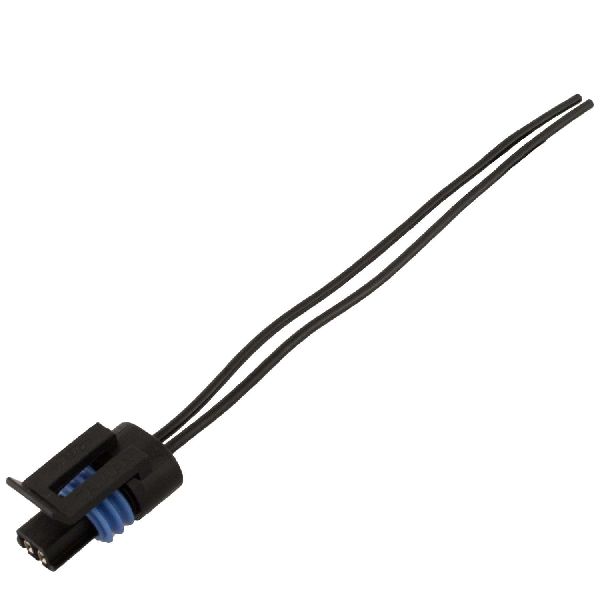
Typical fix: Securely plug the connector back in. If the connector or wiring pigtail is damaged, it will need to be repaired or replaced.
Est. part cost: $15-$30 for a new pigtail connector - Chafed Wiring Harness Near MAP Sensor ⚪ Low Probability GM issued a Technical Service Bulletin (TSB PIP4409F) noting that the engine wiring harness can chafe near the Manifold Absolute Pressure (MAP) sensor, causing a short that can trigger a P0502 code. This bulletin specifically instructs technicians to inspect all MAP sensor circuits for wires being broken inside the insulation near the sensor.
How to confirm: If a new VSS and a check of the VSS wiring do not resolve the issue, inspect the main engine harness in the vicinity of the MAP sensor on the intake manifold for any signs of chafing or damage.
Typical fix: Repair the damaged section of the wiring harness and protect it from future chafing.
Est. part cost: $5-$20 for wiring repair supplies
Rare But Worth Checking
- Faulty Instrument Cluster: → Shop Instrument Cluster The GMT800 platform is known for instrument cluster failures due to bad stepper motors. The cluster acts as a gateway for the VSS signal on some GM vehicles. If you have other gauge-related issues (e.g., erratic fuel or temp gauge), the cluster could be the root cause, though it's less common for P0502 specifically.
- Faulty Powertrain Control Module (PCM): → Shop Engine Control Module (ECM) This is very rare. The PCM's internal circuit for reading the VSS signal can fail. This should only be considered after all other possibilities (sensor, wiring, cluster) have been exhaustively ruled out by testing the signal directly at the PCM connector pins.
- Damaged Reluctor Ring: The VSS reads a toothed ring (reluctor) on the transmission output shaft. In rare cases, especially after transmission work, this ring can be damaged or come loose, preventing the sensor from getting a reading.
Diagnosis Steps
- Read the code with an OBD-II scanner to confirm P0502 is present.
- Get under the vehicle and locate the Vehicle Speed Sensor (VSS). On a 2WD model, it is on the driver's or passenger's side of the transmission's rear tail housing. On a 4WD model, it is on the rear of the transfer case.
- Thoroughly inspect the VSS connector. Ensure it is plugged in securely. A stick or road debris can easily knock it loose. One owner found this was their exact issue.
- Inspect the wiring leading to the sensor for any visible damage, fraying, or melting from contact with the exhaust.
- If wiring looks good, test the sensor. Unplug it and measure resistance across its two pins. A good sensor should read between 976 and 2,354 ohms. If the reading is out of spec, the sensor is bad.
- If the resistance test passes, test the wiring harness. Check for continuity on the two wires (typically purple/white and light green/black) from the VSS connector to the PCM connector.
- If wiring and sensor test good, the most likely cause is a failed VSS that is failing intermittently. Given the low cost, replacement is a reasonable next step.
- Replace the VSS. It is held in by a single bolt (often 10mm or 13mm) or simply screws into the housing. 🎬 See this walkthrough for replacing the vehicle speed sensor. A small amount of transmission fluid may leak out.
- If the problem persists, investigate the wiring harness further up the vehicle, paying special attention to the area near the MAP sensor as noted in TSB PIP4409F.
- As a final, unlikely step, the instrument cluster or PCM would need to be tested by a professional.
Parts You'll Likely Need
- Vehicle Speed Sensor (VSS)
(OEM #ACDelco 213-4529 (replaces 19302667, 213-347))— This is the most common failure point for the P0502 code on this platform. It is an electronic sensor that wears out over time due to heat and vibration.
Trusted brands: ACDelco, Delphi, Standard Motor Products (SMP), Dorman
OEM price range: $40-$60
Aftermarket price range: $20-$40
Technical Service Bulletins (TSBs) & Recalls
- TSB PIP4409F: Notes that a chafed wiring harness near the MAP sensor can cause a P0502 code, along with other seemingly unrelated codes.
- Bulletin #PI1489: An informational bulletin for Chevrolet vehicles providing repair information to correct a Malfunction Indicator Lamp (MIL) illuminated with DTC P0502: Vehicle Speed Sensor (VSS) Circuit Low Voltage.
- Bulletin #PI1489A: Notes that some customers may report an intermittent inability to shift into Reverse when P0502 is set.
Platform-Specific Known Issues
- The location of the VSS on the transmission or transfer case makes its wiring highly susceptible to being damaged or unplugged by road debris.
- The wiring harness for the VSS can be confused with other nearby connectors during transmission service, leading to a P0502 code if plugged in incorrectly.
Mechanic-Grade Diagnostic Values
- VSS AC Voltage Output — expected: Produces a pulsing AC voltage starting at a minimum of 0.5V at 100 RPM and increasing with speed.. Failure: A constant voltage near 0V while the output shaft is spinning.
- PCM Code Trigger Condition — expected: Transmission output speed signal should be > 150 RPM when engine speed is > 3000 RPM in a drive gear.. Failure: The PCM will set code P0502 if it sees transmission output speed < 150 RPM for 2.5 seconds while engine speed is over 3000 RPM.
- VSS Signal at PCM — expected: A pulsing AC voltage signal should be present between pins 49 and 50 of the C2 connector.. Failure: No voltage or a steady low voltage indicates an open or short in the wiring harness or a failed sensor.
Scan Tool Commands That Help
- Tech2 / GDS2 or equivalent professional scanner: Live Data Monitoring (Transmission Output Speed PID) — Used during a road test to see if the PCM is receiving any signal from the VSS. A reading of 0 RPM while moving confirms a total loss of signal.
- High-end diagnostic tool: Sensor Signal Simulation — To test the PCM's input circuit independently. If the technician simulates a valid speed signal and the PCM still doesn't register it, the PCM itself is likely faulty. This is an advanced step after confirming the sensor and wiring are good.
Wiring & Ground Locations
- VSS Circuit Wires at PCM — At the Powertrain Control Module (PCM), typically located in the engine bay. The VSS connects to the C2 connector (which can be blue or green depending on the model year).. The wires are Pin 50 (PPL/WHT) for the VSS Signal and Pin 49 (LT GRN/BLK) for the VSS Low Reference. Testing for signal and continuity at these pins is the definitive way to check the entire circuit from the sensor to the computer.
- G102 / G104 — Bolted to the rear of the cylinder head or the engine block on the driver's or passenger's side.. These are primary engine block grounds that provide the ground reference for multiple sensors and the PCM itself. A loose or corroded ground here can cause erratic sensor readings and codes like P0502.
- G103 — Located on the cowl in the engine compartment, typically above the brake booster.. This ground point serves the Instrument Panel Cluster (IPC) and Body Control Module (BCM). Since the VSS signal can be routed through the cluster on some GM vehicles, a bad ground at G103 can interrupt the signal path.
Real Owner Repair Stories
- YouTube video 'P0502 CODE No Speedometer and Doesn't up Shift SOLVED' (2002 Chevrolet Suburban 1500) — P0502 code, speedometer at zero, transmission would not upshift.
❌ Tried (didn't work) The owner was about to replace the sensor.
✅ What actually fixed it The owner discovered the VSS electrical connector on the transfer case had been knocked loose and unplugged by road debris. Plugging it back in securely resolved all symptoms and cleared the code. - GMTNation forum user 'jmonica' (GMT800 platform truck (specific model not stated, but same components)) — P0502 code, no speedometer, and very late/hard upshifts immediately after a transmission and transfer case installation.
❌ Tried (didn't work) Replacing all three speed sensors on the transfer case.
✅ What actually fixed it The user discovered they had swapped the main VSS connector with the rear speed sensor connector on the transfer case. While correcting the connector swap did not fix their specific issue (implying they had also damaged the wiring harness), it highlights a very common installation error that directly causes a P0502. - NHTSA ODI #10648516 — An owner reported that after their vehicle stalled, a diagnostic check revealed codes P0502, P0513, P0606, and P0700.
OEM Part Supersession History
GM 19302667, ACDelco 213-347→ACDelco 213-4529 (GM 8683960)— Standard part number consolidation and potential minor design updates.
Heads up: For 2WD models with the 4L60E/4L65E, the OEM part is also listed as GM 24225896. Always verify the correct part for 2WD vs. 4WD and for the specific transmission (4L60E vs. 4L80E) as the physical design can differ.
Model Year Variations Within This Range
- 2003-2006: Models from 2003 onward often use a PCM with a green C2 connector, whereas earlier models may have a blue connector. While the function is the same, the pin locations for the VSS (49 and 50) are on this C2 connector. It is important to visually confirm the connector color and wiring when testing at the PCM.
- 2000-2006: The vehicle's transmission option (4L60E vs. the heavier-duty 4L80E found in 2500-series Suburbans) can affect which VSS part number is required. Though they function identically, their physical housings may be different.
Diagnostic Flowchart
Other Known Issues on This Vehicle
Issues unrelated to this code that are worth knowing about as an owner of this generation:
- Instrument Cluster Stepper Motor Failure 🔴 High → Shop Instrument Cluster — Extremely common, especially on 2003-2006 models. Gauges (speedometer, tachometer, etc.) will stick, read incorrectly, or stop working entirely. (Ref: GM extended warranty coverage under program 07187, but this has long since expired. The fix involves replacing the individual stepper motors (part X27.168) on the cluster's circuit board.)
- Rusted / Corroded Brake Lines 🔴 High — Very common in regions that use road salt. The factory steel brake lines are prone to rusting through, leading to a sudden loss of brake fluid and braking ability. (Ref: NHTSA investigated (DP10-005) but did not issue a recall, concluding it was a maintenance issue exacerbated by environmental factors.)
- Fuel Pump Failure 🟠 Medium — Common failure item, often occurring between 100,000 and 150,000 miles. Symptoms include difficulty starting, engine stalling, and a whining noise from the fuel tank.
- 4L60-E Automatic Transmission Failure 🟠 Medium → Shop Transmission Assembly — The 4L60-E used in 1500 models is known to have reliability issues, particularly with the torque converter or 3-4 clutch pack, especially when towing or under heavy load. Symptoms include slipping, harsh shifts, or loss of gears.
- Cracked Cylinder Heads (Castech) 🟡 Low — A specific batch of cylinder heads made by Castech for 5.3L and 6.0L engines had a manufacturing defect that could lead to cracks and coolant loss, often presenting as unexplained coolant consumption. This affects a limited number of 2001-2006 trucks. (Ref: TSB 06-06-01-019B)
Used vs. New Parts: Buying Guide for This Vehicle
When a used part is the smart pick: For this repair, a used part is strongly NOT recommended. The Vehicle Speed Sensor is a relatively inexpensive electronic component that is subjected to significant heat and vibration. The labor involved in replacement outweighs the small cost savings of a used part with an unknown lifespan.
What to inspect on the donor part:
- Not applicable as a used part is not recommended.
OEM-only on this vehicle (don't cheap out):
- No parts for this specific P0502 repair are considered 'OEM-only'. Quality aftermarket sensors are widely available and perform well.
Aftermarket brands forum-validated for this vehicle:
- ACDelco (Original Equipment)
- Delphi
- NTK
- Standard Motor Products (SMP)
Brands owners have reported issues with on this vehicle:
- Dorman: While widely available, some owners in forums have reported inconsistent quality or premature failure of Dorman sensors for this application.
Real Owner Stories
Aggregated from forums and TSBs cited above. Mileages and costs reflect what owners reported in those sources.
2002 Chevrolet Suburban
Symptoms: The speedometer was not working and the transmission would not upshift correctly, triggering the P0502 code.
What fixed it: The VSS connector was found to be unplugged. Securely reconnecting it solved the problem.
Source hint: YouTube: P0502 CODE No Speedometer and Doesn't up Shift SOLVED
2001 Chevrolet Suburban
Symptoms: Speedometer read 0 MPH at all times, cruise control was inoperative, and the transmission was shifting very hard between 1st and 2nd gear.
What fixed it: After inspection, the VSS connector was found to have been knocked loose by road debris. Plugging the connector back in securely cleared the code and all symptoms.
Source hint: Owner report cited in diagnosis steps.
2003 Chevrolet Silverado
Symptoms: Immediately after a transmission service, the Check Engine Light came on for P0502 and the speedometer stopped working.
What fixed it: The investigation found that the shop had mistakenly swapped the VSS connector with another nearby connector. Plugging the correct harness into the VSS fixed the issue.
Source hint: Case study mentioned in common causes regarding swapped connectors on a Silverado.
Related OBD-II Codes
Frequently Asked Questions
Where is the Vehicle Speed Sensor (VSS) located on my 2000-2006 Suburban?
I replaced the VSS, but the P0502 code is still on. What should I check next?
My mechanic fixed my P0502 code by just plugging the VSS connector back in. Is it common for it to come loose?
How can I test the VSS on my 4WD Suburban before buying a new one?
My speedometer on my 2004 Suburban reads zero, but there's no Check Engine Light. Could it be something other than the VSS?
Does the information for P0502 on a Suburban also apply to my 2005 GMC Yukon XL?
Helpful Videos
We Have This Part in Stock


The information in this article is provided for general reference and educational purposes only. Vehicle specifications, procedures, and part compatibility can vary by production date, trim level, and region. Always consult your vehicle's factory service manual and verify part numbers before purchasing or performing repairs. Safety-critical components such as airbags, seat belts, and braking systems should be installed by a qualified professional.
- Chevrolet Suburban:
- 🧭 Diagnostic Flowchart
- 🎬 Helpful Videos
- 🛍️ Shop This Part
- What's Unique About the 2000-2006 Chevrolet Suburban
- Symptoms You May Notice
- Most Likely Causes
- Rare But Worth Checking
- Diagnosis Steps
- Parts You'll Likely Need
- Technical Service Bulletins (TSBs) & Recalls
- Platform-Specific Known Issues
- Mechanic-Grade Diagnostic Values
- Scan Tool Commands That Help
- Wiring & Ground Locations
- Real Owner Repair Stories
- OEM Part Supersession History
- Model Year Variations Within This Range
- Other Known Issues on This Vehicle
- Used vs. New Parts: Buying Guide for This Vehicle
- Real Owner Stories
- 2002 Chevrolet Suburban
- 2001 Chevrolet Suburban
- 2003 Chevrolet Silverado
- Related OBD-II Codes
- Frequently Asked Questions
- 🎟️ Get 5% Off