

P0502 on 2002-2006 Toyota Camry: Causes and Fixes for Vehicle Speed Sensor 'A' Circuit Low Input
On a 2002-2006 Toyota Camry, code P0502 is most often caused by a failed Vehicle Speed Sensor (VSS) located on the transmission. This typically results in a dead speedometer and harsh shifting. Replacing the sensor (OEM Part No. 83181-12040) is a common and affordable DIY fix.
- P0502 on a 2002-2006 Camry almost always points to a bad Vehicle Speed Sensor (VSS) on the transmission, OEM part number 83181-12040.
- Symptoms will include a dead speedometer, harsh shifting, and an illuminated Check Engine Light.
- Replacing the VSS is a DIY-friendly job that can be done with basic tools in under an hour, typically requiring removal of the airbox on 4-cylinder models.
- If a new VSS doesn't fix the issue, check the sensor's wiring for damage before suspecting a less common, but known, issue with the instrument cluster itself.
What's Unique About the 2002-2006 Toyota Camry
For the 2002-2006 (XV30) Camry, the primary speed signal comes from a single, transmission-mounted Vehicle Speed Sensor (VSS), not the ABS wheel speed sensors. The most common cause for P0502 on this platform is the failure of this VSS. A secondary, but notable, issue on this generation is the potential for the instrument cluster itself to fail, which can also cause a dead speedometer. This cluster failure was common enough that Toyota issued a TSB (EL010-05) for the related Sienna platform, which shares similar components.
Symptoms You May Notice
- Check Engine Light is on
- Speedometer reads 0 MPH or is completely dead.
- Odometer does not accumulate mileage.
- Harsh or erratic automatic transmission shifting.
- Cruise control will not engage.
- ABS or Traction Control light may illuminate.
- Replacing ABS wheel speed sensors. For this Camry, the P0502 code points to the primary VSS on the transmission, not the individual wheel speed sensors used for the anti-lock brake system.
- Replacing the wrong speed sensor on the transmission. The transmission has multiple speed sensors (input/output). P0502 refers to the main Vehicle Speed Sensor (VSS) that drives the speedometer, part 83181-12040, not the transmission revolution sensors (e.g., 89413-08020).
Most Likely Causes
- Failed Vehicle Speed Sensor (VSS) 🔴 High Probability → Shop Drive Shaft Sensor The VSS is an electronic component that can fail over time due to heat cycles and internal wear. It is the most common point of failure for this code on this vehicle.
How to confirm: The sensor is located on the top/rear of the transaxle. On 4-cylinder models, it is easily accessed after removing the air filter box assembly. A mechanic can test the sensor's output, which should be a square wave signal that increases in frequency as the wheels spin. If no signal is produced, the sensor has failed.
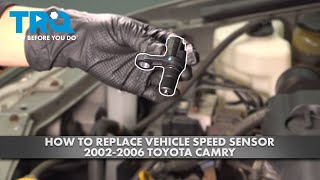
Typical fix: Replace the Vehicle Speed Sensor. This is a straightforward repair that involves removing a single 12mm bolt and an electrical connector. 🎬 Watch: How to replace the VSS on a 4-cylinder Camry
Est. part cost: $20-$100 - Damaged Wiring or Connector 🟡 Medium Probability The wiring harness to the VSS is located in the engine bay and can be susceptible to heat damage, chafing, or corrosion at the connector pins over time.
How to confirm: Visually inspect the wiring harness leading to the VSS for any signs of breaks, fraying, or melted insulation. Check that the connector is secure and free of corrosion. A 'wiggle test' on the harness while monitoring the speed signal can help identify intermittent shorts.
Typical fix: Repair the damaged section of wire or clean the connector terminals. If the connector itself is broken, it will need to be replaced.
Est. part cost: $10-$50 - Faulty Instrument Cluster (Combination Meter) ⚪ Low Probability → Shop Instrument Cluster This generation of Camry is known to have issues with the instrument cluster's internal electronics, which can lead to a complete or intermittent loss of gauge function. While less common than a VSS failure for a P0502 code, it's a known possibility, corroborated by a TSB for the similar Toyota Sienna (EL010-05).
How to confirm: This is typically diagnosed after confirming the VSS and its wiring are good. If the VSS produces a good signal but the speedometer remains dead, the cluster is the likely suspect. Mail-in repair services are widely available for this specific issue.
Typical fix: Replace the instrument cluster with a compatible unit or send the original out for repair to a specialist. Note that mileage is stored in the cluster, so a replacement will show the donor vehicle's mileage unless reprogrammed.
Est. part cost: $50-$200 (Used), $150-$250 (Repair Service)
Rare But Worth Checking
- Faulty Engine Control Module (ECM): → Shop Engine Control Module (ECM) This is very rare. The ECM should only be considered after all other possibilities, including the sensor, wiring, and instrument cluster, have been thoroughly ruled out.
Diagnosis Steps
- Scan the ECM for trouble codes to confirm P0502 is the primary code present.
- Using a scan tool with live data, monitor the 'Vehicle Speed' PID while driving. Confirm that it reads 0 or does not increase with speed.
- Locate the Vehicle Speed Sensor (VSS) on the transmission housing. On 4-cylinder models, remove the air filter box for access. On V6 models, it is in a similar location but may be tighter to access. 🎬 See this VSS replacement walkthrough on a V6 Camry
- Visually inspect the VSS connector and its wiring harness for any obvious signs of damage, corrosion, or loose connections.
- Test the VSS signal. Using a multimeter set to AC Volts, backprobe the sensor's signal wire. With the front wheels raised and spinning, voltage should increase with wheel speed. No signal, or a very low signal, points to a bad sensor. Alternatively, use an oscilloscope to verify a clean square wave signal that increases in frequency with speed.
- If the sensor and wiring test good, the next component to investigate is the instrument cluster, which is a known failure point on this model. Use a scan tool to perform a cluster actuator test to see if the speedometer needle sweeps.
- If the instrument cluster is also confirmed to be working, the final and least likely step is to test the ECM.
Parts You'll Likely Need
- Vehicle Speed Sensor (VSS)
(OEM #83181-12040)— This is the most frequent cause of a P0502 code on the 2002-2006 Camry, leading to a dead speedometer and shifting issues.
Trusted brands: Denso, Aisin, NTK, Dorman
OEM price range: $130-$200
Aftermarket price range: $20-$80 - Instrument Cluster — A known failure point on this Camry generation that can cause speedometer failure. It's the second most likely part to fail after the VSS has been ruled out.
Trusted brands: Toyota (OEM Used), Mail-in Repair Service
OEM price range: $50-$200 (Used)
Aftermarket price range: $150-$250 (Repair Service)
Technical Service Bulletins (TSBs) & Recalls
- TSB EL010-05: While officially for the 2004-2005 Toyota Sienna, this TSB addresses a condition of an inoperative speedometer and/or DTC P0500 caused by a faulty Combination Meter (Instrument Cluster). This is relevant as it shows Toyota's acknowledgement of this failure mode on a closely related platform.
Platform-Specific Known Issues
- The instrument cluster (combination meter) on this generation of Camry is known to fail, causing intermittent or total loss of gauges. 🎬 Watch: How to perform a dead instrument cluster reset This can sometimes manifest as just a speedometer failure, mimicking a bad VSS.
- On the 4-cylinder (2AZ-FE) engine, the VSS is located directly under the air filter housing, which must be removed for access.
Mechanic-Grade Diagnostic Values
- VSS Connector Pin 1 (Yellow Wire) to Ground — expected: Battery Voltage (~12V) with Key On, Engine Off. Failure: 0V indicates a problem with the power supply or fuse to the sensor.
- VSS Connector Pin 2 (Red Wire) to Chassis Ground — expected: < 5 Ohms. Failure: High resistance indicates a bad ground connection for the sensor.
- VSS Signal Output (Pin 3, Light Blue/Red Wire) — expected: A 0-12V square wave signal that increases in frequency as wheel speed increases.. Failure: No signal, or a signal that is stuck low (near 0V), indicates a failed sensor.
Scan Tool Commands That Help
- Toyota Techstream: Data List Monitoring — Select and monitor the 'Vehicle Speed' PID while driving to confirm it reads 0 or is erratic. This is the first step to confirm the symptom reported by the ECM.
- Toyota Techstream: Combination Meter / Active Test — After confirming the VSS and wiring are good, use this function to command the speedometer needle to sweep through its range. If the needle moves correctly, the instrument cluster's gauge motor is likely good, pointing the diagnosis back towards the signal source or ECM. If it fails to sweep, the cluster itself is faulty.
Wiring & Ground Locations
- VSS Connector (90980-11143) — On the top, rear of the transmission/transaxle housing.. This is the main connector for the sensor. Checking for power (Pin 1, Yellow), ground (Pin 2, Red), and signal (Pin 3, Light Blue/Red) at this connector is the primary electrical diagnostic step.
- Ground Point IF / IJ — Located in the driver's (IF) and passenger's (IJ) kick panels.. These are primary ground points for the instrument panel harness. A corroded or loose ground here can cause various issues with the instrument cluster, including an inoperative speedometer that could be misdiagnosed as a VSS failure.
- Ground Point G131 — On the intake manifold (2.2L) or right surge tank (3.0L).. This is a key engine ground point. While less likely to cause an isolated P0502, a poor connection here can introduce electrical noise and various sensor issues.
Real Owner Repair Stories
- Compilation of common forum reports (2004 Toyota Camry LE, 4-Cylinder, ~145,000 miles) — Check Engine Light on, speedometer stuck at 0 MPH, and transmission shifting very hard, especially from 1st to 2nd gear.
❌ Tried (didn't work) Clearing the code (it returned immediately upon driving)., Checking fuses related to the instrument cluster and ECU.
✅ What actually fixed it The owner replaced the Vehicle Speed Sensor (VSS) on the transmission. After removing the airbox for access, the old sensor was removed with a single 12mm bolt. The new sensor was installed, the code was cleared, and a test drive confirmed the speedometer worked and shifting returned to normal. The total repair time was under an hour.
OEM Part Supersession History
83181-12040→83181-12040 (current)— This is the stable part number for the main Vehicle Speed Sensor (VSS) that provides the signal for the speedometer.
Heads up: CRITICAL: Do not confuse with other speed sensors on the transmission, such as the Transmission Revolution Sensors (Input/Output, e.g., 89413-08020 or 89413-48010). While they are also speed sensors, they are used by the Transmission Control Module for shift strategy and will NOT fix a P0502 code or a dead speedometer.
Model Year Variations Within This Range
- 2005-2006: The 4-cylinder models received a 5-speed automatic transmission (U250E), replacing the 4-speed (U241E) from 2002-2004. While the VSS part number and function remain the same, its exact position and the transmission case it bolts into are different between these two transmissions.
Diagnostic Flowchart
Other Known Issues on This Vehicle
Issues unrelated to this code that are worth knowing about as an owner of this generation:
- Excessive Oil Consumption (2.4L 2AZ-FE Engine) 🔴 High — Very common, particularly in 2007-2009 models, but can affect earlier years. Caused by a design flaw in the piston rings. Toyota acknowledged the issue and initiated a warranty enhancement program. (Ref: TSB SB-0094-11 (Piston Assembly & Ring Set Replacement))
- Stripped Cylinder Head Bolt Threads (2.4L 2AZ-FE Engine) 🔴 High — A significant issue primarily affecting 2002-2006 models where the head bolt threads in the aluminum engine block can pull out, causing head gasket failure and overheating. This is a very expensive repair. (Ref: TSB T-SB-0015-11 (describes the repair procedure using a time-sert kit))
- Harsh Automatic Transmission Shifting 🟠 Medium → Shop Transmission Assembly — Owners report issues of hesitation, jerking, or hard shifts, which can sometimes be independent of the VSS failure. The cause can range from old fluid to internal wear or ECM logic.
- Water Pump Failure 🟠 Medium — The water pump can fail without warning, leading to rapid overheating and potential for engine damage if not addressed immediately.
- Faulty Instrument Cluster (Combination Meter) 🟡 Low → Shop Instrument Cluster — As noted in the P0502 diagnosis, the entire instrument cluster can fail, causing gauges to stop working intermittently or permanently. This was acknowledged by Toyota on platform mates like the Sienna via TSB EL010-05. (Ref: TSB EL010-05 (for platform-mate Toyota Sienna))
Used vs. New Parts: Buying Guide for This Vehicle
When a used part is the smart pick: A used instrument cluster from a junkyard is a reasonable choice, as they are often reliable but expensive new. However, be aware that the odometer reading is stored in the cluster and will reflect the donor car's mileage.
Donor-vehicle mileage cap: roughly under 150000 miles for the part to have meaningful remaining life.
What to inspect on the donor part:
- For an instrument cluster, check the clear plastic lens for deep scratches or fogging.
- Ensure the donor vehicle was the same engine type (I4 or V6) as the cluster calibration can differ.
- Ask the salvage yard if they can power it up to confirm the LCD/odometer display works.
- For a VSS, check that the plastic connector isn't cracked and the mounting tab is intact.
OEM-only on this vehicle (don't cheap out):
- Engine Control Module (ECM) - Due to programming and security requirements, a used ECM is difficult to integrate. A remanufactured unit programmed to your VIN is the standard professional repair.
Aftermarket brands forum-validated for this vehicle:
- For the Vehicle Speed Sensor, Denso (the original OEM manufacturer) and Aisin are top-tier choices that are functionally identical to the dealer part. NTK is also a highly reputable brand.
Brands owners have reported issues with on this vehicle:
- Avoid unbranded, 'white-box' sensors from online marketplaces. While extremely cheap, they have a high failure rate, often within months, due to poor quality internal electronics and magnets.
Real Owner Stories
Aggregated from forums and TSBs cited above. Mileages and costs reflect what owners reported in those sources.
2002+ Toyota Camry
Symptoms: The speedometer was inoperative. The owner was unsure if the issue was the sensor or the dashboard itself.
What fixed it: Diagnosis confirmed that for 2002+ models, the failure could be either the speed sensor or a defective instrument cluster.
Source hint: CamryForums.com
2002-2006 Toyota Camry
Symptoms: P0502 code with a 'bad attitude.' The VSS was producing a weak, low-voltage AC signal of only 2.8-3.4V, which was insufficient for the computer to read consistently.
What fixed it: Replaced the Vehicle Speed Sensor. The new sensor produced over 6V AC, which resolved the intermittent code.
Source hint: ScannerDanner Forum - 'P0502 code with bad attitude'
2002-2006 Toyota Camry 4-cylinder
Symptoms: Owner needed to replace the VSS and noted the difficulty of reaching it.
What fixed it: Removed the air cleaner box to gain easier access to the 3-wire sensor located on the transaxle.
Source hint: CamryForums.com - 'Vehicle speed sensor' thread
Related OBD-II Codes
Frequently Asked Questions
Where is the Vehicle Speed Sensor (VSS) located on my 4-cylinder 2002-2006 Camry?
My speedometer is dead but the VSS tested fine. Could it be the instrument cluster?
Will replacing the instrument cluster affect my Camry's odometer reading?
What size tool do I need to replace the VSS on my Camry?
Can a bad VSS cause my Camry to shift harshly?
Is there a specific TSB regarding speedometer failure for this vehicle platform?
Helpful Videos
We Have This Part in Stock


The information in this article is provided for general reference and educational purposes only. Vehicle specifications, procedures, and part compatibility can vary by production date, trim level, and region. Always consult your vehicle's factory service manual and verify part numbers before purchasing or performing repairs. Safety-critical components such as airbags, seat belts, and braking systems should be installed by a qualified professional.
- Toyota Camry:
- 🧭 Diagnostic Flowchart
- 🎬 Helpful Videos
- 🛍️ Shop This Part
- What's Unique About the 2002-2006 Toyota Camry
- Symptoms You May Notice
- Most Likely Causes
- Rare But Worth Checking
- Diagnosis Steps
- Parts You'll Likely Need
- Technical Service Bulletins (TSBs) & Recalls
- Platform-Specific Known Issues
- Mechanic-Grade Diagnostic Values
- Scan Tool Commands That Help
- Wiring & Ground Locations
- Real Owner Repair Stories
- OEM Part Supersession History
- Model Year Variations Within This Range
- Other Known Issues on This Vehicle
- Used vs. New Parts: Buying Guide for This Vehicle
- Real Owner Stories
- 2002+ Toyota Camry
- 2002-2006 Toyota Camry
- 2002-2006 Toyota Camry 4-cylinder
- Related OBD-II Codes
- Frequently Asked Questions
- 🎟️ Get 5% Off