

P0505 on 2003-2008 Honda Pilot: Idle Control System Malfunction Causes and Fixes
On a 2003-2008 Honda Pilot, code P0505 is almost always caused by a dirty or sticking Idle Air Control (IAC) valve located on the underside of the throttle body. A thorough cleaning of the IAC valve and throttle body passages with throttle body cleaner, followed by an idle relearn procedure, usually fixes the problem for under $20 in cleaning supplies. If cleaning fails, replacing the IAC valve is the next step.
- For a P0505 on a 2003-2008 Pilot, always start by cleaning the Idle Air Control (IAC) valve and throttle body passages.
- An idle relearn procedure is mandatory after cleaning/replacing the IAC valve or disconnecting the battery.
- Always use a new gasket when reinstalling the IAC valve to prevent creating a new vacuum leak.
- Before suspecting expensive parts like the PCM, rule out simple issues like low coolant or air in the cooling system, as coolant flows through the IAC valve housing.
What's Unique About the 2003-2008 Honda Pilot
The first-generation Honda Pilot uses a mechanical throttle cable connected to a throttle body, which has a separate Idle Air Control (IAC) valve mounted to its underside. This design is highly susceptible to carbon buildup from the engine's crankcase ventilation (PCV) system, which can clog the small air passages and cause the rotary valve inside the IAC to stick. Unlike newer cars with electronic throttle control (Drive-by-Wire), fixing P0505 on this Pilot almost always involves physically cleaning or replacing this specific valve rather than the entire throttle body assembly. When this code is set, the PCM often disables the VTM-4 (Variable Torque Management 4-Wheel Drive) system as a precaution, illuminating the VTM-4 light on the dashboard.
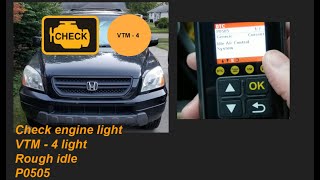
🎬 Watch: Fixing the P0505 and VTM-4 light on a Pilot.Symptoms You May Notice
- Check Engine Light is on
- VTM-4 light may also illuminate as the PCM disables the AWD system as a precaution
- Idle speed is erratic, fluctuating up and down (surging), often between 1000-2000 RPM
- Idle speed is consistently too high or too low
- Engine stalls when coming to a stop or when idling, especially with electrical load (like A/C)
- Rough or shaky idle
- Difficulty starting the engine
- Replacing the Throttle Position Sensor (TPS). A faulty TPS has different symptoms and codes. Owners may replace it unnecessarily when the issue is the nearby IAC valve.
- Adjusting the throttle stop screw. This screw is factory-set and should not be adjusted to compensate for idle issues. Tampering with it can create more problems and mask the true root cause.
- Replacing the EGR valve. While a clogged EGR system is a common issue on J35A engines and can cause a check engine light, it typically sets EGR-specific codes (like P0401) and has different symptoms than the classic P0505 idle surge.
Most Likely Causes
- Dirty or Sticking Idle Air Control (IAC) Valve 🔴 High Probability → Shop Idle Air Control Valve The IAC valve on the J35A engine is prone to carbon and gunk buildup from the PCV system, which restricts the movement of its internal rotary shutter. The small screen and passages get clogged, causing the valve to stick open or closed.
How to confirm: Remove the IAC valve from the bottom of the throttle body and inspect it and the air passages for black, sticky carbon deposits. The valve's screen may be completely blocked.
Typical fix: Thoroughly clean the IAC valve and the throttle body's air passages with throttle body cleaner and a small brush or Q-tips. Replace the IAC valve gasket. If cleaning doesn't resolve the issue, replace the IAC valve.
Est. part cost: $10-$25 (for cleaner and gasket) - Air in the Cooling System / Low Coolant 🟡 Medium Probability The IAC valve on this engine has coolant lines running through it to prevent icing and to provide temperature data. Air pockets in these lines, often introduced during coolant service, can cause erratic temperature readings and lead to idle fluctuations and the P0505 code.
How to confirm: Check the coolant level in the radiator and reservoir. If low, there is a leak. If the level is fine, the system may still have trapped air, especially if recently serviced. The idle may become more erratic as the engine warms up.
Typical fix: Top off the coolant and perform a coolant system bleeding procedure to remove all trapped air. This involves running the engine with the radiator cap off (or using a spill-free funnel) until the cooling fans cycle multiple times.
Est. part cost: $20-$30 (for Honda Type 2 coolant) - Vacuum Leak ⚪ Low Probability Over time, vacuum hoses can become brittle and crack, and intake gaskets can fail, allowing unmetered air to enter the engine. This raises the idle speed beyond the IAC's control range, triggering the code.
How to confirm: With the engine running, listen for hissing sounds around the intake manifold. You can also carefully spray short bursts of brake cleaner or use a smoke machine around vacuum lines and gasket surfaces; a change in idle RPM indicates a leak.
Typical fix: Identify the source of the leak and replace the cracked hose (e.g., PCV hose) or failed gasket (e.g., throttle body gasket).
Est. part cost: $5-$50
Rare But Worth Checking
- Failed IAC Valve Electrical Circuit: The internal motor of the IAC valve can fail, or the wiring harness/connector can become damaged, corroded, or shorted. A diagnostic test involves unplugging the IAC valve with the engine running; if the idle speed changes, the valve is likely receiving a signal. If the P0505 code returns even with the valve unplugged, the problem is likely in the wiring or PCM, not the valve itself.
- Broken Power Steering Pressure Switch Wire: A Honda TSB from 2008 notes that a broken wire at the power steering pressure switch can cause idle fluctuations and P0505. The PCM uses this switch's input to slightly raise the idle when the steering wheel is turned (to compensate for the pump's load). A broken wire can send erratic signals, confusing the idle control logic. The switch is located on the high-pressure power steering line.
- Faulty Powertrain Control Module (PCM): → Shop Engine Control Module (ECM) In very rare cases, the driver circuit within the PCM that controls the IAC valve can fail. This is a last-resort diagnosis and should only be considered after all other possibilities (valve, wiring, vacuum leaks, coolant system) have been exhaustively ruled out by a professional.
Diagnosis Steps
- Check for other stored trouble codes. Address those first if they are present.
- Inspect the air intake tube between the air filter and throttle body for cracks or loose connections.
- Check the engine coolant level in the radiator (when cool) and the overflow reservoir. A low level or air in the system is a common cause. If needed, perform a coolant bleed.
- Remove the air intake ducting from the throttle body.
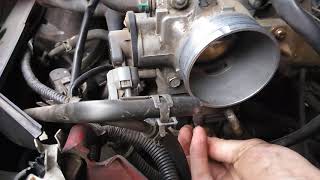
- To access the Idle Air Control (IAC) valve, you must remove the entire throttle body, which is held on by four 12mm bolts/nuts.
- Once the throttle body is off, flip it over to access the IAC valve on the bottom, held by two Phillips head screws.
- Remove the IAC valve. Inspect the valve's screen and internal rotary shutter, as well as the air passages in the throttle body, for heavy carbon buildup.
- Thoroughly clean the IAC valve and throttle body passages using throttle body cleaner and a soft brush or Q-tips. Ensure the rotary valve inside the IAC moves freely after cleaning.
- Reinstall the IAC valve with a new gasket. Reassemble the throttle body (with a new gasket) and intake components.
- Disconnect the negative battery cable for 15 minutes to clear the PCM's learned memory.
- Perform the Idle Relearn Procedure: Start the engine with all electrical accessories OFF. Hold the RPM at 3,000 until the radiator fan comes on (or until the engine reaches normal operating temperature, ~194°F). Then, let the engine idle for at least 5-10 minutes without touching the throttle. 🎬 Watch: How to correctly perform the Honda idle relearn procedure.
- If the problem persists, check for vacuum leaks using a smoke machine or by carefully spraying brake cleaner around the intake manifold gaskets and vacuum hoses.
- If no leaks are found and cleaning did not work, test the IAC valve's electrical circuit for power and ground before condemning the valve itself. If the circuit is good, the IAC valve has likely failed internally and requires replacement.
Parts You'll Likely Need
- Idle Air Control Valve (IACV)
(OEM #16022-P8A-A03)— This is the most common failure point. The internal motor can fail or get stuck due to carbon buildup, directly causing the P0505 code. Cleaning often works, but replacement is the definitive fix if cleaning fails. This part number supersedes 16022-P8A-A01 and 16022-P8A-A02.
Trusted brands: Honda (OEM), Standard Motor Products, Hitachi, Denso
OEM price range: $200-$250
Aftermarket price range: $40-$120 - IAC Valve Gasket
(OEM #Included with some valves, or sold separately. Original was rubber, replacements may be fiber.)— This gasket must be replaced anytime the IAC valve is removed for cleaning or replacement to prevent vacuum leaks. Reusing the old, compressed gasket is a common cause of failure.
Trusted brands: Honda (OEM), Fel-Pro
OEM price range: $5-$10
Aftermarket price range: $2-$5 - Throttle Body Gasket
(OEM #16176-P8A-A01)— Required because the entire throttle body must be removed to access the IAC valve. Reusing the old gasket is a high risk for a vacuum leak.
Related Codes That Often Appear With This One
- P0507 (Idle Air Control System RPM Higher Than Expected): Often seen when a vacuum leak or stuck-open IAC valve is the cause.
- P1519 (Idle Air Control IACV Circuit Malfunction): A companion code that points specifically to an electrical fault in the IAC valve's motor or wiring, rather than just a performance issue.
Technical Service Bulletins (TSBs) & Recalls
- August 2008 Honda TSB (un-numbered in search results): Mentions stuck IAC valve or broken power steering pressure switch wire as causes for P0505 on early Pilot/Odyssey models.
- Honda TSB SN040901: While for the Odyssey, this TSB is highly relevant as it identifies a broken power steering pressure switch wire as a specific cause for P0505 on the same J35A engine platform.
Platform-Specific Known Issues
- A Honda Technical Service Bulletin (TSB) from August 2008 noted that early 2000s Pilot and Odyssey models could experience a fluctuating idle and P0505 due to a stuck-open IAC valve or a broken wire at the power steering pressure switch.
- The location of the IAC valve on the bottom of the throttle body makes it a bit more difficult to access than on some other vehicles, requiring removal of the entire throttle body assembly for service.
Mechanic-Grade Diagnostic Values
- IAC Valve Winding Resistance — expected: ~8-15 Ohms between the center pin and each outer pin on the 3-pin connector.. Failure: A reading significantly outside this range, or an open (OL) or shorted (0 Ohms) reading, indicates a failed valve.
- IAC Valve Connector Voltage (Key-On, Engine-Off) — expected: The center pin (Yel/Blk wire) should have battery voltage (~12V). One of the outer pins should show a good ground (< 0.1V). The third pin is the control signal from the PCM.. Failure: No voltage on the power pin points to a fuse or PGM-FI main relay issue. No ground indicates a wiring problem.
- Main Engine Ground Resistance — expected: < 0.1 Ω between the ground point (e.g., G101 on the engine block) and the negative battery terminal.. Failure: Higher resistance indicates a corroded or loose ground connection, which can cause erratic behavior from multiple sensors, including the IAC system.
Scan Tool Commands That Help
- Honda HDS (or compatible, e.g., Autel): ACV Test / IAC Valve Test — Use this bidirectional test to command the IAC valve to open and close in stages. The tool will monitor RPM response. If the RPMs change as commanded, the PCM, wiring, and valve motor are likely functional, pointing towards a clog or mechanical stickiness. If RPMs do not change, it indicates a failure in the valve, wiring, or PCM driver.
Wiring & Ground Locations
- G101 — Typically found on the thermostat housing or nearby on the engine block/cylinder head, serving as the main engine-to-chassis ground.. This is a primary ground point for the PCM and many engine sensors. A poor connection here can cause erratic voltage signals and incorrect sensor readings, confusing the PCM's idle control logic and potentially triggering a P0505.
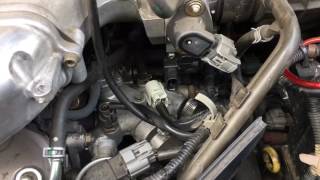
- IAC Valve Connector — A 3-pin connector attached to the IAC valve on the underside of the throttle body (2003-2004 models).. This is the direct connection for power, ground, and control signals to the valve. Wires can fray or break right at the connector from vibration and heat, leading to an open circuit and a P1519 or P0505 code. The center pin is typically 12V power (Yel/Blk wire).
Real Owner Repair Stories
- Honda-Tech forum user (92 Honda Civic (with similar 2-wire IACV system)) — Extremely low idle, Code 14 (pre-OBDII for IACV issue).
❌ Tried (didn't work) Cleaned the IACV, Replaced the IACV twice
✅ What actually fixed it The wiring between the ECU and the IACV connector was faulty. The owner stopped trying to find the break in the harness and ran a new wire directly from the ECU pin to the IACV connector, which permanently solved the problem. - Tacoma World forum user (Toyota Tacoma (with similar IACV and P0505 issue)) — Persistent high idle and P0505 code.
❌ Tried (didn't work) IAC valve replacement, Vacuum line check, MAF cleaning
✅ What actually fixed it The throttle body itself was worn out. The owner sent the throttle body to a specialty service (MAXBORE) that bores it out and fits a new, oversized throttle plate. This fixed the air leak around the worn throttle shaft/plate that was causing the high idle. - NHTSA ODI #10533782 (Honda Odyssey owner) — Reported that the check engine light illuminated with codes P0730 for incorrect gear ratio and P0505 for idle. The owner noted a near-crash situation while driving uphill.
- NHTSA ODI #10195472 (Honda Accord owner) — Reported a failure involving codes P0420, P0505, and P1456. The owner noted the failure occurred around 97,596 miles, despite a previous guarantee only up to 80,000 miles.
"I Checked Everything" — The Actual Cause
- In some cases, a smoke test for vacuum leaks may come back clean, but the P0505 and high idle persist. The root cause can be subtle mechanical wear on the throttle body's butterfly valve shaft or plate. This creates a small, unmetered air gap that the IAC system cannot compensate for, but it may not show up as a typical 'leak' from a hose or gasket during a smoke test. The fix in this scenario is the replacement of the entire throttle body assembly.
OEM Part Supersession History
16022-P8A-A01, 16022-P8A-A02→16022-P8A-A03— Standard part revision by the manufacturer to improve reliability or sourcing.
Heads up: These parts are interchangeable for the specified 2003-2004 cable-throttle models. This part number will NOT fit 2005-2008 models with electronic throttle.
Model Year Variations Within This Range
- 2003-2004: These models use the J35A4 engine with a mechanical throttle cable and a separate Idle Air Control (IAC) valve. The entire diagnosis path focusing on cleaning/replacing the IAC valve is correct for these years.
- 2005-2008: Starting with the 2005 model (J35A6 engine) and continuing through 2008 (J35A9/J35Z1 engines), the Pilot switched to an electronic 'Drive-by-Wire' (DBW) throttle. These models DO NOT have a separate IAC valve. Idle speed is controlled by the PCM making small adjustments to the main electronic throttle plate. A P0505 code on these later models points to a problem with the electronic throttle body itself, its sensors, or the PCM, not a separate IAC valve.
Diagnostic Flowchart
Other Known Issues on This Vehicle
Issues unrelated to this code that are worth knowing about as an owner of this generation:
- Automatic Transmission Failure 🔴 High — Very common on 2003-2005 models, often occurring between 90,000 and 150,000 miles. Symptoms include slipping, harsh shifts, and sudden failure. (Ref: NHTSA Recall #04V176000 was issued for a defect that could cause the transmission to lock up, but widespread failures from other causes are also reported.)
- Takata Airbag Inflator Rupture 🔴 High — Affects all 2003-2008 models. This was part of a massive, well-documented global recall. (Ref: Multiple NHTSA recalls, including #19V499000 and #19E068000, were issued to replace defective driver and passenger side airbag inflators that could explode.)
- Clogged EGR Passages 🟠 Medium — Common issue where carbon buildup clogs the EGR port and passages in the intake manifold, leading to an EGR-related check engine light (e.g., P0401).
- Failing Ignition Switch / Fuel Pump Relay 🟠 Medium — Can cause intermittent no-start conditions or stalling, particularly on the 2003-2004 models. (Ref: A recall was issued for the ignition switch on some models.)
- Worn Engine Mounts 🟡 Low — The hydraulic engine mounts are known to wear out over time, leading to excessive engine vibration felt in the cabin, especially at idle and in gear.
Used vs. New Parts: Buying Guide for This Vehicle
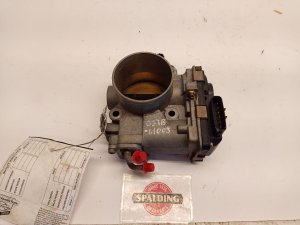
When a used part is the smart pick: A used part is an excellent, cost-effective choice for this repair. Since the IAC valve, Throttle Position Sensor (TPS), and MAP sensor are all mounted to the throttle body, purchasing a complete used throttle body assembly from a junkyard or eBay is often the most efficient repair. It allows you to replace all potential culprits in one go for a fraction of the cost of a new OEM IAC valve alone.
Donor-vehicle mileage cap: roughly under 150000 miles for the part to have meaningful remaining life.
What to inspect on the donor part:
- Look for a donor vehicle with lower mileage if possible.
- Inspect the throttle bore for excessive carbon buildup before purchase.
- Ensure the connectors for all sensors are intact with no broken clips or frayed wires.
- If possible, check for minimal play in the throttle plate shaft.
OEM-only on this vehicle (don't cheap out):
- Powertrain Control Module (PCM) - Aftermarket or improperly matched used units can cause a host of issues and are difficult to program.
Aftermarket brands forum-validated for this vehicle:
- Denso (often the OEM manufacturer)
- Standard Motor Products (SMP)
- Hitachi
- Holstein
Brands owners have reported issues with on this vehicle:
- Ultra-cheap, no-name parts from online marketplaces are frequently reported on forums to be dead-on-arrival or fail within a few months, leading to wasted time and money.
Real Owner Stories
Aggregated from forums and TSBs cited above. Mileages and costs reflect what owners reported in those sources.
2003 Honda Pilot J35A
Symptoms: Check engine light P0505, VTM-4 light, and a high idle.
What fixed it: Removed the throttle body, cleaned the IAC valve (IACV), and performed the idle relearn procedure.
Source hint: YouTube (EZ Auto channel): 'CHECK ENGINE LIGHT P0505, VTM-4 LIGHT - 2003 Honda Pilot idle air control valve repair'
2001-2006 Acura MDX (J35A platform-mate)
Symptoms: P0505 code with an unstable idle; the owner confirmed the issue by manually plugging the IAC air port in the throttle body bore which stabilized the idle.
What fixed it: The diagnosis proved the IAC valve was stuck open and required replacement/service.
Source hint: AcuraZine Forums: 'P0505 Idle'
Honda Odyssey (J-series engine platform-mate)
Symptoms: P0505 code present but without the typical idle surge symptoms.
What fixed it: Diagnostic testing for an internally shorted IAC valve by unplugging the sensor to see if the code returned (indicating a wiring/PCM fault) or stayed away (indicating an internal IAC short).
Source hint: Reddit r/Cartalk: 'Honda Idle Air Control Code P0505, none of the usual symptoms'
Related OBD-II Codes
Frequently Asked Questions
Why is my VTM-4 light on at the same time as the P0505 Check Engine Light?
Does Honda have a Technical Service Bulletin for P0505 on the Pilot?
Can I just clean the IAC valve on my J35A engine instead of replacing it?
Why does my Pilot's idle surge specifically after I changed the coolant?
Where is the IAC valve located on the 2003-2008 Pilot?
What is the 'Idle Relearn Procedure' for the Honda Pilot?
Helpful Videos


We Have This Part in Stock

The information in this article is provided for general reference and educational purposes only. Vehicle specifications, procedures, and part compatibility can vary by production date, trim level, and region. Always consult your vehicle's factory service manual and verify part numbers before purchasing or performing repairs. Safety-critical components such as airbags, seat belts, and braking systems should be installed by a qualified professional.
- Honda Pilot:
- 🧭 Diagnostic Flowchart
- 🎬 Helpful Videos
- 🛍️ Shop This Part
- What's Unique About the 2003-2008 Honda Pilot
- Symptoms You May Notice
- Most Likely Causes
- Rare But Worth Checking
- Diagnosis Steps
- Parts You'll Likely Need
- Related Codes That Often Appear With This One
- Technical Service Bulletins (TSBs) & Recalls
- Platform-Specific Known Issues
- Mechanic-Grade Diagnostic Values
- Scan Tool Commands That Help
- Wiring & Ground Locations
- Real Owner Repair Stories
- "I Checked Everything" — The Actual Cause
- OEM Part Supersession History
- Model Year Variations Within This Range
- Other Known Issues on This Vehicle
- Used vs. New Parts: Buying Guide for This Vehicle
- Real Owner Stories
- 2003 Honda Pilot J35A
- 2001-2006 Acura MDX (J35A platform-mate)
- Honda Odyssey (J-series engine platform-mate)
- Related OBD-II Codes
- Frequently Asked Questions
- 🎟️ Get 5% Off