

P0506 on 2016-2017 Buick Envision: Causes and Fixes for Low Idle Speed
On a 2016-2017 Envision, P0506 is most often caused by a dirty throttle body that needs cleaning (~$15 for cleaner). For the 2.0L Turbo engine, a disconnected charge air cooler (CAC) tube at the throttle body is also a very common cause and should be the first thing you check. A less common but documented cause on both engines is loose intake manifold bolts, per GM TSB #PIP5529B.
- For the 2016-2017 Buick Envision, P0506 almost always points to an issue with air entering the engine at idle.
- If you have the 2.0L Turbo engine, your very first check should be the large air tube connected to the throttle body; make sure it is securely attached.
- The most common fix for both the 2.5L and 2.0L engines is cleaning the carbon buildup from the electronic throttle body, a low-cost DIY job.
- Do not replace any expensive sensors or the throttle body itself until you have ruled out simple air leaks and have performed a thorough cleaning.
- After any repair involving the intake or throttle body, an idle relearn procedure is recommended to allow the computer to recalibrate.
What's Unique About the 2016-2017 Buick ENVISION
While a dirty throttle body is a common cause on many cars, the 2016-2017 Envision with the 2.0L Turbo (LTG) engine has a specific weak point. The charge air cooler (CAC) tube that connects to the throttle body is known to become loose or disconnect entirely. This creates a massive air leak that the engine's computer cannot compensate for, immediately causing a low, rough idle and triggering code P0506, often with other air metering codes. Additionally, GM Technical Service Bulletin #PIP5529B specifically identifies loose intake manifold bolts as a cause for P0506 on both the 2.0L LTG and 2.5L LCV engines used in the Envision.
Diagnostic Flowchart
Tap your situation to follow the diagnostic path that matches what you're seeing on this vehicle.
Symptoms You May Notice
- Engine idles lower than normal (e.g., below 700 RPM)
- Rough or vibrating idle
- Engine stalling when coming to a stop or when the A/C is turned on
- Hesitation when accelerating from a stop
- Illuminated Check Engine Light
- Audible 'whooshing' or hissing sound from the engine bay, especially on 2.0L Turbo models during acceleration if the CAC tube is disconnected.
- Replacing the entire electronic throttle body assembly when it only needs to be cleaned.
- Replacing the Mass Airflow (MAF) or Manifold Absolute Pressure (MAP) sensors before checking for physical air leaks (like the CAC tube) or carbon buildup.
Most Likely Causes
- Dirty Throttle Body 🔴 High Probability → Shop Fuel Injection Throttle Body The PCV (Positive Crankcase Ventilation) system routes oil vapors and combustion byproducts back into the intake. Over time, this creates a sticky layer of carbon buildup around the throttle plate, restricting the small amount of air needed for a stable idle.
How to confirm: Remove the air intake duct from the throttle body and visually inspect the throttle bore and the edges of the metal plate for a black, gummy film.
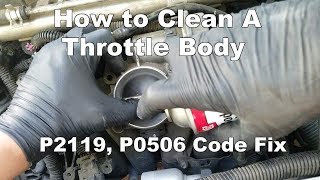
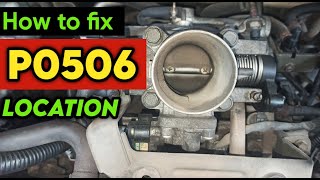
Typical fix: Remove the throttle body from the intake manifold (typically four bolts) for a thorough cleaning. 🎬 Watch: How to clean the throttle body and fix P0506. Use a dedicated throttle body cleaner and a soft cloth or brush to remove all carbon buildup. An idle relearn procedure is required after reinstallation.
Est. part cost: $10-$20 - Disconnected or Leaking Charge Air Cooler (CAC) Tube (2.0L Turbo Engine Only) 🔴 High Probability → Shop Intercooler The connection between the charge air cooler outlet pipe and the electronic throttle body is a known weak point on this GM engine platform. The factory retaining clip can fail or the tube can simply pop off under boost pressure, creating a large unmetered air leak.
How to confirm: Visually inspect the large-diameter black plastic tube connected to the front of the throttle body. Check if it is loose, disconnected, or if the retaining clip is missing or damaged. A smoke test will definitively show a leak at this connection. This is a very common issue on platform mates like the Chevy Malibu.
Typical fix: Reconnect the tube and ensure the retaining clip is properly seated. In many cases, an improved retainer clip (GM Part #13434668, which has been superseded by #84828210) is needed to create a more secure connection.
Est. part cost: $15-$40 - Loose Intake Manifold Bolts 🟡 Medium Probability → Shop Engine Intake Manifold GM TSB #PIP5529B specifically calls out this issue for the 2016-2017 Envision with both the 2.5L and 2.0L engines. The intake manifold bolts can loosen over time, causing a vacuum leak that leads to P0506 and other codes.
How to confirm: A smoke test is the most effective method. A technician may also check the torque on the intake manifold bolts. The TSB was issued because this can be missed during standard diagnostics.
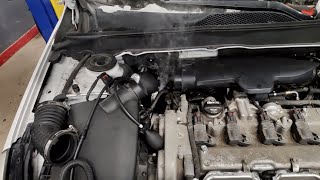
Typical fix: Per TSB #PIP5529B, the fix is to remove one bolt at a time, apply medium strength threadlocker, and torque the bolts in sequence to the proper specification. 🎬 See how to fix loose intake manifold bolts and smoke test. The intake gasket usually does not need to be replaced.
Est. part cost: $10-$20 (for threadlocker)
Rare But Worth Checking
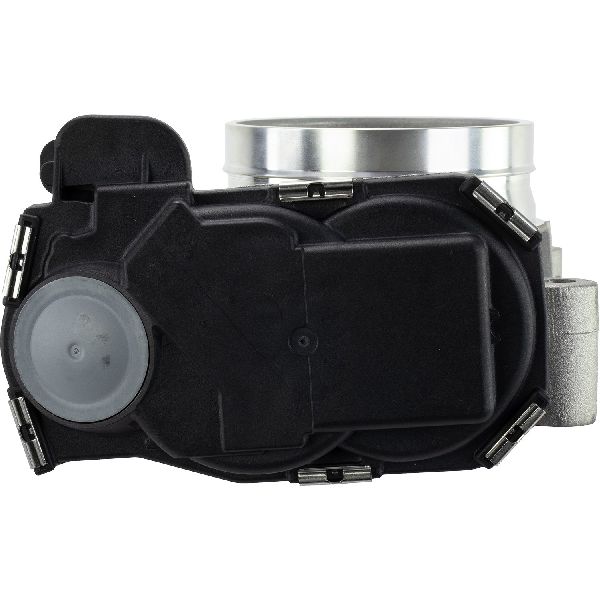
- Faulty Electronic Throttle Body: → Shop Fuel Injection Throttle Body If a thorough cleaning does not resolve the issue and there are no vacuum leaks, the internal motor or position sensor within the throttle body assembly may have failed. This is less common than a simple cleaning being the fix.
- Standard Vacuum Leak (PCV System, etc.): While the loose intake manifold is a specific type of vacuum leak, other hoses can become brittle and crack over time, and gaskets can fail. A smoke test is the best way to find these less common leaks.
Diagnosis Steps
- Scan for other DTCs. Codes like P0101 or P0299 strongly suggest a large air leak after the turbo on 2.0L models.
- For 2.0L Turbo engines, visually and physically inspect the charge air cooler (CAC) tube connection at the throttle body. This is a primary suspect and a known weak point.
- If no obvious leaks are found, check the intake manifold bolts for looseness as per TSB #PIP5529B.
- Perform a smoke test to check for hidden vacuum leaks from gaskets or the PCV system.
- If no leaks are found, remove the air intake duct and inspect the throttle body for carbon buildup.
- If dirty, remove and thoroughly clean the throttle body using appropriate cleaner. Do not force the throttle plate by hand on an electronic unit.
- After reassembly, perform an idle relearn procedure. This is critical for the ECM to recalibrate. A generic procedure is to turn the ignition ON (engine off) for 2-3 minutes, then OFF for 1 minute, then start the engine and let it idle for 10-15 minutes without touching the throttle.
- If the problem persists after cleaning and confirming no leaks, the electronic throttle body itself may be faulty and require testing or replacement.
Parts You'll Likely Need
- Throttle Body Cleaner — This is the most common fix, used to remove carbon buildup that restricts airflow at idle.
Trusted brands: CRC, ACDelco
OEM price range: $15-$25
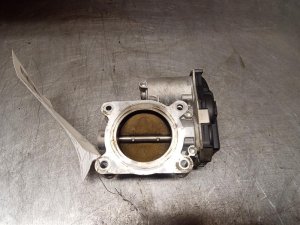
Aftermarket price range: $10-$20 - Electronic Throttle Body Assembly (2.5L LCV)
(OEM #12670834)— Replaced only if cleaning does not solve the problem and the unit is confirmed to be faulty. This part number fits the 2.5L engine.
Trusted brands: ACDelco (GM Genuine), Bosch
OEM price range: $150-$250
Aftermarket price range: $100-$180 - Electronic Throttle Body Assembly (2.0L LTG)
(OEM #12670839)— Replaced only if cleaning does not solve the problem and the unit is confirmed to be faulty. This part number fits the 2.0L Turbo engine.
Trusted brands: ACDelco (GM Genuine), Bosch
OEM price range: $200-$350
Aftermarket price range: $120-$250 - Charge Air Cooler Retainer Clip
(OEM #84828210 (replaces 13434668))— For 2.0L Turbo models, this improved clip may be needed to secure a disconnected CAC tube. Part number 13434668 is frequently cited but has been superseded by 84828210.
Trusted brands: ACDelco (GM Genuine)
OEM price range: $15-$40
Related Codes That Often Appear With This One
- P0101 — Mass Airflow (MAF) Sensor Performance. Often appears with a large vacuum leak (like a disconnected CAC tube) because the measured airflow from the MAF sensor doesn't match what the engine expects. This is explicitly mentioned in TSBs for the CAC tube issue.
- P0299 — Turbocharger Underboost. This code is common when the charge air cooler tube disconnects, as the boost pressure leaks out before it can reach the engine.
- P0068, P0106, P0171 — These codes (related to MAP/MAF/Throttle Position Correlation and System Too Lean) are listed alongside P0506 in GM Technical Service Bulletin #PIP5529B, indicating they can appear together due to a general engine performance fault, often caused by loose intake manifold bolts.
Technical Service Bulletins (TSBs) & Recalls
- PIP5529B: Malfunction indicator lamp illumination due to any combination of diagnostic trouble codes P0068 P0101 P0106 P0171 P0131 P0137 P0324 P0326 P0331 P0506. Cause may be loose intake manifold bolts.
- PIP5529A: An earlier version of the same bulletin listing P0506 among many other codes for a general engine performance issue.
- GM
Platform-Specific Known Issues
- TSB #PIP5529B: This bulletin is highly relevant. It states that for P0506 (and a list of other codes), if standard diagnostics fail, technicians should inspect for loose intake manifold bolts. The fix is to apply threadlocker and re-torque the bolts. This applies to both the 2.5L and 2.0L Turbo engines in the 2016-2017 Envision.
- Charge Air Cooler (CAC) System Issues (2.0L Turbo): → Shop Intercooler While no TSB may list the Envision by name for this specific issue, numerous TSBs for platform mates (Chevy Malibu, Cadillac CT6) with the same LTG engine explicitly cite the CAC tube disconnecting from the throttle body as a primary cause for P0506. This should be considered a top-priority check for any 2.0L Turbo Envision with this code.
Mechanic-Grade Diagnostic Values
- High-Pressure Fuel System (2.0L LTG Engine) — expected: Approximately 750 psi (5,171 kPa) at idle, up to 2,250 psi (15,513 kPa) at wide open throttle.. Failure: Significantly lower or erratic fuel pressure at idle could contribute to stalling or low idle speed.
- Throttle Position Sensor (TPS) Reference Voltage — expected: 4.75 to 5.25 Volts between the reference voltage wire and ground at the sensor connector (Key On, Engine Off).. Failure: Voltage outside this range indicates a problem with the ECM or wiring, not necessarily the sensor itself.
- Scan Tool Live Data: Throttle Body Airflow Compensation — expected: Should be at or very near 0% after an idle learn procedure is complete and the engine is at normal idle.. Failure: A non-zero value indicates the ECM is still trying to compensate for an unlearned idle position or an underlying issue like a vacuum leak.
Scan Tool Commands That Help
- GDS2 (or equivalent professional scan tool): Idle Learn Reset / Reset ECM Learned Values — This function must be used after cleaning or replacing the throttle body to clear the old learned airflow values from the ECM. Failure to do so can result in a continued incorrect idle speed or stalling.
- GDS2 (or equivalent professional scan tool): Engine Speed Control — A bidirectional command that allows a technician to command a specific RPM. This is used to test the range and response of the electronic throttle control system to see if it can maintain a commanded idle speed, helping to isolate a faulty throttle body from other causes.
"I Checked Everything" — The Actual Cause
- In cases where a smoke test reveals no vacuum leaks from hoses or gaskets, the root cause may be loose intake manifold bolts, as documented in GM TSB #PIP5529B. This condition creates a vacuum leak between the manifold and the cylinder head that may not be obvious during a standard smoke test but is sufficient to cause a low idle and set code P0506. The prescribed fix is to re-torque the bolts with threadlocker, not replace the gasket unless it's proven to be damaged after torquing.
When the Usual Fixes Don't Work
- While cleaning the throttle body is a very common fix for P0506, it may not resolve the issue on a 2016-2017 Envision if the underlying cause is loose intake manifold bolts. Per TSB #PIP5529B, the vehicle can present with P0506, and if standard diagnostics (including cleaning the throttle body) fail, the actual fix is to apply threadlocker and re-torque the intake manifold bolts to specification.
OEM Part Supersession History
12632101, 12669146→12670834— Standard part design updates and consolidation.
Heads up: This applies to the Electronic Throttle Body for the 2.5L LCV engine.
Model Year Variations Within This Range
- 2016: The 2016 model year Envision was sold in North America exclusively with the 2.0L Turbo (LTG) engine. Therefore, any 2016 model with P0506 must have the 2.0L engine, making the disconnected Charge Air Cooler (CAC) tube a primary suspect.
- 2017: For the 2017 model year, the 2.5L (LCV) engine was introduced as the base engine alongside the 2.0L Turbo. Technicians must first identify which engine is present, as the diagnostic path differs (e.g., the CAC tube issue is not applicable to the 2.5L naturally aspirated engine).
Helpful Videos
Used OEM Parts in Stock
New Aftermarket Parts Available


The information in this article is provided for general reference and educational purposes only. Vehicle specifications, procedures, and part compatibility can vary by production date, trim level, and region. Always consult your vehicle's factory service manual and verify part numbers before purchasing or performing repairs. Safety-critical components such as airbags, seat belts, and braking systems should be installed by a qualified professional.
- Buick ENVISION:
- 🧭 Diagnostic Flowchart
- 🎬 Helpful Videos
- 🛍️ Shop This Part
- What's Unique About the 2016-2017 Buick ENVISION
- Symptoms You May Notice
- Most Likely Causes
- Rare But Worth Checking
- Diagnosis Steps
- Parts You'll Likely Need
- Related Codes That Often Appear With This One
- Technical Service Bulletins (TSBs) & Recalls
- Platform-Specific Known Issues
- Mechanic-Grade Diagnostic Values
- Scan Tool Commands That Help
- "I Checked Everything" — The Actual Cause
- When the Usual Fixes Don't Work
- OEM Part Supersession History
- Model Year Variations Within This Range
- 🎟️ Get 5% Off