

P0506 on 1997-2001 Toyota Camry: Idle Speed Low Causes and Fixes
On a 1997-2001 Toyota Camry, code P0506 is almost always caused by a carbon-clogged Idle Air Control (IAC) valve or a dirty throttle body. A thorough cleaning of both components using throttle body cleaner is a very common, inexpensive, and effective DIY fix that usually resolves the low, rough idle and stalling symptoms.
- P0506 on a 1997-2001 Camry points to the engine idling too slowly.
- The most likely cause by far is a dirty Idle Air Control (IAC) valve and/or throttle body, which can be fixed with a can of throttle body cleaner.
- Symptoms include a low/rough idle and stalling when the car comes to a stop.
- This is a common DIY repair that requires basic tools and about an hour of time.
- If cleaning doesn't solve the problem, check for cracked vacuum hoses before replacing the IAC valve itself.
What's Unique About the 1997-2001 Toyota Camry
The 1997-2001 (XV20 generation) Camry uses a mechanical throttle cable and a separate, replaceable Idle Air Control (IAC) valve, unlike newer cars with integrated electronic throttle bodies. This specific IAC valve design, which uses a rotary shutter controlled by a small electric motor, is highly susceptible to carbon and oil vapor buildup from the PCV system. This buildup causes the valve's moving parts to stick, restricting airflow. As a result, P0506 on this Camry is very frequently a simple "clean and maintain" issue rather than a complex electronic failure, a fact corroborated by countless owner experiences in online forums.
Symptoms You May Notice
- Engine idles at a lower RPM than usual (e.g., below 600 RPM, sometimes dropping to 400-500 RPM)
- Rough, shaking, or unstable idle, especially when in gear ('Drive' or 'Reverse')
- Engine stalls when coming to a stop, in neutral, or immediately after a cold start
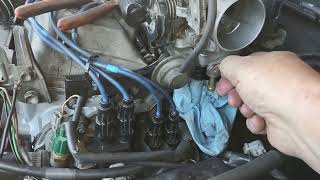
- Difficulty starting the engine, especially when cold, unless the gas pedal is pressed slightly 🎬 Watch: How to fix a stalling or no-start condition quickly.
- Illuminated Check Engine Light
- Engine RPMs drop significantly when electrical loads like the A/C are turned on
- Replacing the throttle position sensor (TPS). The TPS reports the throttle angle to the computer but does not control the idle air bypass. A faulty TPS usually has different symptoms and codes.
- Replacing the IAC valve when a thorough cleaning would have fixed it. Many owners report that cleaning is sufficient and replacement is only needed if the internal motor fails.
Most Likely Causes
- Dirty or Sticking Idle Air Control (IAC) Valve 🔴 High Probability → Shop Idle Air Control Valve The IAC valve on both the 4-cylinder (5S-FE) and V6 (1MZ-FE) engines is prone to accumulating heavy carbon deposits, which restricts its rotary shutter's movement and causes it to get stuck in a partially closed position.
How to confirm: Remove the air intake hose from the throttle body. The IAC valve is mounted to the throttle body (often on the underside). Remove the valve (typically 2-4 bolts) and inspect its passages and rotary gate for thick black carbon buildup. The gate should move freely.
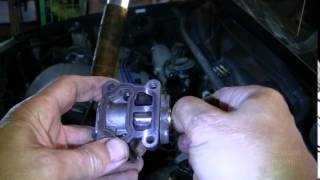
Typical fix: Thoroughly clean the IAC valve and its corresponding passages in the throttle body with throttle body cleaner and a small brush (an old toothbrush works well). Ensure the rotary part moves smoothly after cleaning. Reinstall with a new gasket. If cleaning does not restore function, the valve's internal motor has likely failed 🎬 Watch: A professional mechanic's guide to a better IAC repair method. and it must be replaced.
Est. part cost: $5-$15 for cleaner, $70-$250 for a new valve - Dirty Throttle Body 🔴 High Probability → Shop Fuel Injection Throttle Body Over time, carbon and oil vapor from the PCV system build up a sticky ring of grime around the throttle plate and bore, restricting the small amount of air needed to maintain a proper idle when the plate is closed.
How to confirm: Remove the air intake hose and visually inspect the throttle plate and the bore for a ring of black grime. The plate should be shiny metal, not black.
Typical fix: Spray throttle body cleaner on a rag and wipe the throttle plate (front and back) and bore clean. Open the plate by hand to clean the edges. This is almost always done at the same time as cleaning 🎬 See this step-by-step walkthrough for cleaning your Camry's IAC valve. the IAC valve for a complete fix.
Est. part cost: $5-$15 for cleaner - Vacuum Leak 🟡 Medium Probability After 20+ years and countless heat cycles, the rubber vacuum hoses connected to the intake manifold can become brittle, crack, or disconnect, allowing unmetered air to enter the engine. While a vacuum leak more commonly causes a high idle (P0507), a small or intermittent leak can confuse the PCM, leading it to overcorrect and cause a low idle.
How to confirm: With the engine running, listen for a hissing sound around the engine bay. You can also spray short bursts of brake cleaner or starter fluid around vacuum lines and intake gaskets; a change in engine idle RPM indicates you've found the leak. Pay close attention to the large air intake hose between the air filter and throttle body, as cracks are common there.
Typical fix: Replace the cracked or broken vacuum hose. Hoses are typically inexpensive and can be bought by the foot.
Est. part cost: $5-$25
Rare But Worth Checking
- Faulty PCV Valve: → Shop PCV Valve A Positive Crankcase Ventilation (PCV) valve that is stuck open can create a vacuum leak, disrupting the idle. It's an inexpensive and easy part to check and replace during diagnosis.
- Clogged Air Filter: → Shop Air Cleaner Assembly A severely clogged engine air filter can starve the engine of air, contributing to a low idle. It's a basic maintenance item that should be checked first as per owner forum recommendations.
- Corrupted ECM Memory / Idle Relearn Needed: After a battery replacement or disconnection, the Engine Control Module (ECM) can lose its learned idle values, resulting in a low or rough idle. An 'idle relearn' procedure (letting the car idle for 10-15 minutes after warming up) can sometimes resolve this.
Diagnosis Steps
- Verify the Check Engine Light is on and code P0506 is present using an OBD-II scanner.
- Check the engine air filter. If it is excessively dirty, replace it before proceeding.
- Visually inspect all vacuum hoses connected to the intake manifold for cracks, breaks, or disconnections. Pay special attention to the large intake boot. Listen for audible hissing with the engine running.
- Remove the air intake ducting from the throttle body.
- Inspect the throttle body bore and plate for carbon buildup. Clean thoroughly with a dedicated throttle body cleaner and a soft brush or rag.
- Locate and remove the Idle Air Control (IAC) valve from the throttle body. It is held on by screws or bolts and has coolant lines attached, which should be pinched off to minimize coolant loss.
- Inspect the IAC valve's rotary gate and passages for heavy carbon buildup. Clean the valve's mechanical parts and the air passages with throttle body cleaner until all carbon is removed and the gate moves freely.
- Reinstall the IAC valve using a new gasket to prevent vacuum leaks. Reconnect all hoses and electrical connectors.
- Clear the trouble code with the scanner. Start the engine. It may run rough initially. Let it idle for several minutes to warm up and perform an idle relearn to see if the idle speed stabilizes and if the code returns.
Parts You'll Likely Need
- Idle Air Control (IAC) Valve
(OEM #For 2.2L 5S-FE: 22270-03030 (replaces 22270-74340). For 3.0L 1MZ-FE: 22270-20050.)— This is the most common part to become clogged, directly causing the P0506 code on this vehicle. Cleaning often works, but if the internal motor has failed, it requires replacement.
Trusted brands: Toyota (OEM), Denso, Aisin, Standard Motor Products (SMP)
OEM price range: $250-$390
Aftermarket price range: $70-$200 - Throttle Body Cleaner — Required for cleaning both the IAC valve and the throttle body bore, which is the most common and effective fix.
Trusted brands: CRC, Gumout, WD-40 Specialist
Aftermarket price range: $5-$15 - IAC Valve Gasket
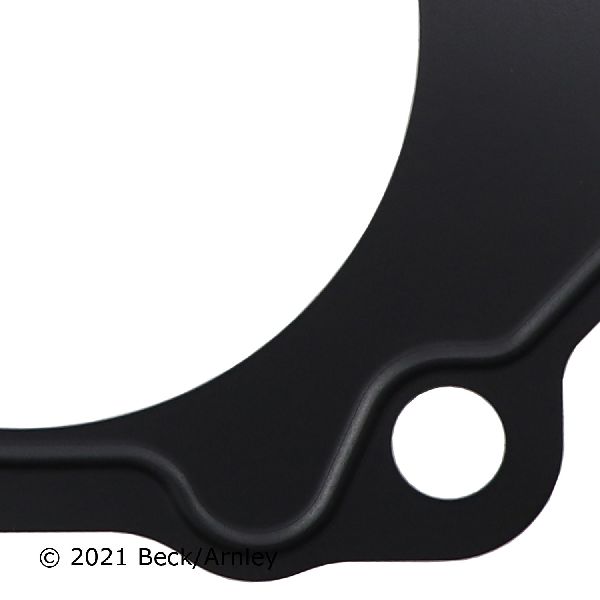
(OEM #For 3.0L 1MZ-FE: 22215-20010. For 2.2L 5S-FE, the gasket is often integrated with the valve itself or sold with it.)— It is best practice to replace the gasket when removing the IAC valve for cleaning or replacement to prevent a vacuum leak. A new gasket is cheap insurance against having to do the job twice.
Trusted brands: Toyota (OEM), Fel-Pro, Mahle
OEM price range: $6-$15
Aftermarket price range: $2-$10
Related Codes That Often Appear With This One
- P0505 — P0505 indicates a general malfunction in the Idle Air Control system circuit or mechanism. It can appear alongside P0506 if the computer detects both a general fault (like a bad motor winding) and the specific low RPM condition.
Technical Service Bulletins (TSBs) & Recalls
- While not directly for P0506, Toyota Technical Service Bulletin T-TT-0362-15 addresses 'Hard Start or Poor Idle after 12 Volt Power Interruption' for many models including the Camry. It recommends cleaning the throttle body of excessive deposits as a primary step, which aligns with the common fix for P0506.
Platform-Specific Known Issues
- On the 3.0L V6 (1MZ-FE) engine, the IAC valve is located underneath the throttle body, making access slightly more difficult than on the 4-cylinder (5S-FE) engine where it is more exposed.
- Owners report that the IAC valve may require cleaning periodically, with some noting the issue returns every 50,000-80,000 miles as carbon re-accumulates. It is often considered a routine maintenance item for high-mileage XV20 Camrys.
- A successful cleaning is often confirmed when the car starts and idles high (1500-2000 RPM) for a few moments before the ECU corrects it and settles it down to the proper ~750 RPM.
Mechanic-Grade Diagnostic Values
- IAC Valve Coil Resistance — expected: Cold (14°F to 122°F): 17.0 - 24.5 Ω. Hot (122°F to 212°F): 21.5 - 28.5 Ω. Measured between the center pin (+B) and each outer pin (RSC, RSO).. Failure: Readings outside of this range, or an open circuit (infinite resistance), indicate a failed internal coil.
- IAC Valve Duty Ratio (Scan Tool Live Data) — expected: 22.5% - 43% at normal idle.. Failure: A value stuck at 0% or 100%, or a value that doesn't change as electrical loads (like A/C) are turned on and off, suggests a problem with the valve or its control circuit.
Scan Tool Commands That Help
- Toyota Techstream (or equivalent professional scanner): Active Test: Control the Idle Air Control Valve — This bidirectional command allows a technician to manually open and close the IAC valve or hold a specific engine RPM (e.g., 900-1300 RPM) to verify the valve's mechanical and electrical response. If the engine RPM does not change when commanded, it confirms a fault in the IAC valve, its wiring, or its air passages.
Wiring & Ground Locations
- G131 (V6) / Engine Block Ground — On the 3.0L 1MZ-FE, ground point G131 is located on the right surge tank (intake manifold). On the 2.2L 5S-FE, a primary engine ground is on the intake manifold.. The Engine Control Module (ECM) and its sensors rely on clean ground connections. A corroded or loose engine ground can cause erratic sensor readings and incorrect operation of actuators like the IAC valve, leading to idle issues.
- ECM (Engine Control Module) — Located under the dashboard, near the center console area, accessible from the driver's or passenger's side footwell.. This is the location for checking ECU connections and performing pin-out voltage tests on the IAC valve circuit if a wiring fault is suspected.
- IAC Valve Connector Pins — On the IAC valve itself, which is attached to the throttle body.. The 3-pin connector has a center pin for 12V power (+B) and two outer pins for the open (RSO) and close (RSC) control signals from the ECM. Knowing this pinout is essential for performing resistance and voltage tests directly at the component.
Real Owner Repair Stories
- Toymods Car Club forum user 'JetspeedCamry' (Toyota Avalon with 1MZ-FE engine (mechanically similar to Camry V6)) — Car would not idle from a cold start; the owner had to 'juggle the revs' until it warmed up.
❌ Tried (didn't work) Initial diagnosis pointed towards a faulty IAC valve or cold start injector.
✅ What actually fixed it The problem was corrupted fuel mixture data stored in the ECU after a fuse had previously blown. The fix was to perform a hard reset of the ECU by disconnecting the battery cable and holding the brake pedal down to purge any remaining charge from the system. After reconnecting, the idle was normal.
Model Year Variations Within This Range
- 1997-2001 (V6 1MZ-FE): The 3.0L 1MZ-FE V6 engine from this era was known to be susceptible to engine oil sludge if oil change intervals were extended or non-synthetic oil was used. This condition can increase crankcase pressure and cause excessive oil vapor to be routed through the PCV system, leading to faster and heavier carbon buildup on the IAC valve and throttle body compared to the 4-cylinder engine.
Diagnostic Flowchart
Used vs. New Parts: Buying Guide for This Vehicle
When a used part is the smart pick: A used IAC valve from a junkyard is a risky but potentially budget-friendly option ONLY if you are prepared to thoroughly clean it before installation. Since the most common failure is carbon buildup, a cleaning can sometimes restore function. However, there is no guarantee the internal electric motor is functional, making it a gamble.
Donor-vehicle mileage cap: roughly under 80000 miles for the part to have meaningful remaining life.
What to inspect on the donor part:
- Check the donor vehicle's mileage; lower is always better.
- Look inside the throttle body of the donor car. If it is exceptionally black and grimy, the IAC valve is likely in similar or worse condition.
- If possible, perform a resistance check on the used part's pins with a multimeter before purchase, ensuring it falls within the 17-25 Ohm range.
Aftermarket brands forum-validated for this vehicle:
- Aisin: Widely reported to be an OEM supplier for this part.
- Denso: A primary OEM supplier for many Toyota electrical components and a trusted brand.
Brands owners have reported issues with on this vehicle:
- Avoid no-name, unbranded parts from online marketplaces. Forum discussions frequently warn against cheap aftermarket IAC valves that may fail prematurely or have incorrect calibration, causing persistent idle issues.
Real Owner Stories
Aggregated from forums and TSBs cited above. Mileages and costs reflect what owners reported in those sources.
1997-2001 Toyota Camry
Symptoms: The car had a rough idle and was stalling.
What fixed it: The owner cleaned the throttle body and the Idle Air Control (IAC) valve, which resolved the issue.
Source hint: Reddit r/askcarguys - 'Got a P0506 code...'
1997-2001 Toyota Camry
Symptoms: The engine was stalling at stop lights, and the problem was worse when the A/C was turned on.
What fixed it: The owner found and replaced a cracked intake hose and then performed a thorough cleaning of the IAC valve using a toothbrush.
Source hint: CamryForums.com - 'cleaning/replacing IAC valve'
Related OBD-II Codes
Frequently Asked Questions
Is it harder to access the Idle Air Control (IAC) valve on the V6 Camry compared to the 4-cylinder?
After cleaning the IAC valve, my Camry's idle is now very high. Is this normal?
Will cleaning the IAC valve permanently fix the P0506 code?
Is there an official Toyota TSB for code P0506 on this Camry?
Do other Toyota or Lexus models from this era have the same low idle problem?
What is the most likely cause of a P0506 code on my 1997-2001 Camry?
What parts should I buy before cleaning the IAC valve?
Helpful Videos

We Have This Part in Stock




The information in this article is provided for general reference and educational purposes only. Vehicle specifications, procedures, and part compatibility can vary by production date, trim level, and region. Always consult your vehicle's factory service manual and verify part numbers before purchasing or performing repairs. Safety-critical components such as airbags, seat belts, and braking systems should be installed by a qualified professional.
- Toyota Camry:
- 🧭 Diagnostic Flowchart
- 🎬 Helpful Videos
- 🛍️ Shop This Part
- What's Unique About the 1997-2001 Toyota Camry
- Symptoms You May Notice
- Most Likely Causes
- Rare But Worth Checking
- Diagnosis Steps
- Parts You'll Likely Need
- Related Codes That Often Appear With This One
- Technical Service Bulletins (TSBs) & Recalls
- Platform-Specific Known Issues
- Mechanic-Grade Diagnostic Values
- Scan Tool Commands That Help
- Wiring & Ground Locations
- Real Owner Repair Stories
- Model Year Variations Within This Range
- Used vs. New Parts: Buying Guide for This Vehicle
- Real Owner Stories
- 1997-2001 Toyota Camry
- 1997-2001 Toyota Camry
- Related OBD-II Codes
- Frequently Asked Questions
- 🎟️ Get 5% Off