

P0507 on 2005-2009 Chevrolet Equinox 3.4L: High Idle Causes and Fixes
On a 2005-2009 Equinox, code P0507 is most often caused by a vacuum leak from failed lower intake manifold gaskets or a dirty/faulty Idle Air Control (IAC) valve. A smoke test to find leaks is the best first step before replacing parts. The intake gasket failure is a notorious issue on this specific engine.
- Assume you have a vacuum leak until proven otherwise. This is the most common cause of P0507 on this engine.
- A smoke test is the most valuable diagnostic step and can save you from replacing unnecessary parts. Focus the test on the intake manifold gaskets.
- If you must replace the intake gaskets, use the upgraded metal-framed design (Fel-Pro MS 98014 T) to prevent a repeat failure.
- Before replacing an expensive part, always try cleaning it first. A $5 can of throttle body cleaner can often fix a sticky IAC valve or dirty throttle body.
- If other causes are ruled out, investigate the PCV system, and be aware that you may need to replace the entire front valve cover if the orifice has failed.
What's Unique About the 2005-2009 Chevrolet Equinox
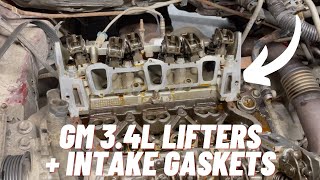
The first-generation Equinox with the 3.4L V6 is particularly known for two issues that directly cause code P0507. The first is the frequent failure of the lower intake manifold gaskets, which creates a significant vacuum leak. The original plastic-carrier gaskets degrade from heat and Dex-Cool coolant. The second is a confusing PCV valve design; on some model years, it is a non-serviceable part integrated into the valve cover, which can fail and act as a persistent vacuum leak.
Symptoms You May Notice
- Check Engine Light is on
- Engine idle speed is higher than normal (e.g., 1500-2200 RPM in Park)
- Rough or unstable idle
- Harsh engagement when shifting into gear
- Increased fuel consumption
- Hissing or sucking sounds from the engine bay, especially under acceleration
- Replacing the Throttle Position Sensor (TPS). The TPS reports the throttle plate angle; it does not cause a high idle on its own unless it fails in a way that incorrectly reports the throttle is open, which is rare. A faulty TPS usually causes other drivability issues, not just a high idle.
Most Likely Causes
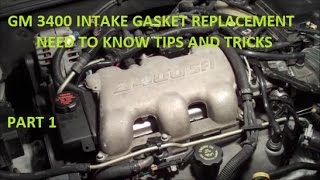
- Vacuum Leak from Lower Intake Manifold Gaskets 🔴 High Probability → Shop Engine Intake Manifold The original factory gaskets on the 3.4L V6 are a well-documented, common failure point, leading to both vacuum and coolant leaks. The plastic/nylon material degrades from exposure to engine heat and Dex-Cool coolant.
How to confirm: Perform a smoke test on the intake system. Smoke will be seen escaping from where the lower intake manifold meets the cylinder heads. Alternatively, carefully spraying starter fluid or carb cleaner around this area with the engine running will cause a noticeable change in idle RPM.
Typical fix: Replace the upper and lower intake manifold gaskets. It is strongly recommended to use the updated metal-framed gasket set (e.g., Fel-Pro MS 98014 T) for a more durable repair. This upgraded design resists heat and corrosion better than the OE plastic.
Est. part cost: $60-$120 - Dirty or Faulty Idle Air Control (IAC) Valve 🔴 High Probability → Shop Idle Air Control Valve Carbon buildup from the PCV system can cause the IAC valve's pintle to stick, preventing it from closing fully to reduce idle speed.
How to confirm: Remove the IAC valve from the throttle body. Inspect its pintle and the air passages for heavy carbon deposits. A scan tool can also show the IAC 'counts' or 'steps'; if the PCM is commanding it to 0 (fully closed) but the idle is still high, it points to a leak elsewhere or a valve that is mechanically stuck open.
Typical fix: First, try cleaning the IAC valve and its passages with throttle body cleaner. If cleaning doesn't resolve the issue, or if the valve is worn, replace the IAC valve.
Est. part cost: $40-$90 - Dirty Throttle Body 🟡 Medium Probability → Shop Fuel Injection Throttle Body Carbon and oil vapor from the PCV system can build up around the throttle plate, preventing it from closing completely at idle, which allows excess air to enter the engine.
How to confirm: Visually inspect the throttle bore and the edges of the throttle plate for a thick ring of carbon buildup. This can prevent the plate from closing completely.
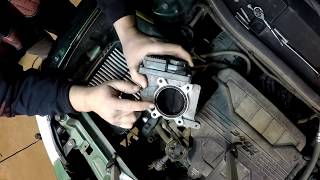
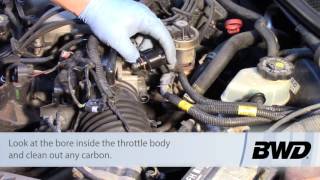
Typical fix: Clean the throttle body thoroughly with a dedicated throttle body cleaner and a soft brush, paying special attention to the area where the throttle plate seats. 🎬 See how to properly clean the throttle body to fix idle issues.
Est. part cost: $5-$15 for cleaner - Failed PCV System ⚪ Low Probability On some later models in this year range, the PCV orifice is integrated into the front valve cover and is not separately serviceable. If it fails or clogs, the entire valve cover must be replaced. Earlier models may have a serviceable valve, but it can be difficult to access.
How to confirm: Inspect the PCV hoses for cracks or disconnection. A stuck-open PCV valve acts as a constant vacuum leak. If the valve is integrated into the cover, diagnosis is more difficult and is often done after other causes are ruled out.
Typical fix: Replace cracked hoses. If the PCV valve is separate, attempt to clean or replace it. If it's integrated into the valve cover, the entire valve cover must be replaced.
Est. part cost: $10-$20 for hoses, $50-$80 for a valve cover
Rare But Worth Checking
- Leaking Brake Booster: → Shop Power Brake Booster The brake booster uses engine vacuum to operate. A leak in its internal diaphragm can create a large, unmetered vacuum leak, causing a high idle. This can be checked by pinching off the vacuum hose to the booster and listening for a change in idle speed. If the idle drops when the hose is pinched, the booster is leaking internally.
Diagnosis Steps
- Read all fault codes with an OBD-II scanner. Note if P0171 or P0300 are also present, as this strongly suggests a vacuum leak.
- Visually inspect all vacuum hoses connected to the intake manifold and throttle body for cracks, disconnection, or brittleness.
- Perform a smoke test. This is the most effective way to find vacuum leaks. Introduce smoke into the intake system and watch for leaks, paying close attention to the intake manifold gaskets, PCV hoses, and the brake booster hose.
- If no vacuum leaks are found, remove the air intake ducting from the throttle body. Inspect the throttle plate and bore for carbon buildup. Clean if necessary.
- Locate and remove the Idle Air Control (IAC) valve on the side of the throttle body. Inspect the pintle and passages for carbon. Clean thoroughly with throttle body cleaner or replace the valve if it appears damaged 🎬 Watch: A step-by-step guide to replacing the Idle Air Control valve. or cleaning does not help.
- Inspect the PCV system. Check the condition of the hose from the valve cover to the intake. Determine if your vehicle has a serviceable PCV valve or one integrated into the valve cover.
- After any cleaning or replacement of the IAC or throttle body, an idle relearn procedure may be necessary. A common GM procedure is to start the engine, let it idle in Park for 3 minutes, turn the engine off for 60 seconds, then restart and idle for another 3 minutes.
Parts You'll Likely Need
- Lower Intake Manifold Gasket Set — This is the most common point of failure leading to a vacuum leak and a P0507 code on the 3.4L V6 engine. The upgraded design provides a more reliable seal.
Trusted brands: Fel-Pro (Part #MS 98014 T)
OEM price range: $90-$150
Aftermarket price range: $60-$120 - Idle Air Control Valve
(OEM #17113390)— Carbon buildup can cause this valve to stick open, preventing the PCM from being able to lower the engine idle speed.
Trusted brands: ACDelco (Part #214-552), Standard Motor Products (AC429), Delphi (CV10034)
OEM price range: $70-$110
Aftermarket price range: $40-$90 - Front Valve Cover (with integrated PCV)
(OEM #12590410)— On models where the PCV system is integral to the valve cover, a failure requires replacement of the entire cover to fix the resulting vacuum leak.
Trusted brands: ACDelco (GM Genuine)
OEM price range: $60-$90
Aftermarket price range: $40-$70
Related Codes That Often Appear With This One
- P0171 — This 'System Too Lean' code is frequently triggered alongside P0507 because a vacuum leak is the root cause of both issues. The unmetered air raises the idle speed and also creates a lean air/fuel mixture.
- P0300 — A 'Random/Multiple Cylinder Misfire' code can appear if the vacuum leak is severe enough to disrupt the air/fuel mixture to the point of causing misfires across multiple cylinders.
Technical Service Bulletins (TSBs) & Recalls
- While no TSB is specific to P0507, TSB #03-06-04-037 discusses issues that can lead to related codes like P0300, pointing to the sensitivity of the engine management system.
Platform-Specific Known Issues
- The lower intake manifold gaskets are a known major weak point on the LNJ 3.4L V6, often failing and causing vacuum leaks that trigger P0507 and P0171 codes. Owners strongly recommend using the upgraded Fel-Pro MS 98014 T metal-frame gasket set over the OEM-style plastic ones for a lasting repair.
- The PCV valve design can be confusing. Some early models use a traditional valve that may be serviceable, while later models integrate a non-serviceable orifice into the valve cover itself, requiring full cover replacement if it fails.
Mechanic-Grade Diagnostic Values
- Scan Tool: Idle Air Control (IAC) Position Counts — expected: 20-40 counts at warm idle with no accessory load.. Failure: When P0507 is active, the IAC counts will be commanded to or near 0 as the PCM attempts to close the valve and lower the idle. If the count is 0 and the idle is still high, it confirms un-commanded air is entering the engine.
- Scan Tool: Desired RPM vs. Actual RPM — expected: Actual RPM should be within approximately 25 RPM of the Desired RPM at a stable, warm idle.. Failure: The P0507 code is set when the Actual RPM is consistently 175-275 RPM or more above the Desired RPM for several seconds.
- IAC Valve Coil Resistance — expected: Approximately 40 to 80 ohms between each pair of coil terminals (e.g., terminals 1&2 and 3&4).. Failure: An open circuit (infinite resistance) or a short (near zero resistance) on either coil indicates a failed IAC valve motor.
Scan Tool Commands That Help
- GM Tech 2: IAC Control (Engine Output Controls) — This bidirectional control allows a technician to manually command the IAC pintle to extend or retract. If commanding the valve causes the engine RPM to rise and fall accordingly, it proves the IAC motor, wiring, and PCM driver are all working correctly, pointing the diagnosis towards a vacuum leak or a mechanical blockage.
- GM Tech 2: IAC Reset / Idle Learn (Special Functions) — This function should be performed after replacing the IAC valve or cleaning the throttle body to reset the learned idle position in the PCM.
Wiring & Ground Locations
- G103 — On the left side of the engine compartment, sometimes on the cowl above the brake booster.. This is a primary ground point for the Powertrain Control Module (PCM). A poor connection here can cause erratic PCM behavior and incorrect sensor readings, potentially leading to improper idle control calculations.
- G104 — On the rear of the left (driver's side) cylinder head.. This is a critical engine ground. A loose or corroded connection can affect sensor reference voltages and overall ECM operation, which is crucial for stable idle control.
- IAC Valve Connector — The 4-pin connector on the Idle Air Control valve, mounted to the throttle body.. The four pins correspond to the two stepper motor coils inside the IAC. A technician can back-probe these pins to check for the square wave signals from the PCM that command the valve to move. Loss of signal on one or more wires indicates a wiring fault between the PCM and the IAC.
Real Owner Repair Stories
- ScannerDanner YouTube Channel (GM Vehicle with 3.4L V6 (MAP-based system, similar to Equinox)) — High idle around 850 RPM (desired was 600), P0507 code, IAC counts at 0.
❌ Tried (didn't work) Initial diagnosis was confusing because fuel trims were normal, which would typically rule out a vacuum leak on a MAF-equipped car. However, on a MAP-based engine like the 3.4L, the MAP sensor can compensate for a leak, hiding the fuel trim evidence.
✅ What actually fixed it A leaking power brake booster was found to be the source of the vacuum leak. The technician pinched off the vacuum hose to the booster, and the idle immediately dropped to normal, confirming the booster's internal diaphragm had failed. - NHTSA ODI #11721239 (Cross-model Chevrolet reference) — An owner reported a delayed engagement when moving from Park to Drive, requiring repeated shifting to get the vehicle to move. Diagnostic scans revealed P0507 alongside P0325, P0505, and P0700.
- NHTSA ODI #10593542 (Cross-model Chevrolet reference) — A report describes a P0507 code appearing in conjunction with a P1810, which resulted in the traction control system being disabled and a loss of reverse gear.
"I Checked Everything" — The Actual Cause
- A leaking power brake booster diaphragm can cause a significant vacuum leak that sets P0507. This may not show up during a standard low-pressure smoke test if the one-way check valve in the booster's vacuum hose is still functioning. The definitive test is to pinch off the vacuum hose to the booster with the engine running; if the idle speed drops, the booster is the source of the leak.
OEM Part Supersession History
17113390→Discontinued by GM. Aftermarket replacements like ACDelco 214-552 or Standard Motor Products AC429 are the service replacements.— Part lifecycle end.
Model Year Variations Within This Range
- Approximately 2007-2009: Later models in this generation are more likely to have the non-serviceable PCV orifice integrated directly into the front valve cover (GM Part #12590410). Earlier models (approx. 2005-2006) are more likely to have a traditional, replaceable PCV valve. This is not a strict cutoff and should be visually verified.
Diagnostic Flowchart
Other Known Issues on This Vehicle
Issues unrelated to this code that are worth knowing about as an owner of this generation:
- Blown Head Gasket 🔴 High — Common failure, often occurring between 60,000 and 120,000 miles. Can be caused by overheating or degradation from Dex-Cool coolant.
- Heater Core Failure / No Heat at Idle 🟠 Medium — Widespread issue where the heater blows cold at idle but hot when accelerating. Often caused by a clogged heater core, air in the cooling system, or a failing water pump. Repair is labor-intensive and expensive.
- Excessive Oil Consumption 🟠 Medium — Some owners report higher-than-normal oil consumption, which can be related to PCV issues or piston ring wear.
- HVAC Blend Door Actuator / Control Module Failure 🟡 Low — Failures in the HVAC control module or blend door actuators can cause erratic A/C behavior, such as switching modes on its own or incorrect temperature output. (Ref: A TSB exists for an ECM software update to correct A/C compressor cycling issues on 2008 models.)
- ABS Module Malfunction 🟠 Medium — Failure of the ABS control module is a known issue, leading to an illuminated ABS light and loss of anti-lock braking function.
Used vs. New Parts: Buying Guide for This Vehicle
When a used part is the smart pick: A used throttle body assembly can be a cost-effective option if it's clean and the IAC valve is confirmed to be functional. A used valve cover (for models with the integrated PCV) is also a viable option, as they are not a high-wear item.
Donor-vehicle mileage cap: roughly under 120000 miles for the part to have meaningful remaining life.
What to inspect on the donor part:
- For a throttle body, inspect the bore for deep scoring and ensure the throttle plate moves smoothly without binding.
- For a valve cover, ensure there are no cracks, especially around the bolt holes and the integrated PCV baffle area.
- Check for signs of heavy oil sludge on the underside of the valve cover, which could indicate a poorly maintained donor engine.
OEM-only on this vehicle (don't cheap out):
- While not strictly OEM-only, using a high-quality aftermarket intake manifold gasket set like the Fel-Pro metal-framed version (MS 98014 T) is critical. Avoid cheap, no-name gasket kits as the labor to replace them is significant.
Aftermarket brands forum-validated for this vehicle:
- Fel-Pro for intake manifold gaskets.
- ACDelco, Delphi, or Standard Motor Products (SMP) for the Idle Air Control (IAC) valve.
Brands owners have reported issues with on this vehicle:
- Avoid unbranded, 'white-box' electronic parts like IAC valves and sensors, as their internal components and calibration often do not meet OEM standards and can fail prematurely or cause persistent drivability issues.
Real Owner Stories
Aggregated from forums and TSBs cited above. Mileages and costs reflect what owners reported in those sources.
2008 Chevrolet Equinox 3.4L V6
Symptoms: High idle, along with codes P0300, P0171, and P0420.
What fixed it: The issues were traced back to a massive vacuum leak, strongly suspected to be the intake manifold gaskets.
Source hint: chevroletforum.com thread titled 'multiple pcodes 2008 chevy equinox'
2007 Chevrolet Equinox LS 3.4L V6
Symptoms: Troubleshooting codes P0172 and P0507.
What fixed it: The owner report in the context was cut off, but the diagnosis steps for these codes involve checking the IAC valve and intake gaskets.
Source hint: Chevrolet Forum owner report
2005 Chevrolet Equinox 3.4L V6 — ~90000 miles
Symptoms: Vacuum and coolant leaks from the lower intake manifold area.
What fixed it: Replacing the original plastic/nylon factory gaskets with an updated metal-framed gasket set.
Source hint: bobistheoilguy.com forum discussions
Related OBD-II Codes
Frequently Asked Questions
Is there a specific gasket recommended for the 3.4L V6 intake manifold leak on my Equinox?
Does TSB #03-06-04-037 apply to the engine issues causing my high idle?
Can I just replace the PCV valve on my later model 2008-2009 Equinox?
Why does my Equinox shift harshly into gear when the Check Engine Light is on for P0507?
Will cleaning the throttle body fix the P0507 code on my 3.4L V6?
Is the high idle issue on the Pontiac Torrent the same as my Chevrolet Equinox?
Helpful Videos

We Have This Part in Stock


The information in this article is provided for general reference and educational purposes only. Vehicle specifications, procedures, and part compatibility can vary by production date, trim level, and region. Always consult your vehicle's factory service manual and verify part numbers before purchasing or performing repairs. Safety-critical components such as airbags, seat belts, and braking systems should be installed by a qualified professional.
- Chevrolet Equinox:
- 🧭 Diagnostic Flowchart
- 🎬 Helpful Videos
- 🛍️ Shop This Part
- What's Unique About the 2005-2009 Chevrolet Equinox
- Symptoms You May Notice
- Most Likely Causes
- Rare But Worth Checking
- Diagnosis Steps
- Parts You'll Likely Need
- Related Codes That Often Appear With This One
- Technical Service Bulletins (TSBs) & Recalls
- Platform-Specific Known Issues
- Mechanic-Grade Diagnostic Values
- Scan Tool Commands That Help
- Wiring & Ground Locations
- Real Owner Repair Stories
- "I Checked Everything" — The Actual Cause
- OEM Part Supersession History
- Model Year Variations Within This Range
- Other Known Issues on This Vehicle
- Used vs. New Parts: Buying Guide for This Vehicle
- Real Owner Stories
- 2008 Chevrolet Equinox 3.4L V6
- 2007 Chevrolet Equinox LS 3.4L V6
- 2005 Chevrolet Equinox 3.4L V6 — ~90000 miles
- Related OBD-II Codes
- Frequently Asked Questions
- 🎟️ Get 5% Off