

P0507 on 2004-2007 Ford Freestar 3.9L: High Idle Causes and Fixes
Code P0507 on a Ford Freestar almost always means the engine is idling too high. The most common cause is a vacuum leak from a cracked PCV hose assembly, a cheap part to replace. This is a well-documented failure on the 3.9L and 4.2L V6 engines. Other likely culprits are a dirty Idle Air Control (IAC) valve or a carbon-fouled throttle body.
- Before buying any parts, carefully inspect the PCV hoses for cracks, especially the rubber elbows connected to the intake manifold.
- A hissing sound from the engine bay at idle is a strong indicator of a vacuum leak, which is the most likely cause.
- If no vacuum leaks are found, the next logical steps are to clean the throttle body and inspect/clean the Idle Air Control (IAC) valve.
- This code is often accompanied by lean codes P0171 and P0174, further pointing to a vacuum leak as the root cause.
What's Unique About the 2004-2007 Ford Freestar
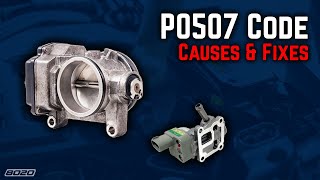
On the Freestar's 3.9L V6 engine (and its nearly identical 4.2L V6 counterpart), this code is very frequently caused by a simple, age-related failure: vacuum leaks. Specifically, the rubber hoses and elbows in the Positive Crankcase Ventilation (PCV) system are known to become brittle, oil-soaked, and crack or collapse over time. This introduces unmetered air into the engine, tricking the computer and causing the high idle. While other issues can cause P0507, a thorough inspection of the PCV hoses, particularly the complex assembly at the rear of the intake manifold, is always the first and most important step 🎬 Watch: This complete P0507 diagnosis and repair walkthrough. for this particular vehicle.
Symptoms You May Notice
- Check Engine Light is on
- Engine idle speed is noticeably high, sometimes surging to 2000 RPM or more.
- Engine may idle roughly or fluctuate in speed.
- Harsh or abrupt clunk when shifting from Park into Drive or Reverse.
- Increased effort needed on the brake pedal to hold the vehicle at a stop.
- Possible engine stalling when coming to a stop or after starting.
- A distinct hissing sound from the engine bay, indicating a vacuum leak.
- Replacing the Throttle Position Sensor (TPS). The TPS tells the computer how far the throttle is open, but it doesn't directly control idle speed. A bad TPS usually causes other performance issues but is not a primary cause for a standalone P0507 code.
- Replacing the Mass Airflow (MAF) sensor. A dirty MAF sensor can cause a variety of issues, but it's more likely to cause lean codes (P0171/P0174) and a rough or stumbling idle, rather than a consistently high idle.
Most Likely Causes
- Cracked or Collapsed PCV System Hoses 🔴 High Probability The rubber hoses, particularly the multi-port elbow assembly connecting to the rear of the intake manifold, are exposed to oil vapor and intense heat. This causes them to soften, swell, and eventually crack or collapse under engine vacuum. This is a very common failure point on Ford 3.9L and 4.2L V6 engines of this era.
How to confirm: Visually inspect all PCV hoses between the valve covers and the intake manifold. The failure is often in a pre-formed hose assembly located at the back of the engine. Pay close attention to the rubber elbows for cracks, holes, or mushy spots. A hissing sound near the hoses with the engine running is a dead giveaway. A smoke test is the most definitive method to find a leak.
Typical fix: Replace the faulty PCV hose assembly. It is highly recommended to replace the entire hose assembly (Part No. 3F2Z-6758-DA) and the PCV valve at the same time. Ford released an updated hose design that is more durable.
Est. part cost: $25-$60 - Dirty or Faulty Idle Air Control (IAC) Valve 🟡 Medium Probability → Shop Idle Air Control Valve The IAC valve regulates airflow at idle by creating a bypass around the throttle plate. Over time, it can become clogged with carbon and oil deposits, causing it to stick open. This allows too much air to bypass the throttle plate, resulting in a high idle.
How to confirm: With the engine idling high, unplug the electrical connector from the IAC valve. If the engine speed drops significantly or the engine stalls, the IAC valve is likely stuck open and is the problem. You can also remove the valve (typically held by two 8mm or 10mm bolts) and inspect its pintle and air passages for carbon buildup.
Typical fix: First, try cleaning the IAC valve and its passages with throttle body cleaner and a soft brush. If cleaning doesn't resolve the issue or the fix is temporary, the valve's internal motor is likely failing and the entire IAC valve should be replaced. After replacement, an idle relearn procedure may be necessary, which can sometimes be accomplished by driving the vehicle through a few cycles.
Est. part cost: $50-$120 - Dirty Throttle Body 🟡 Medium Probability → Shop Fuel Injection Throttle Body Carbon and gunk can build up around the throttle plate and inside the throttle bore. This accumulation can prevent the throttle plate from closing completely, creating a small gap that allows excess air to enter the engine, raising the idle speed.
How to confirm: Remove the air intake tube from the throttle body. Visually inspect the throttle plate and the bore for a black, sticky layer of carbon. The buildup is often most significant on the back side of the plate and the area where it seats when closed.
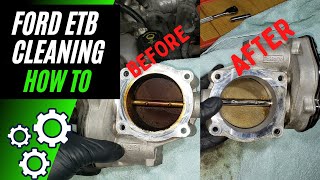
Typical fix: Clean the throttle body thoroughly using a dedicated throttle body cleaner (not carburetor cleaner) and a soft brush or microfiber cloth. Manually open the throttle plate to clean all surfaces. 🎬 Watch: How to safely clean a Ford electronic throttle body. Replace the throttle body gasket if it is removed or damaged.
Est. part cost: $5-$15 for cleaner and a gasket - Leaking Intake Manifold Gaskets ⚪ Low Probability → Shop Engine Intake Manifold While less common than PCV hoses, the upper and lower intake manifold gaskets can degrade and fail over time, creating a vacuum leak. This is a more significant repair but can be a root cause if all other vacuum leaks have been ruled out.
How to confirm: A professional smoke test is the best way to confirm a leaking intake manifold gasket. A less precise method involves carefully spraying a small amount of brake cleaner or unlit propane near the gasket sealing surfaces with the engine running; a change in engine RPM indicates a leak. This should be done with extreme caution due to fire risk.
Typical fix: This is a more involved repair that requires removing the upper intake manifold (plenum) to replace the gaskets. It is advisable to replace both upper and lower gaskets if undertaking this job.
Est. part cost: $40-$80 for gaskets
Rare But Worth Checking
- Stuck open PCV valve
- Leaking brake booster or vacuum line
- Faulty power steering pressure switch
Diagnosis Steps
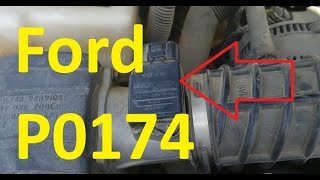
- Check for other stored trouble codes. Codes like P0171 and P0174 strongly suggest a vacuum leak. 🎬 See how vacuum leaks cause stalling and lean codes.
- With the engine running, listen for a distinct hissing sound around the top and rear of the engine, especially near the PCV hoses and intake manifold.
- Perform a thorough visual inspection of all vacuum lines and PCV hoses, especially the rubber elbows and the complex hose assembly at the rear of the intake. Look for obvious cracks, soft/swollen spots, or disconnections.
- If no obvious leaks are found, perform a smoke test to definitively locate any hard-to-see leaks in the intake system. This is the most reliable method.
- If no vacuum leaks are present, test the Idle Air Control (IAC) valve. With the engine idling high, unplug its electrical connector. A significant drop in RPM or a stall points to a faulty IAC.
- If the IAC test is inconclusive, remove the air intake duct and inspect the throttle body and plate for carbon buildup. Clean if necessary.
- If all else fails, investigate less common causes like leaking intake manifold gaskets or a faulty brake booster.
Parts You'll Likely Need
- PCV Valve Hose Assembly
(OEM #3F2Z-6758-DA)— This is the most frequent failure point leading to a vacuum leak that causes code P0507 on this engine. The original hoses become brittle and crack, especially the elbow at the rear of the intake. This part number replaces the previous version 3F2Z-6758-BA.
Trusted brands: Motorcraft, Dorman (HELP! line), Gates
OEM price range: $40-$60
Aftermarket price range: $25-$45 - Idle Air Control (IAC) Valve
(OEM #CX-1768 or 5L2Z-9F715-A)— This valve can get stuck open due to carbon buildup, causing a persistent high idle. Cleaning is a temporary fix; replacement is often necessary for a long-term solution.
Trusted brands: Motorcraft, Standard Motor Products, Hitachi
OEM price range: $90-$130
Aftermarket price range: $40-$80 - PCV Valve (Heated)
(OEM #EV-261)— It's good practice to replace the PCV valve when replacing the hoses, as it is an inexpensive part and can also get clogged. The Freestar uses a heated PCV valve, which is more expensive than a standard one.
Trusted brands: Motorcraft
OEM price range: $80-$100
Aftermarket price range: $30-$50
Related Codes That Often Appear With This One
- P0171 — This code means 'System Too Lean (Bank 1)'. A vacuum leak, which is a primary cause of P0507, allows unmetered air into the engine, creating a lean air/fuel mixture that triggers P0171.
- P0174 — This code means 'System Too Lean (Bank 2)'. It often appears with P0171 for the same reason: a significant vacuum leak is affecting both cylinder banks of the V6 engine.
Technical Service Bulletins (TSBs) & Recalls
- SSM 46085: A Special Service Message from Ford revising the diagnostic procedure for electronic throttle bodies (ETBs), though not directly a fix for P0507, it is related to the idle control system.
Platform-Specific Known Issues
- The PCV hoses, particularly the rubber elbows in the assembly at the rear of the intake manifold, are a well-documented weak point on the 3.9L and 4.2L V6 engines, frequently causing vacuum leaks that lead to lean codes and high idle conditions.
- The 4.2L V6 engine option in the Freestar and Monterey shares the exact same PCV hose assembly (3F2Z-6758-DA) and suffers from the identical failure mode causing P0507.
Documented NHTSA Reports
While the following reports involve other Ford models, they highlight how P0507 often interacts with other system failures in the manufacturer's platforms:
- NHTSA ODI #11509589 describes a diagnosis where P0507 appeared alongside P1450, leading to the discovery of a leaking fuel tank and a damaged fuel pump caused by excessive vacuum.
- An owner reported in NHTSA ODI #11024843 that P0507 was accompanied by rough idling at stops, stalling, and the vehicle cutting off in traffic while shifting down.
- NHTSA ODI #11440617 notes a case where P0507 (idle air control system RPM higher than expected) was found in conjunction with P1450 and an O2 sensor signal bias (P2195).
Mechanic-Grade Diagnostic Values
- Idle Air Control (IAC) Valve Resistance — expected: 6.0 to 13.0 ohms across the two terminals.. Failure: A reading outside this range indicates a faulty internal coil and the IAC valve should be replaced.
- Idle Air Control (IAC) Valve Internal Short Test — expected: 10,000 ohms or greater between either terminal and the IAC valve body.. Failure: A reading less than 10,000 ohms indicates the internal circuitry is shorted to the case, requiring replacement.
Wiring & Ground Locations
- G104 — Located on the left side of the engine compartment.. This is a primary ground point for multiple engine management components, including the PCM and the shield for the crankshaft position sensor wire. A poor connection here can cause erratic sensor readings and incorrect idle control.
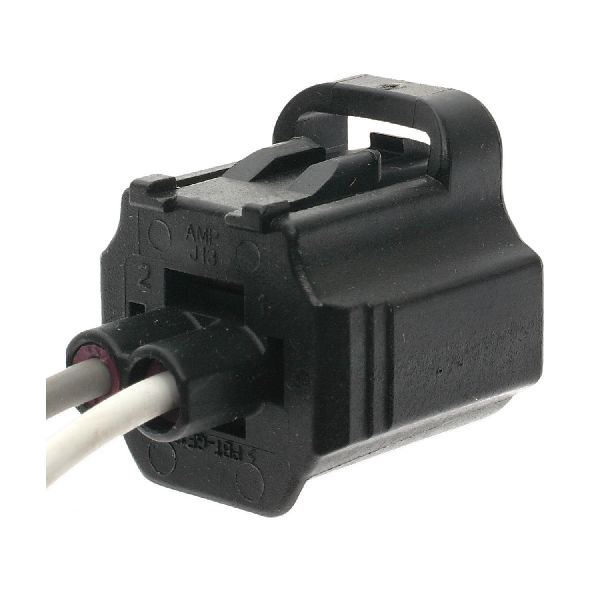
- IAC Valve Connector — On the Idle Air Control valve, mounted to the throttle body.. The two pins are for the IAC valve control signal from the PCM. Back-probing these wires can test for voltage signals, but a resistance check of the valve itself is more definitive for diagnosing a failed coil.
- Crankshaft Position Sensor Shield Wire — The wiring harness leading to the crankshaft position sensor at the front of the engine.. The two sensor wires are wrapped in a foil shield with a bare drain wire that grounds at the PCM. If this shield is damaged and the drain wire touches the engine block, it can introduce electrical noise (EMI), causing incorrect timing and idle control, potentially leading to misfires and idle issues.
Real Owner Repair Stories
- eBay review on genuine Ford part 3F2Z-6758-DA (2004 Ford Freestar 4.2L (same part as 3.9L)) — Very rough idle and lean codes affecting both banks.
✅ What actually fixed it The problem was a hole in the original PCV valve hose assembly. Replacing the entire assembly (part 3F2Z-6758-DA) resolved the rough idle and lean codes. - Automotive Forums Car Chat user (2004 Ford Freestar 3.9L with 149,000 miles) — P0507 with very high idle around 2000 RPM. Unplugging the IAC connector caused the engine to stall immediately.
❌ Tried (didn't work) Replacing the Idle Air Control (IAC) valve with a new one from AutoZone., Replacing the throttle body with a used unit.
✅ What actually fixed it The forum user was advised that a vacuum leak was the next most likely cause, which is the standard diagnostic path after the attempted fixes. The thread did not have a final resolution post from the original user confirming the fix.
OEM Part Supersession History
3F2Z-6758-BA→3F2Z-6758-DA— The original PCV hose assembly was prone to premature cracking and softening. The updated -DA part is a more durable design to better withstand heat and oil vapor.
Diagnostic Flowchart
Other Known Issues on This Vehicle
Issues unrelated to this code that are worth knowing about as an owner of this generation:
- Torque Converter Output Shaft Failure 🔴 High — Common enough to trigger a major recall on 2004-2005 models. Can lead to a sudden, complete loss of motive power. (Ref: NHTSA Recall #12V006000)
- Water Leak from Cowl onto PCM 🔴 High — A very common and well-documented issue. Water drips from the cowl panel area directly onto the Powertrain Control Module (PCM), causing corrosion and a wide array of severe electrical and transmission problems. (Ref: TSB 06-14-10)
- Premature Rear Brake Wear 🟠 Medium — Many owners report accelerated wear of the rear brake pads and rotors compared to the front brakes. (Ref: TSB #18246, TSB #042610)
- Third Row Seat Latch Corrosion 🔴 High — In regions using road salt, the sheet metal supporting the third-row seat latches can corrode, compromising the seat's integrity in a crash. (Ref: Safety Recall 13S01, TSB #16-0069)
- Internal Transmission Failures (AX4N/4F50N) 🔴 High — Beyond the torque converter recall, these transmissions are known for other internal failures, such as broken drive chains, leading to a no-move condition. Coolant intrusion from the radiator can also destroy the transmission clutches.
Used vs. New Parts: Buying Guide for This Vehicle
When a used part is the smart pick: For this specific P0507 repair, used parts are generally not recommended. The primary causes are age-related failures of rubber and electronic components. A used throttle body could be considered if it's clean and from a low-mileage donor, but the other key parts should be purchased new.
Donor-vehicle mileage cap: roughly under 60000 miles for the part to have meaningful remaining life.
What to inspect on the donor part:
- For a throttle body: check for cleanliness, absence of carbon buildup, and smooth throttle plate operation.
- For an IAC valve: visually inspect for carbon, but internal electronic failure cannot be seen, making it a gamble.
OEM-only on this vehicle (don't cheap out):
- PCV Valve Hose Assembly: While aftermarket is available, the OEM Motorcraft part (3F2Z-6758-DA) is a revised, more durable design known to fit perfectly and solve the problem long-term.
Aftermarket brands forum-validated for this vehicle:
- Motorcraft (for all parts, as it is the OEM supplier).
- Standard Motor Products (for IAC valve).
- Gates (for vacuum hoses).
Brands owners have reported issues with on this vehicle:
- Dorman PCV Hoses: Some owners across various Ford models have reported poor fitment and material quality with Dorman PCV hoses compared to the OEM Motorcraft part, sometimes failing to resolve the vacuum leak.
Real Owner Stories
Aggregated from forums and TSBs cited above. Mileages and costs reflect what owners reported in those sources.
2004 Ford Freestar 3.9L V6
Symptoms: The vehicle was throwing P0507, P0171, and P0174 codes simultaneously.
What fixed it: Replacing the entire PCV hose assembly (Part No. 3F2Z-6758-DA).
Source hint: https://www.fordforums.com/threads/2004-freestar-p0171-p0174-p0507-solved.273811/
2004 Ford Freestar 3.9L V6
Symptoms: Engine was idling at 2000 RPM. Unplugging the IAC caused the engine to stall. Replacing the IAC and the throttle body did not fix the high idle.
What fixed it: The owner was advised to check for vacuum leaks first, as replacing the IAC and throttle body failed to resolve the 2000 RPM idle.
Source hint: https://www.automotiveforums.com/t1002341-ford_freestar_p0507_code.html
2004 Ford Freestar 4.2L V6
Symptoms: The engine had a very rough idle and was running lean on both banks (side 1 and 2).
What fixed it: Installation of an original Ford PCV valve hose. The owner noted it is important to look for holes in the PCV valve hose.
Source hint: https://www.ebay.com/p/1123019013 user review
Related OBD-II Codes
Frequently Asked Questions
My 2004 Freestar is idling at 2000 RPM. Is there a simple test to see if the Idle Air Control (IAC) valve is the problem?
Is there a specific part number for the PCV hose assembly that commonly fails on the 3.9L and 4.2L V6?
Does the Mercury Monterey suffer from the same P0507 high idle issues as the Freestar?
I heard there was a major recall for the 2004-2005 Freestar; is it related to the P0507 code?
Are there any Ford TSBs or service messages regarding the idle control system on this vehicle?
Can I use carburetor cleaner to clean the throttle body on my 3.9L Freestar?
Helpful Videos

We Have This Part in Stock


The information in this article is provided for general reference and educational purposes only. Vehicle specifications, procedures, and part compatibility can vary by production date, trim level, and region. Always consult your vehicle's factory service manual and verify part numbers before purchasing or performing repairs. Safety-critical components such as airbags, seat belts, and braking systems should be installed by a qualified professional.
- Ford Freestar:
- 🧭 Diagnostic Flowchart
- 🎬 Helpful Videos
- 🛍️ Shop This Part
- What's Unique About the 2004-2007 Ford Freestar
- Symptoms You May Notice
- Most Likely Causes
- Rare But Worth Checking
- Diagnosis Steps
- Parts You'll Likely Need
- Related Codes That Often Appear With This One
- Technical Service Bulletins (TSBs) & Recalls
- Platform-Specific Known Issues
- Documented NHTSA Reports
- Mechanic-Grade Diagnostic Values
- Wiring & Ground Locations
- Real Owner Repair Stories
- OEM Part Supersession History
- Other Known Issues on This Vehicle
- Used vs. New Parts: Buying Guide for This Vehicle
- Real Owner Stories
- 2004 Ford Freestar 3.9L V6
- 2004 Ford Freestar 3.9L V6
- 2004 Ford Freestar 4.2L V6
- Related OBD-II Codes
- Frequently Asked Questions
- 🎟️ Get 5% Off