

P0514 on 2017 Alfa Romeo Giulia: Battery Monitor Performance Fault Guide
On a 2017 Alfa Romeo Giulia, code P0514 points to a fault in the Battery Monitor Module's temperature sensor. The most common fix is replacing the Intelligent Battery Sensor (IBS), which is attached to the negative battery terminal. A software update (TSB 18-030-17) may also be required for early production models. After hardware replacement, a battery disconnect reset procedure is often necessary.
- P0514 on a 2017 Giulia specifically refers to a fault with the battery temperature monitoring, handled by the Intelligent Battery Sensor (IBS) on the negative terminal.
- The most common fix is replacing the entire negative battery terminal assembly, which includes the IBS (Part #50548044).
- For early 2017 models (built before June 29, 2017), check if TSB 18-030-17 has been performed, as a software update may resolve the issue without replacing parts.
- A weak or old battery can cause this code and many other electrical problems on this sensitive platform.
- After any battery disconnection, a reset procedure (turning steering wheel lock-to-lock) is required to clear temporary system warnings.
What's Unique About the 2017-2017 Alfa Romeo GIULIA

Alfa Romeo, like many modern European vehicles, uses a sophisticated Intelligent Battery Sensor (IBS) that does more than just read temperature; it monitors voltage, current, and calculates the battery's state-of-charge and state-of-health to manage the start/stop system and charging strategy. A key issue for the 2017 Giulia, as documented in TSB #18-030-17 REV. D, is that P0514 can be triggered as part of a cluster of seemingly unrelated fault codes. For vehicles built on or before June 29, 2017, this may be resolved by an ECM software update rather than a hardware replacement.
Diagnostic Flowchart

Tap your situation to follow the diagnostic path that matches what you're seeing on this vehicle.
Symptoms You May Notice

- Check Engine Light is illuminated.
- Malfunction or complete unavailability of the auto start/stop system (often with a dashboard message).
- Potential for a weakened or prematurely worn-out battery over time due to incorrect charging voltage.
- In rare cases, a battery warning light may appear on the dashboard.
- A cascade of other, seemingly unrelated warning lights (e.g., for ESC, Hill Hold, Power Steering) may appear, especially after a battery disconnect or if battery voltage is low.
- Replacing the alternator when it is not the root cause. While charging system issues can be related, the P0514 code specifically points to the temperature sensing circuit within the IBS, not the alternator's output itself.
Most Likely Causes

- Faulty Intelligent Battery Sensor (IBS) 🔴 High Probability → Shop Vehicle Battery The IBS is a complex electronic component mounted in the harsh environment of the battery compartment. Electronic failure is the most common reason for this code, sometimes accompanied by code U1427-87 (Missing message from IBS).
How to confirm: Using a diagnostic scan tool, observe the live data for the battery temperature. If the reading is fixed at an extreme value (e.g., -40°F or 250°F) or doesn't change with ambient temperature, the sensor is likely faulty. Also, check the small connector on the IBS to ensure it hasn't been accidentally disconnected during battery service.
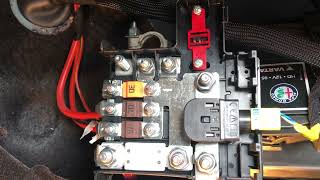
Typical fix: Replace the Intelligent Battery Sensor (IBS). This part is attached to the negative battery terminal clamp. After replacement, a battery disconnect reset procedure is required.
Est. part cost: $100-$150 - Corroded or Loose Battery Terminals 🟡 Medium Probability → Shop Vehicle Battery Alfa Romeo vehicles are noted to be sensitive to battery connection integrity. Corrosion on the battery posts or a loose connection at the IBS can cause faulty readings and a host of electrical issues.
How to confirm: Visually inspect the negative battery terminal, the IBS connector, and the battery posts for any signs of white, blue, or green corrosion or looseness.
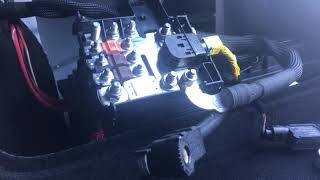
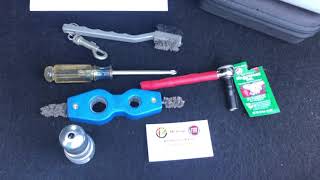
Typical fix: Disconnect the battery (negative terminal first), clean the posts and terminal clamps thoroughly with a wire brush, and re-secure them. Apply a dielectric grease or anti-corrosion gel to prevent future buildup. 🎬 Watch: How to clean battery posts and find the starter relay.
Est. part cost: $5-$10 - Outdated Engine Control Module (ECM) Software 🟡 Medium Probability → Shop Engine Control Module (ECM) TSB #18-030-17 REV. D explicitly lists P0514 among several codes that can be erroneously triggered on vehicles built on or before June 29, 2017. This indicates the original software calibration was overly sensitive or had logic flaws.
How to confirm: Check if other codes mentioned in TSB #18-030-17 (like P062A, P0128, P0244) are also present. A dealership can verify if the software update from the TSB has been applied to the vehicle by checking its VIN.
Typical fix: Have an Alfa Romeo dealership perform the software reflash as specified in Technical Service Bulletin #18-030-17.
Est. part cost: $0-$200 - Weak or Failing Battery ⚪ Low Probability → Shop Vehicle Battery The Giulia's complex electrical system is very sensitive to battery voltage and health. An aging battery can cause a host of unpredictable electrical faults, sometimes including P0514 if the IBS cannot get stable readings.
How to confirm: Have the battery professionally tested using a load tester or a modern electronic tester that can evaluate its state of health (SoH). A simple voltage check is not sufficient.
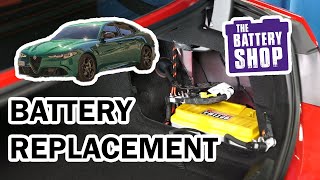
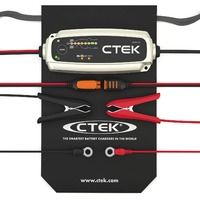
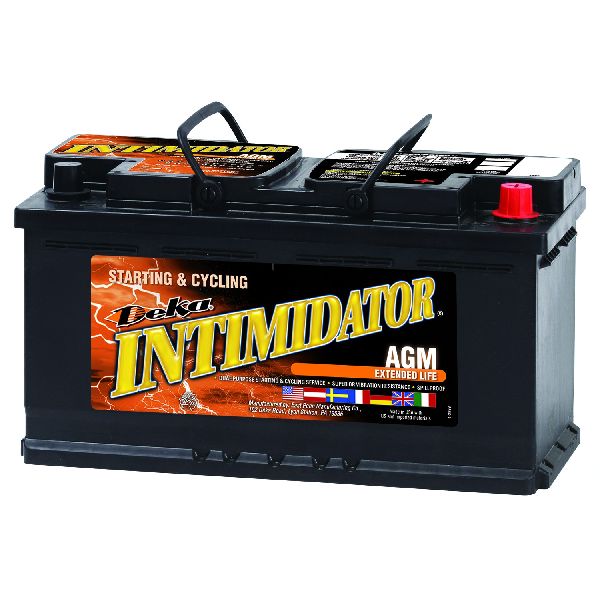
Typical fix: Replace the battery with a new one of the correct type (AGM or EFB, check OEM spec) and register it with the vehicle's system using a compatible scan tool. 🎬 See this walkthrough for a proper Giulia battery installation. Some sources suggest registration is not strictly required, as the IBS will 'learn' the new battery over several drive cycles, but start/stop may be disabled during this period.
Est. part cost: $250-$450
Rare But Worth Checking
- Damaged Wiring Harness:
Diagnosis Steps
- Scan the ECM for any other stored trouble codes. Note if codes from TSB #18-030-17 or U1427-87 are present.
- Visually inspect the battery, its terminals, and the Intelligent Battery Sensor (IBS) on the negative terminal for corrosion, damage, or loose connections. Ensure the small plug on the IBS is securely connected.
- Using a capable OBD-II scanner (like MultiECUScan), access the live data stream and monitor the 'Battery Temperature' parameter. Verify if the reading is plausible for the current ambient conditions.
- If the temperature reading is stuck at a default value (e.g., -40°F) or is clearly incorrect, and the wiring is intact, the IBS is faulty.
- Perform a comprehensive test of the 12V battery to check its state of charge and state of health. A weak battery can cause various electrical faults on the Giulia.
- If multiple TSB-related codes are present, consult a dealer to check if the vehicle's software is up to date, especially if built before June 29, 2017.
- If the IBS or battery is replaced, clear all codes. Perform the steering angle sensor reset by starting the engine and turning the steering wheel fully lock-to-lock, then centering it. This should clear most temporary warnings. Some users report an 'on-off' key cycle method can also clear non-active codes. 🎬 Watch: How to clear dashboard faults after a battery disconnect.
Parts You'll Likely Need
- Intelligent Battery Sensor (IBS)
(OEM #50548044)— This module contains the temperature sensor that fails, triggering code P0514. It is the most common hardware failure for this specific code. It is sold as a complete negative terminal assembly.
Trusted brands: Mopar (OEM)
OEM price range: $100-$150
Aftermarket price range: $70-$120
Related Codes That Often Appear With This One
- P062A — Listed together in TSB #18-030-17, suggesting a common software-related trigger.
- P0128 — Listed together in TSB #18-030-17, suggesting a common software-related trigger.
- P0244 — Listed together in TSB #18-030-17, suggesting a common software-related trigger.
- U1427-87 — This code for 'Missing message from IBS' often appears alongside P0514, strongly indicating a faulty or disconnected Intelligent Battery Sensor.
Technical Service Bulletins (TSBs) & Recalls
- 18-030-17 REV. D: Addresses a condition where P0514 may be set along with other DTCs on vehicles built on or before June 29, 2017, and recommends a software update for the ECM.
Platform-Specific Known Issues
- TSB Software Update: TSB #18-030-17 indicates that on 2017 models built before late June, P0514 can be part of a group of fault codes that are resolved by an ECM software update, not a hardware replacement.
- Battery System Sensitivity: → Shop Vehicle Battery These vehicles are highly sensitive to battery health and proper connections. Minor corrosion or a weak battery is known to cause a wide array of seemingly unrelated electrical error messages and system warnings.
- Post-Replacement Reset Procedure: After disconnecting the battery for any service, a specific reset procedure is required. The car will display multiple errors (steering, ESC, etc.) upon restart. These are typically cleared by starting the engine and turning the steering wheel from full left lock to full right lock, then back to center.
Mechanic-Grade Diagnostic Values
- IBS LIN Bus Signal Waveform — expected: A square wave alternating between approximately 0V and 12V (battery voltage).. Failure: A flat line at 0V, 12V, or an intermediate voltage indicates a communication failure, which could be caused by a faulty master (BCM), slave (IBS), or a short/open in the wiring.
- MultiECUScan Live Data: 'Battery Current from IBS' — expected: The raw value displayed in the software must be divided by approximately 128 to get the true current reading in Amperes (A).. Failure: Making diagnostic decisions based on the raw, unscaled value will lead to incorrect conclusions about battery charging or discharging rates.
- IBS Connector Voltage — expected: The 2-pin connector should have a 12V power supply on one pin (often a red/green wire) and the LIN bus signal on the other (often a gray/green wire).. Failure: Absence of 12V power on the supply pin will cause the sensor to be completely inoperative, even if the sensor itself is good.
Hidden / Shadow Codes Worth Checking
- P0516: Battery Temperature Sensor Circuit Low. This code may appear alongside or instead of P0514, pointing to the same faulty component or circuit. (see via Standard OBD-II scan tool or MultiECUScan.)
- P058D: Generic information error logged in the ECU. On Fiat-Chrysler platforms, this has been traced by owners to be triggered by a faulty IBS, even though the code itself is not specific. (see via MultiECUScan or other advanced diagnostic tools.)
Scan Tool Commands That Help
- MultiECUScan: Read IBS Parameters — Use this function to view live data from the IBS, such as 'Battery Current', 'Battery Voltage', and 'IBS battery charge (%)'. This is crucial for determining if the sensor is reporting logical data.
- MultiECUScan: Proxy Alignment Procedure — After replacing a major electronic module like the IBS or BCM, a proxy alignment is required to ensure all modules on the CAN network recognize each other. Failure to do so can result in a flashing odometer and other electrical gremlins.
Wiring & Ground Locations
- IBS Connector — A small 2-pin connector plugging directly into the Intelligent Battery Sensor module on the negative battery terminal clamp in the trunk.. This is the direct connection to the sensor. It provides both power (Pin 1, Red/Green wire) and the LIN bus communication line (Pin 2, Gray/Green wire). A loose connection or damage here is a primary point of failure.
- BCM Connector C5, Pin 2 — The Body Control Module (BCM) is located behind the trim in the trunk. The LIN bus wire from the IBS connects to Pin 2 of the C5 connector on the BCM.. This is the termination point for the IBS data line. If the sensor and its local connector are good, a fault could exist in the wiring between this pin and the IBS, or within the BCM itself (which acts as the LIN master).
- Engine/Transmission Ground Strap — A braided metal strap connecting the chassis to the transmission case. On RWD models, it's on the passenger side; on AWD models, it's on the driver's side.. While not a direct cause of P0514, this ground strap is notoriously prone to corrosion and failure. A poor ground can cause widespread, unpredictable electrical issues and voltage fluctuations, potentially confusing sensitive modules like the IBS and BCM. It should be inspected during any electrical diagnosis on this platform.
Real Owner Repair Stories
- ClubAlfa.it forum user (Alfa Romeo Stelvio (mechanically and electrically very similar to Giulia)) — Start/Stop system unavailable, check engine light with codes P058D and P0516.
❌ Tried (didn't work) Replacing the battery., Replacing the Intelligent Battery Sensor (IBS).
✅ What actually fixed it The user diagnosed a lack of 12V power at the IBS 2-pin connector. After tracing the wiring, they found and repaired the fault in the power supply wire to the IBS, which restored sensor function and cleared the codes. - Reddit user on r/AlfaRomeo (2020 Alfa Romeo Giulia) — Check engine light, 'automatic shut off unavailable' message, and a random assortment of communication (U-codes) and body (B-codes) faults.
❌ Tried (didn't work) Clearing the codes (they returned after a week).
✅ What actually fixed it The user replaced the original battery, even though it was only a couple of years old. This resolved all the random error codes.
OEM Part Supersession History
50543928, 50546498→50548044— Standard part evolution and revision.
Model Year Variations Within This Range
- 2017 (Build date on or before June 29, 2017): Vehicles built before this date may have overly sensitive ECM software that can erroneously trigger P0514 along with a cluster of other codes. TSB #18-030-17 recommends a software update as the primary fix, rather than hardware replacement.
Helpful Videos
We Have This Part in Stock


The information in this article is provided for general reference and educational purposes only. Vehicle specifications, procedures, and part compatibility can vary by production date, trim level, and region. Always consult your vehicle's factory service manual and verify part numbers before purchasing or performing repairs. Safety-critical components such as airbags, seat belts, and braking systems should be installed by a qualified professional.
- Alfa Romeo GIULIA:
- 🧭 Diagnostic Flowchart
- 🎬 Helpful Videos
- 🛍️ Shop This Part
- What's Unique About the 2017-2017 Alfa Romeo GIULIA
- Symptoms You May Notice
- Most Likely Causes
- Rare But Worth Checking
- Diagnosis Steps
- Parts You'll Likely Need
- Related Codes That Often Appear With This One
- Technical Service Bulletins (TSBs) & Recalls
- Platform-Specific Known Issues
- Mechanic-Grade Diagnostic Values
- Hidden / Shadow Codes Worth Checking
- Scan Tool Commands That Help
- Wiring & Ground Locations
- Real Owner Repair Stories
- OEM Part Supersession History
- Model Year Variations Within This Range
- 🎟️ Get 5% Off