

P0520 on 2005-2013 Chevrolet Corvette: Engine Oil Pressure Sensor Circuit Causes and Fixes
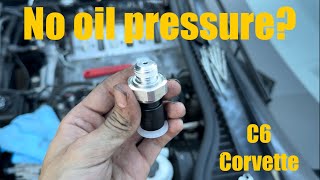
On a C6 Corvette with an LS2, LS3, or LS7 engine, code P0520 is almost always caused by a failed engine oil pressure sensor (also called a sending unit). The sensor is in a difficult-to-reach location behind the intake manifold, making replacement a 2-4 hour job. Some owners access it by using a special 1 1/16" oil pressure sensor socket with multiple extensions and swivels, while others find it easier to remove the intake manifold. Expect to pay $40-$90 for a quality OEM replacement part (ACDel
- P0520 on a C6 Corvette almost always points to a failed oil pressure sensor.
- Before replacing any parts, check the oil level and confirm the engine isn't making any unusual noises like knocking or ticking.
- The most difficult part of the repair is accessing the sensor, which is located at the back of the engine against the firewall.
- Always use a high-quality replacement sensor, like ACDelco (part #12677836), to avoid premature failure.
- Verifying actual oil pressure with a mechanical gauge is the only way to be 100% certain the issue is electrical and not a more serious mechanical problem.
What's Unique About the 2005-2013 Chevrolet Corvette
On the LS series of engines (LS2, LS3, LS7) used in the C6 Corvette, the oil pressure sensor is a notorious failure point. The sensor is located at the very back of the engine block, tucked behind the intake manifold and close to the firewall. This location subjects it to significant heat cycles, which causes the electronics inside the sensor to fail over time. The failure is so common that many owners consider it a 'rite of passage' and will likely experience it at some point. Some owners have even developed methods of cutting an access hole in the cowl to make future replacements easier, or have installed relocation kits.
Symptoms You May Notice
- Check Engine Light is on
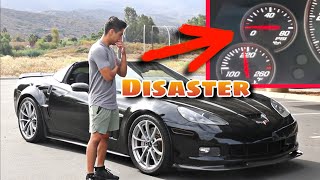
- Oil pressure gauge reads zero, an incorrect value (e.g., pegged at max), or 'XXX' on the Driver Information Center (DIC).
- Low Oil Pressure warning message on the DIC 🎬 See what a real C6 Corvette oil pressure failure looks like
- In some cases, the engine may enter a reduced power or "limp mode".
- Engine may exhibit unusual noises like knocking or ticking if the code is accompanied by a true low oil pressure condition.
- Replacing the oil pump without verifying the actual oil pressure with a mechanical gauge.
- Replacing the instrument cluster or PCM before confirming the sensor and its circuit are functioning correctly.
- Assuming an engine replacement is needed due to a zero PSI reading on the gauge, without first suspecting the common sensor failure.
Most Likely Causes
- Failed Engine Oil Pressure Sensor (Sending Unit) 🔴 High Probability The sensor is located in a high-heat area at the back of the engine, leading to premature failure of its internal electronics. This is a well-documented weak point on LS engines and the most common cause for P0520.
How to confirm: If the oil level is correct and the engine is running quietly, a gauge reading of zero or a constant high/low value strongly indicates a failed sensor. The definitive test is to verify actual oil pressure with a mechanical gauge.
Typical fix: Replace the oil pressure sensor. Due to its location, this often requires either the removal of the intake manifold for access or the use of a special 1 1/16" deep socket with a combination of extensions and swivel joints to reach it from the side.
Est. part cost: $40-$90 - Damaged Wiring or Connector 🟡 Medium Probability The wiring and connector are also subjected to the same high-heat conditions as the sensor, which can make them brittle and prone to cracking or corrosion over time. The connector's plastic locking tab can become fragile and break during removal.
How to confirm: Visually inspect the connector and wiring leading to the sensor for any signs of melting, cracking, or oil contamination. Test for 5V reference, ground, and signal continuity with a multimeter. The connector is often difficult to see without removing the intake manifold.
Typical fix: Repair the damaged section of wiring or replace the connector pigtail.
Est. part cost: $15-$30 - Low Engine Oil Level or Poor Oil Condition ⚪ Low Probability
How to confirm: Check the engine oil dipstick. If the oil level is low, top it off. If the oil is very old, dirty, or has the wrong viscosity, it can affect pressure readings.
Typical fix: Perform an oil and filter change using the correct specification oil (typically a full synthetic 5W-30 for these engines).
Est. part cost: $50-$100
Rare But Worth Checking
- Failing Oil Pump: While rare, a P0520 can be triggered by the erratic pressure produced by a failing oil pump. This would typically be accompanied by other symptoms like engine noise (ticking, whining) and other oil pressure-related codes. A mechanical gauge test is required to diagnose this.
- Powertrain Control Module (PCM) Fault: → Shop Engine Control Module (ECM) This is extremely unlikely. The PCM should only be considered a potential cause after all other possibilities, including the sensor, wiring, and mechanical oil pressure, have been thoroughly ruled out.
Diagnosis Steps
- Check the engine oil level and condition. Ensure the oil is full and clean.
- Read the code with an OBD-II scanner. Note if any other codes are present, especially P0521, P0522, or P0523.
- Observe the oil pressure gauge behavior. Does it read zero, max out, or fluctuate wildly? A pegged gauge often points directly to a failed sensor.
- CRITICAL STEP: Verify actual engine oil pressure. Remove the factory sensor and install a mechanical oil pressure gauge. Start the engine and compare the mechanical reading to the vehicle's specifications. If mechanical pressure is good, the problem is electrical (sensor, wiring, or PCM). If mechanical pressure is low, there is a serious internal engine issue (oil pump, bearings, etc.) that requires immediate attention.
- If mechanical pressure is good, inspect the oil pressure sensor's connector and wiring for damage, corrosion, or oil saturation. This is difficult without at least partially removing the intake manifold.
- Using a multimeter, test the sensor's circuit for the correct 5-volt reference signal from the PCM, a good ground, and a proper signal return.
- If the wiring and voltages are correct, the oil pressure sensor itself is faulty and must be replaced.
Parts You'll Likely Need
- Engine Oil Pressure Sensor / Switch
(OEM #12677836)— This sensor is the most common point of failure for the P0520 code on LS engines due to its design and location. Part number 12616646 has been superseded multiple times, with 12677836 being the current replacement.
Trusted brands: ACDelco, GM Genuine
OEM price range: $40-$90
Aftermarket price range: $25-$60 - Oil Pressure Sensor Socket — A special 1 1/16-inch deep socket is required to remove and install the sensor, especially if attempting the repair without removing the intake manifold.
Trusted brands: Lisle, OEMTools
Aftermarket price range: $10-$20 - Intake Manifold Gaskets — If the intake manifold is removed to access the sensor, it is best practice to replace the gaskets to prevent vacuum leaks.
Trusted brands: Fel-Pro, ACDelco
OEM price range: $30-$50
Aftermarket price range: $20-$40
Related Codes That Often Appear With This One
- P0521 — P0521 indicates 'Engine Oil Pressure Sensor/Switch Range/Performance'. A failing sensor can send readings that are out of the expected performance range, triggering both codes.
- P0522 — P0522 indicates 'Engine Oil Pressure Sensor/Switch Circuit Low'. This can be set if the sensor fails by shorting to ground.
- P0523 — P0523 indicates 'Engine Oil Pressure Sensor/Switch Circuit High'. This can be set if the sensor's internal circuit fails open, often causing the gauge to peg at its maximum reading (80 psi on a C6).
Platform-Specific Known Issues
- The primary issue for this vehicle is the difficult-to-access location of the oil pressure sensor. It is located behind the intake manifold against the firewall. While some mechanics can replace it without removing the manifold using a combination of swivels and extensions, it is a very tight space to work in and often done by feel. Most procedures, and many DIYers, find it necessary to remove the intake manifold to gain proper access. Some owners have resorted to cutting an access hole in the plastic cowl panel for easier access. 🎬 Watch: Step-by-step LS3 oil pressure sensor replacement walkthrough
Mechanic-Grade Diagnostic Values
- Engine Oil Pressure Sensor 5V Reference — expected: ~5.0 V at the sensor connector (Gray wire) with key on, engine off.. Failure: Voltage significantly lower than 5.0V or 0V indicates a wiring issue or a problem with the PCM's 5V reference circuit.
- Engine Oil Pressure Sensor Signal Voltage — expected: Approximately 0.5V at idle, increasing with RPM. Should not be 0V or a constant 5V.. Failure: A reading of 0V or near 0V can trigger P0522 (Circuit Low). A reading stuck near 5V can trigger P0523 (Circuit High). Either condition can also trigger the general P0520 circuit fault.
- Mechanical Oil Pressure (LS2/LS3/LS7) — expected: Minimum 6 psi at 1,000 RPM, 18 psi at 2,000 RPM, and 24 psi at 4,000 RPM when hot. A healthy engine will typically show 25-45 psi at hot idle and 50-70 psi under load.. Failure: Pressure below these minimums indicates a mechanical engine problem (oil pump, bearings, etc.), not a sensor circuit fault.
Scan Tool Commands That Help
- Tech2 / GDS2: Live Data - Engine Oil Pressure Sensor Voltage/Pressure — This is the primary way to monitor what the PCM is seeing from the sensor in real-time. A reading that is stuck high (e.g., 130 psi) or low (0 psi) despite a running engine points directly to a sensor or circuit issue.
Wiring & Ground Locations
- Oil Pressure Sensor Connector Pinout — At the sensor, located on the back of the engine block behind the intake manifold.. Testing for voltage and ground at the connector is a key diagnostic step. Pin A (Tan/White wire) is the signal wire to the PCM. Pin B (Black/White wire) is the low reference/ground. Pin C (Gray wire) is the 5-volt reference from the PCM.
- G107 — On the engine block, just below the driver's side cylinder head.. This is a critical engine ground. While not directly for the oil pressure sensor's low reference (which is provided by the PCM), a loose or corroded G107 can cause widespread electrical issues and erratic sensor behavior, including no-start conditions that could be misdiagnosed.
- G105 / G106 — On the frame rails in the engine bay, near the front. G105 is on the driver's side, G106 is on the passenger's side.. These are major chassis grounds. Poor connections here can introduce electrical noise and unstable voltages for various systems, potentially affecting PCM operation and sensor readings.
Real Owner Repair Stories
- CorvetteForum.com user (2006 C6 Corvette) — Oil pressure gauge pegged at 80 PSI, then later read 130 PSI on the DIC even with the car off. P0520 code present.
❌ Tried (didn't work) Initially, the user suspected the gauge cluster.
✅ What actually fixed it Replacing the original oil pressure sensor with a new ACDelco unit (part #12677836) temporarily fixed the issue, but it failed again in two days. The ultimate resolution for many owners in the thread was to either use a specific brass-bodied aftermarket sensor or install a relocation kit to move the sensor away from the high-heat area.
OEM Part Supersession History
12585328, 12616646→12677836 (also cross-references to ACDelco D1846A)— Design and material improvements to increase durability and resistance to heat-related failure.
Heads up: While all are physically interchangeable, the latest part number (12677836) is the recommended replacement for improved longevity. Some owners report even the newest OEM parts failing and prefer specific aftermarket brass-bodied sensors.
Model Year Variations Within This Range
- 2005-2007 (LS2) vs 2008-2013 (LS3): While the P0520 code and sensor failure are common to both, the LS3 engine (2008+) featured revisions to the oiling system for better performance. The fundamental cause of P0520 (sensor failure due to heat) remains identical across these engines, as the sensor location and design are the same.
Diagnostic Flowchart
Other Known Issues on This Vehicle
Issues unrelated to this code that are worth knowing about as an owner of this generation:
- Harmonic Balancer Wobble 🔴 High — Common across all C6 model years. The rubber bonding the inner and outer rings of the balancer fails, causing a visible wobble and often a 'chirping' sound from the belt. If it fails completely, it can cause significant engine damage. (Ref: TSB #05-06-01-001A was issued for early 2005 models for a loose bolt, but the delamination issue affects all years.)
- Fuel Level Sending Unit Failure 🟠 Medium — A very common issue where the fuel gauge reads empty after a fill-up or becomes erratic. It's caused by wear on the sender's contact fingers inside the fuel tank. The repair is labor-intensive as it requires dropping the fuel tank(s). (Ref: A service bulletin was released for early models, but the problem persists across the generation.)
- LS7 Valve Guide Wear (Z06 Models) 🔴 High — Specific to the 7.0L LS7 engine in the Z06. Machining errors from the factory can cause excessive wear on the valve guides, potentially leading to a dropped valve and catastrophic engine failure. Many owners perform a preventative fix by having the cylinder heads rebuilt with aftermarket guides. (Ref: GM issued TSB #13-06-01-001A acknowledging customer concerns but downplaying the prevalence.)
- Service Active Handling System Message 🟠 Medium — This warning can be triggered by numerous issues, most commonly a faulty steering wheel position sensor or a weak battery. In some cases, the system can erroneously apply the brakes, creating a safety hazard. A common fix involves securing a connector under the steering column. (Ref: TSB #06-02-35-002B addresses the steering wheel position sensor connector.)
- Flying Roof Panel (Targa Top Delamination) 🔴 High — Primarily affects 2005-2007 models. The adhesive bonding the roof panel to its frame can fail, causing the panel to separate from the car, often at highway speeds. (Ref: Subject to NHTSA recall #09V493000, which superseded an earlier, less effective recall.)
Used vs. New Parts: Buying Guide for This Vehicle
When a used part is the smart pick: For this repair, using a used part is almost never a smart choice. The primary failure part, the oil pressure sensor, is an inexpensive electronic component with a known high failure rate due to heat cycles. A used sensor has an unknown amount of life and is very likely to fail soon. A used intake manifold could be considered if the original is damaged during removal, but it's rare.
What to inspect on the donor part:
- Not applicable for the sensor. For a used intake manifold, check for cracks, stripped threads, and a flat, unwarped mating surface.
OEM-only on this vehicle (don't cheap out):
- Engine Oil Pressure Sensor
Aftermarket brands forum-validated for this vehicle:
- Standard Motor Products (SMP) PS308T is often cited by forum members as a more durable, brass-bodied alternative to the OEM aluminum sensor.
Brands owners have reported issues with on this vehicle:
- Unbranded, no-name sensors from online marketplaces often have high failure rates and should be avoided due to the high labor cost of replacement.
Real Owner Stories
Aggregated from forums and TSBs cited above. Mileages and costs reflect what owners reported in those sources.
2005 Chevrolet Corvette C6
Symptoms: The oil pressure gauge was reading 0 psi.
What fixed it: Replaced the oil pressure sending unit without removing the intake manifold.
Source hint: CorvetteForum.com: "oil pressure sending unit"
2005 Chevrolet Corvette C6
Symptoms: The oil pressure was fluctuating, signaling an impending failure of the sensor.
What fixed it: The owner detailed the process of removing the intake manifold to gain access to the sensor for replacement.
Cost: $600-$600
Source hint: CorvetteForum.com: "Oil pressure sensor 05 c6"
2005-2013 Chevrolet Corvette (LS Engine)
Symptoms: Extreme difficulty accessing the sensor due to its location behind the intake manifold against the firewall.
What fixed it: The owner drilled an access hole in the plastic cowl panel to reach the sensor and proposed a DIY relocation kit for future service.
Source hint: CorvetteForum.com: "DIY oil pressure sensor relocation."
Related OBD-II Codes
Frequently Asked Questions
My 2005 C6 Corvette oil gauge is reading zero psi. Is my engine about to fail?
Can I replace the oil pressure sensor on my LS3 Corvette without removing the intake manifold?
Why did the oil pressure sensor fail on my low-mileage Corvette?
What should the oil pressure gauge look like if the sensor is the problem?
Is there a TSB for the LS7 valve guide issue that might be related to my oil pressure concerns?
Helpful Videos
We Have This Part in Stock


The information in this article is provided for general reference and educational purposes only. Vehicle specifications, procedures, and part compatibility can vary by production date, trim level, and region. Always consult your vehicle's factory service manual and verify part numbers before purchasing or performing repairs. Safety-critical components such as airbags, seat belts, and braking systems should be installed by a qualified professional.
- Chevrolet Corvette:
- 🧭 Diagnostic Flowchart
- 🎬 Helpful Videos
- 🛍️ Shop This Part
- What's Unique About the 2005-2013 Chevrolet Corvette
- Symptoms You May Notice
- Most Likely Causes
- Rare But Worth Checking
- Diagnosis Steps
- Parts You'll Likely Need
- Related Codes That Often Appear With This One
- Platform-Specific Known Issues
- Mechanic-Grade Diagnostic Values
- Scan Tool Commands That Help
- Wiring & Ground Locations
- Real Owner Repair Stories
- OEM Part Supersession History
- Model Year Variations Within This Range
- Other Known Issues on This Vehicle
- Used vs. New Parts: Buying Guide for This Vehicle
- Real Owner Stories
- 2005 Chevrolet Corvette C6
- 2005 Chevrolet Corvette C6
- 2005-2013 Chevrolet Corvette (LS Engine)
- Related OBD-II Codes
- Frequently Asked Questions
- 🎟️ Get 5% Off