

P0520 on 2013-2014 Dodge Durango: Engine Oil Pressure Sensor Circuit Causes and Fixes
On a 2013-2014 Dodge Durango, the P0520 code almost always means the engine oil pressure sensor has failed. This is a well-documented issue covered by a manufacturer's Technical Service Bulletin (TSB #18-034-14 REV. A). The sensor itself is inexpensive, but replacement difficulty varies greatly by engine: it's an easy DIY job on the 5.7L V8 but a labor-intensive repair on the 3.6L V6 requiring intake manifold removal.
- P0520 on a 2013-2014 Durango is overwhelmingly caused by a failed oil pressure sensor, a known defect.
- A Technical Service Bulletin (TSB #18-034-14 REV. A) exists for this exact problem and specifies using a revised part.
- The repair is simple and cheap for the 5.7L HEMI V8 but complex and more costly for the 3.6L V6 due to the sensor's location under the intake manifolds.
- Always check the oil level first, but expect the sensor to be the culprit.
- If you have the 3.6L V6, replace the upper and lower intake gaskets during the repair to prevent future issues.
What's Unique About the 2013-2014 Dodge DURANGO
This P0520 code is an extremely common problem on 2013-2014 Dodge Durangos and many other Chrysler/Dodge/Jeep/Ram products from this era. The original-equipment oil pressure sensors were prone to failure, prompting the manufacturer to issue a Technical Service Bulletin (TSB 18-034-14 REV. A) that calls for replacing the faulty sensor with a revised part. The repair difficulty is drastically different depending on the engine: on the 3.6L V6, the sensor is buried under the lower intake manifold, while on the 5.7L HEMI V8, it is easily accessible near the oil filter.
Diagnostic Flowchart
Tap your situation to follow the diagnostic path that matches what you're seeing on this vehicle.
Symptoms You May Notice
- Check Engine Light is on.
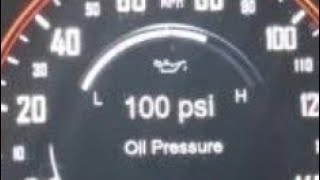
- Oil pressure gauge reads erratically, is stuck at maximum (e.g., 99-100 PSI), or drops to zero, sometimes even with the engine off.
- Red oil pressure warning light may illuminate or flicker.
- Remote start may be disabled.
- Engine may make knocking or ticking sounds if there is a true low oil pressure condition that the faulty sensor is not reporting.
- Replacing the oil pump. An oil pump failure is highly unlikely to cause a P0520 *circuit* code and would typically present with other symptoms like engine noise and verified low pressure with a mechanical gauge.
- Assuming a major internal engine problem. While you should never ignore an oil pressure warning, P0520 on this specific vehicle is almost always an electrical fault, not a mechanical one.
Most Likely Causes
- Faulty Engine Oil Pressure Sensor 🔴 High Probability The original sensor is known to be defective, as acknowledged by manufacturer TSB #18-034-14 REV. A, which recommends a revised part. The sensor can fail internally or leak oil through its body or electrical connector.
How to confirm: Observe the oil pressure gauge with the ignition on but the engine off; if it shows any pressure (e.g., 99 PSI), the sensor is bad. 🎬 Watch: A simple fix for the Durango P0520 circuit failure. A scan tool showing erratic voltage or pressure readings also points to a bad sensor. Visually inspect the sensor for oil leakage.
Typical fix: Replace the oil pressure sensor with the revised OEM part (Mopar #5149062AB or similar) or a quality aftermarket equivalent.
Est. part cost: $25-$60 - Wiring or Connector Issue 🟡 Medium Probability The sensor's location exposes its wiring to engine heat and potential oil contamination from a leaking sensor, which can degrade the connector, pins, or wires over time.
How to confirm: Visually inspect the sensor's electrical connector and nearby wiring for signs of oil saturation, corrosion, or physical damage. Wiggle the connector with the engine running to see if the gauge reading flickers. Check for 5V reference and good ground at the connector with a multimeter.
Typical fix: Clean the oil-soaked connector with electrical contact cleaner. Repair or replace any damaged wiring or the connector pigtail.
Est. part cost: $10-$30 - Incorrect or Low Engine Oil ⚪ Low Probability
How to confirm: Check the engine oil level via the dipstick and verify the correct oil viscosity (e.g., 5W-20 for 5.7L, 5W-30 for 3.6L) was used during the last oil change. P0520 is a circuit code, but extreme pressure variations from wrong/low oil can sometimes stress the sensor into electrical failure.
Typical fix: Top off or change the engine oil with the manufacturer-specified grade and a quality filter.
Est. part cost: $40-$90
Rare But Worth Checking
- Faulty Powertrain Control Module (PCM): → Shop Engine Control Module (ECM) This is extremely rare. The PCM should only be considered after all other possibilities, including the sensor, wiring, and actual oil pressure (tested with a mechanical gauge), have been definitively ruled out.
Diagnosis Steps
- Check the engine oil level and condition. Ensure it is full and not overdue for a change.
- With the ignition on but the engine off, check the oil pressure gauge. If it reads anything above zero (e.g., 99 PSI), the sensor is faulty and needs replacement.
- If the gauge reads zero, use an OBD-II scanner to read the live data from the oil pressure sensor. Look for voltage that is stuck, erratic, or out of range.
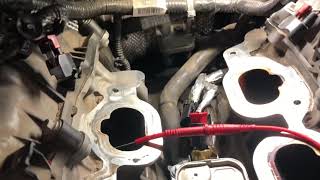
- Locate the sensor. On the 5.7L V8, it's near the oil filter, accessible from underneath the passenger side. On the 3.6L V6, it is under the lower intake manifold in the engine valley, towards the firewall.
- Inspect the sensor's connector and wiring for oil leaks, corrosion, or damage. The connector may have a red locking tab that needs to be disengaged.
- If wiring appears intact and symptoms point to the sensor, replace it. This is the most common fix. A special deep socket (often 27mm or 1 1/16 inch) is required.
- For the 3.6L V6, since the upper and lower intake manifolds must be removed, it is highly recommended to replace the upper and lower intake gaskets at the same time to prevent vacuum leaks. 🎬 See this step-by-step walkthrough for the 3.6L V6 sensor replacement. It is also a good time to inspect the oil filter housing assembly for leaks, another common issue.
- (Advanced) If a new sensor does not resolve the code, use a multimeter to check for 5V reference, good ground, and signal continuity at the sensor connector. If all wiring is confirmed good, verify actual oil pressure with a mechanical gauge before considering a rare PCM fault.
Parts You'll Likely Need
- Engine Oil Pressure Sensor
(OEM #5149062AB (revised part), 05149062AA (original))— This is the root cause of the P0520 code in the vast majority of cases for this vehicle, as confirmed by a manufacturer TSB.
Trusted brands: Mopar, Standard Motor Products (SMP), Duralast (PS401)
OEM price range: $40-$70
Aftermarket price range: $25-$50 - Upper and Lower Intake Manifold Gaskets (3.6L V6 Only)
(OEM #Mopar Lower: 5184331AC, Mopar Upper: 5184562AC)— These must be removed to access the sensor on the 3.6L V6 and should always be replaced to prevent vacuum leaks.
Trusted brands: Mopar, Fel-Pro, Mahle
OEM price range: $50-$80
Aftermarket price range: $30-$60
Related Codes That Often Appear With This One
- P1521 — This code for 'Incorrect Engine Oil Type' can sometimes be triggered by the erratic signals from the failing P0520 sensor. The PCM misinterprets the faulty pressure readings as being inconsistent with the expected pressure for the current oil viscosity. Addressing the P0520 code often resolves this one as well.
Technical Service Bulletins (TSBs) & Recalls
- Bulletin #18-034-14 REV. A: Dated July 15, 2014, this TSB covers a wide range of 2013-2014 Chrysler/Dodge/Jeep/Ram vehicles, including the Durango with 3.6L and 5.7L engines. It explicitly states that for a P0520 code, the repair is to replace the original oil pressure sensor with a revised part. It also notes this was released as a Rapid Response Transmittal (RRT) 14-046.
Platform-Specific Known Issues
- A high failure rate of the original oil pressure sensor (p/n 05149062AA) prompted Chrysler to issue TSB #18-034-14 REV. A, which applies to 2013-2014 Durangos and recommends replacing the sensor with a revised part (p/n 5149062AB).
- On the 3.6L V6 engine, the sensor is located in the engine valley underneath the intake manifolds, making replacement a labor-intensive job (3-4.5 hours). This location is shared with the oil filter housing, which is also a common source of oil leaks and is often replaced at the same time.
- On the 5.7L HEMI V8 engine, the sensor is easily accessible from under the vehicle, located near the oil filter, making for a quick repair (under 1 hour). The torque spec for the sensor is approximately 11 ft-lbs. 🎬 Watch: 5.7L HEMI oil pressure sensor diagnosis and replacement guide.
Mechanic-Grade Diagnostic Values
- Sensor Signal Voltage (general) — expected: Varies with pressure, typically 0.5V (low pressure) to 4.5V (high pressure).. Failure: Voltage is stuck high (e.g., 4.5V) with the engine off, or does not change with engine RPM.
- Sensor 5V Reference Voltage (at connector, KOEO) — expected: ~5.0 Volts.. Failure: No voltage or significantly low voltage, indicating a wiring or PCM issue.
- Wiring Circuit Resistance (from sensor connector to PCM) — expected: Below 5.0 Ohms.. Failure: Resistance above 5.0 Ohms indicates excessive resistance in the circuit that needs to be repaired.
- Torque Spec (3.6L V6 Lower Intake Manifold Bolts) — expected: 106 in-lbs (approx. 8.8 ft-lbs).. Failure: N/A - This is an installation specification.
- Torque Spec (3.6L V6 Upper Intake Manifold Bolts) — expected: 89 in-lbs (approx. 7.4 ft-lbs).. Failure: N/A - This is an installation specification.
- Torque Spec (5.7L V8 Oil Pressure Sensor) — expected: 11 ft-lbs.. Failure: N/A - This is an installation specification.
Wiring & Ground Locations
- (G6) Engine Oil Pressure Signal Circuit — Wire running from the oil pressure sensor connector to the PCM.. This is the signal wire the PCM reads. A short to ground or voltage on this wire will directly cause the P0520 code.
- (K855) or (F855) 5-Volt Supply Circuit — Wire providing the 5V reference from the PCM to the oil pressure sensor.. Loss of this voltage supply will cause the sensor to stop working and trigger a circuit fault.
- (K900) Sensor Ground Circuit — Wire providing the ground reference from the PCM to the oil pressure sensor.. An open or high resistance in the ground circuit will cause incorrect sensor readings and can set a P0520 code.
Real Owner Repair Stories
- YouTube channel 'Pine Hollow Auto Diagnostics' (2013 Dodge Durango 3.6L) — Check engine light with code P0522 (Engine Oil Pressure Sensor Circuit Low), which is closely related to P0520. The gauge read 99 PSI with the engine off.
❌ Tried (didn't work) A mobile mechanic had already replaced the entire oil filter housing assembly, which came with a new oil pressure sensor. The code returned a couple of days later.
✅ What actually fixed it The technician diagnosed that the 'new' sensor that came with the replacement oil filter housing was also faulty from the factory. He confirmed this by plugging in another brand new sensor without installing it and seeing the scan tool readings return to normal (0 PSI with engine off). Replacing just the sensor a second time resolved the issue.
OEM Part Supersession History
05149062AA (also 5149062AA)→5149062AB— The original part had a high failure rate, prompting the TSB #18-034-14 REV. A. The new part is a revised design for better reliability.68060337AA→5149062AB— Part number consolidation and supersession to the revised design.
Helpful Videos
We Have This Part in Stock


The information in this article is provided for general reference and educational purposes only. Vehicle specifications, procedures, and part compatibility can vary by production date, trim level, and region. Always consult your vehicle's factory service manual and verify part numbers before purchasing or performing repairs. Safety-critical components such as airbags, seat belts, and braking systems should be installed by a qualified professional.
- Dodge DURANGO:
- 🧭 Diagnostic Flowchart
- 🎬 Helpful Videos
- 🛍️ Shop This Part
- What's Unique About the 2013-2014 Dodge DURANGO
- Symptoms You May Notice
- Most Likely Causes
- Rare But Worth Checking
- Diagnosis Steps
- Parts You'll Likely Need
- Related Codes That Often Appear With This One
- Technical Service Bulletins (TSBs) & Recalls
- Platform-Specific Known Issues
- Mechanic-Grade Diagnostic Values
- Wiring & Ground Locations
- Real Owner Repair Stories
- OEM Part Supersession History
- 🎟️ Get 5% Off