

P0520 on 2018-2023 Kia Stinger 3.3T: Engine Oil Pressure Sensor Circuit Causes and Fixes
On the Stinger 3.3T, P0520 almost always means the oil pressure switch has failed, a very common issue for this engine. The part is cheap (~$25-$100), but it's buried under the intake manifold, making the repair labor-intensive and costing $500-$800 at an independent shop or over $1,100 at a dealer.
- P0520 on a Stinger 3.3T is almost certainly a failed oil pressure switch, a very common problem.
- Do NOT drive the vehicle. You must first confirm it's not a real, catastrophic loss of oil pressure.
- The repair is expensive ($500-$850) not because of the part, but because the sensor is buried under the intake manifold, requiring 3-4 hours of labor.
- Always check if the SC300 turbo oil line recall is open for your vehicle, as its symptoms can mimic a sensor failure but pose a fire risk.
- When replacing the sensor, always replace the intake manifold gaskets at the same time to prevent future leaks.
What's Unique About the 2018-2023 Kia Stinger
The Kia Stinger 3.3T V6 has a well-documented, widespread issue with premature failure of the original oil pressure switch. Many owners report seeing the oil pressure warning light flicker or turn on at idle once the engine is warm, which then disappears with a slight increase in RPM. This specific symptom is the classic sign of a faulty switch on this platform, not typically a failing oil pump. The switch's location deep in the engine valley beneath the intake manifold makes its replacement a surprisingly labor-intensive job. This issue is shared with its platform-mate, the Genesis G70 3.3T.
Symptoms You May Notice
- Check Engine Light is on
- Red oil pressure warning light is on, often flickering specifically at warm idle 🎬 See how a faulty switch causes the oil light to flash.
- Oil pressure gauge (if equipped) reads zero or behaves erratically
- Warning light turns off as soon as engine RPM is raised slightly above idle
- Replacing the oil pump before verifying actual mechanical oil pressure with a gauge.
- Ignoring the oil pressure light, assuming it's 'just the common sensor issue'. While likely, it could be a real pressure drop or a leak related to the SC300 recall, which is a fire hazard.
- Performing the labor-intensive sensor replacement without also changing the inexpensive intake gaskets, leading to vacuum leaks and requiring the job to be done a second time.
Most Likely Causes
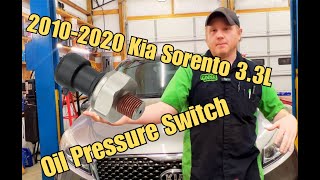
- Faulty Engine Oil Pressure Switch 🔴 High Probability → Shop Engine Oil Pressure Switch This is a widely documented failure point on the 3.3T Lambda II engine, with many owners experiencing failure, often between 80,000-150,000 km (50,000-93,000 miles). The heat in the engine valley where the sensor is located likely contributes to its premature failure.
How to confirm: The primary confirmation is ruling out other causes. First, check the oil level and condition. The definitive test is to connect a mechanical oil pressure gauge; if the pressure is stable and within spec at warm idle (e.g., >11.4 PSI) while the light is on, the switch is bad.
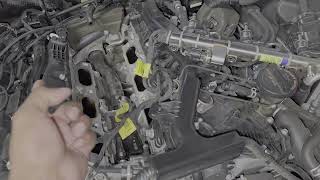
Typical fix: Replace the oil pressure switch. Due to its location, the intake manifold must be removed. It is highly recommended to also replace the intake manifold, surge tank, and injector seals at the same time. Some owners also take this opportunity to perform a walnut blast cleaning of the intake valves 🎬 Pro tip: How to access spark plugs without removing the manifold. for carbon buildup.
Est. part cost: $25-$100 - Low Engine Oil Level or Incorrect Oil 🟡 Medium Probability
How to confirm: Physically check the engine oil dipstick. Ensure the oil level is between the 'min' and 'max' marks. Verify that the oil viscosity matches the manufacturer's recommendation (e.g., 5W-30).
Typical fix: Top off or change the engine oil and replace the oil filter.
Est. part cost: $50-$100 - Damaged Wiring or Connector ⚪ Low Probability The wiring harness sits in the hot engine valley and can become brittle over time. Rodents can also cause damage.
How to confirm: Once the intake manifold is removed to access the switch, visually inspect the connector and wiring harness for signs of melting, corrosion, or breaks. The switch uses a single-wire connector. Test for proper voltage and ground at the connector.
Typical fix: Repair the damaged section of the wiring harness or replace the connector pigtail.
Est. part cost: $10-$50
Rare But Worth Checking
- Failing Oil Pump or Clogged Oil Passages: This would be a true mechanical failure. If a mechanical gauge test shows low or zero oil pressure, the engine has a serious internal problem that must be addressed immediately. Stop the engine to prevent further damage.
- Faulty Engine Control Module (ECM): → Shop Engine Control Module (ECM) In very rare cases, the ECM itself can fail to properly interpret the signal from the sensor. This should only be considered after all other possibilities (sensor, wiring, actual oil pressure) have been exhaustively ruled out.
Diagnosis Steps
- Check the engine oil level and condition immediately. If low, top it off, clear the code, and see if it returns.
- Check for any open recalls, specifically Safety Recall SC300 (NHTSA 24V143000) for the turbocharger oil feed pipe, which can cause an oil leak and trigger the oil pressure light.
- Connect a scan tool to confirm P0520 is the primary code. Note any other codes.
- The most crucial step: connect a mechanical oil pressure gauge in place of the sensor to measure the actual engine oil pressure at warm idle and at ~3,000 RPM.
- If mechanical pressure is good and stable while the warning light is on, the oil pressure switch is faulty and must be replaced.
- If mechanical pressure is low, the engine has a serious internal problem (e.g., oil pump, bearing wear) and requires further teardown and inspection.
- If replacing the switch, remove the intake manifold. While the manifold is off, inspect the switch's electrical connector and wiring for damage. This is also the ideal time to clean carbon buildup from the intake valves (walnut blasting).
- Install the new switch, along with new intake manifold gaskets, surge tank gasket, and fuel injector seals to prevent future leaks.
Parts You'll Likely Need
- Engine Oil Pressure Switch
(OEM #94750-37100 (supersedes 94750-37000))— This is the most common failure point for this code on the Stinger 3.3T, with a well-known pattern of causing a flickering oil light at warm idle.
Trusted brands: Genuine Kia/Hyundai
OEM price range: $15-$40
Aftermarket price range: $10-$25 - Intake Manifold Gasket Set
(OEM #28411-3L100)— These are single-use gaskets that must be replaced when the intake manifold is removed to access the oil pressure switch. Reusing old gaskets will cause vacuum leaks.
Trusted brands: Genuine Kia/Hyundai
OEM price range: $40-$60
Aftermarket price range: $20-$40 - Surge Tank Gasket
(OEM #29215-3L100)— This gasket seals the surge tank (plenum) to the intake manifold and should be replaced during the service to prevent leaks.
Trusted brands: Genuine Kia/Hyundai
OEM price range: $15-$25
Aftermarket price range: $10-$20 - Fuel Injector Seal Kit (x6)
(OEM #35313-3L000)— The fuel rails must be removed, and it is best practice to replace the injector seals to prevent fuel leaks upon reassembly.
Trusted brands: Genuine Kia/Hyundai
OEM price range: $50-$80
Aftermarket price range: $30-$50 - Coolant Crossover Pipe Gaskets
(OEM #28217-3L120 (RH), 28217-3L110 (LH))— These gaskets for the coolant pipes that run over the intake manifold should be replaced to prevent coolant leaks.
Trusted brands: Genuine Kia/Hyundai
OEM price range: $20-$30
Aftermarket price range: $10-$20
Related Codes That Often Appear With This One
- P0524 — P0524 (Engine Oil Pressure Too Low) may accompany P0520 if the sensor fails in a way that sends a signal interpreted as critically low pressure, or if there is a genuine mechanical issue.
Technical Service Bulletins (TSBs) & Recalls
- SC300 / NHTSA 24V143000 - Safety Recall for Left-Hand Turbocharger Oil Feed Pipe and Hose Assembly Replacement.
Platform-Specific Known Issues
- A widespread and well-documented history of the original oil pressure switch failing, causing the oil light to illuminate at warm idle.
- Safety Recall SC300 (NHTSA 24V143000) was issued for the 2018-2023 Stinger 3.3T because the left turbocharger oil feed pipe can degrade, leak oil, and cause an engine fire. Symptoms of this leak can include an oil pressure warning light.
Mechanic-Grade Diagnostic Values
- Mechanical Engine Oil Pressure at Idle (Hot) — expected: 11.4 PSI (0.8 kgf/cm², 78 kPa) or higher. Failure: Pressure below this threshold may indicate a mechanical issue (oil pump, bearing wear) rather than just a sensor fault.
- Mechanical Engine Oil Pressure at 3000 RPM (Hot) — expected: 35.6 PSI (2.5 kgf/cm², 245 kPa) or higher. Failure: Pressure below this value under load strongly suggests a failing oil pump or significant internal blockages/leaks.
- Oil Pressure Switch Circuit Voltage — expected: The component is a simple one-wire on/off switch, not a variable voltage sensor.. Failure: Testing focuses on continuity and whether the switch opens/closes at the correct pressure threshold, rather than a specific voltage reading.
Wiring & Ground Locations
- Engine Ground Wiring Assembly — Main ground strap connecting the engine block to the chassis.. A poor engine ground can cause erratic behavior from various sensors, including the oil pressure switch. The specific OEM part for the 3.3L Stinger is 91860-J5010.
- Oil Pressure Switch Connector — Deep in the engine valley, below the intake manifold, connected to the oil pressure switch.. This is a single-wire connector. The wire runs through a very hot area and is prone to becoming brittle or damaged, which would directly cause a P0520 code. It must be inspected for integrity when the manifold is removed.
Real Owner Repair Stories
- Reddit user in r/kiastinger (Kia Stinger 3.3T, failure at 150,000 km (approx. 93,000 miles)) — Oil pressure warning light would come on when the engine was warm and at idle, but would turn off as soon as RPMs were raised.
❌ Tried (didn't work) The owner correctly identified the likely cause and did not report trying other fixes first.
✅ What actually fixed it The owner took the vehicle to an independent shop, which replaced the oil pressure switch. While the intake manifold was off for the job, the owner also had the shop perform a walnut blast cleaning of the intake valves. The total cost for the repair was approximately $1100 CDN.
OEM Part Supersession History
94750-37000→94750-37100— The original part is known for a high failure rate. The superseding part is the revised, more durable version that should be used for all replacements.
Model Year Variations Within This Range
- 2022-2023: The 2022 model year refresh included minor cosmetic updates, a new infotainment screen, and a new variable exhaust system that resulted in a 3-horsepower increase for the 3.3T engine. However, the core engine design, the location of the oil pressure switch, and the widespread nature of this specific P0520 fault remain identical to the 2018-2021 models.
Diagnostic Flowchart
Other Known Issues on This Vehicle
Issues unrelated to this code that are worth knowing about as an owner of this generation:
- Tailgate/Hatch Rattle 🟡 Low — Very common on early (2018-2019) models. Many owners report rattles developing over bumps shortly after purchase. (Ref: TSB SA322 was issued for 2018 models to address the noise by adjusting bumpers and installing a guide bumper mounting kit.)
- High-Pressure Fuel Pump (HPFP) Failure 🔴 High — Affects a significant number of 2018-2021 2.0T and 3.3T models, potentially causing loss of power while driving. (Ref: Recall SC281 (NHTSA 23V652000) was issued for the 2.0T. A similar issue is noted on the 3.3T, with TSB 25-FL-002G extending the warranty for the HPFP on the related G70.)
- Low-Pressure Fuel Pump Failure 🟠 Medium — Less common than HPFP issues, but affects certain 2020-2021 models. (Ref: Recall SC198 was issued because plastic burrs from manufacturing could block the jet nozzle, causing fuel starvation.)
- Interior Rattles (Doors/Dash) 🟡 Low — Common complaint across all model years. Rattles often emanate from door panels, the dashboard, or overhead console area due to temperature changes or road vibration. (Ref: TSB SA483 addresses a detached front door grip handle on some 2022 models.)
- Intake Valve Carbon Buildup 🟠 Medium — A known characteristic of all Gasoline Direct Injection (GDI) engines, including the Lambda II. Performance degradation can become noticeable after 60,000-80,000 miles.
Used vs. New Parts: Buying Guide for This Vehicle
When a used part is the smart pick: Never. For this specific repair, using a used part is a very poor choice. The primary failure component, the oil pressure switch, is a known wear/failure item with a flawed original design, and the part itself is inexpensive to buy new.
What to inspect on the donor part:
- Not applicable as used parts are not recommended.
OEM-only on this vehicle (don't cheap out):
- Engine Oil Pressure Switch: While aftermarket versions exist, the cost of labor for this job is extremely high. Using the genuine, superseded Kia/Hyundai OEM part (94750-37100) is strongly recommended to ensure reliability and avoid having to do the job twice.
- Intake Manifold & Surge Tank Gaskets: These are critical, single-use seals. Using cheap, low-quality aftermarket gaskets risks vacuum leaks, which would require re-doing the entire intake manifold removal. Stick with OEM.
Aftermarket brands forum-validated for this vehicle:
- While some owners may have success with brands like Beck/Arnley for sensors, the consensus for this specific, labor-intensive job points towards using genuine OEM parts for peace of mind.
Brands owners have reported issues with on this vehicle:
- Generic, unbranded, or 'white-box' sensors and gaskets from online marketplaces should be avoided due to the high labor cost of replacement if they fail prematurely.
Real Owner Stories
Aggregated from forums and TSBs cited above. Mileages and costs reflect what owners reported in those sources.
2018 Kia Stinger GT 3.3T — 91000 miles
Symptoms: The oil light appeared at low RPMs.
What fixed it: The owner received a quote to replace the oil pressure switch.
Cost: $3250-$3250
Source hint: Reddit r/MechanicAdvice - 'Repair or trade in. 2018 Kia Stinger GT'
2018-2023 Kia Stinger 3.3T — 93000 miles
Symptoms: The oil pressure light appeared at warm idle and would disappear with throttle.
What fixed it: The sensor was replaced at an independent shop.
Source hint: Reddit r/kiastinger - 'Oil pressure light issues'
2018-2023 Kia Stinger 3.3T
Symptoms: An oil light came on, leading to a dealership visit.
What fixed it: Another user in the thread described a successful DIY repair by replacing the switch, which took 6-7 hours.
Cost: $300-$300
Source hint: Reddit r/kiastinger - '$4400 quote for oil light'
Related OBD-II Codes
Frequently Asked Questions
My 2018 Stinger's red oil light is flickering at idle but goes away when I accelerate. Is this a serious problem?
Is there a recall for oil pressure issues on the 2018-2023 Kia Stinger 3.3T?
The dealership quoted me over $3,000 to fix the P0520 code. Is this a reasonable price?
If I'm replacing the oil pressure switch for code P0520, what other maintenance should I do at the same time?
Does the P0520 oil pressure switch issue affect the Genesis G70 3.3T as well?
How can I confirm the oil pressure switch is bad before starting the repair?
Helpful Videos

We Have This Part in Stock

The information in this article is provided for general reference and educational purposes only. Vehicle specifications, procedures, and part compatibility can vary by production date, trim level, and region. Always consult your vehicle's factory service manual and verify part numbers before purchasing or performing repairs. Safety-critical components such as airbags, seat belts, and braking systems should be installed by a qualified professional.
- Kia Stinger:
- 🧭 Diagnostic Flowchart
- 🎬 Helpful Videos
- 🛍️ Shop This Part
- What's Unique About the 2018-2023 Kia Stinger
- Symptoms You May Notice
- Most Likely Causes
- Rare But Worth Checking
- Diagnosis Steps
- Parts You'll Likely Need
- Related Codes That Often Appear With This One
- Technical Service Bulletins (TSBs) & Recalls
- Platform-Specific Known Issues
- Mechanic-Grade Diagnostic Values
- Wiring & Ground Locations
- Real Owner Repair Stories
- OEM Part Supersession History
- Model Year Variations Within This Range
- Other Known Issues on This Vehicle
- Used vs. New Parts: Buying Guide for This Vehicle
- Real Owner Stories
- 2018 Kia Stinger GT 3.3T — 91000 miles
- 2018-2023 Kia Stinger 3.3T — 93000 miles
- 2018-2023 Kia Stinger 3.3T
- Related OBD-II Codes
- Frequently Asked Questions
- 🎟️ Get 5% Off