

P0521 on 2020-2024 Hyundai Palisade 3.8L: Engine Oil Pressure Sensor Causes and Fixes
On a 2020-2024 Palisade, code P0521 most often points to a faulty engine oil pressure sensor. The part itself is moderately expensive, but its location under the intake manifold makes replacement a labor-intensive job. Expect a shop repair to cost between $700 and $1,200, with most of that being labor. This is a well-documented issue on both the Palisade and its platform-mate, the Kia Telluride.
- P0521 means the oil pressure *sensor's signal* is faulty, not necessarily that the oil pressure itself is low.
- You must not drive the vehicle, as there is a small but critical chance of a true low oil pressure condition that could destroy the engine.
- The most likely fix is replacing the oil pressure sensor (OEM Part #94751-3C000).
- This is not a simple DIY job. The sensor is located under the intake manifold, making the repair labor-intensive and expensive.
- Always verify actual oil pressure with a mechanical gauge before approving a costly sensor replacement to rule out a more serious mechanical engine problem.
- This issue is also common on the Kia Telluride, which shares the same engine and design.
What's Unique About the 2020-2024 Hyundai Palisade
For the Lambda II 3.8L V6 engine in the Palisade and Kia Telluride, the most significant factor for a P0521 code is the physical location of the oil pressure sensor. It is buried deep in the 'V' of the engine, underneath the entire upper and lower intake manifold assembly. This high-heat area can experience heat-soak, contributing to the electronic failure of the sensor over time. This design choice turns what would be a simple sensor swap on many other engines into a significant, labor-intensive repair that requires several hours of work just to access the part, which is the primary driver of the high repair cost.
Symptoms You May Notice
- Check Engine Light is on
- Oil pressure warning light may illuminate on the dashboard, sometimes flickering at idle
- Oil pressure gauge on the instrument cluster reads abnormally low or high, or may be stuck at zero or max
- Engine may run rough or make unusual ticking/knocking noises (if actual oil pressure is low)
- Decreased engine performance or stalling in severe cases
- Replacing the oil pump without first verifying low oil pressure with a mechanical gauge. The sensor is a far more common failure point than the pump itself.
- Assuming the code means the oil is just low, without checking. While low oil can cause it, the sensor itself is the more frequent culprit on this specific engine.
Most Likely Causes
- Faulty Engine Oil Pressure Sensor 🔴 High Probability The sensor is located in a high-heat area deep within the engine valley, which can contribute to premature failure. This is a known pattern on the wider Hyundai/Kia Lambda V6 engine family, including the Kia Telluride.
How to confirm: After confirming oil level/condition and verifying actual oil pressure with a mechanical gauge is normal, the sensor is the presumed culprit. If the mechanical gauge shows low pressure, the sensor is NOT the cause.
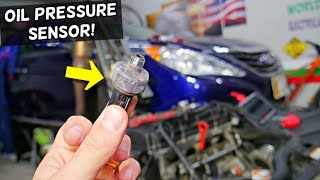
Typical fix: Replace the engine oil pressure sensor. This requires removing the upper and lower intake manifolds 🎬 See this walkthrough for removing the sensor on a Hyundai V6 to gain access.
Est. part cost: $150-$220 (OEM) - Low or Incorrect Engine Oil 🟡 Medium Probability Some owners have reported higher than average oil consumption. If the oil level drops too low, it can trigger a P0521 code before the main low oil level light comes on.
How to confirm: Check the engine oil dipstick. The level should be between the 'F' and 'L' marks. The oil should be the correct viscosity (check owner's manual) and not appear overly dark, thick, or sludgy.
Typical fix: Perform an oil and filter change using the manufacturer-specified oil type and a quality filter. Top off oil if it is simply low. Clear codes and monitor.
Est. part cost: $50-$100 - Damaged Wiring or Connector ⚪ Low Probability The sensor wiring is located under the intake manifold, making it susceptible to damage during other engine repairs if care is not taken. Rodents can also chew on wiring in this protected area.
How to confirm: Once the intake manifold is removed for sensor access, visually inspect the wiring harness and connector for breaks, corrosion, or melted sections.
Typical fix: Repair the damaged section of the wiring harness or replace the connector pigtail.
Est. part cost: $20-$50
Rare But Worth Checking
- Failing Oil Pump / Clogged Oil Passages: → Shop Engine Oil Pump This is a serious mechanical failure. If a mechanical gauge confirms that the engine's oil pressure is truly low, the issue is internal. This could be a failing oil pump or sludge blocking the oil pickup tube or passages. This requires extensive engine work.
Diagnosis Steps
- Check Engine Oil Level and Condition: Pull the dipstick. If the oil is low, dirty, or the wrong type, correct this first. An oil change is the cheapest first step. 🎬 Watch: Two simple DIY methods to address a P0521 code Clear the code and see if it returns.
- Verify Actual Oil Pressure: This is a critical step. 🎬 Watch: How to test engine oil pressure like a professional Connect a mechanical oil pressure gauge to the engine (in place of the electronic sensor). Start the engine and compare the gauge's readings at idle and ~3,000 RPM to the manufacturer's specifications. This is the only way to know if you have a real pressure problem or just a sensor problem.
- Analyze Gauge Results: If the mechanical gauge shows normal, steady oil pressure (see Specific Diagnostic Values), the problem is very likely the oil pressure sensor or its wiring. If the mechanical gauge shows low, erratic, or no pressure, STOP. You have a serious internal engine problem (e.g., oil pump, clogged pickup tube, internal wear) that requires immediate professional attention.
- Inspect Sensor and Wiring: If proceeding with sensor replacement, you must first remove the upper and lower intake manifolds. Once you have access, closely inspect the sensor's connector and wiring for any signs of damage, melting, or corrosion before replacing the sensor.
- Replace the Oil Pressure Sensor: If steps 1-4 point to a bad sensor, replace it with a new OEM part. It is also mandatory to replace the upper and lower intake manifold gaskets at this time as they are single-use.
- Reassemble and Test: Carefully reassemble all components, ensuring all vacuum lines and electrical connectors are re-secured. Torque intake manifold bolts to manufacturer specifications. Clear the P0521 trouble code with a scanner and perform a test drive to ensure the code does not return.
Parts You'll Likely Need
- Engine Oil Pressure Sensor (Sender Assembly)
(OEM #94751-3C000)— This is the most common failure point for code P0521 on this engine. It fails electronically, sending incorrect data to the ECM.
Trusted brands: Hyundai (OEM)
OEM price range: $150-$220
Aftermarket price range: $25-$80 - Upper Intake Manifold Gasket Set
(OEM #Fel-Pro MS 98024 / Mahle MS20317)— These gaskets are single-use and must be replaced anytime the upper intake manifold is removed to access the oil pressure sensor.
Trusted brands: Hyundai (OEM), Fel-Pro, Mahle
OEM price range: $50-$80
Aftermarket price range: $10-$30 - Lower Intake Manifold Gasket Set
(OEM #Fel-Pro MS 98020 / Mahle MS20318)— These gaskets are single-use and must be replaced anytime the lower intake manifold is removed to access the oil pressure sensor.
Trusted brands: Hyundai (OEM), Fel-Pro, Mahle
OEM price range: $50-$80
Aftermarket price range: $15-$40
Technical Service Bulletins (TSBs) & Recalls
- While no TSB is specific to P0521 on the Palisade, Hyundai has issued TSBs for related engine families and problems, such as TSB 21-EM-003H for oil consumption diagnosis on other models.
- A warranty extension was issued for self-leveling rear shocks on 2020-2022 models, which can cause noise. While unrelated to P0521, it is a known platform issue.
- TSB 20-AT-020H describes a procedure for transferring oil pressure data to the TCU using the GDS scan tool after transmission or PCM replacement on the Palisade, highlighting the integration of pressure data in the vehicle's systems.
Platform-Specific Known Issues
- The repair cost for the identical job on the Kia Telluride is estimated between $515 and $690, with labor accounting for $374 to $548, corroborating the high labor cost due to sensor location.
Mechanic-Grade Diagnostic Values
- Engine Oil Pressure at Idle (Hot, verified with mechanical gauge) — expected: 11.4 PSI (0.8 kgf/cm², 78 kPa) or higher. Failure: Pressure below this value indicates a mechanical issue (pump, blockage, wear), not a sensor fault.
- Engine Oil Pressure at ~3000 RPM (Hot, verified with mechanical gauge) — expected: 35.6 PSI (2.5 kgf/cm², 245 kPa) or higher. Failure: Pressure below this value under load points to a significant mechanical problem like a failing oil pump.
- Oil Pressure Sensor 5V Reference Voltage — expected: ~5.0V (Key On, Engine Off). Failure: Voltage significantly below 5.0V points to a wiring short or an issue with the ECM's 5V reference circuit.
Scan Tool Commands That Help
- Hyundai GDS (Global Diagnostic System): Vehicle S/W Management -> Resetting adaptive values — After replacing a major component or sensor, this function can be used to clear the ECM's learned values and force it to recalibrate, which may be beneficial after replacing the oil pressure sensor.
- Hyundai GDS (Global Diagnostic System): S/W Management -> Automatic Transaxle -> Oil pressure characteristics Input — As per TSB 20-AT-020H, this specific function is used to input pressure data from a barcode on the transmission into the TCU/PCM. While for the transmission, it shows the deep integration of pressure readings and the capability of the OEM scan tool.
Wiring & Ground Locations
- ECM Pin 48 — At the main Engine Control Module (ECM) connector.. This pin provides the sensor ground for both the MAP sensor and the Oil Pressure sensor. A bad ground at this pin or in the shared harness could cause erratic readings for both sensors. A continuity test from the sensor connector back to this pin is a definitive wiring check.
- Ground Point GC202 — Engine bay, exact location requires service manual diagram.. The ECM itself relies on main ground points like this one. While not directly for the sensor, a corroded or loose main engine ground can cause a host of bizarre electronic issues, including faulty sensor readings.
OEM Part Supersession History
94751-3C000→N/A— This part number appears to be stable and is used across a wide range of Hyundai/Genesis models from 2015 to 2025, including the Palisade.
Model Year Variations Within This Range
- 2020-2024: The Palisade received a significant facelift for the 2023 model year, but the 3.8L V6 engine and 8-speed automatic transmission were carried over without changes. Therefore, the causes, diagnostic procedures, and repairs for code P0521 are identical across the entire 2020-2024 range.
Diagnostic Flowchart
Other Known Issues on This Vehicle
Issues unrelated to this code that are worth knowing about as an owner of this generation:
- Excessive Wind/Whistling Noise from Doors/Windows 🟡 Low — Common on 2020-2021 models. Multiple TSBs issued to address the problem with foam pads and updated moldings. (Ref: TSB 21-BD-003H, TSB 19-BD-010H.)
- Foul Interior Odor from Headrests 🟡 Low — Primarily affected 2020-2021 Limited and Calligraphy trims with Nappa leather. Caused by a manufacturing flaw in the imitation leather headrests. (Ref: TSB 20-BD-018H.)
- Tow Hitch Wiring Harness Fire Risk 🔴 High — Affects 2020-2022 models equipped with an accessory tow hitch harness. Debris/moisture can cause an electrical short. (Ref: NHTSA Recall No. 22V-633.)
- Failing Self-Leveling Rear Shocks 🟠 Medium — Some 2020-2022 models may experience clunking or thumping noises from the rear suspension. (Ref: Warranty extension TSB issued for certain 2020-2022 models, covering the issue for 10 years/120,000 miles.)
- Windshield Wipers May Fail 🟠 Medium — A recall was issued for 122,949 units of 2020-2021 Palisades where the driver's side wiper motor could become inoperative. (Ref: NHTSA Recall.)
- Excessive Oil Consumption 🔴 High — Some owners have reported high rates of oil consumption, requiring frequent top-offs. In severe cases, this can lead to engine damage if not monitored.
Used vs. New Parts: Buying Guide for This Vehicle
When a used part is the smart pick: For this specific repair, using a used part is almost never a smart choice. The primary failure is an electronic sensor, and the labor to access it is extensive (4-6 hours). The risk of a used sensor failing shortly after installation far outweighs the minor cost savings on the part itself.
What to inspect on the donor part:
- Not applicable for the sensor. For larger components like a replacement engine (if the original failed due to low oil pressure), look for a donor vehicle with a documented service history, under 75,000 miles, and no signs of front-end collision damage.
OEM-only on this vehicle (don't cheap out):
- Engine Oil Pressure Sensor: Given the massive labor cost to replace this part, using a genuine Hyundai OEM sensor (Part No. 94751-3C000) is the only recommended path. The cost of a potential premature failure of an aftermarket sensor makes it a poor economic choice.
- Intake Manifold Gaskets: While quality aftermarket brands like Fel-Pro exist, the cost savings are minimal compared to the labor. Using OEM gaskets ensures perfect fitment and material compatibility.
Aftermarket brands forum-validated for this vehicle:
- For gaskets, Fel-Pro and Mahle are generally considered reputable alternatives if OEM is unavailable.
Brands owners have reported issues with on this vehicle:
- Avoid unbranded, low-cost oil pressure sensors from online marketplaces. The quality control is often non-existent, and failure rates are high, making them a significant gamble for a part that requires this much labor to install.
Real Owner Stories
Aggregated from forums and TSBs cited above. Mileages and costs reflect what owners reported in those sources.
2020-2024 Kia Telluride 3.8L V6
Symptoms: Owner experienced the P0521 code and noted high repair costs due to the sensor being buried under the intake manifold.
What fixed it: Replacement of the oil pressure sensor.
Cost: $515-$690
Source hint: vehicle_specific_issues
2016 Genesis 3.8L V6
Symptoms: The sensor failed on this shared engine family, resulting in an extremely high dealer quote due to the difficult access under the intake manifold.
What fixed it: Oil pressure sensor replacement.
Cost: $2,500-$2,500
Source hint: Reddit r/MechanicAdvice thread for a 2016 Genesis with the same 3.8L engine family
Kia (Lambda V6 engine)
Symptoms: A known issue where the oil pressure sensor fails and is difficult to access.
What fixed it: Replacement of the oil pressure sensor.
Cost: $1,080-$1,080
Source hint: Reddit r/MechanicAdvice thread for a Kia with a similar engine
Related OBD-II Codes
Frequently Asked Questions
Is there a TSB for the P0521 code on my 2020-2024 Hyundai Palisade?
Why is the repair for a simple oil pressure sensor so expensive on the Palisade?
Can I use a used oil pressure sensor to save money on this repair?
Could my Palisade's oil consumption issue be causing the P0521 code?
Does the Kia Telluride have this same oil pressure sensor problem?
What else should be replaced when fixing the oil pressure sensor?
Helpful Videos
![How to Fix P0521 Engine Code in 4 Minutes [2 DIY Methods / Only $6.87]](https://img.youtube.com/vi/W9EL9QHCDMo/mqdefault.jpg)
We Have This Part in Stock

The information in this article is provided for general reference and educational purposes only. Vehicle specifications, procedures, and part compatibility can vary by production date, trim level, and region. Always consult your vehicle's factory service manual and verify part numbers before purchasing or performing repairs. Safety-critical components such as airbags, seat belts, and braking systems should be installed by a qualified professional.
- Hyundai Palisade:
- 🧭 Diagnostic Flowchart
- 🎬 Helpful Videos
- 🛍️ Shop This Part
- What's Unique About the 2020-2024 Hyundai Palisade
- Symptoms You May Notice
- Most Likely Causes
- Rare But Worth Checking
- Diagnosis Steps
- Parts You'll Likely Need
- Technical Service Bulletins (TSBs) & Recalls
- Platform-Specific Known Issues
- Mechanic-Grade Diagnostic Values
- Scan Tool Commands That Help
- Wiring & Ground Locations
- OEM Part Supersession History
- Model Year Variations Within This Range
- Other Known Issues on This Vehicle
- Used vs. New Parts: Buying Guide for This Vehicle
- Real Owner Stories
- 2020-2024 Kia Telluride 3.8L V6
- 2016 Genesis 3.8L V6
- Kia (Lambda V6 engine)
- Related OBD-II Codes
- Frequently Asked Questions
- 🎟️ Get 5% Off