

P0521 on 2018-2023 Kia Stinger 3.3T: Oil Pressure Sensor Causes and Fixes
On the 3.3T Stinger, code P0521 is almost always a failed oil pressure sensor. The part is cheap (~$30-$100), but it's buried under the intake manifold, making the repair labor-intensive (3-4 hours) and costing $600-$1000+. Do not drive until you confirm it's not a true low-pressure condition.
- P0521 on a 2018-2023 Kia Stinger 3.3T is most likely caused by a failed oil pressure sensor, a very common issue on this engine.
- Do not drive the vehicle. You must first confirm it's not a real, catastrophic loss of oil pressure by checking oil levels and using a mechanical gauge.
- The repair is expensive ($600-$1100+) not because of the part, but because the sensor is buried under the intake manifold, requiring 3-4+ hours of labor.
- Always check if the SC300 turbo oil line recall is open for your vehicle, as an oil leak from this part can also cause low oil pressure.
- When replacing the sensor, always replace the intake manifold and surge tank gaskets to prevent future air leaks.
What's Unique About the 2018-2023 Kia Stinger
The Kia Stinger's Lambda II 3.3T V6 has a well-documented, widespread issue with premature failure of the original oil pressure switch. Many owners report the oil pressure warning light flickering at a warm idle, which disappears with a slight increase in RPM; this is the classic symptom of a faulty switch on this platform, not typically a failing oil pump. The switch's location deep in the engine valley beneath the intake manifold makes its replacement a surprisingly labor-intensive and expensive job for a relatively inexpensive part.
Symptoms You May Notice
- Check Engine Light is on
- Oil pressure warning light flickers or stays on, especially at warm idle
- Oil pressure gauge (if equipped) reads abnormally high or low
- Engine running rough or making unusual noises (tapping/knocking)
- Engine stalling
- Burning oil smell or white smoke from the engine bay if the sensor is leaking onto hot components.
- Replacing the oil pump. On the 3.3T engine, the oil pressure switch is a far more common failure point than the oil pump. Always confirm actual oil pressure with a mechanical gauge before condemning the pump.
- Misdiagnosing the oil leak as a rear main seal. A leaking oil pressure switch in the engine valley can drain to the back of the engine and onto the transmission bellhousing, mimicking a rear main seal leak.
Most Likely Causes
- Faulty Engine Oil Pressure Switch 🔴 High Probability → Shop Engine Oil Pressure Switch This is a very common failure item on the Lambda II 3.3T engine, with the internal seal of the switch failing over time, typically around 60,000-90,000 miles, though some fail earlier. The sensor's location in the hot engine valley contributes to its failure.
How to confirm: After confirming oil level is correct, the definitive test is to connect a mechanical oil pressure gauge. If the mechanical gauge shows normal pressure (e.g., >10 PSI at warm idle) while the dashboard light is on or the scan tool shows an erratic reading, the sensor is bad. Often, the sensor's electrical connector will be full of oil, which is a clear sign of internal failure.
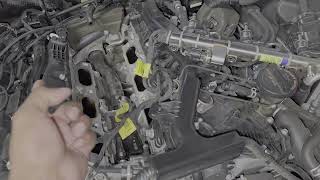
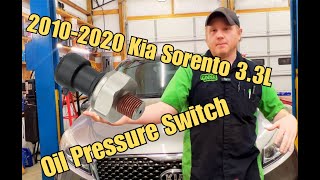
Typical fix: Replace the oil pressure switch. This requires removing the upper intake manifold for access. 🎬 Watch: Step-by-step guide to replacing the Stinger's oil pressure switch. It is highly recommended to replace the intake manifold gaskets, surge tank gasket, and injector seals at the same time.
Est. part cost: $25-$100 - Low or Dirty Engine Oil 🟡 Medium Probability All engines require correct oil levels to maintain pressure. Additionally, a known recall (SC300) for a cracking turbo oil feed line can cause significant oil leaks and subsequent low oil levels. Some owners also report higher than average oil consumption.
How to confirm: Physically check the engine oil dipstick. Ensure the oil level is between the 'min' and 'max' marks and that the oil is not overly dark, sludgy, or past its service interval. Check for signs of external leaks, particularly around the left turbocharger.
Typical fix: Perform an oil and filter change using the manufacturer-specified oil viscosity (e.g., 5W-30). If a leak is present from the turbo oil line, have the SC300 recall performed by a Kia dealer.
Est. part cost: $50-$100 - Damaged Wiring or Connector ⚪ Low Probability The sensor wiring is located in the hot engine valley, which can make insulation brittle over time. Damage can also occur during other engine service, such as spark plug changes.
How to confirm: Once the intake manifold is removed for sensor access, visually inspect the single-wire connector and the harness for any signs of melting, chafing, corrosion, or breaks. Oil contamination in the connector is a very common sign the sensor itself has failed internally.
Typical fix: Repair the damaged section of the wiring harness or replace the connector pigtail. If the connector is full of oil, it must be thoroughly cleaned or replaced, along with the faulty sensor.
Est. part cost: $15-$50
Rare But Worth Checking
- Clogged Oil Passages or Failing Oil Pump: → Shop Engine Oil Pump This is a serious mechanical failure. If a mechanical gauge confirms that the oil pressure is actually low, the engine has a significant internal problem that could be caused by sludge, a clogged oil pickup tube, or a worn oil pump. Oil pump replacement is a very expensive repair, often costing over $2,000.
Diagnosis Steps
- Check the engine oil level and condition immediately. Top off or change if necessary.
- Scan the vehicle for any other stored trouble codes.
- Check for any open recalls, specifically SC300 / NHTSA 24V169000 related to the turbo oil feed line, as a leak can cause low oil pressure.
- Connect a scan tool to observe the live data from the oil pressure sensor. Note the reading at idle and with the engine held at 2,500 RPM, both when cold and when fully warmed up.
- Crucially, connect a mechanical oil pressure gauge to the engine. Compare the mechanical gauge's readings to the scan tool's readings.
- If the mechanical gauge shows stable, normal pressure but the scan tool shows erratic or incorrect pressure (or the oil light is on), the oil pressure sensor is faulty and needs replacement.
- If the mechanical gauge confirms low oil pressure, stop the engine immediately. The problem is mechanical (e.g., oil pump, pickup tube, internal wear) and requires major engine service.
- If replacing the sensor, remove the intake manifold. While it is off, inspect the sensor's electrical connector and wiring for damage. If the connector is contaminated with oil, the sensor has failed internally and must be replaced.
Parts You'll Likely Need
- Engine Oil Pressure Switch
(OEM #94750-3C000)— This is the most common cause of P0521 on the Stinger 3.3T due to a high rate of premature failure. Note: Some sources list superseded or alternative part numbers like 94750-37100 or 94751-3C000, always confirm with a dealer by VIN.
Trusted brands: Kia Genuine, Hyundai Genuine
OEM price range: $25-$50
Aftermarket price range: $15-$40 - Intake Manifold Gasket Set
(OEM #28411-3L100)— These are single-use gaskets that must be replaced anytime the intake manifold is removed for service, such as replacing the oil pressure switch.
Trusted brands: Kia Genuine
OEM price range: $40-$60
Aftermarket price range: $20-$40 - Surge Tank Gasket
(OEM #29215-3L100)— This is a single-use gasket that must be replaced when the intake manifold is removed.
Trusted brands: Kia Genuine
OEM price range: $10-$20
Aftermarket price range: $5-$15
Related Codes That Often Appear With This One
- P0520 — P0520 refers to a malfunction in the sensor's electrical circuit, while P0521 refers to its performance. They are very closely related and often point to the same root cause: a faulty oil pressure sensor.
- P0019 — The engine's variable valve timing (CVVT) system is hydraulic and relies on oil pressure. If there is a true low-pressure condition, it can disrupt cam phasing and trigger cam/crank correlation codes.
Technical Service Bulletins (TSBs) & Recalls
- SC300 / NHTSA 24V169000: Safety Recall for Left-Hand Oil Feed Pipe and Hose Assembly Replacement due to heat deterioration, which can cause an oil leak.
- ENG237 (Rev 1): A TSB for other Lambda V6 engines that details a warranty extension for leaking oil pressure switches and warns technicians not to misdiagnose the leak as a rear main seal. While not for the Stinger specifically, it describes the identical failure mode. 🎬 Watch: How this common Lambda V6 oil leak is diagnosed and repaired.
Platform-Specific Known Issues
- Recall SC300 / NHTSA 24V169000 addresses a cracking left turbocharger oil feed pipe that can leak oil, leading to low oil pressure and risk of fire. This should be inspected and addressed.
Mechanic-Grade Diagnostic Values
- Engine Oil Pressure (Mechanical Gauge) — expected: Idle: >10.6 PSI (0.75 kgf/cm², 73.7 kPa). At 3,000 RPM: 35.5 - 42.6 PSI (2.5 - 3.0 kgf/cm², 245 - 294 kPa).. Failure: Pressure below these specifications indicates a mechanical issue (pump, clog, etc.). Pressure within spec while the dash light is on points to a bad sensor.
- Oil Pressure Switch Continuity (Off Vehicle) — expected: With no pressure applied, the switch should show continuity (be a closed circuit) between the pin and the switch body.. Failure: If the switch shows an open circuit (no continuity) with no pressure applied, it is faulty. Conversely, if it fails to go open-circuit when sufficient air pressure is applied, it is also faulty.
Wiring & Ground Locations
- Oil Pressure Switch Connector — Deep in the engine valley, under the intake manifold, towards the rear of the engine. It is a single-pin connector.. This is the primary connection point for the sensor. Oil saturation in this connector is a definitive sign of internal sensor failure. Its location makes visual inspection impossible without significant disassembly.
- ECM Connector Pin 48 — At the Engine Control Module (ECM).. This pin serves as the sensor ground for the oil pressure sensor. A poor connection or high resistance at this pin could cause erratic readings and trigger P0521.
- Main Engine Ground — Typically a heavy gauge wire from the engine block to the chassis. Specific locations can be found in the 'Ground Distribution' section of the factory service manual.. A poor main engine ground can cause a floating ground reference for all sensors, including the oil pressure switch, leading to incorrect readings and various electrical faults.
Real Owner Repair Stories
- YouTube video 'Kia Stinger/G70 3.3t oil pressure switch replacement' (Kia Stinger 3.3T, mileage ~80,000+) — Oil light coming on at idle even though the oil level is good.
✅ What actually fixed it The owner replaced the oil pressure switch (PN 94751-3C000), along with the intake manifold gaskets (PN 28411-3L100), surge tank gasket (PN 29215-3L100), and injector seals (PN 35313-3L000). The video details the difficult access and the need for a special thin 24mm wrench. - genesisforums.org / Go-Parts article (Genesis G80 3.3L V6 Turbo (mechanically identical engine)) — Oil light came on at low RPMs and would turn off with increased RPMs.
❌ Tried (didn't work) Initial dealer diagnosis was inconclusive without a costly teardown.
✅ What actually fixed it Replacement of the oil pressure sender/switch and fuel injector seals resolved the issue. The article notes a special thin-walled 24mm wrench, sometimes ground down to be thinner, is required for the job.
OEM Part Supersession History
94750-37000→94750-37100— Standard part revision/update. These parts are generally interchangeable for the application.94750-3C000 / 94751-3C000→N/A - Current Part— This is the part number commonly cited for the 3.3T V6 engine in the Stinger and Genesis models.
Heads up: Always verify the correct part number with a VIN at a Kia dealership, as multiple switch/sensor types exist across the Kia/Hyundai lineup for different engines and years.
Model Year Variations Within This Range
- 2022-2023: For the 2022 model year refresh, Kia introduced a new base engine, a 2.5L Turbo 4-cylinder (G4KIII), alongside the 3.3T V6. The V6 received a minor 3hp bump from a new variable exhaust system. The oil pressure switch for the 2.5T is a different part (e.g., 94750-2M454) and is not the subject of this article. This is important when ordering parts to ensure the correct engine is specified.
Diagnostic Flowchart
Other Known Issues on This Vehicle
Issues unrelated to this code that are worth knowing about as an owner of this generation:
- Cracking Left Turbocharger Oil Feed Pipe 🔴 High — Widespread enough to trigger a safety recall across all model years. (Ref: Recall SC300 / NHTSA 24V169000)
- Electronic Wastegate Actuator Rattle/Failure 🟠 Medium — A common issue that can cause rattling noises or underboost/overboost conditions. Often requires adjustment or replacement.
- High-Pressure Fuel Pump (HPFP) Failure 🔴 High — Affects 2018-2021 models, can cause stalling and loss of power. Led to a safety recall. (Ref: Recall SC300 / NHTSA 23V634000)
- Brake Rotor Warping / Vibration 🟡 Low — A very common complaint from owners is premature brake rotor warping, leading to vibration under braking. Often resolved by upgrading to aftermarket rotors and pads.
- Hatch/Trunk and Interior Rattles 🟡 Low — Many owners report persistent rattles from the rear hatch area and other interior panels. Various DIY fixes exist.
- Thin Paint / Prone to Chipping 🟡 Low — A common owner complaint is that the factory paint is thin and chips easily, especially on the front fascia and hood.
Used vs. New Parts: Buying Guide for This Vehicle
When a used part is the smart pick: For this specific P0521 repair, using used parts is not recommended for the primary failure components. The only scenario where a used part might be considered is for a larger component like an intake manifold if it were damaged during the repair, or a wiring harness pigtail if the original connector is broken.
Donor-vehicle mileage cap: roughly under 100000 miles for the part to have meaningful remaining life.
What to inspect on the donor part:
- For a wiring pigtail, ensure the connector is not brittle, cracked, and the locking tab is intact.
- Inspect wiring for any signs of previous repair, chafing, or heat damage.
OEM-only on this vehicle (don't cheap out):
- Engine Oil Pressure Switch: Given the high failure rate of the original part and the extreme labor involved in replacement, installing a used switch is a major risk. A new, genuine Kia/Hyundai part is the only sensible choice.
- Intake Manifold Gaskets / Surge Tank Gasket: These are single-use, crush-style gaskets. They must be new to ensure a proper seal and prevent vacuum leaks.
Aftermarket brands forum-validated for this vehicle:
- Standard Motor Products (SMP): Often cited as a reputable aftermarket manufacturer for sensors and switches.
Brands owners have reported issues with on this vehicle:
- No-name / unbranded sensors from online marketplaces: The quality control is unknown, and the risk of premature failure is too high given the labor cost to access the part.
Real Owner Stories
Aggregated from forums and TSBs cited above. Mileages and costs reflect what owners reported in those sources.
2018-2023 Kia Stinger 3.3T — ~75000 miles
Symptoms: Oil pressure sensor failure described as a known problem occurring after 75k miles.
What fixed it: Replacement of the oil pressure sensor.
Cost: $1,000-$1,000
Source hint: Reddit r/StingerGT
2018-2023 Kia Stinger 3.3T
Symptoms: Flickering oil pressure warning light at idle.
What fixed it: Replacement of the oil pressure sensor/switch.
Source hint: stingerforum.org thread titled 'P0521 - Oil Pressure Sensor/Switch Range/Performance'
2018-2023 Kia Stinger 3.3T
Symptoms: Dreaded oil pressure warning; owner reported losing a whole quart of oil shortly after topping it off.
What fixed it: Repair involving replacement of the sensor and multiple gaskets as listed on the dealer invoice.
Source hint: Torque News
Related OBD-II Codes
Frequently Asked Questions
Does the SC300 recall for the Kia Stinger address the P0521 oil pressure sensor failure?
Is there a TSB for the oil pressure switch failure on the 3.3L Lambda II engine?
What additional parts should I replace when fixing the oil pressure sensor on my Stinger?
How can I tell if my P0521 code is a sensor failure or a real mechanical oil pressure problem?
Why does the oil pressure sensor fail so frequently on the 3.3T Stinger?
Helpful Videos

We Have This Part in Stock

The information in this article is provided for general reference and educational purposes only. Vehicle specifications, procedures, and part compatibility can vary by production date, trim level, and region. Always consult your vehicle's factory service manual and verify part numbers before purchasing or performing repairs. Safety-critical components such as airbags, seat belts, and braking systems should be installed by a qualified professional.
- Kia Stinger:
- 🧭 Diagnostic Flowchart
- 🎬 Helpful Videos
- 🛍️ Shop This Part
- What's Unique About the 2018-2023 Kia Stinger
- Symptoms You May Notice
- Most Likely Causes
- Rare But Worth Checking
- Diagnosis Steps
- Parts You'll Likely Need
- Related Codes That Often Appear With This One
- Technical Service Bulletins (TSBs) & Recalls
- Platform-Specific Known Issues
- Mechanic-Grade Diagnostic Values
- Wiring & Ground Locations
- Real Owner Repair Stories
- OEM Part Supersession History
- Model Year Variations Within This Range
- Other Known Issues on This Vehicle
- Used vs. New Parts: Buying Guide for This Vehicle
- Real Owner Stories
- 2018-2023 Kia Stinger 3.3T — ~75000 miles
- 2018-2023 Kia Stinger 3.3T
- 2018-2023 Kia Stinger 3.3T
- Related OBD-II Codes
- Frequently Asked Questions
- 🎟️ Get 5% Off