

P0524 on 2016-2017 Ford Edge 2.7L EcoBoost: Engine Oil Pressure Too Low
On a 2016-2017 Ford Edge with the 2.7L EcoBoost, P0524 is a critical warning that often indicates a severe internal engine defect related to oil consumption, not just a bad sensor. This is especially true for engines built between April 2016 and January 2017. Stop driving immediately and have the vehicle towed for professional diagnosis. The repair may involve cylinder head or complete engine replacement as per Ford TSBs.
- P0524 on a 2016-2017 Edge 2.7L is a critical alert. Stop driving immediately to prevent engine seizure.
- This code is strongly linked to a known engine defect causing severe oil consumption, especially on models built from mid-2016 to early 2017.
- Diagnosis MUST begin with a mechanical oil pressure test to confirm if the pressure loss is real before replacing any parts.
- Do not be surprised if the repair involves replacing the cylinder heads or the entire engine; this is a common outcome for this specific problem.
- Look for associated codes like P06DD (oil pressure control) and P030x (misfires), as they reinforce the diagnosis of a major internal engine fault.
What's Unique About the 2016-2017 Ford Edge
🎬 Watch: A mechanic's review of the top 2.7L EcoBoost engine issues.For the 2.7L EcoBoost engine in this specific timeframe, P0524 is not a generic code to be taken lightly. Ford has issued multiple Technical Service Bulletins (TSBs), including 19-2243 (which supersedes 17-2235 and others), for the Edge, F-150, and Lincoln MKX with this engine. Specifically, engines built between April 1, 2016, and January 1, 2017, are prone to faulty cylinder head valve guides, which cause excessive oil consumption (1 quart in under 3,000 miles). This consumption depletes the oil level, leading to a genuine and dangerous low-pressure state that triggers P0524.
Symptoms You May Notice
- Oil pressure warning light illuminated on the dashboard.
- Check Engine Light is on.
- Engine making unusual noises, such as ticking, knocking, or grinding.
- Rough idle, especially in neutral or park at normal operating temperature.
- White or blue smoke from the exhaust, indicating oil is being burned.
- Reduced engine power or engine stalling.
- Limp mode activation, possibly with a 'Service Advance Trac' message.
- Simply replacing the oil pressure sensor without first verifying the actual engine oil pressure with a mechanical gauge. If the pressure is truly low, a new sensor will not fix the problem and the engine will be destroyed.
Most Likely Causes
- Internal Engine Failure (Valve Guides) 🔴 High Probability A known manufacturing defect affects 2.7L EcoBoost engines built from April 1, 2016, to January 1, 2017, causing excessive oil consumption due to faulty valve guides, which leads to oil starvation and low pressure. This is documented in TSBs 17-0007, 17-2077, 19-2243, and 19-2384.
How to confirm: Confirm the vehicle's build date. Perform a formal oil consumption test (consumption over 1 quart in 3,000 miles is a key indicator). If P0524 is present with misfire codes (P030x) and/or P06DD, this is a very strong indicator.
Typical fix: Replacement of the cylinder heads or the entire long block engine assembly per Ford's TSBs. If P0524 and P06DD are present together, the TSBs often direct replacement of the long block.
Est. part cost: $3000-$8500 - Critically Low Engine Oil Level 🔴 High Probability This is often a direct symptom of the primary cause: excessive oil consumption from the valve guide issue. It can also be due to neglected maintenance or other leaks, like from the plastic oil pan.
How to confirm: Check the engine oil dipstick. The level will be below the minimum mark.
Typical fix: Top up the oil to the correct level with full synthetic SAE 5W-30 oil and immediately investigate the cause of the oil loss. Simply refilling the oil is not a fix.
Est. part cost: $20-$50 - Faulty Engine Oil Pressure Sensor 🟡 Medium Probability On many Ford engines from this era, the sensor (or its pigtail connector) is known to fail by leaking oil internally through its body and into the electrical connector, causing a short or incorrect reading. However, this should not be assumed to be the cause on the 2.7L without ruling out true low pressure.
How to confirm: After verifying actual oil pressure is good with a mechanical gauge, inspect the sensor's electrical connector for any signs of oil contamination. If oil is present, the sensor is bad.
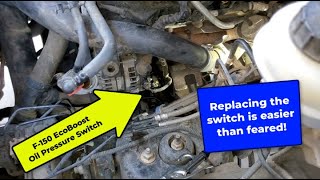
Typical fix: Replace the engine oil pressure sensor (Motorcraft SW-7670) and clean the electrical connector thoroughly. 🎬 See how to replace the oil pressure switch on an EcoBoost.
Est. part cost: $25-$60 - Incorrect Oil Viscosity or Clogged/Improper Filter ⚪ Low Probability
How to confirm: Check service records or drain the oil to see if the wrong type was used (this engine requires SAE 5W-30). Inspect the oil filter. A damaged O-ring on a cartridge-style filter can also cause a pressure leak.
Typical fix: Perform an oil and filter change using the correct OEM-specified full synthetic 5W-30 oil and a high-quality filter (e.g., Motorcraft). Ensure all seals and O-rings are correctly installed.
Est. part cost: $50-$100
Rare But Worth Checking
- Failing Oil Pump: → Shop Engine Oil Pump While less common than the sensor or the known engine defect, a mechanically worn or failing oil pump cannot produce adequate pressure. The dual-stage oil pump can also have issues with its control solenoid, triggering code P06DD. This is a serious mechanical failure requiring extensive labor to replace.
- Damaged Wiring Harness: The wiring to the oil pressure sensor could be chafed, melted, or broken, causing a short to ground that results in a false low-pressure reading. 🎬 Watch: Troubleshooting a low oil pressure sensor warning that won't clear.
Diagnosis Steps
- DO NOT START THE ENGINE. Check the engine oil level using the dipstick.
- If the oil level is low, top it off with the correct full synthetic SAE 5W-30 oil. Note how much oil was needed.
- Scan the vehicle for any other stored trouble codes, paying close attention to misfire codes (P030x) or oil pressure control codes (P06DD).
- CRITICAL STEP: Connect a mechanical oil pressure gauge to the engine to measure the actual oil pressure. Compare this reading to the manufacturer's specifications. Do not skip this step.
- If mechanical pressure is within spec: The issue is with the sending unit. Inspect the oil pressure sensor's electrical connector for oil contamination. If oil is present, replace the sensor and clean the connector. If no oil is found, test the sensor circuit for continuity and shorts.
- If mechanical pressure is LOW: The engine has a serious mechanical problem. Check the vehicle's build date. If it falls between April 2016 and January 2017, suspect the internal failure described in Ford's TSBs (19-2243, 19-2384, etc.). Professional teardown and inspection will be required. The presence of misfire codes alongside P0524 and P06DD strongly points to needing a long block replacement.
Parts You'll Likely Need
- Engine Long Block Assembly
(OEM #KT4Z-6006-B)— This is the prescribed fix per Ford's TSBs for vehicles within the affected build range (mid-2016 to early-2017) that exhibit P0524 and P06DD with excessive oil consumption and misfires.
Trusted brands: Motorcraft
OEM price range: $5000-$8500
Aftermarket price range: $4000-$6000 - Cylinder Head Assembly
(OEM #FT4Z-6049-E (Left), FT4Z-6049-F (Right))— If oil consumption and misfires are present but low pressure codes have not yet set, TSBs may direct replacement of the cylinder heads due to the faulty valve guides.
Trusted brands: Motorcraft
OEM price range: $1500-$2500 - Engine Oil Pressure Sensor
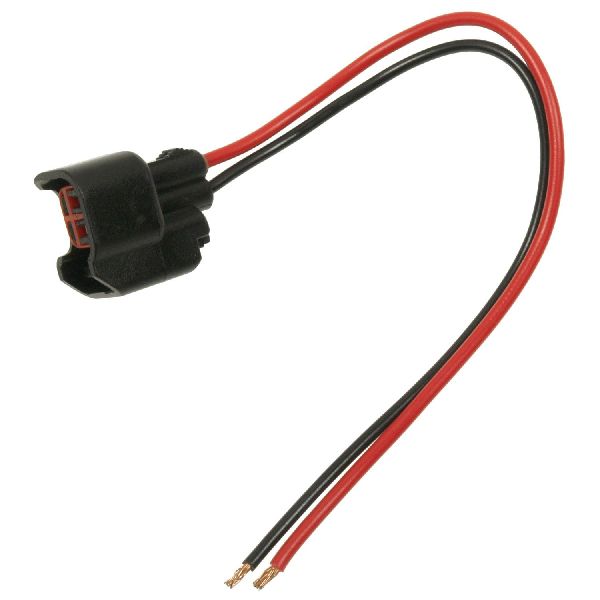
(OEM #SW-7670 (Motorcraft))— If actual oil pressure is confirmed to be good, a faulty sensor is the next most likely cause. These are known to leak oil into their electrical connector, causing false readings.
Trusted brands: Motorcraft, Bosch, Standard Motor Products
OEM price range: $25-$40
Aftermarket price range: $15-$30 - Engine Oil and Filter — Required for any repair, and essential to rule out a clogged filter or incorrect oil viscosity as the cause.
Trusted brands: Motorcraft
OEM price range: $50-$80
Aftermarket price range: $40-$60
Related Codes That Often Appear With This One
- P06DD — This code for 'Engine Oil Pressure Control Stuck Off' can indicate a problem with the variable displacement oil pump. The TSBs for the 2.7L engine explicitly state that when P06DD is present with P0524 and misfire codes, a complete long block replacement is often required.
- P0300, P0301-P0306 — These random and specific cylinder misfire codes are explicitly mentioned in Ford TSBs 19-2243 and 19-2384 for the 2.7L engine. The excessive oil consumption from faulty valve guides fouls the spark plugs, causing misfires.
- P0316 — This code for 'Misfire Detected on Startup' is also linked in the TSBs as a consequence of the oil consumption and spark plug fouling issue.
Technical Service Bulletins (TSBs) & Recalls
- TSB 19-2243
- TSB 19-2384
- TSB 17-2077
- TSB 17-0007
- SSM 46363
Platform-Specific Known Issues
- Ford TSB 19-2243 (supersedes 17-2235) addresses an issue on 2.7L GTDI engines built from April 1, 2016, to January 1, 2017, that may exhibit excessive oil consumption, blue/white exhaust smoke, and store codes P0524, P06DD, and various misfire codes. The prescribed fix is often cylinder head or complete engine replacement.
- TSB 17-0007 and 19-2384 detail the same issue specifically for the F-150, but the engine defect, symptoms, and diagnostic logic are identical, confirming the problem is with the engine, not the specific vehicle model.
Mechanic-Grade Diagnostic Values
- Mechanical Oil Pressure (Scan Tool PID: EOP_PRESS) — expected: Minimum 21 psi (144.8 kPa) at 2,000 RPM with engine at normal operating temperature.. Failure: Pressure reading below the minimum specification indicates a mechanical fault or severe oil loss.
- Mechanical Oil Pressure (Mechanical Gauge) — expected: Minimum 30 psi at 1500 RPM when at normal operating temperature.. Failure: Pressure significantly below this value points to a mechanical fault like a worn pump or bearing clearances.
- Engine Oil Pressure (EOP) Sensor Voltage — expected: Approximately 0.5V to 4.5V, varying with engine RPM and pressure.. Failure: A reading of 0V or 5V, or a static reading that does not change with RPM, indicates a faulty sensor or wiring circuit.
Hidden / Shadow Codes Worth Checking
- P0524 and/or P06DD in combination with P030x (misfire codes): This specific combination of codes is treated as a unique diagnostic flag by Ford's TSBs. It indicates that the known oil consumption issue has progressed to the point of causing both lubrication failure and combustion misfires, likely from oil fouling plugs and losing pressure from oil starvation. (see via Any standard OBD-II scanner can read these codes, but their combined meaning is defined in Ford's TSBs (like 19-2243) and requires a professional-level tool like the Ford Integrated Diagnostic System (IDS) to follow the specific diagnostic path.)
Scan Tool Commands That Help
- Ford IDS or FORScan: Live Data PID Monitoring (EOP_PRESS) — This is a critical first diagnostic step to see the oil pressure value that the PCM is reporting in real-time. It helps differentiate between a potential sensor/wiring issue and a true low-pressure event before connecting a mechanical gauge.
- Ford IDS: Power Balance Test — Since TSBs link P0524 to misfire codes (P03xx), running a power balance test can identify which specific cylinders are misfiring. This provides strong supporting evidence for the oil consumption/valve guide failure described in the TSB, helping to confirm the root cause.
Wiring & Ground Locations
- Engine Oil Pressure Sensor — On the driver's side of the engine block, near the oil filter housing assembly.. This is the primary sensor that triggers the P0524 code. Its location makes it susceptible to oil leaks from the filter housing and heat from the engine block, and its connector is a common point of failure due to oil contamination.
- PCM Connector C1381E, Pin 57 — This is the main connector for the Powertrain Control Module (PCM).. Pin 57 is the specific input pin for the Engine Oil Pressure sensor signal. A technician would test for voltage and continuity at this pin to diagnose a wiring issue between the sensor and the PCM without having to visually trace the entire harness.
Real Owner Repair Stories
- Reddit user in r/f150 (2016 Ford F-150 2.7L EcoBoost (built between Apr-2016 and Oct-2016)) — Intermittent 'Low Oil Pressure' warning on the dash, especially when cold and accelerating onto a highway. Also experienced rough idle and white/blue exhaust smoke.
❌ Tried (didn't work) The owner initially considered it might be a sensor glitch.
✅ What actually fixed it The issue was identified by another user as matching Ford TSB 17-0007. The TSB diagnostic procedure for a vehicle with P0524 and/or P06DD along with misfire codes (P030x) was to replace the entire engine long block assembly. The owner was advised to take it to the dealer for warranty repair under the TSB.
OEM Part Supersession History
KT4Z-6006-A→KT4Z-6006-B— This is the service part number for the complete 2.7L long block engine assembly. Supersessions typically involve internal revisions to address known issues, improve durability, or change suppliers. Given the TSB for this engine, it's highly likely the newer revision includes updated cylinder heads or other components to mitigate the oil consumption/valve guide defect.
Model Year Variations Within This Range
- 2016-2017 (Engines built April 1, 2016 - Jan 1, 2017): Engines within this specific build date range are susceptible to a manufacturing defect in the cylinder head valve guides, leading to excessive oil consumption and the associated P0524/P06DD codes. Engines built before or after this window are significantly less likely to experience this specific TSB-related failure.
- 2018+: Later versions of the 2.7L EcoBoost (second generation) added a port fuel injection system alongside the direct injection. While not directly related to oil pressure, this change helped mitigate carbon buildup on intake valves, a separate known issue on the first generation (2015-2017) engines. Additionally, a different valve material ('Silchrome 1') was used starting in late 2021 to address valve failure issues on newer models, though this is outside the 2016-2017 scope.
Diagnostic Flowchart
Other Known Issues on This Vehicle
Issues unrelated to this code that are worth knowing about as an owner of this generation:
- Power Transfer Unit (PTU) Failure 🔴 High — Common issue on AWD models. Fluid can overheat and degrade, leading to seal leaks and eventual gear failure. Often noticed by a burning gear oil smell or fluid leaks.
- Intake Valve Carbon Buildup 🟠 Medium — Common to all Gasoline Direct Injection (GDI) engines, including the 2.7L EcoBoost. Over time (50k-100k miles), carbon can accumulate on intake valves, causing rough idle, hesitation, or misfires. Not a defect, but a maintenance consideration.
- Leaking Plastic Oil Pan 🟡 Low — The original plastic oil pan on early 2.7L EcoBoost engines was prone to developing leaks at the seal after numerous heat cycles. Ford later released an updated pan design. TSB 19-2205 addresses this for other models. (Ref: TSB 19-2205)
- Coolant Leaks (2.0L EcoBoost) 🔴 High — While the 2.7L V6 is generally not known for this, the 2.0L 4-cylinder EcoBoost in other Edge models is notorious for coolant intrusion into cylinders, leading to engine failure. This is a critical distinction for owners to be aware of.
Used vs. New Parts: Buying Guide for This Vehicle
When a used part is the smart pick: For this specific failure, buying a used engine is extremely high-risk and generally not recommended. The primary cause is a known, date-specific manufacturing defect. A used engine from a 2016-2017 donor vehicle is highly likely to have the same defect or be on the verge of failure. Used parts may be considered for ancillary components like a wiring harness or a sensor if confirmed to be from a vehicle outside the problematic build date range.
Donor-vehicle mileage cap: roughly under 20000 miles for the part to have meaningful remaining life.
What to inspect on the donor part:
- For a used engine, MUST have verifiable proof of the donor vehicle's build date (must be outside April 2016 - Jan 2017).
- Check for signs of oil leaks around the oil pan, turbo lines, and valve covers.
- If possible, inspect the intake for heavy oil residue, which indicates excessive blow-by or consumption.
- For a sensor or harness, ensure the connector pins are clean, straight, and free of corrosion or oil contamination.
OEM-only on this vehicle (don't cheap out):
- Engine Long Block Assembly
- Cylinder Head Assembly
- Variable Displacement Oil Pump
Aftermarket brands forum-validated for this vehicle:
- For gaskets during engine work, Fel-Pro is a widely trusted aftermarket brand.
- For a replacement oil pan, some owners upgrade from the stock plastic pan to an aftermarket aluminum one for better durability and heat dissipation.
Brands owners have reported issues with on this vehicle:
- Avoid unbranded, low-cost oil pressure sensors from online marketplaces, as their accuracy and longevity are questionable.
- Be cautious with non-OEM oil filters; a faulty anti-drainback valve or incorrect bypass pressure can cause lubrication issues.
Real Owner Stories
Aggregated from forums and TSBs cited above. Mileages and costs reflect what owners reported in those sources.
2016 Ford Edge Sport 2.7L
Symptoms: Low oil pressure warnings appearing specifically after having the oil pan gasket replaced.
What fixed it: Investigation into the oil pan gasket replacement procedure (potential alternative cause for pressure issues).
Source hint: Ford Edge Forum: 2.7l Edge Sport oil pressure issue
2016-2017 Ford F-150 2.7L EcoBoost
Symptoms: Oil consumption, rough idle, misfires, and exhaust smoke.
What fixed it: Replacement of the engine (long block) as per TSB 17-2077.
Source hint: F150 Forum: 2016/17 F150 2.7L - Oil Consumption, Rough Idle, Misfire, Ex. Smoke ***TSB 17-2077
2016-2017 Ford Edge 2.7L EcoBoost
Symptoms: Excessive oil consumption (over 1 quart in 3,000 miles), blue/white smoke from the exhaust, and an 'hour glass' wear pattern on the valve guides.
What fixed it: Replacement of the cylinder heads or the entire long block engine assembly.
Source hint: BobIsTheOilGuy: Blown 2.7L Ecoboost Engines -TSB, What Root Cause?
Related OBD-II Codes
Frequently Asked Questions
Does TSB 19-2243 apply to my 2016 Ford Edge with the 2.7L EcoBoost?
I have a 2016 Edge Sport and just replaced my oil pan gasket; why am I seeing a low oil pressure warning now?
What specific oil should I use for my 2.7L EcoBoost to avoid P0524?
If I have both P0524 and P06DD codes, what is the likely repair?
Can a faulty sensor cause P0524 even if my oil level is fine?
Is the oil consumption issue limited only to the Ford Edge?
Helpful Videos
We Have This Part in Stock



The information in this article is provided for general reference and educational purposes only. Vehicle specifications, procedures, and part compatibility can vary by production date, trim level, and region. Always consult your vehicle's factory service manual and verify part numbers before purchasing or performing repairs. Safety-critical components such as airbags, seat belts, and braking systems should be installed by a qualified professional.
- Ford Edge:
- 🧭 Diagnostic Flowchart
- 🎬 Helpful Videos
- 🛍️ Shop This Part
- What's Unique About the 2016-2017 Ford Edge
- Symptoms You May Notice
- Most Likely Causes
- Rare But Worth Checking
- Diagnosis Steps
- Parts You'll Likely Need
- Related Codes That Often Appear With This One
- Technical Service Bulletins (TSBs) & Recalls
- Platform-Specific Known Issues
- Mechanic-Grade Diagnostic Values
- Hidden / Shadow Codes Worth Checking
- Scan Tool Commands That Help
- Wiring & Ground Locations
- Real Owner Repair Stories
- OEM Part Supersession History
- Model Year Variations Within This Range
- Other Known Issues on This Vehicle
- Used vs. New Parts: Buying Guide for This Vehicle
- Real Owner Stories
- 2016 Ford Edge Sport 2.7L
- 2016-2017 Ford F-150 2.7L EcoBoost
- 2016-2017 Ford Edge 2.7L EcoBoost
- Related OBD-II Codes
- Frequently Asked Questions
- 🎟️ Get 5% Off