

P0534 on 2020 Jeep Wrangler: A/C Refrigerant Charge Loss Explained
P0534 on a 2020 Wrangler means your A/C system has lost refrigerant. This is almost always due to a leak, most commonly from the A/C condenser being damaged by road debris, or from a leaking seal or hose. A professional diagnosis is needed to find and fix the leak, as it requires specialized A/C service equipment for the R-1234yf refrigerant.
- P0534 means your 2020 Wrangler's A/C system has a refrigerant leak.
- The most common symptom is the A/C blowing warm air, accompanied by a Check Engine Light.
- This is not a DIY-friendly repair. Due to the specialized tools and handling procedures for R-1234yf refrigerant, professional service is required.
- The most likely culprit is a leak, often from the A/C condenser being punctured by road debris, followed by a faulty pressure sensor or its seal.
- Do not simply add more refrigerant; the leak must be found and repaired first for a permanent solution.
What's Unique About the 2020-2020 Jeep WRANGLER
For the 2020 Jeep Wrangler (JL generation), this code points directly to a problem with the A/C system's integrity. While A/C leaks can 🎬 Watch: How to diagnose common refrigerant leak causes and fixes. happen on any vehicle, the Wrangler's prominent, upright seven-slot grille offers less protection to the A/C condenser, making it highly susceptible to damage from rocks and road debris. This is a widely discussed failure point among owners and repair professionals. Additionally, this model uses the newer R-1234yf refrigerant, which is more environmentally friendly but also more expensive and requires specific service equipment to handle legally and safely.
Diagnostic Flowchart
Tap your situation to follow the diagnostic path that matches what you're seeing on this vehicle.
Symptoms You May Notice
- A/C system blows warm or only slightly cool air.
- Check Engine Light is illuminated.
- A/C compressor clutch does not engage or cycles on and off rapidly.
- Hissing noises from the engine bay if there is a large, active leak.
- Visible oily residue on A/C components, especially the condenser fins behind the grille.
- Adding refrigerant without fixing the leak. This is a temporary fix at best; the system will lose pressure again, and repeatedly adding refrigerant is costly and harmful to the environment. It can also lead to an overcharged system if done incorrectly, which causes its own set of problems.
Most Likely Causes
- A/C System Leak 🔴 High Probability The A/C condenser is located at the front of the vehicle and is extremely vulnerable to damage from road debris passing through the grille slots. This is the most common failure point. O-rings at line fittings can also degrade, and hoses can develop leaks. One owner of a platform-mate Gladiator reported leaking A/C hoses requiring replacement.
How to confirm: A technician will inject UV dye into the A/C system, run it, and then use a black light to find the source of the fluorescent green/yellow dye. An electronic 'sniffer' can also be used to detect refrigerant gas. A visual inspection of the condenser through the grille may reveal an oily patch indicating a leak.
Typical fix: Repair or replace the leaking component, which could be a condenser, hose, O-ring, or the compressor itself. The system must then be evacuated and recharged to the correct specification.
Est. part cost: $20-$500 - Faulty A/C Refrigerant Pressure Sensor 🟡 Medium Probability → Shop Refrigerant Sensors can fail electrically over time. There is also a known issue with the O-ring seal for the pressure sensor, which can cause a refrigerant leak at the sensor itself (see TSB 26-044).
How to confirm: Compare the sensor's pressure reading on a scan tool with the actual system pressure measured by a set of A/C manifold gauges. If the readings differ significantly, the sensor is likely faulty. Also, check the sensor's wiring for proper voltage and ground. Inspect the sensor base for signs of leaking refrigerant oil/dye.
Typical fix: Replace the A/C refrigerant pressure sensor and its O-ring, then ensure the electrical connector is clean and secure. The system will need to be evacuated and recharged if refrigerant was lost.
Est. part cost: $40-$100 - Wiring or Connector Issue ⚪ Low Probability
How to confirm: Visually inspect the wiring harness and connector for the A/C pressure sensor. Check for breaks, corrosion, or loose pins. Perform a continuity test on the wires between the sensor and the PCM.
Typical fix: Repair the damaged section of wiring or replace the connector pigtail.
Est. part cost: $10-$50
Rare But Worth Checking
- Leaking A/C Pressure Transducer O-Ring:
Diagnosis Steps
- Confirm the P0534 code is present using an OBD-II scanner.
- Visually inspect all accessible A/C components, paying close attention to the front of the A/C condenser through the grille for obvious signs of impact damage or oily residue, which indicates a leak.
- Connect a set of A/C manifold gauges to the high and low-side service ports to measure the static pressure. A very low reading (near zero) confirms a significant loss of refrigerant.
- If the pressure is low, the system must be tested for leaks. This is professionally done by adding UV dye and using a black light, or with an electronic leak detector. Check common failure points like the condenser, hose crimps, and the pressure sensor seal.
- Once the leak is located, replace the faulty component (e.g., condenser, hose, O-ring).
- If the gauge pressure appears normal but the code is present, suspect the A/C pressure sensor or its circuit. Test the sensor's output voltage and compare it to specifications.
- After any repair involving a leak, a technician must use a recovery/recharge machine to pull a deep vacuum on the system to remove air and moisture before recharging with the precise weight of R-1234yf refrigerant specified for the vehicle.
Parts You'll Likely Need
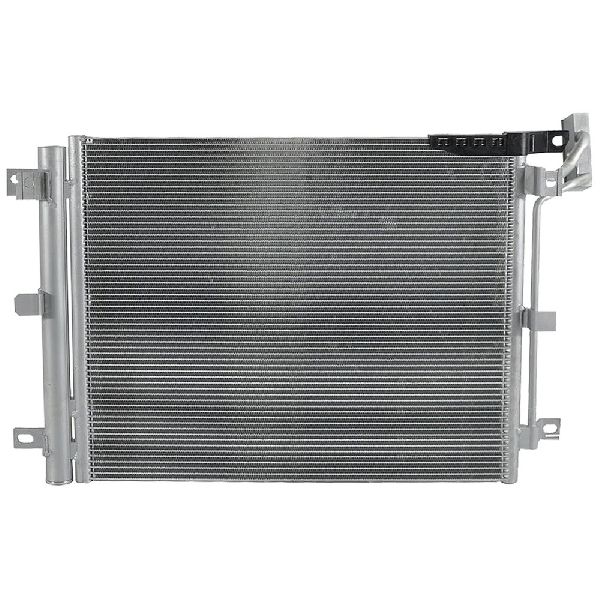
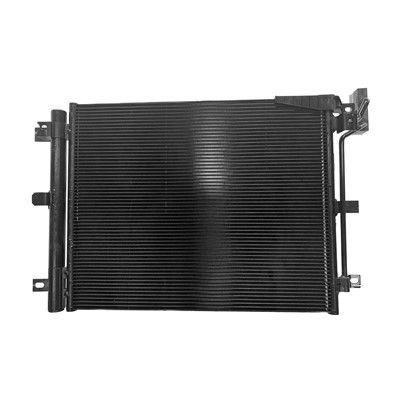
- A/C Condenser
(OEM #68314789AC (supersedes 68314789AB, 68314789AA))— Due to its exposed location at the front of the Wrangler, it is the most common component to be damaged by road debris, causing a refrigerant leak.
Trusted brands: Mopar, Denso, Spectra Premium
OEM price range: $250-$360
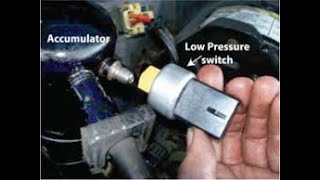
Aftermarket price range: $150-$300 - A/C Refrigerant Pressure Sensor/Switch — This sensor can fail electrically, sending an incorrect low-pressure signal to the PCM even when the refrigerant charge is correct. The O-ring seal for this sensor is also a known leak point.
Trusted brands: Mopar, Bosch, Standard Motor Products
OEM price range: $60-$100
Aftermarket price range: $40-$70 - A/C O-Ring Kit
(OEM #05183358AA (for pressure transducer))— Leaks often occur at the fittings where hoses and components connect. It is standard practice to replace O-rings whenever the system is opened for repair. A specific TSB points to the pressure transducer O-ring as a failure point.
Trusted brands: Mopar, Four Seasons
OEM price range: $20-$40
Aftermarket price range: $10-$25
Technical Service Bulletins (TSBs) & Recalls
- 18-003-23: A TSB for 2020 Jeep Wranglers related to back-over prevention systems that lists P0534-00 - AC Refrigerant System A Charge Loss as a possible diagnostic trouble code.
- 1804921: A TSB for 2020 Jeep Wranglers related to the electrical system that also lists P0534-00 - A/C Refrigerant System "A" Charge Loss as a potential code.
- 26-044: This TSB, issued March 2026, specifically addresses A/C refrigerant leaking at the temperature and pressure sensor (transducer) seal. It instructs technicians to replace the O-ring (Part No. 05183358AA) to fix the leak.
Platform-Specific Known Issues
- Condenser Vulnerability: The open design of the Wrangler's grille makes the A/C condenser highly prone to punctures from rocks and other road debris, leading to refrigerant leaks and a P0534 code. This is the most frequently cited cause of A/C failure on this platform.
- Pressure Sensor Seal Leak: TSB 26-044 identifies a specific failure of the O-ring seal for the A/C pressure transducer, causing a refrigerant leak at the sensor fitting.
Mechanic-Grade Diagnostic Values
- A/C System Pressure - Normal Operation — expected: Low Side: ~30 PSI, High Side: 150+ PSI. Failure: Low static pressure (e.g., near 0 PSI) indicates a major leak. Low dynamic pressure (e.g., 125/30 PSI) indicates a low charge.
- A/C Pressure Sensor Voltage (Signal Wire) — expected: Typically 0.5V (low pressure) to 4.5V (high pressure) on a 5V reference circuit. Voltage should track system pressure.. Failure: Voltage that is stuck high or low regardless of actual system pressure, or voltage that doesn't change when the A/C is turned on, points to a faulty sensor or wiring issue.
- A/C Pressure Sensor Power Supply — expected: 5V or 12V reference voltage at the sensor's power pin, with the key on.. Failure: No voltage indicates a wiring issue or a problem with the PCM's reference voltage supply.
Scan Tool Commands That Help
- wiTECH (Dealer Tool): HVAC Control Module Software Update — For vehicles built on or before Sept 30, 2020, experiencing intermittent blasts of warm air. This is per TSB 24-007-21 and may resolve issues that could be misdiagnosed as a pressure problem.
- Professional Scan Tool: A/C Compressor Clutch Relay Actuation — To manually command the A/C compressor clutch on and off. This helps determine if the clutch itself is functional and if the control circuit from the PCM is working, isolating the problem to either the control side or the pressure/refrigerant side.
Wiring & Ground Locations
- A/C Pressure Sensor Connector — Typically located on the high-pressure A/C line, which is the smaller diameter metal pipe coming from the A/C compressor.. This is the primary sensor for P0534. The connector and its wiring are critical. It has three pins: a 5-volt reference, a low reference (ground), and the signal wire that sends pressure data to the PCM.
- G905A / G914A — These are instrument panel (IP) and dash harness grounds located in the driver and passenger footwells, under the kick panels.. The A/C pressure sensor circuit, along with other HVAC controls, relies on a solid ground connection. A corroded or loose ground at these common points can cause erratic sensor readings, potentially triggering a false P0534 code.
- Engine Bay Ground Stud — On the driver's side of the engine bay, near the brake booster, there is a factory ground stud on the body.. This is a primary grounding point for many engine bay components. Ensuring this connection is clean and tight is a crucial step when diagnosing any electrical fault, including sensor circuit issues for the A/C system.
"I Checked Everything" — The Actual Cause
- In A/C diagnostics, the equivalent of a 'smoke test clean' is when a technician cannot find a leak in the engine bay using UV dye or an electronic 'sniffer'. In these cases, the leak is often in the A/C evaporator core, which is hidden inside the HVAC housing under the dashboard. The tell-tale sign is often a sweet, chemical smell of refrigerant oil inside the cabin or fluorescent UV dye appearing in the A/C condensation water draining under the vehicle. This is commonly missed because it requires a much more involved inspection than just looking around the engine bay and is a labor-intensive repair.
OEM Part Supersession History
68314789AA, 68314789AB→68314789AC— Part revision by manufacturer for improved design or manufacturing process.
Model Year Variations Within This Range
- 2020 (built on or before September 30, 2020): These models may have a software issue in the HVAC control module that causes intermittent warm air. Jeep issued TSB 24-007-21 to resolve this with a software update, which could be misdiagnosed as a refrigerant or hardware issue.
Helpful Videos



We Have This Part in Stock

The information in this article is provided for general reference and educational purposes only. Vehicle specifications, procedures, and part compatibility can vary by production date, trim level, and region. Always consult your vehicle's factory service manual and verify part numbers before purchasing or performing repairs. Safety-critical components such as airbags, seat belts, and braking systems should be installed by a qualified professional.
- Jeep WRANGLER:
- 🧭 Diagnostic Flowchart
- 🎬 Helpful Videos
- 🛍️ Shop This Part
- What's Unique About the 2020-2020 Jeep WRANGLER
- Symptoms You May Notice
- Most Likely Causes
- Rare But Worth Checking
- Diagnosis Steps
- Parts You'll Likely Need
- Technical Service Bulletins (TSBs) & Recalls
- Platform-Specific Known Issues
- Mechanic-Grade Diagnostic Values
- Scan Tool Commands That Help
- Wiring & Ground Locations
- "I Checked Everything" — The Actual Cause
- OEM Part Supersession History
- Model Year Variations Within This Range
- 🎟️ Get 5% Off