

OBD-II Code P0549: Exhaust Gas Temperature Sensor Circuit High (Bank 2, Sensor 1)
The Ultimate Expert Guide to Diagnosing and Fixing P0549
- P0549 triggers when the Powertrain Control Module (PCM) detects a continuous high voltage (near 5.0V) from the Bank 2, Sensor 1 Exhaust Gas Temperature (EGT) sensor.
- Replacing the EGT sensor fixes this code in 80% of cases, costing between $150 and $350 for parts and labor.
- Stop driving diesel vehicles with this code immediately; it halts DPF regeneration and destroys the $3,000+ filter within 100 to 200 miles.
- Test the sensor's resistance with a multimeter before replacing it; a reading near 0 Ohms confirms an internal short and a dead sensor.
- Inspect the wiring harness near the hot exhaust manifold for melted insulation, as a short to a 5V power source perfectly mimics a failed sensor.
What Does P0549 Mean?
P0549 means the Powertrain Control Module (PCM) detects a continuous high voltage signal (near 5.0V) from the Exhaust Gas Temperature (EGT) sensor on Bank 2, Sensor 1. Bank 2 is the engine side without cylinder #1, and Sensor 1 is upstream of the catalytic converter or DPF. The PCM interprets this 5V signal as a dangerously high exhaust temperature and cuts engine power to protect the turbocharger and exhaust components.
Technical definition: The SAE/OBD-II definition is "Exhaust Gas Temperature Sensor Circuit High Bank 2 Sensor 1". The PCM sets this code when it receives a voltage from the EGT sensor at or near the top of its 5-volt reference range. The EGT sensor is a thermistor that decreases internal resistance as temperature increases. A constant 5V signal indicates a short circuit to voltage or a completely failed sensor.
Can I Drive With P0549?
Yes, But With Caution. You can drive, but do not exceed 50 miles. The engine enters limp mode, drastically reducing power and making highway driving dangerous. Continuing to drive diesel vehicles with this fault destroys the Diesel Particulate Filter (DPF) within 100 to 200 miles, resulting in a $2,000-$5,000 replacement. Gasoline engines risk $800-$2,500 in catalytic converter damage from overheating.
Common Causes
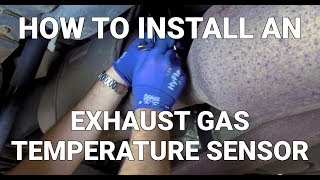
- Failed or Internally Shorted EGT Sensor (Very Common) — The sensor itself is the most frequent culprit. 🎬 See this walkthrough on installing a new EGT sensor Internal components fail and short circuit, sending a constant 5V signal to the PCM regardless of the actual exhaust temperature.
- Damaged Wiring or Connectors (Common) — The wiring harness is exposed to extreme heat and vibration near the exhaust. Melted insulation or corroded connectors create a short circuit to a 5V power source, mimicking a failed sensor.
- Excessive Soot Buildup on Sensor (Common On Diesel) — On diesel engines, heavy combustion soot cakes onto the sensor probe. This insulates the sensor, causing erratic readings that trigger a high voltage fault code.
- Exhaust System Leaks (Less Common) — A crack in the exhaust manifold upstream of the sensor introduces oxygen into the exhaust stream. This alters temperature readings and triggers a circuit high code in specific PCM logic.
- Aftermarket Exhaust or Aggressive Tune (Uncommon) — Poorly designed aftermarket exhausts lack proper EGT sensor bungs, altering exhaust flow. Aggressive engine tunes raise actual EGTs beyond stock parameters, triggering the code.
- PCM Failure or Software Glitch (Rare) — An internal short on the PCM's 5-volt reference circuit or corrupted software misinterprets a normal voltage signal as a fault. This requires a software reflash or PCM replacement.
Symptoms
- Check Engine Light & Emissions Warnings — The Malfunction Indicator Lamp (MIL) illuminates immediately. You will also see dashboard messages like "Check Emissions System" or "Service Exhaust System".
- Reduced Engine Power / Limp Mode — The PCM defensively limits engine power and throttle response to protect the turbocharger and exhaust from perceived overheating. The vehicle feels sluggish and struggles to accelerate.
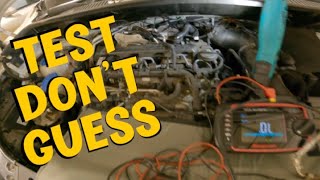
- DPF Regeneration Halted (Diesel Engines) — The EGT sensor provides critical data for Diesel Particulate Filter (DPF) regeneration. A faulty sensor blocks regeneration entirely, 🎬 Watch: Testing and replacing EGT probes on diesel engines leading to a clogged DPF and secondary warning lights.
- Increased Fuel Consumption — The PCM commands a richer fuel mixture to cool the combustion chamber, causing a noticeable 10-15% decrease in fuel economy.
Diagnostic Flowchart
Tap your situation to follow the diagnostic path that matches what you're seeing on this code.
Common Fixes & Costs
- Replace the EGT Sensor — Parts: $50-$200, Labor: $100-$150, ~1.2 hr book time (DIY)
- Repair Damaged Wiring or Connector — Parts: $15-$60, Labor: $120-$250, ~1.5 hr book time (Intermediate)
- Repair Exhaust Leak — Parts: $20-$150, Labor: $150-$350, ~2.5 hr book time (Intermediate)
- Professional Diagnosis — Parts: $0, Labor: $150-$165, ~1.0 hr book time (Professional)
- Replace the Powertrain Control Module (PCM) — Parts: $800-$1200, Labor: $150-$250, ~1.5 hr book time (Professional)
DIY vs Professional
- Replace the EGT Sensor — Beginner: yes
Tools: ['OBD-II Scanner', 'EGT Sensor Socket or 17mm/19mm Flare Nut Wrench', 'Penetrating Oil (PB Blaster)', 'High-Temperature Anti-Seize'] - Repair Damaged Wiring — Beginner: no
Tools: ['Digital Multimeter', 'Wire Strippers', 'Soldering Iron', 'Heat Shrink Tubing']
Used vs. New Parts: Buying Guide
When a used part is worth it: Buying a used EGT sensor is never recommended. These are inexpensive wear-and-tear components operating in extreme environments. The risk of a used sensor failing immediately is high.
Donor-vehicle mileage cap: roughly under 20000 miles for the part to have meaningful remaining life.
Donor quality checklist:
- Ensure the part number matches exactly.
- Avoid parts from regions with heavy road salt usage.
Decision logic:
- If The cost of a new OEM or reputable aftermarket EGT sensor is under $200 → Always buy new. The reliability and warranty are worth the cost.
Warranty tradeoff: Used parts have a 30-day warranty. New aftermarket sensors carry a 1-year to limited lifetime warranty.
Worst-case if a used part fails: $350 (Cost of a new sensor plus repeated labor charges).
What Happens If You Wait — Timeline
- 0-2 weeks: Check Engine Light illuminates and vehicle enters limp mode. DPF regeneration is inhibited on diesel vehicles. (MPG impact: 5-10%% · Added cost: $0)
- 2 weeks - 2 months (Diesel): DPF soot level rises past the threshold for active regeneration. Power loss becomes severe as exhaust backpressure increases. (MPG impact: 10-20%% · Added cost: $200-$600 (Cost for a forced DPF regeneration at a shop).)
- 2-4 months (Diesel): DPF becomes critically clogged with soot and ash. The filter cracks or melts internally from excessive backpressure. (MPG impact: 20-40%% · Added cost: $2,000-$5,000 (Cost for DPF replacement).)
- 3-6+ months (Gasoline): The PCM runs a consistently rich air-fuel mixture to cool the exhaust, overheating and destroying the catalytic converter substrate. (MPG impact: 10-15%% · Added cost: $800-$2,500 (Cost for catalytic converter replacement).)
Cost of Not Fixing It
- Immediate: Reduced engine power ('limp mode') and a 10-15% drop in fuel economy. (Added cost: Negligible)
- 1-3 months (Diesel): The DPF becomes critically clogged due to inhibited regeneration, requiring forced regeneration or replacement. (Added cost: $3,000-$5,000)
- 1-6 months (Gasoline): The catalytic converter overheats and fails due to incorrect air/fuel mixtures commanded by the PCM. (Added cost: $1,200-$2,500)
Diagnosis Steps
- Read Codes and Freeze Frame Data
Use an OBD-II scanner to confirm P0549 is active. Analyze the freeze-frame data to identify the engine RPM, load, and temperature when the fault triggered. Note any accompanying DPF or misfire codes.
Tools: OBD-II Scanner (Beginner) - Analyze Live Sensor Data
View the live data stream for 'EGT B2S1' with the key on and engine off (KOEO). A healthy sensor reads close to ambient temperature (1.0V - 1.5V). A reading locked at maximum temperature (e.g., 1800°F / 1000°C) or 5.0V confirms a hard circuit high fault.
Tools: Advanced OBD-II Scanner (Intermediate) - Visually Inspect the Sensor and Wiring
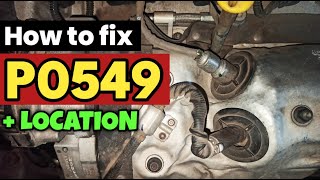
Locate the EGT sensor on exhaust Bank 2, upstream of the catalytic converter. Inspect the wiring harness for melted insulation, frayed wires, or connector corrosion. Physical damage here guarantees a short circuit.
Tools: Flashlight, Safety Glasses (Beginner) - [PRO TIP] Perform a 'Wiggle Test'
While watching live scanner data, aggressively wiggle the EGT wiring harness and connector. If the voltage drops to normal or fluctuates wildly, you have located an intermittent short in the wiring.
Tools: Advanced OBD-II Scanner, Mechanic's Gloves (Intermediate) - Test Sensor Resistance
Disconnect the sensor and measure resistance across its two pins with a multimeter. A healthy sensor reads 150-200 Ohms at room temperature. A reading near zero Ohms confirms an internal short and a dead sensor.
Tools: Digital Multimeter, Basic Hand Tools (Intermediate) - Test Circuit Voltages
With the sensor disconnected and key on (engine off), probe the harness connector. One wire must show a 5-volt reference signal from the PCM. The other is the ground. If the signal wire shows voltage, the harness is shorted to power.
Tools: Digital Multimeter (Advanced) - Check for Exhaust Leaks
With the engine running, inspect the exhaust manifold near the sensor for black soot trails or audible ticking sounds. Repair any leaks, as they skew sensor readings.
Tools: Flashlight (Intermediate) - [ADVANCED] Lab Scope Analysis
Back-probe the signal wire at the PCM using an oscilloscope. A signal stuck at 5 volts, containing excessive noise, or jumping suddenly to 5 volts confirms a circuit fault with 100% accuracy.
Tools: Automotive Oscilloscope, Back-probe Pins (Professional) - Clear Codes and Test Drive
After replacing the sensor or repairing wiring, clear the DTCs. Drive the vehicle at highway speeds for 20 minutes to ensure the fault does not return and readiness monitors reset.
Tools: OBD-II Scanner (Beginner)
When This Code Triggers (Freeze-Frame Conditions)
- Engine Coolant Temp: 170-220°F (77-104°C) (Fully warmed up)
- Engine RPM: 1500-2500 RPM (Steady cruise or light acceleration)
- Engine Load: 25-60% (Sustained driving, not at idle or full throttle)
Related Codes
- P0548 — The direct opposite code: 'Exhaust Gas Temperature Sensor Circuit Low'. P0549 indicates a short to voltage, while P0548 indicates an open circuit or short to ground.
- P0544 — 'Exhaust Gas Temperature Sensor Circuit (Bank 1, Sensor 1)'. The exact same fault, but located on the opposite bank of a V-type engine.
- P242F — 'Diesel Particulate Filter Restriction'. This code is a direct consequence of an unresolved P0549 fault preventing DPF regeneration.
Climate & Environmental Factors
- Road Salt & Cold Climates: Salt and moisture create a highly corrosive environment that attacks the sensor body and connector pins. This corrosion causes internal sensor failure or wiring shorts, triggering the P0549 fault.
- Extreme Heat Cycles: Vehicles used for heavy towing experience intense thermal stress. These extreme heat cycles accelerate the degradation of the EGT sensor's internal thermistor and surrounding wiring insulation.
How to Talk to a Mechanic About This Code
Say this: "I have an OBD-II code P0549 for the Exhaust Gas Temperature Sensor Circuit on Bank 2. Please check the sensor's live data voltage and test its resistance before recommending a replacement to ensure it's not just a wiring short."
This signals you understand the code relates to a specific electrical circuit. It requests simple tests that prevent a shop from replacing the sensor without proper diagnosis, saving you money if the problem is a broken wire.
Avoid saying:
- 'Just fix whatever's wrong'
- 'My check engine light is on, can you look at it?'
Questions to ask before authorizing the repair:
- What was the sensor's voltage reading on the scan tool with the key on and engine off?
- Did you measure the resistance across the sensor's pins, and what was the reading in Ohms?
- Did you confirm there is a 5-volt reference signal at the harness connector?
Where to Take It: Dealer vs Independent vs Chain
- Dealer:
Best for: Vehicles under powertrain or extended emissions warranty (e.g., VW 'Dieselgate')., Vehicles requiring a manufacturer-specific 'adaptation' procedure after sensor replacement.
Downsides: Labor rates are 40-50% higher than independent shops., Dealers often replace entire wiring harnesses rather than repairing a small section. (Typical cost: +50% vs. baseline) - Independent Shop:
Best fit for most situations. A competent independent mechanic easily diagnoses a P0549 fault with basic electrical tools, offering significant cost savings.
Best for: Most out-of-warranty vehicles., Straightforward diagnosis of sensor and wiring faults.
Downsides: May not have specific tools for post-repair adaptations on some German vehicles. (Typical cost: +0% vs. baseline) - Chain Shop:
Avoid for initial diagnosis. Acceptable for a simple EGT sensor swap only if you are certain the sensor is the problem.
Best for: Simple part replacement IF you have already performed the diagnosis yourself.
Downsides: High pressure to upsell services., Less likely to perform detailed circuit testing required for an accurate diagnosis. (Typical cost: -10% vs. baseline)
When to Walk Away From the Repair
If the total estimated repair cost exceeds 40-50% of the car's private-party value, seriously consider selling the vehicle as-is.
- Car worth $5000, fix is $350: Fix it. This is a standard repair cost well below the threshold.
- Car worth $4000, fix is $2800: Walk away. This cost implies the P0549 fault was ignored and caused DPF failure. The repair is 70% of the car's value.
What Scan Tool You Need for This Code
Minimum: An OBD-II reader that displays live sensor data, specifically voltage and temperature PIDs.
A basic $20 code reader only shows the P0549 code. It cannot display live voltage data, which is essential to confirm if the signal is truly 'stuck high' (near 5V).
Budget: BlueDriver Pro (~$100) — Displays and graphs live data streams on your smartphone, allowing you to see the EGT sensor's voltage and temperature readings in real-time.
Mid-range: Foxwell NT510 Elite (~$180) — Offers manufacturer-specific functions. For VW/Audi, it performs the required 'adaptation' after a new sensor is installed.
Professional: Autel MaxiCOM MK808S (~$450) — Provides full OE-level diagnostics and bidirectional control for active tests on related components.
Rent vs buy: For a one-time diagnosis, use the free loaner tool program from AutoZone or O'Reilly Auto Parts. Verify the loaner scanner supports live data.
How to Clear the Code After You Fix It
- Use an OBD-II scan tool to clear the P0549 code.
- Ensure the fuel tank is between 35% and 85% full.
- Perform a complete drive cycle to allow readiness monitors to run.
Drive cycle (~20 minutes): Start the engine cold and idle for 3 minutes. Drive in mixed city/highway conditions, including steady-state cruising at 55-60 mph for at least 5 minutes. Allow the vehicle to decelerate without braking where possible.
Readiness monitors affected: Catalyst Monitor, Oxygen (O2) Sensor Monitor, Exhaust Gas Recirculation (EGR) System
Before emissions retest: drive at least 50 miles to fully set monitors.
Watch out for:
- Clearing the code resets all readiness monitors to 'Not Ready', causing an immediate emissions test failure.
- The code returns immediately if the underlying electrical short has not been repaired.
Will This Fail Emissions / State Inspection?
Yes — this code typically fails an OBD-II emissions inspection.
- California: An active P0549 code is an automatic smog check failure. A full drive cycle must be completed to set all readiness monitors before a re-test.
- Texas: An illuminated Check Engine Light is an automatic failure. Clearing the code is not enough; readiness monitors must show 'Ready'.
Most Commonly Affected Vehicles
- Volkswagen Golf, Jetta, Passat (TDI) (2009-2015) — Extremely common failure item. Often requires a specific adaptation procedure with a VCDS scan tool after replacement.
- Ford F-250/F-350 (6.4L & 6.7L Power Stroke) (2008-2016) — A failure of any EGT sensor halts DPF regeneration, leading to a clogged filter and severe power loss.
- Chevrolet / GMC Silverado/Sierra (Duramax) (2007-2016) — P0549 prevents active regeneration. Must be addressed immediately to avoid costly DPF damage.
- Subaru WRX, Forester XT (2008-2014) — The ECU drastically cuts boost and power to protect the turbocharger the moment this code triggers.
- Nissan Titan XD (5.0L Cummins) (2016-2019) — EGT sensor failures cause a dramatic loss of power and frequently appear alongside code P2083.
Manufacturer-Specific Notes
- Volkswagen/Audi: On TDI engines, this code is exceptionally common and almost always a failed sensor. After replacement, the ECU must be notified of the new sensor via an 'adaptation' procedure using a VCDS scan tool.
- Subaru: On turbocharged models, the EGT sensor is a primary input for turbocharger protection. A P0549 fault immediately triggers an aggressive limp mode, severely limiting boost pressure.
- Ford / GMC (Diesel Trucks): EGT sensors are non-negotiable for DPF health. A P0549 code inhibits active DPF regeneration, quickly leading to a clogged DPF and a P242F code.
Real Owner Stories
2011 VW Jetta TDI at 115K miles
Check Engine Light and DPF light illuminated simultaneously. The car entered limp mode with a major loss of power.
What they tried:
- Read codes, found P0549.
- Visually inspected the Bank 2 EGT sensor and found no obvious wiring damage.
- Replaced the EGT sensor (Bank 2, Sensor 1).
Outcome: Replacing the sensor fixed the issue. After clearing the codes, the car returned to normal power, and a short highway drive allowed the DPF to regenerate. Total cost was $120 for an aftermarket sensor and 1 hour of DIY labor.
Lesson: On VW TDI engines, P0549 is almost always a failed sensor. Fixing it immediately prevents the DPF from clogging.
2012 Ford F-350 6.7L Power Stroke at 160K miles
Check Engine Light came on with an "Exhaust Overload, Drive to Clean" message. The truck eventually went into limp mode, unable to exceed 50 mph.
What they tried:
- A shop misdiagnosed the issue as a clogged DPF and attempted a failed forced regeneration.
- A second shop correctly diagnosed P0549, identified the faulty EGT sensor, and replaced it.
Outcome: Replacing the correct EGT sensor cleared the code and allowed the truck to complete a DPF regeneration cycle, restoring full power. The final repair cost $250.
Lesson: P0549 prevents DPF regeneration. Do not assume the DPF is the root cause; the faulty sensor is the trigger.
How to Prevent This Code From Triggering
- Use high-quality diesel fuel and additives (Every fill-up) — High-quality fuel produces less soot during combustion. Less soot prevents the sensor probe from becoming insulated and reading incorrectly.
- Allow for periodic highway driving (diesel engines) (20-30 minutes weekly) — Sustained highway speeds allow the exhaust to reach temperatures needed for passive DPF regeneration, burning off soot that accumulates on the EGT sensor.
- Apply high-temperature anti-seize to new sensor threads (During replacement) — Applying a nickel-based anti-seize compound prevents the sensor from seizing in the exhaust manifold, making future replacements vastly easier.
Frequently Asked Questions
Is it safe to drive with a P0549 code?
No. While technically drivable, the reduced power is a safety hazard, and ignoring it destroys the catalytic converter or Diesel Particulate Filter (DPF) within weeks.
Can a dirty EGT sensor cause a P0549 code?
Yes, especially on diesel engines. Heavy soot buildup insulates the sensor, causing inaccurate signals that trigger a circuit fault. While cleaning with a wire brush sometimes works, heavy soot usually means the sensor requires replacement.
What is the most common misdiagnosis for P0549?
The most frequent mistake is replacing an Oxygen (O2) sensor instead of the Exhaust Gas Temperature (EGT) sensor. They are located near each other but are functionally different. Always verify part numbers before replacing.
What is 'Bank 2' and 'Sensor 1'?
'Bank 2' is the side of a V-style engine that does not contain cylinder #1. 'Sensor 1' denotes the sensor is located upstream of the catalytic converter or DPF.
How much does it cost to fix P0549?
Replacing the EGT sensor is the most common fix and costs between $150 and $350 for parts and labor. Wiring repairs range from $135 to $310. Professional diagnosis typically costs $150.
Will a P0549 fault prevent my diesel truck from regenerating?
Yes. The PCM relies on accurate EGT readings to control the DPF regeneration cycle and blocks all attempts to prevent a potential exhaust fire.
Can an aftermarket engine tune cause P0549?
Yes. An aggressive performance tune increases exhaust gas temperatures beyond factory limits. If EGTs exceed the maximum threshold expected by the PCM, it sets a P0549 code even if the sensor is healthy.
What is the difference between an EGT sensor and an O2 sensor?
An EGT sensor measures exhaust gas temperature to protect components and manage DPF regeneration. An Oxygen (O2) sensor measures unburned oxygen to fine-tune the air-fuel ratio. They are not interchangeable.
Key Takeaways
- P0549 triggers when the Powertrain Control Module (PCM) detects a continuous high voltage (near 5.0V) from the Bank 2, Sensor 1 Exhaust Gas Temperature (EGT) sensor.
- Replacing the EGT sensor fixes this code in 80% of cases, costing between $150 and $350 for parts and labor.
- Stop driving diesel vehicles with this code immediately; it halts DPF regeneration and destroys the $3,000+ filter within 100 to 200 miles.
- Test the sensor's resistance with a multimeter before replacing it; a reading near 0 Ohms confirms an internal short and a dead sensor.
- Inspect the wiring harness near the hot exhaust manifold for melted insulation, as a short to a 5V power source perfectly mimics a failed sensor.
Helpful Videos
Shop the Parts Behind P0549
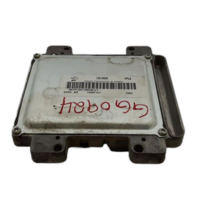
Below are the parts most often responsible for code P0549, ranked by how frequently each one is the actual culprit (per the diagnosis above). Tap any to see what we have for your vehicle.

The information in this article is provided for general reference and educational purposes only. Vehicle specifications, procedures, and part compatibility can vary by production date, trim level, and region. Always consult your vehicle's factory service manual and verify part numbers before purchasing or performing repairs. Safety-critical components such as airbags, seat belts, and braking systems should be installed by a qualified professional.
- 🧭 Diagnostic Flowchart
- 🎬 Helpful Videos
- 🛍️ Shop This Part
- What Does P0549 Mean?
- Can I Drive With P0549?
- Common Causes
- Symptoms
- Common Fixes & Costs
- DIY vs Professional
- Used vs. New Parts: Buying Guide
- What Happens If You Wait — Timeline
- Cost of Not Fixing It
- Diagnosis Steps
- When This Code Triggers (Freeze-Frame Conditions)
- Related Codes
- Climate & Environmental Factors
- How to Talk to a Mechanic About This Code
- Where to Take It: Dealer vs Independent vs Chain
- When to Walk Away From the Repair
- What Scan Tool You Need for This Code
- How to Clear the Code After You Fix It
- Will This Fail Emissions / State Inspection?
- Most Commonly Affected Vehicles
- Manufacturer-Specific Notes
- Real Owner Stories
- 2011 VW Jetta TDI at 115K miles
- 2012 Ford F-350 6.7L Power Stroke at 160K miles
- How to Prevent This Code From Triggering
- Frequently Asked Questions
- Is it safe to drive with a P0549 code?
- Can a dirty EGT sensor cause a P0549 code?
- What is the most common misdiagnosis for P0549?
- What is 'Bank 2' and 'Sensor 1'?
- How much does it cost to fix P0549?
- Will a P0549 fault prevent my diesel truck from regenerating?
- Can an aftermarket engine tune cause P0549?
- What is the difference between an EGT sensor and an O2 sensor?
- Key Takeaways
- 🎟️ Get 5% Off