

OBD-II Code P0551: Power Steering Sensor Problem
The Ultimate Guide to P0551: What It Means, Why It Triggers, and How to Fix It for Good
- Code P0551 triggers when the Powertrain Control Module receives an erratic voltage signal—typically outside the expected 0.5V to 4.5V range—from the power steering pressure sensor.
- The most frequent symptom is the engine stalling or dropping below 600 RPM during low-speed parking maneuvers, often misdiagnosed as a faulty Idle Air Control (IAC) valve.
- Inspect the sensor's electrical connector before buying parts; finding oily power steering fluid inside the plug guarantees the internal seal has failed and requires immediate replacement.
- Always install an OEM sensor (like Mopar or Motorcraft) on Dodge, Chrysler, and Ford vehicles, as aftermarket sensors frequently trigger false P0551 codes at steady highway speeds.
What Does P0551 Mean?
The Powertrain Control Module (PCM) detected an illogical signal from the power steering pressure sensor. This sensor measures hydraulic pressure to tell the computer how hard the power steering pump is working. The PCM uses this data to increase engine idle speed during turns, preventing the engine from stalling under load.
Technical definition: SAE/OBD-II definition: "Power Steering Pressure Sensor/Switch Circuit Range/Performance". The PCM receives a voltage signal from the sensor, but it is illogical, erratic, or outside the expected range based on vehicle speed and steering angle. The code triggers when the signal is stuck, jumpy, or fails to correlate with steering activity.
Can I Drive With P0551?
No — Do Not Drive. Driving with this code is unsafe. Power steering assist can fail or become extremely heavy without warning, making the vehicle difficult to control during emergencies or low-speed turns. Address this critical safety issue immediately.
Common Causes
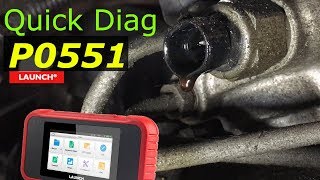
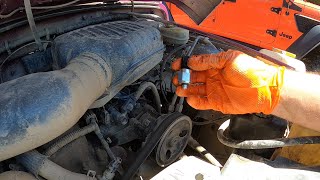
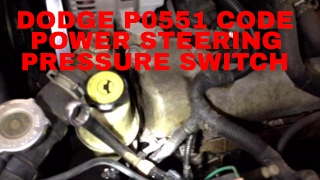
- Defective Power Steering Pressure (PSP) Sensor (Very Common) — The sensor itself is the most frequent cause. 🎬 See this step-by-step guide to replacing a faulty pressure sensor. An internal seal breaks, allowing pressurized power steering fluid to leak directly into the electrical connector, shorting it out and causing erratic readings.
- Damaged or Corroded Wiring/Connector (Common) — Wires leading to the sensor fray, break, or corrode from exposure to road salt and moisture, especially since the sensor sits in an exposed area of the engine bay.
- Low, Contaminated, or Aerated Power Steering Fluid (Common) — Low fluid levels cause the pump to suck in air, creating erratic pressure and chaotic sensor signals. Dirty or contaminated fluid also disrupts the sensor's ability to read pressure accurately.
- Failing Power Steering Pump (Less Common) — A weak power steering pump cannot produce consistent hydraulic pressure, causing the sensor to send out-of-range signals to the computer.
- Clogged Power Steering Lines or Filter (Less Common) — Blockages in the power steering hoses or internal filters disrupt normal hydraulic pressure flow, leading to abnormal sensor readings even with a healthy pump.
- Non-OEM Sensor or Improper Calibration (Rare) — Some vehicles reject non-OEM sensors because they do not operate within the exact voltage ranges the PCM expects. Additionally, failing to calibrate the control module after replacing a hydraulic component triggers this code.
- Powertrain Control Module (PCM) Fault (Rare) — The PCM suffers a failed internal converter or corrupted firmware, causing it to misinterpret a perfectly good signal.
Symptoms
- Engine Stalls or Idles Roughly During Low-Speed Turns — The engine dies or RPMs surge and dip when you turn the steering wheel sharply. The computer fails to increase idle speed to handle the extra load from the power steering pump.
- Heavy or Stiff Steering with Intermittent Assist — The steering wheel becomes difficult to turn at low speeds. You feel the power assist cut in and out intermittently, often accompanied by steering wheel vibration.
- Check Engine Light is On — The Malfunction Indicator Lamp (MIL) illuminates. Some vehicles also display a specific power steering warning message.
- Whining Noise When Turning — A whining sound from the engine bay gets louder when you turn the wheel, pointing directly to low power steering fluid or a failing pump.
Diagnostic Flowchart
Tap your situation to follow the diagnostic path that matches what you're seeing on this code.
Common Fixes & Costs
- Replace Power Steering Pressure Sensor
— Parts: $30-$90, Labor: $75-$150, ~0.8 hr book time
(DIY)
Dodge Ram 1500 (2002-2006): OEM Mopar 56041335AB (Alt: Standard Motor Products PS472, Duralast PS472)
Jeep Grand Cherokee (1999-2004): OEM Mopar 56041584AF (Alt: Standard Motor Products PS401, Dorman 926-455)
Ford F-150 (2004-2008): OEM Motorcraft SW6372 (Alt: Dorman 926-437, Standard Motor Products PSS42) - Repair Damaged Wiring or Connector — Parts: $10-$30, Labor: $125-$300, ~1.5 hr book time (Intermediate)
- Power Steering Fluid Flush and Refill — Parts: $20-$40, Labor: $100-$175, ~1.0 hr book time (DIY)
- Replace Power Steering Pump
— Parts: $150-$450, Labor: $250-$550, ~2.5 hr book time
(Professional)
Dodge Ram 1500 (2006, 5.7L): OEM Mopar 52113923AB (Alt: Cardone 20-897, BBB Industries N919-0114)
Jeep Grand Cherokee (2007, 4.7L): OEM Mopar 52089339AC (Alt: Cardone 21-5438, Lares 1505)
Ford F-150 (2005, 5.4L): OEM Motorcraft STP289RM (Alt: Cardone 20-290, A-1 Cardone 96-290) - Replace Powertrain Control Module (PCM) — Parts: $400-$1000, Labor: $150-$300, ~1.2 hr book time (Professional)
DIY vs Professional
- Replace Power Steering Pressure Sensor — Beginner:
- Power Steering Fluid Flush — Beginner:
- Repair Damaged Wiring — Beginner:
- Replace Power Steering Pump — Beginner:
Used vs. New Parts: Buying Guide
When a used part is worth it: For a simple, inexpensive electronic part like a Power Steering Pressure Sensor, buying used never makes sense. The risk of receiving a part near the end of its life outweighs the minimal cost savings.
Donor-vehicle mileage cap: roughly under 40000 miles for the part to have meaningful remaining life.
Donor quality checklist:
- Match the part number exactly, as different sensors have different pressure/voltage curves.
- Visually inspect the used sensor's connector for any signs of fluid leakage or corrosion.
- Avoid parts from vehicles with high mileage or from regions with heavy road salt usage.
Decision logic:
- If The cost of a new OEM or quality aftermarket sensor is under $100. → Always buy new. The labor to replace a failed used part costs more than the part itself.
- If You are replacing a more expensive component like a Power Steering Pump or PCM. → A used part from a low-mileage, accident-damaged vehicle is a viable option, but a new or remanufactured part with a warranty is strongly preferred.
Warranty tradeoff: Used parts from a salvage yard typically offer a 30-90 day warranty. New aftermarket parts come with a 1-year to limited lifetime warranty. New OEM parts carry a 1-2 year warranty.
Worst-case if a used part fails: $150 - $300 if a used sensor fails shortly after installation, primarily due to repeated labor costs.
What Happens If You Wait — Timeline
- 0-1 month: Code P0551 is set, and the Check Engine Light is on. The engine occasionally stumbles or stalls when parking. Steering feels slightly heavy at times. (MPG impact: 1-3%% · Added cost: $0-$25 in wasted fuel.)
- 1-4 months: Stalling during low-speed turns becomes frequent and predictable. The power steering pump begins to whine due to low fluid or constant aeration, indicating increased strain. (MPG impact: 3-5%% · Added cost: $50-$100 in wasted fuel. The risk of pump damage begins.)
- 4-9 months: The power steering pump fails due to prolonged operation with low/aerated/contaminated fluid. The whining is constant, steering is heavy, and the pump sheds metal debris into the system. (MPG impact: 5-10%% · Added cost: $500 - $900 for a now-necessary power steering pump replacement, plus the original sensor fix.)
- 9+ months: Catastrophic system failure. Metal debris from the failed pump circulates through the entire system, destroying the expensive steering rack or gearbox. The fluid is black and full of metal shavings. (MPG impact: 10%+% · Added cost: $1500 - $3000+. This requires a full system replacement: new pump, new steering rack/gearbox, flushing all lines, and replacing the sensor.)
Cost of Not Fixing It
- Immediate: Unpredictable steering assist creates a significant accident risk. The engine stalls in critical situations like intersections or parking lots, leading to a loss of power brakes and steering control. (Added cost: Negligible to Total Loss of Vehicle)
- 1-3 months: Operating with low or aerated fluid causes the power steering pump to whine, overheat, and fail prematurely, requiring an expensive replacement. (Added cost: $400 - $1000)
- 3+ months: A failing pump sheds metal debris into the hydraulic system, contaminating the fluid and destroying the expensive steering rack or gearbox, turning a simple sensor fix into a full system overhaul. (Added cost: $1200 - $2500+)
Diagnosis Steps
- Visually Inspect the Sensor and Wiring
Locate the power steering pressure sensor, usually screwed into the high-pressure line or steering rack. Unplug the electrical connector and look inside both the sensor and the connector for oily fluid. If it is wet with power steering fluid, the sensor has failed internally and requires immediate replacement. Check the wiring harness for obvious damage, corrosion, or loose connections.
Tools: Flashlight (Beginner) - Check Power Steering Fluid & Bleed System
Locate the power steering fluid reservoir. Verify the fluid level is between the 'MIN' and 'MAX' marks. The fluid must be reddish or clear, not brown, black, or foamy (indicating air). Top off if low. To bleed air, raise the front wheels, start the engine, and slowly turn the steering wheel lock-to-lock 10-15 times until bubbles stop appearing in the reservoir.
Tools: Jack and jack stands, Correct power steering fluid (Beginner) - Scan for Codes and View Live Data
Connect an OBD-II scanner. Confirm P0551 is present and check for related codes. Use 'Live Data' to monitor the Power Steering Pressure (PSP) sensor voltage while an assistant turns the steering wheel lock-to-lock with the engine running. The voltage must sweep smoothly between approximately 0.5V and 4.5V. If the voltage is stuck, erratic, or outside this range, the sensor or circuit is faulty.
Tools: OBD-II Scanner with Live Data (Intermediate) - Test the Sensor Circuit Voltages
With the key on and engine off, disconnect the sensor. Use a multimeter to test the harness-side connector. Verify a 5-volt reference wire from the PCM (expect 4.8V-5.2V) and a ground wire (near 0 volts). If the 5V reference is missing, the problem lies within the PCM or the wiring between the PCM and the sensor.
Tools: Multimeter (Intermediate) - Check for Wiring Continuity and Shorts
If reference voltage and ground are good but the signal is bad, disconnect the sensor and the PCM connector. Use a multimeter to check for continuity (near 0 ohms) on the signal wire between the sensor connector and the PCM connector. Test for a short by checking continuity between the signal pin and a known good ground, and between the signal pin and a 12V source. Repair broken or shorted wires.
Tools: Multimeter, Vehicle-specific wiring diagram (Advanced) - PRO TIP: Perform a Voltage Drop Test on Ground Circuit
A poor ground is a common hidden cause of range/performance codes. Connect the black multimeter lead to the battery negative post and the red lead to the ground pin on the sensor's harness connector (sensor plugged in, engine running). The reading must be less than 0.1 volts (100mV). A higher reading indicates high resistance in the ground circuit requiring repair.
Tools: Multimeter with long leads (Advanced) - Inspect Power Steering Pump and System Pressure
If the sensor and circuit test good, the issue is mechanical. Connect a power steering pressure gauge in-line on the high-pressure side. With the engine idling, pressure is low. When turning the wheels, pressure rises. At full lock, the pump's relief pressure must meet manufacturer specs (typically 850-1400 PSI). Low or erratic pressure indicates a failing pump, system restriction, or faulty relief valve. Take the vehicle to a professional shop if you lack the tools to safely measure hydraulic line pressure.
Tools: Power steering pressure gauge set, Serpentine belt tool (Advanced) - PRO TIP: Use a Lab Scope for Signal Analysis
For intermittent issues, a multimeter is too slow. Connect a lab scope to the sensor's signal wire. With the engine running, turn the wheel back and forth. The waveform must be a smooth, consistent line rising and falling with steering pressure. Sudden dropouts to zero, voltage spikes, or a noisy pattern indicate electrical interference or a failing sensor.
Tools: Automotive Oscilloscope (Lab Scope) (Advanced)
When This Code Triggers (Freeze-Frame Conditions)
- Engine Coolant Temp: 180-210°F (Engine at full operating temperature.)
- RPM: 600-800 RPM (at idle) or 1500-2500 RPM (at cruise) (Code sets during low-speed turns (idle) or at steady highway cruise, depending on manufacturer logic.)
- Engine Load: 20-50% (Under light to moderate load, where a discrepancy between expected and actual sensor readings becomes apparent.)
- Vehicle Speed: 0-10 mph or 40-65 mph (Triggers either during low-speed parking maneuvers or during steady highway driving where the signal is unexpectedly flat.)
Related Codes
- P0550 — A general code for a Power Steering Pressure Sensor Circuit Malfunction. P0551 is more specific, indicating the signal is irrational. P0550 sets for a wider range of electrical faults.
- P0552 — Indicates the sensor circuit input is consistently too low (e.g., below 0.28V). This points directly to a short to ground in the signal wire or a sensor that failed in a shorted state.
- P0553 — Indicates the sensor circuit input is consistently too high (e.g., above 4.9V). This points directly to an open signal circuit, a loss of ground to the sensor, or a short to a voltage source.
- P0554 — Indicates the sensor circuit is experiencing an intermittent fault. The PCM detected a rapid, sporadic disruption in the signal that isn't consistent enough to trigger a P0552 or P0553.
Climate & Environmental Factors
- Road Salt / High Humidity: Regions with heavy road salt use in winter or high-humidity coastal climates experience higher rates of failure. Salt and moisture accelerate corrosion on the sensor body, its electrical connector, and the metal power steering lines, leading to leaks and electrical faults.
- Mechanical Stress: The sensor and its wiring sit in exposed areas of the engine bay, making them susceptible to damage from road debris, engine vibration, and heat cycling, which degrades internal seals and wiring insulation over time.
How to Talk to a Mechanic About This Code
Say this: "I have a P0551 code and my engine is stalling during low-speed turns. I'd like to schedule a diagnostic. Please check for fluid in the sensor connector and watch the sensor's live data on a scanner before recommending any part replacements."
This shows you've done your research. You're directing them to the most common, simple failure points first, preventing them from immediately quoting an expensive power steering pump or rack replacement. It establishes you as an informed customer.
Avoid saying:
- 'My steering is acting weird.'
- 'My check engine light is on, can you just fix it?'
- 'I think I need a new power steering pump.'
Questions to ask before authorizing the repair:
- Did you find power steering fluid inside the electrical connector? If so, the sensor needs replacement.
- What did the sensor's voltage or pressure reading do on the scan tool when you turned the steering wheel?
- If you're recommending a power steering pump, what were the system pressure readings from your gauge test?
- Is the wiring to the sensor intact and free of corrosion?
- What is the warranty on the parts and labor for this repair?
Where to Take It: Dealer vs Independent vs Chain
- Dealer:
Recommended only if a trusted independent shop can't solve it or if a manufacturer-specific software issue is suspected.
Best for: Vehicles still under warranty., Complex cases where an independent shop has already failed to fix the issue., Vehicles with known manufacturer quirks (like the highway-speed issue on Dodge/Chrysler) that require a PCM software update.
Downsides: Highest labor rates., Quicker to replace larger assemblies rather than perform detailed circuit diagnostics. (Typical cost: +50% vs. baseline) - Independent Shop:
Best fit for most P0551 situations. This is a bread-and-butter hydraulic and electrical diagnosis that any competent independent technician handles easily.
Best for: Most out-of-warranty vehicles., Straightforward diagnosis and repair of common failures like the sensor, fluid, or wiring.
Downsides: Quality and diagnostic skill vary widely. Look for ASE certifications and good reviews., May lack access to the very latest manufacturer TSBs or software. (Typical cost: +0% vs. baseline) - Chain Shop:
Use with caution. Acceptable for a fluid flush, but risky for diagnosing the root cause of the P0551 code. Get a second opinion before approving major repairs.
Best for: Simple, related maintenance like a power steering fluid flush if you don't want to DIY.
Downsides: Technician skill varies dramatically., High pressure to upsell services; often recommend a new pump or rack without proper diagnosis., Lack the advanced diagnostic tools or experience for tricky electrical faults. (Typical cost: -10% vs. baseline)
When to Walk Away From the Repair
If the estimated repair cost exceeds 40% to 50% of the car's private-party value (check Kelley Blue Book), it's time to seriously consider selling or trading in the vehicle.
- Car worth $4000, fix is $2200: Walk away. The repair cost is over 50% of the car's value. It's not a sound investment.
- Car worth $12000, fix is $800: Fix it. The repair is a small fraction of the vehicle's value and addresses a critical safety system.
- Car worth $2500, fix is $250: Fix it. A simple sensor replacement is well below the threshold and makes the car safe and sellable.
What Scan Tool You Need for This Code
Minimum: An OBD-II scanner that displays 'Live Data' for the Power Steering Pressure (PSP) sensor.
A basic $20 code reader only shows the P0551 code. It cannot show live sensor data, which is essential to confirm if the sensor signal changes as you turn the wheel. Without live data, you are guessing.
Budget: BlueDriver Pro or Ancel BD310 (~$60-100) — Connects to your smartphone via Bluetooth. The app allows you to read and clear the code, and most importantly, view and graph the live data from the power steering pressure sensor.
Mid-range: Foxwell NT510 Elite or Innova 5610 (~$150-350) — Dedicated handheld units with robust capabilities. They provide live data graphing and access manufacturer-specific PIDs for detailed information.
Professional: Autel MaxiCOM MK808S or Launch X431 series (~$400-900) — Offers full bidirectional control, allowing you to command system components. Performs system calibrations needed after a pump replacement. Provides OEM-level diagnostics.
Rent vs buy: AutoZone's 'Loan-A-Tool' program allows you to borrow an OBD-II scanner for free with a refundable deposit. If this is a one-time fix, renting is the most cost-effective option. Buy a scanner only if you plan to do your own diagnostics regularly.
How to Clear the Code After You Fix It
- Use an OBD-II scan tool to formally clear the P0551 code.
- Reconnect the battery if it was disconnected for the repair.
- Perform a complete OBD-II drive cycle to allow readiness monitors to run.
Drive cycle (~30 minutes): Start the engine cold and idle for 2-3 minutes. Drive in mixed city/highway conditions, including steady cruising between 55-60 mph for at least 10 minutes. Perform several slow-downs without aggressive braking. Idle the vehicle for another 2-3 minutes before shutting it off. Let the vehicle cool down completely.
Readiness monitors affected: Comprehensive Component Monitor (CCM), Catalyst (CAT) Monitor, Evaporative (EVAP) System Monitor
Before emissions retest: drive at least 50 miles to fully set monitors.
Watch out for:
- Disconnecting the battery clears the code but resets all emissions readiness monitors to 'Incomplete', guaranteeing an emissions test failure.
- The code returns immediately if the underlying mechanical or electrical fault remains unaddressed.
- Some vehicles require specific drive cycle conditions (like steady speed for many miles) to set certain monitors.
Will This Fail Emissions / State Inspection?
Yes — this code typically fails an OBD-II emissions inspection.
- California: An active P0551 code with the Check Engine Light on is an automatic failure for a smog check. All required readiness monitors must be 'Complete' before a test can be passed.
- New York: The NYS DMV emissions inspection includes an OBD-II scan. A P0551 code results in an inspection failure.
- Texas: In counties where emissions testing is required, a vehicle with an illuminated Check Engine Light for a code like P0551 fails the inspection.
Most Commonly Affected Vehicles
- Dodge Ram 1500 (2002-2008) — Extremely common issue. The code often triggers at highway speeds due to PCM logic. Owners report high success rates using OEM sensors over aftermarket ones. A failing switch is a primary cause of stalling during low-speed turns.
- Jeep Grand Cherokee (1999-2010) — The sensor's location on WJ and WK models makes it prone to damage from road debris and corrosion.
- Ford Explorer, Focus, F-150 (2002-2018) — Frequently reported across multiple models. On some Focus models, the sensor integrates into a pressure line, requiring the entire line to be replaced.
- Chevrolet / GMC Silverado, Sierra, Tahoe, Suburban (2000-2013) — A known issue on various GM trucks and SUVs with hydraulic power steering. The cause is often corrosion at the connector or a faulty sensor.
- Hyundai Tucson, Santa Fe, Elantra (2005-2015) — Commonly affected by sensor circuit faults. For 2007-2009 Santa Fe models with the 3.3L engine, TSB 12-ST-002 notes a part update moving the pressure switch from the hose assembly to the pump assembly.
- Subaru Impreza, Forester, Outback (2002-2012) — Owners report issues with stalling during turns and sensor failures on models with hydraulic steering, prevalent before the widespread adoption of electric power steering.
- Dodge Charger, Grand Caravan (2006-2010) — Known to experience problems with the power steering pressure sensor circuit, often leading to stalling when parking.
- Nissan Titan, Armada, Frontier (2004-2015) — These trucks experience P0551 due to sensor failure. The sensor is located on the high-pressure power steering line and is a common replacement item to fix stalling and idle issues.
Manufacturer-Specific Notes
- Dodge/Chrysler/Jeep: On many trucks and SUVs from the 2000s, this code sets during steady highway driving (above 40 MPH). The PCM expects minor voltage fluctuations from the sensor as the driver makes small steering corrections. If the sensor signal is completely flat for an extended period, the PCM interprets this lack of activity as a fault, even if steering feels normal.
- Ford: Ford vehicles are particularly sensitive to aftermarket PSP sensors. If a P0551 code appears immediately after replacing the sensor with a non-OEM part, the new sensor's voltage range is incompatible with the PCM's expectations. Using a Motorcraft-branded sensor fixes this.
- General Motors (GM): On some Silverado and Sierra trucks, the PCM logic flags a P0551 if it doesn't see a pressure change signal within a specific timeframe after detecting a significant steering wheel angle change at low speeds. This happens even with a healthy sensor if there's a slight delay in the hydraulic system's response.
- Hyundai: Per TSB 12-ST-002 for the 2007-2009 Santa Fe 3.3L, the location of the pressure switch moved from the power steering hose to the pump itself. Replacing a failed hose-mounted switch on an older model requires replacing the pump, hose, and suction line as a set with the new design parts.
Real Owner Stories
2004 Dodge Ram 1500 Hemi at 130,000 miles
Check Engine Light came on during highway driving, but steering felt normal. Code was P0551. Engine would not stall during low-speed turns.
What they tried:
- Cleared the code, but it returned after about 30 miles of freeway driving.
- Cleaned the sensor and connector, but the code came back again.
- Replaced the power steering pressure switch with a new OEM part from Dodge for $37.
Outcome: Replacing the sensor with an OEM part resolved the issue. The owner noted a mechanic's advice that for sensitive electronics, the small savings on an aftermarket part isn't worth the risk of it not working correctly.
Lesson: For certain vehicles like Dodge/Chrysler, the PCM's software is known to be sensitive. Using an OEM sensor, even if it costs slightly more, is crucial for a lasting fix, especially when the code appears at highway speeds without other symptoms.
1997 Jeep Wrangler (TJ) 2.5L
Check Engine Light on with code P0551. Owner noticed some fluid buildup around the sensor, suggesting a slow leak.
What they tried:
- Visually inspected the sensor and confirmed it was the source of the code.
- Used a 5/8 box wrench to hold the fixed line and another wrench to loosen the sensor.
- Quickly swapped the old sensor for a new one to minimize fluid loss.
Outcome: A straightforward sensor replacement fixed the problem. The old sensor's O-ring was worn, and the leak was the cause of the failure.
Lesson: A quick visual inspection for fluid inside the connector or around the sensor base is the fastest way to confirm a failed sensor. Having the new part ready to swap in makes the job quick and clean.
2003 Dodge Ram 1500 5.7L
Persistent P0551 code despite replacing the sensor. The owner had already verified fluid level and replaced the switch.
What they tried:
- Verified continuity on the signal and ground wires from the sensor to the PCM connector and ground point.
- Performed a load test on the wiring, confirming the wires could carry a 4-amp load without issue.
- Researched the specific failure conditions for their vehicle model year.
Outcome: The issue was related to the specific PCM logic for that model year, which sets the code if the sensor signal remains open for too long at highway speeds (above 40 mph). This highlights a scenario where the sensor and wiring are good, but the PCM's interpretation is overly sensitive.
Lesson: If a new sensor and confirmed-good wiring don't fix the code, research the specific TSBs or manufacturer quirks for your vehicle. Some codes have very specific, non-intuitive triggers, like steady highway driving.
How to Prevent This Code From Triggering
- Change Power Steering Fluid (Every 30,000-50,000 miles or 2-4 years.) — Fluid breaks down and gets contaminated with particles from hoses and seals. Dirty, abrasive fluid wears out the pump, clogs lines, and damages the sensitive diaphragm inside the pressure sensor.
- Inspect Fluid Level and Condition Regularly (Every oil change.) — Catching a low fluid level early prevents the pump from sucking in air, which causes whining noises, pressure fluctuations, and burns out the pump. Checking the fluid's color (it should be clear/reddish, not dark brown or grey) helps you know when it needs changing.
- Avoid Holding Steering at Full Lock (Daily driving habit.) — Holding the steering wheel all the way to its stop (full lock) causes the power steering pump to operate at maximum relief pressure. This generates extreme heat and stress on the pump, hoses, and fluid, accelerating wear.
- Address Fluid Leaks Immediately (As needed.) — A small leak leads to a low fluid level, causing pump damage from aeration and overheating. Leaking fluid also saturates and destroys nearby rubber components like belts and motor mounts.
Frequently Asked Questions
My engine stalls when I turn the wheel at a stop. Is it my Idle Air Control (IAC) valve?
While a faulty IAC valve causes stalling, it is a common misdiagnosis for code P0551. The power steering pressure sensor's primary job is to tell the engine computer to increase idle speed to handle the load of the power steering pump. Always diagnose the P0551 code first before suspecting the IAC system.
Does it matter if I use a cheap aftermarket power steering pressure sensor?
Yes. Vehicles from manufacturers like Chrysler/Dodge and Ford are highly sensitive to the precise voltage ranges of their sensors. An aftermarket sensor's signal often falls outside what the PCM is programmed to expect, causing the code to return immediately.
Is it safe to drive with code P0551?
No. You risk a sudden loss of power steering, making the vehicle extremely difficult to steer during an emergency maneuver.
Will replacing the sensor always fix a P0551 code?
Not always. While the sensor itself is the most common failure, the problem is also caused by bad wiring, low or aerated fluid, a clogged line, or a failing power steering pump.
What is the most important thing to check first?
Check the power steering fluid level and inspect the sensor's electrical connector. Fluid leaking from inside the sensor into the connector is a definitive sign the sensor is bad and requires replacement.
Can I just clear the code and keep driving?
Clearing the code does not fix the underlying problem. The code returns as soon as the computer detects the fault again, leaving you with an unsafe vehicle.
My steering feels fine, but the P0551 code is on. What's wrong?
This is common on Dodge/Chrysler vehicles at highway speeds. The computer's software is overly sensitive and sets the code if it doesn't see tiny signal changes over time, interpreting a steady signal as a fault. Ensure you are using an OEM sensor to resolve this.
Key Takeaways
- Code P0551 triggers when the Powertrain Control Module receives an erratic voltage signal—typically outside the expected 0.5V to 4.5V range—from the power steering pressure sensor.
- The most frequent symptom is the engine stalling or dropping below 600 RPM during low-speed parking maneuvers, often misdiagnosed as a faulty Idle Air Control (IAC) valve.
- Inspect the sensor's electrical connector before buying parts; finding oily power steering fluid inside the plug guarantees the internal seal has failed and requires immediate replacement.
- Always install an OEM sensor (like Mopar or Motorcraft) on Dodge, Chrysler, and Ford vehicles, as aftermarket sensors frequently trigger false P0551 codes at steady highway speeds.
Helpful Videos


Shop the Parts Behind P0551
Below are the parts most often responsible for code P0551, ranked by how frequently each one is the actual culprit (per the diagnosis above). Tap any to see what we have for your vehicle.



The information in this article is provided for general reference and educational purposes only. Vehicle specifications, procedures, and part compatibility can vary by production date, trim level, and region. Always consult your vehicle's factory service manual and verify part numbers before purchasing or performing repairs. Safety-critical components such as airbags, seat belts, and braking systems should be installed by a qualified professional.
- 🧭 Diagnostic Flowchart
- 🎬 Helpful Videos
- 🛍️ Shop This Part
- What Does P0551 Mean?
- Can I Drive With P0551?
- Common Causes
- Symptoms
- Common Fixes & Costs
- DIY vs Professional
- Used vs. New Parts: Buying Guide
- What Happens If You Wait — Timeline
- Cost of Not Fixing It
- Diagnosis Steps
- When This Code Triggers (Freeze-Frame Conditions)
- Related Codes
- Climate & Environmental Factors
- How to Talk to a Mechanic About This Code
- Where to Take It: Dealer vs Independent vs Chain
- When to Walk Away From the Repair
- What Scan Tool You Need for This Code
- How to Clear the Code After You Fix It
- Will This Fail Emissions / State Inspection?
- Most Commonly Affected Vehicles
- Manufacturer-Specific Notes
- Real Owner Stories
- 2004 Dodge Ram 1500 Hemi at 130,000 miles
- 1997 Jeep Wrangler (TJ) 2.5L
- 2003 Dodge Ram 1500 5.7L
- How to Prevent This Code From Triggering
- Frequently Asked Questions
- My engine stalls when I turn the wheel at a stop. Is it my Idle Air Control (IAC) valve?
- Does it matter if I use a cheap aftermarket power steering pressure sensor?
- Is it safe to drive with code P0551?
- Will replacing the sensor always fix a P0551 code?
- What is the most important thing to check first?
- Can I just clear the code and keep driving?
- My steering feels fine, but the P0551 code is on. What's wrong?
- Key Takeaways
- 🎟️ Get 5% Off