

OBD-II Code P0555: Brake Booster Pressure Sensor Circuit
What P0555 means, why it triggers, and how to fix it
- A P0555 code typically causes a hard brake pedal, increasing your stopping distance by up to 3 times and creating an immediate safety hazard.
- Inspect the vacuum hoses and the sensor's electrical connector before buying parts; a loose $0 connector or a cracked $15 hose causes this code just as often as a failed sensor.
- Do not drive normally with an active P0555 code; tow the vehicle or drive at low speeds directly to a shop, as power brake assist will likely fail.
- Check for manufacturer Technical Service Bulletins (TSBs) first; Fiat 500 and VW Jetta models frequently trigger P0555 due to a software glitch requiring a 1-hour dealer ECU update.
What Does P0555 Mean?
The Powertrain Control Module (PCM) detected a problem with the brake booster pressure sensor's electrical circuit. This sensor measures vacuum pressure inside the brake booster, which provides power assist for braking. The computer flags this code when the sensor's signal is incorrect, missing, or outside the expected range.
Technical definition: SAE/OBD-II defines P0555 as "Brake Booster Pressure Sensor Circuit". The Powertrain Control Module (PCM) or Brake Control Module (BCM) sets this code when the voltage signal from the brake booster pressure sensor falls outside its expected range, becomes intermittent, or drops out completely.
Can I Drive With P0555?
Yes, But With Caution. Yes, but only for a short distance to a repair facility. Power brakes will likely fail, requiring much harder pedal pressure to stop. This increases stopping distance by 2 to 3 times, creating a severe safety risk.
Common Causes
- Faulty Brake Booster Pressure Sensor (Very Common) — The sensor's internal electronics or sensing diaphragm fail from age, heat, and vibration, sending incorrect or zero voltage signals to the PCM.
- Vacuum Leak (Common) — A cracked vacuum hose, bad sensor grommet, or faulty check valve between the intake manifold and brake booster causes a loss of vacuum. The sensor reports this abnormal pressure, triggering the code.
- Loose Electrical Connector (Common) — Engine vibrations cause the sensor's electrical connector to back out just enough to create an intermittent or open circuit.
- Damaged Wiring or Corroded Connectors (Common) — Engine bay heat and vibration fray or short the wiring harness. Moisture corrodes the connector pins, leading to poor connections. Fluid contamination from a leaking master cylinder also shorts this circuit.
- Faulty Brake Booster (Less Common) — A ruptured internal diaphragm prevents the booster from holding vacuum, resulting in a hard brake pedal and triggering the code.
- Faulty Powertrain Control Module (PCM) (Rare) — The vehicle's main computer develops an internal circuit fault. Consider this only after exhaustively ruling out all other components and wiring.
Symptoms
- Hard Brake Pedal — The brake pedal suddenly requires significantly more physical force to press due to lost power assist.
- Increased Stopping Distance — Without power assist, the vehicle takes 2 to 3 times longer to stop, severely compromising safety.
- Check Engine Light or Brake Warning Light is On — The PCM illuminates the Malfunction Indicator Lamp (MIL) or a dedicated brake warning light on the dashboard.
- Hissing Noise from Under the Dash — A distinct hissing sound from under the dash or engine bay indicates a vacuum leak from the booster or its hoses.
- Engine Stalling or Rough Idle When Braking — A large vacuum leak allows unmetered air into the engine, causing it to stumble, run lean, or stall when braking.
- Spongy or Inconsistent Brake Pedal Feel — Intermittent circuit faults or fluid contamination cause the pedal to feel soft or unpredictable rather than consistently hard.
Diagnostic Flowchart
Tap your situation to follow the diagnostic path that matches what you're seeing on this code.
Common Fixes & Costs
- Replace Brake Booster Pressure Sensor — Parts: $50-$120, Labor: $90-$150, ~0.8 hr book time (DIY)
- Repair or Replace Vacuum Hose/Line — Parts: $15-$60, Labor: $50-$130, ~0.7 hr book time (DIY)
- Repair Wiring or Replace Connector — Parts: $20-$70, Labor: $100-$250, ~1.5 hr book time (Intermediate)
- Update or Reprogram PCM/ECU — Parts: $0, Labor: $120-$220, ~1.0 hr book time (Professional)
- Replace Brake Booster — Parts: $150-$650, Labor: $200-$450, ~2.5 hr book time (Professional)
DIY vs Professional
- Replace Brake Booster Pressure Sensor — Beginner: Yes
Tools: Basic hand tools (pliers, socket set). - Repair or Replace Vacuum Hose/Line — Beginner: Yes
Tools: Pliers, hose cutters, basic hand tools. - Repair Wiring or Replace Connector — Beginner: No
Tools: Multimeter, wire strippers, crimpers, heat shrink tubing, soldering iron. - Replace Brake Booster — Beginner: No
Tools: Extensive socket set, flare-nut wrenches, torque wrench, brake fluid, brake bleeding equipment.
Used vs. New Parts: Buying Guide
When a used part is worth it: Buying a used brake booster pressure sensor is not recommended. The low cost of a new aftermarket part makes the risk of a used electronic part failing not worth the savings.
Donor-vehicle mileage cap: roughly under 50000 miles for the part to have meaningful remaining life.
Donor quality checklist:
- Verify the part number exactly matches the original.
- Inspect the electrical connector for corrosion or physical damage.
- Avoid parts from high-mileage vehicles or harsh climates.
Decision logic:
- If The cost of a new OEM or quality aftermarket sensor is under $100 → Always buy new. The warranty and peace of mind outweigh the small savings.
- If The part is part of a larger assembly (like a complete brake booster) → Consider a low-mileage used assembly from a reputable salvage yard, but acknowledge the increased labor risk.
Warranty tradeoff: Salvage yard parts typically have a 30-90 day warranty covering only the part. New aftermarket parts carry a 1-year to limited lifetime warranty.
Worst-case if a used part fails: $100-$250 if a used sensor fails, requiring repeat labor for diagnosis and replacement.
What Happens If You Wait — Timeline
- 0-1 month: Check Engine Light illuminates with code P0555. The issue is likely intermittent, and there may be no noticeable symptoms other than the light. (MPG impact: 0-2%% · Added cost: $0)
- 1-3 months: The fault becomes consistent. If caused by a vacuum leak, a hard brake pedal and hissing sound become noticeable. The engine develops a rough idle. (MPG impact: 3-8%% · Added cost: $50-$150 in wasted fuel.)
- 3-6 months: Significant safety risk develops. The brake pedal is consistently hard, increasing stopping distances by 2-3x. Constant stress wears on the master cylinder seals. (MPG impact: 5-15%% · Added cost: $300-$800)
- 6+ months: Catastrophic failure of related components. The brake booster is likely destroyed, or a persistent lean condition causes engine performance issues. The vehicle is unsafe to drive. (MPG impact: 10-20%+% · Added cost: $500-$1200+)
Cost of Not Fixing It
- Immediate: Increased stopping distances and a hard brake pedal create a major safety hazard. (Added cost: Cost of an accident (variable, potentially thousands).)
- 1-3 months: Driving with a hard pedal severely stresses the master cylinder and pedal assembly, causing premature failure. (Added cost: $300-$800)
- 3+ months: A persistent vacuum leak causes a lean running condition, destroying fuel economy and potentially burning engine valves. (Added cost: $200-$1000+)
Diagnosis Steps
- Read the Trouble Codes and Freeze Frame Data
Use an OBD-II scanner to confirm P0555. Check for related codes (P0556-P0558, P050F) to narrow the root cause. Note freeze-frame data to see exact engine conditions when the fault occurred.
Tools: OBD-II Scanner (Beginner) - Perform a Thorough Visual Inspection
Inspect the sensor, connector, and wiring for melted insulation, frayed wires, or green/white pin corrosion. Push the connector until it clicks. Check all vacuum hoses for cracks or loose fittings.
Tools: Flashlight, Inspection Mirror (Beginner) - Test the Brake Booster's Vacuum Integrity
With the engine off, pump the brake pedal 4-5 times until firm. Hold the pedal with moderate force and start the engine. The pedal should drop slightly as vacuum builds. If it stays hard, you have a vacuum leak or failed booster.
Tools: None (Physical Test) (Beginner) - Check for Vacuum Leaks
With the engine idling, listen for hissing around the booster. Spray a controlled amount of brake cleaner around hose connections; a sudden change in engine RPM pinpoints the leak.
Tools: Brake cleaner or unlit propane torch (Intermediate) - PRO TIP: Test the Sensor's Electrical Circuit (Voltage)
Disconnect the sensor. With the key on/engine off, use a multimeter to verify 5V on the reference wire and <0.1 Ω on the ground wire. Reconnect and back-probe the signal wire; voltage should sit around 0.5V at idle and rise smoothly toward 4.5V when pressing the brake.
Tools: Multimeter, Back-probe kit (Intermediate) - ADVANCED: Analyze Live Data with a Scan Tool
Connect a live-data scan tool and monitor the 'Brake Booster Pressure' PID. Voltage should correlate smoothly with pedal application. A stuck or erratic reading confirms a sensor or circuit fault.
Tools: Advanced OBD-II Scanner with Live Data (Advanced) - Test the Sensor with a Vacuum Pump
Disconnect the sensor from the vacuum line and attach a hand-held vacuum pump. Monitor the back-probed signal voltage while applying vacuum. If voltage jumps erratically or stays stuck, replace the sensor.
Tools: Hand-held vacuum pump, Multimeter, Back-probe kit (Advanced) - PRO TIP: Test the Circuit for Shorts and Opens
Disconnect the sensor and PCM. Measure resistance on the signal wire between both connectors (<1.0 Ω). Test the signal pin to chassis ground (should read OL) to rule out a short to ground.
Tools: Multimeter, Vehicle-specific wiring diagram (Advanced)
When This Code Triggers (Freeze-Frame Conditions)
- Engine Coolant Temp: 175-210°F (Fully warmed up, during normal operation.)
- RPM: 700-2500 (Triggers at idle (if a large vacuum leak is present) or during steady-state cruising.)
- Engine Load: 20-50% (Occurs under light to moderate load, not typically during heavy acceleration.)
- Brake Pedal Status: On or Off (Detected when brakes are applied (signal doesn't change) or during a self-test when brakes are off.)
Related Codes
- P0556 — Range/Performance. The signal is present but illogical (e.g., vacuum doesn't change when braking), pointing to a 'lazy' or failing sensor rather than a broken wire.
- P0557 — Circuit Low. Voltage is stuck below the minimum threshold (e.g., <0.3V), strongly suggesting a short to ground or a massive vacuum leak.
- P0558 — Circuit High. Voltage is stuck above the maximum threshold (e.g., >4.7V), indicating a short to power or an open ground circuit.
- P050F — Brake Assist Vacuum Too Low. P0555 reports an electrical sensor issue; P050F reports a physical lack of vacuum. They frequently appear together.
Climate & Environmental Factors
- High Humidity: Accelerates corrosion on electrical connector pins. Moisture entering unsealed connectors causes shorts or high resistance.
- Extreme Cold: Turns plastic vacuum hoses and rubber grommets brittle, making them highly susceptible to cracking and vacuum leaks.
- Temperature Fluctuations: Rapid engine bay heating and cooling creates condensation inside components, contributing to long-term corrosion and short circuits.
How to Talk to a Mechanic About This Code
Say this: "I have a P0555 code for the brake booster pressure sensor circuit, and I'm experiencing a hard brake pedal. Please test the vacuum supply, check the sensor's wiring and connector, and test the sensor itself before recommending a part replacement."
This signals that you understand the code and its common causes. It directs the mechanic to perform a logical diagnosis instead of immediately replacing the expensive brake booster.
Avoid saying:
- 'My check engine light is on.' (Too vague, invites a costly diagnostic).
- 'Just fix the P0555 code.' (Leads to replacing the sensor without checking for a cheaper vacuum leak).
- 'My brakes feel weird.' (Fails to provide the specific clue that the pedal is 'hard').
Questions to ask before authorizing the repair:
- What was the result of the vacuum test on the booster and the supply line?
- Did you test the sensor's 5-volt reference, ground, and signal wire at the connector?
- Can you confirm the problem is the part you want to replace and not a simple vacuum leak or loose connector?
- What is the warranty on this specific repair, including parts and labor?
Where to Take It: Dealer vs Independent vs Chain
- Dealer:
Recommended only if you have a known manufacturer software issue, are under warranty, or if an independent shop failed to diagnose a complex electrical fault.
Best for: Vehicles under warranty., Vehicles with known software issues causing P0555 (Fiat or VW models)., Complex electrical issues or suspected PCM failure.
Downsides: Highest labor rates., May recommend replacing an entire assembly when only a smaller component failed. (Typical cost: +50% vs. baseline) - Independent Shop:
Best overall fit. An experienced independent mechanic efficiently diagnoses the most common causes of P0555 at a reasonable cost.
Best for: Most P0555 scenarios on out-of-warranty vehicles., Diagnosing common causes like vacuum leaks, faulty sensors, and wiring issues.
Downsides: Quality varies greatly; vet shops based on reviews and ASE certifications., May lack specialized tools for software updates required by some manufacturers. (Typical cost: +0% vs. baseline) - Chain Shop:
Use with caution. Acceptable if you are certain the sensor needs replacing, but avoid for initial diagnosis to prevent unnecessary upsells.
Best for: Simple parts replacement if you have already diagnosed the problem yourself.
Downsides: Technician skill varies dramatically., High pressure to upsell services., May lack diagnostic depth to distinguish between a sensor failure and a vacuum leak. (Typical cost: -10% vs. baseline)
When to Walk Away From the Repair
If the estimated repair cost exceeds 40-50% of the car's private-party value, pause and reconsider the repair.
- Car worth $7000, fix is $350: Fix it. A sensor or vacuum line replacement is a minor cost relative to the car's value.
- Car worth $4000, fix is $1800: Walk away. A costly brake booster replacement on an older car is not a good investment.
- Car worth $2500, fix is $1100: Borderline. This repair is nearly 50% of the car's value. Get a second opinion.
What Scan Tool You Need for This Code
Minimum: An OBD-II scanner that can read and graph live data PIDs (Parameter IDs).
A basic $20 code reader only shows the P0555 code. It cannot show the live voltage or pressure signal from the sensor, which is essential to determine if the sensor is working or stuck.
Budget: BlueDriver Pro (~$100) — Connects to your smartphone to read codes, view freeze-frame data, and graph live data from the brake booster pressure sensor.
Mid-range: Foxwell NT510 Elite (~$180) — A handheld unit providing live data graphing and bi-directional controls to command specific components during diagnostics.
Professional: Autel MaxiCOM MK808S (~$450) — A professional tablet scanner with full bi-directional controls and extensive live data options, ideal for diagnosing tricky electrical faults.
Rent vs buy: If this is a one-time fix, AutoZone's Loan-A-Tool program allows you to borrow a scanner for free. Buy a scanner only if you perform diagnostics regularly.
How to Clear the Code After You Fix It
- Use an OBD-II scan tool to clear the diagnostic trouble code (DTC).
- Perform a 20-minute drive cycle to allow the vehicle's readiness monitors to run.
- Re-scan the vehicle to ensure the P0555 code does not return.
Drive cycle (~20 minutes): A complete drive cycle involves a cold start, a period of idling, mixed city driving (stop-and-go), and 5-10 minutes of steady 55 mph highway driving.
Readiness monitors affected: Comprehensive Component Monitor (CCM), Misfire Monitor
Before emissions retest: drive at least 50 miles to fully set monitors.
Watch out for:
- Clearing the code without fixing the underlying issue guarantees the code will return.
- Disconnecting the battery clears the code but resets all readiness monitors, causing an automatic emissions test failure.
- Skipping the varied drive cycle prevents readiness monitors from setting.
Will This Fail Emissions / State Inspection?
Yes — this code typically fails an OBD-II emissions inspection.
- California: A P0555 code causes an automatic smog check failure. A full drive cycle must be completed post-repair to set readiness monitors.
- New York: An active P0555 code and illuminated Check Engine Light results in an immediate inspection failure.
- Texas: In the 17 counties requiring emissions testing, an active P0555 code fails the OBD-II portion of the inspection.
Most Commonly Affected Vehicles
- Fiat 500 / 500L (2010-2017) — Frequently cited for P0555. The cause is often a software glitch requiring an ECU update from a dealer, or a faulty sensor.
- Ford F-150 (2014-2020) — Often related to a failing sensor grommet causing a vacuum leak. Be aware of Ford Recall 20S31 for a leaking master cylinder contaminating the booster.
- Dodge / Ram Ram 1500 / 2500 / 3500 (2013-2018) — On models with electronic vacuum pumps, P0555 triggers from a failed pump or blown fuse in addition to sensor faults.
- Chrysler / Dodge Town & Country / Grand Caravan (2011-2016) — These minivans set this code due to failing brake booster pressure sensors or brittle vacuum line leaks.
- General Motors (Chevrolet / GMC) Silverado / Sierra / Various SUVs (2019-2022) — TSB 21-NA-045 notes improper routing of the brake booster vacuum pipe causes chafing and triggers P0555.
- Honda Civic (2022-2025) — Newer Civics show a pattern of setting P0555 due to faulty sensors or circuit issues reading abnormally high voltage.
- Volkswagen Jetta / Golf / Passat (2017-2021) — Triggered by a loose electrical connector, chafed vacuum pipe, or a software issue requiring an ECM update (TSB 01-18-09).
- Toyota Avensis (2003-2009) — Specific to models with 1AZ-FSE/2AZ-FSE engines. Testing the 5V reference and ground circuits is critical for diagnosis.
Manufacturer-Specific Notes
- Fiat: On some Fiat 500 models, this code triggers from an ECU software glitch. A dealer software update is the required fix before replacing hardware.
- Ford: On F-150 trucks, the rubber grommet sealing the sensor to the booster degrades and causes a vacuum leak. Also check for Ford Recall 20S31.
- General Motors: TSB 21-NA-045 involves brake booster vacuum pipe routing that leads to chafing. The fix involves replacing the pipe with a revised part.
- Volkswagen: For 2017-2019 Jetta and Golf models, TSB 01-18-09 notes an ECM software update fixes logic errors causing this code. Always check for a loose sensor connector first.
Real Owner Stories
2017 VW Jetta with an intermittent Check Engine Light
Check Engine Light illuminated intermittently with code P0555, but brakes felt normal.
What they tried:
- Checked for vacuum leaks but found none.
- Inspected the sensor and found the electrical connector was not fully clicked into place.
Outcome: The owner firmly pushed the connector onto the sensor until it clicked. The code changed to 'passive' and did not return. The fix cost $0.
Lesson: Always start with the simplest physical check: ensure the electrical connector is clean and securely seated. A loose connection is a frequent cause for intermittent codes.
2015 Ford F-150 with a hard brake pedal and hissing noise
The brake pedal became hard to press, accompanied by a hissing sound from the engine bay. Codes P0555, P0556, and P050F were present.
What they tried:
- Located the hissing sound coming from where the brake booster pressure sensor enters the vacuum line assembly.
Outcome: Pulling the sensor out revealed a ripped rubber grommet. Replacing the sensor and the torn grommet stopped the vacuum leak and resolved all codes.
Lesson: A hissing noise is a direct clue to a vacuum leak. On Ford trucks, the grommet sealing the pressure sensor is a known failure point and a cheap fix.
2010 Fiat 500 with a persistent P0555 code
An amber warning light appeared intermittently with code P0555. Brakes felt normal.
What they tried:
- Checked the vacuum hose for suction and found it was good.
- Tested the sensor with a multimeter and found it unresponsive.
Outcome: Replacing the brake booster pressure sensor assembly fixed the issue permanently.
Lesson: On Fiat models, the sensor itself is a very common failure point. If vacuum supply and electrical connections are good, replace the sensor.
2014-2017 Ford F-150 with reduced braking power
Driver experienced increased pedal effort and reduced braking function, accompanied by P0555.
What they tried:
- Took the vehicle to a dealer due to the severe safety risk.
Outcome: Ford identified a compromised seal in the brake master cylinder leaking fluid into the brake booster. Ford issued Safety Recall 20S31 to replace the master cylinder and booster at no charge.
Lesson: If you own an affected Ford F-150, check for open recalls. A leaking master cylinder destroys the booster and sensor, and the repair may be free.
How to Prevent This Code From Triggering
- Perform regular brake fluid flushes. (Every 2-3 years or 30,000 miles.) — Brake fluid absorbs moisture, causing internal corrosion. A leaking master cylinder leaks fluid into the brake booster, destroying its diaphragm and the pressure sensor.
- Periodically inspect all engine bay vacuum hoses. (Every oil change or 6 months.) — Engine heat causes rubber hoses to become brittle and crack, leading to vacuum leaks. Replacing a $15 hose prevents a larger repair bill.
- Apply a silicone-based protectant to rubber vacuum lines. (Once per year.) — Applying a silicone-based protectant keeps hoses pliable and extends their life, preventing them from drying out and cracking.
- Keep the engine bay and firewall area clean. (As needed.) — Cleaning away dirt and oil prevents contaminants from degrading rubber hoses and electrical connector seals over time.
Frequently Asked Questions
Can I drive my car with a P0555 code?
You can, but it is highly dangerous and only recommended for a short distance to a repair shop. Power brakes will likely fail, making the car much harder to stop.
What are the most common mistakes when diagnosing P0555?
The most common mistake is immediately replacing the sensor without performing a full diagnosis. Technicians often find the actual problem was a cracked vacuum hose, a loose connector, or a wiring fault. Always test the circuit and vacuum supply first.
Will replacing the brake booster pressure sensor definitely fix a P0555 code?
Not always. While the sensor is a common cause, the problem is frequently a vacuum leak, damaged wiring, or a PCM software issue. Proper diagnosis avoids unnecessary parts spending.
What's the difference between an 'active' and 'stored' P0555 code?
An 'active' code means the fault is happening right now and illuminating your Check Engine Light. A 'stored' code indicates a past fault that is no longer detected, often caused by a loose connection that temporarily lost contact. Active codes require immediate repair, while stored codes may clear themselves.
Where is the brake booster pressure sensor located?
The sensor is located directly on the brake booster itself or in the main vacuum line running from the engine's intake manifold to the booster. It is a small, black plastic sensor with a 3-wire connector.
Can a bad master cylinder cause a P0555 code?
Yes. If the master cylinder leaks brake fluid into the brake booster, the fluid destroys the booster's internal diaphragm and the pressure sensor, leading to a P0555 code.
How much does it cost to fix a P0555 code?
Cost depends entirely on the root cause. A simple vacuum hose replacement costs $65-$190, while a new sensor ranges from $140-$270 including labor. Replacing the entire brake booster is the most expensive scenario, ranging from $350 to over $1,100.
Key Takeaways
- A P0555 code typically causes a hard brake pedal, increasing your stopping distance by up to 3 times and creating an immediate safety hazard.
- Inspect the vacuum hoses and the sensor's electrical connector before buying parts; a loose $0 connector or a cracked $15 hose causes this code just as often as a failed sensor.
- Do not drive normally with an active P0555 code; tow the vehicle or drive at low speeds directly to a shop, as power brake assist will likely fail.
- Check for manufacturer Technical Service Bulletins (TSBs) first; Fiat 500 and VW Jetta models frequently trigger P0555 due to a software glitch requiring a 1-hour dealer ECU update.
Helpful Videos
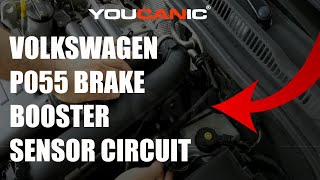
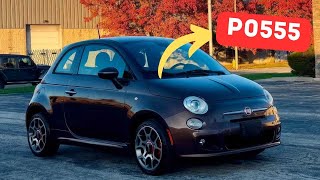
Shop the Parts Behind P0555
Below are the parts most often responsible for code P0555, ranked by how frequently each one is the actual culprit (per the diagnosis above). Tap any to see what we have for your vehicle.



The information in this article is provided for general reference and educational purposes only. Vehicle specifications, procedures, and part compatibility can vary by production date, trim level, and region. Always consult your vehicle's factory service manual and verify part numbers before purchasing or performing repairs. Safety-critical components such as airbags, seat belts, and braking systems should be installed by a qualified professional.
- 🧭 Diagnostic Flowchart
- 🎬 Helpful Videos
- 🛍️ Shop This Part
- What Does P0555 Mean?
- Can I Drive With P0555?
- Common Causes
- Symptoms
- Common Fixes & Costs
- DIY vs Professional
- Used vs. New Parts: Buying Guide
- What Happens If You Wait — Timeline
- Cost of Not Fixing It
- Diagnosis Steps
- When This Code Triggers (Freeze-Frame Conditions)
- Related Codes
- Climate & Environmental Factors
- How to Talk to a Mechanic About This Code
- Where to Take It: Dealer vs Independent vs Chain
- When to Walk Away From the Repair
- What Scan Tool You Need for This Code
- How to Clear the Code After You Fix It
- Will This Fail Emissions / State Inspection?
- Most Commonly Affected Vehicles
- Manufacturer-Specific Notes
- Real Owner Stories
- 2017 VW Jetta with an intermittent Check Engine Light
- 2015 Ford F-150 with a hard brake pedal and hissing noise
- 2010 Fiat 500 with a persistent P0555 code
- 2014-2017 Ford F-150 with reduced braking power
- How to Prevent This Code From Triggering
- Frequently Asked Questions
- Can I drive my car with a P0555 code?
- What are the most common mistakes when diagnosing P0555?
- Will replacing the brake booster pressure sensor definitely fix a P0555 code?
- What's the difference between an 'active' and 'stored' P0555 code?
- Where is the brake booster pressure sensor located?
- Can a bad master cylinder cause a P0555 code?
- How much does it cost to fix a P0555 code?
- Key Takeaways
- 🎟️ Get 5% Off