

P0556 on 2018-2024 Chevrolet Equinox: Brake Booster Pressure Sensor Causes and Fixes
On the 2018-2024 Equinox 1.5L, code P0556 is most often caused by a failed engine-driven vacuum pump, resulting in a hard brake pedal and a 'Service Brake Assist' message. This pump is a widely documented failure point. A less common cause is a faulty sensor in the vacuum pipe assembly. In severe cases, the pump can disintegrate, sending metal debris into the engine and damaging the camshaft. The issue is so prevalent it has led to a class-action lawsuit against GM.
- P0556 on a 2018-2024 Equinox is a critical safety issue that should be addressed immediately.
- The most common symptom is a sudden, hard brake pedal, which almost always points to a failed engine vacuum pump.
- Diagnose the problem by checking for suction from the vacuum pump; no suction means the pump must be replaced.
- If the pump is working, the next most likely cause is a faulty sensor, which is fixed by replacing the entire vacuum pipe assembly with GM part #84974392.
- Due to the risk of sudden brake failure and potential for engine damage, this is not a recommended DIY repair for beginners.
What's Unique About the 2018-2024 Chevrolet Equinox
The 1.5L turbocharged engine in the Equinox relies on a mechanical, camshaft-driven vacuum pump to create consistent vacuum for the brake booster, as turbo engines don't always produce sufficient intake manifold vacuum. This specific vacuum pump has become a notorious failure point, with widespread reports of it failing suddenly, causing a hard brake pedal. This issue is so prevalent that it has prompted a class-action lawsuit against GM (Thieme, et al. v. General Motors, LLC), alleging a design defect in the pump. In severe cases, the pump's drive lugs can break off, or the pump can disintegrate, sending metal fragments into the engine. This debris can damage the camshaft and cause the exhaust camshaft reluctor wheel to spin out of position, leading to additional codes like P0014/P0017 and a crank/no-start condition, as detailed in GM TSB 21-NA-268.
Symptoms You May Notice
- Sudden and severe increase in brake pedal effort (hard brake pedal).
- "Service Brake Assist" message on the driver information center (DIC).
- Check Engine Light illuminated with code P0556.
- Disabled auto start/stop functionality.
- Longer than normal stopping distances.
- In case of catastrophic pump failure, a crank-no-start or extended crank condition may occur.
- Replacing the brake booster. The booster itself is a simple diaphragm and rarely fails. The problem is almost always a lack of vacuum *to* the booster. 🎬 See how a failed pump causes a hard brake pedal. A hard pedal points to a lack of assist, while a soft/sinking pedal points to a bad master cylinder or booster.
- Replacing only the brake pads and rotors. While these are wear items, they will not cause a P0556 code or a sudden hard pedal.
- Assuming the sensor is bad without testing the vacuum pump first. The vast majority of P0556 codes on this platform are due to a failed pump.
Most Likely Causes
- Failed Mechanical Brake Vacuum Pump 🔴 High Probability → Shop Vacuum Pump This is a widely documented design and manufacturing flaw on this engine platform, as alleged in the class-action lawsuit Thieme, et al. v. General Motors, LLC. The pump's internal components or drive lugs can break, leading to a complete loss of vacuum. NHTSA ODI #11505962 notes that the P0556 code is stored when the PCM detects a problem with the brake booster pressure sensor circuit because of abnormal vacuum levels.
How to confirm: With the engine off, pump the brakes 5-6 times to bleed any residual vacuum. Start the engine. Disconnect the main vacuum hose from the pump (it has two green tabs). There should be strong suction at the pump's outlet port. If there is little to no suction, the pump has failed. Oil leaking from the pump is also a common sign of impending failure.
Typical fix: The vacuum pump must be replaced. 🎬 Watch this step-by-step guide to diagnose and replace the pump. A new gasket/seal should be installed. If the pump has disintegrated, the valve cover must be removed to locate and remove all broken metal debris from the cylinder head to prevent engine damage. The camshaft must also be inspected for damage to its drive slot.
Est. part cost: $60-$180 - Faulty Brake Booster Pressure Sensor / Vacuum Pipe Assembly 🟡 Medium Probability → Shop Power Brake Booster GM issued TSB 21-NA-107 for a related code (P0557) on the 2018-2021 Equinox LYX, indicating the original sensor is sensitive to electrical fluctuations. The fix is an updated pipe assembly with a more robust sensor. While P0556 is a range/performance code, a faulty sensor can still be the cause if the vacuum pump is confirmed to be working. An owner report in NHTSA ODI #11682297 for a similar Chevrolet model confirmed that a P0556 code was explicitly diagnosed as a faulty brake booster pressure sensor.
How to confirm: If the vacuum pump is confirmed to be producing strong vacuum, the sensor is the next likely culprit. A technician can use a scan tool to monitor the sensor's voltage readings to see if they are erratic, stuck, or out of the specified range when vacuum is applied and released. Expected voltage is ~4.5V with the engine off and should drop to 0.5V-1.0V at idle.
Typical fix: Replace the entire power brake booster vacuum pipe assembly. The sensor is integrated into this part and is not sold separately by GM. Use the updated part number.
Est. part cost: $40-$70 - Cracked or Leaking Vacuum Hoses ⚪ Low Probability → Shop Vacuum Hose
How to confirm: Visually inspect all vacuum lines between the vacuum pump, the sensor, and the brake booster for cracks, brittleness, or loose connections. A smoke test can be performed to find hard-to-see leaks. The plastic pipe assembly itself can crack.
Typical fix: Replace the damaged hose or line assembly.
Est. part cost: $20-$70
Rare But Worth Checking
- Wiring or Connector Issue: The wiring harness to the brake booster pressure sensor can become damaged, or the connector pins can corrode, leading to an intermittent or lost signal. This should be inspected before replacing the sensor/pipe assembly.
- Weak Vehicle Battery: Some owners report that a failing battery can cause various electrical issues, including the 'Service Brake Assist' message, especially during auto start/stop events. This can cause voltage fluctuations that trigger the sensor code, though it's less common than a mechanical pump failure.
Diagnosis Steps
- Scan the vehicle for all stored trouble codes. Note if any camshaft-related codes (P0014, P0017, P0365, P0366) are present alongside P0556, as this indicates possible catastrophic pump failure and engine damage per TSB 21-NA-268.
- Verify the primary symptom: Is the brake pedal hard to press? If yes, a lack of vacuum is the immediate suspect.
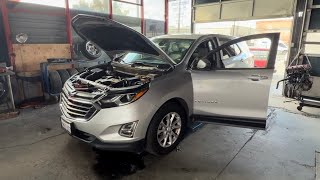
- With the engine running, carefully disconnect the vacuum line at the mechanical vacuum pump by pressing the two green tabs and pulling. Test for strong suction with your finger. 🎬 Watch a live demonstration of confirming a failed vacuum pump. If suction is weak or absent, the vacuum pump has failed and must be replaced.
- If the vacuum pump is working, reconnect the line and inspect the entire vacuum pipe assembly (Part No. 84974392) and hoses leading to the brake booster for any visible cracks, damage, or loose connections.
- If no leaks are found, inspect the electrical connector and wiring going to the brake booster pressure sensor for damage, corrosion, or looseness.
- Using a scan tool with live data, monitor the Brake Booster Pressure Sensor reading. Check if the voltage is within the manufacturer's specified range (~4.5V KOEO, 0.5-1.0V at idle) and if it changes logically when the brake pedal is applied and released. Erratic or static readings point to a faulty sensor.
- If the pump has failed, carefully remove it and inspect the drive tangs. If they are broken, you MUST inspect the cylinder head (requires removing the valve cover) for metal debris to prevent further engine damage. Also inspect the camshaft drive slot for damage.
Parts You'll Likely Need
- Brake Vacuum Pump
(OEM #12684050)— This is the most common cause of a P0556 code accompanied by a hard brake pedal on this vehicle due to a known high failure rate.
Trusted brands: ACDelco (GM Genuine), Dorman (P/N: 904-883)
OEM price range: $120-$180
Aftermarket price range: $60-$110 - Power Brake Booster Vacuum Pipe Assembly
(OEM #84974392)— This assembly contains the integrated pressure sensor. It is the official GM-recommended fix for sensor-related faults on this system, per TSB 21-NA-107. It replaces previous part numbers 84361879, 84259588, and 13388368.
Trusted brands: ACDelco (GM Genuine)
OEM price range: $40-$70
Related Codes That Often Appear With This One
- P0557 — This code for 'Brake Booster Pressure Sensor Circuit Low' points to the same component and system. TSB 21-NA-107 directly addresses this code with the same fix (replacing the vacuum pipe assembly).
- P0014 / P0017 — These camshaft position codes can appear if the vacuum pump fails catastrophically, breaks apart, and the debris causes the camshaft reluctor wheel to shift its position. This indicates probable engine damage and is specifically addressed in TSB 21-NA-268.
Technical Service Bulletins (TSBs) & Recalls
- 21-NA-107: Addresses a 'Service Brake Assist' message and DTC P0557 by replacing the power brake booster vacuum pipe with an updated version containing a more robust sensor.
- 21-NA-268: Details how a failed vacuum pump can cause camshaft reluctor wheel damage, leading to no-start conditions and camshaft position codes. This TSB confirms the link between the brake system failure and subsequent engine timing problems.
- PIP5835: A diagnostic tip bulletin that explicitly links customer complaints of 'increased brake pedal effort' to the failure of the mechanical vacuum pump, directing technicians to TSB 21-NA-268.
Platform-Specific Known Issues
- Class-Action Lawsuit (Thieme, et al. v. General Motors, LLC): A lawsuit filed in February 2026 alleges that the engine-driven vacuum pumps in 2018-2022+ Equinox and Terrain models are defective and can fail prematurely, leading to a dangerous loss of power brake assist. The suit claims GM was aware of the defect but concealed it.
- TSB 21-NA-268: Catastrophic Pump Failure and Engine Damage: This bulletin details how a failed vacuum pump can break apart, causing the exhaust camshaft reluctor wheel to spin on the camshaft. This leads to a crank/no-start condition and sets camshaft position codes (P0014, P0017, etc.). The repair requires replacing both the vacuum pump and the exhaust camshaft, and removing all debris.
- Preliminary Information Bulletin PIP5835: GM issued this bulletin specifically for P0556, P0557, and/or a 'Service Brake Assist' message on 2021-2022 Chevrolet Trailblazer and 2020-2022 Buick Encore GX models, indicating the issue extends to other GM platforms. It guides technicians to check for a collapsed vacuum hose or a faulty vacuum pump.
Mechanic-Grade Diagnostic Values
- Brake Booster Pressure Sensor Signal Voltage (KOEO) — expected: ~4.5 V (Atmospheric Pressure). Failure: Voltage significantly lower than 4.5V indicates a sensor or wiring issue.
- Brake Booster Pressure Sensor Signal Voltage (Engine at Idle) — expected: 0.5 V to 1.0 V (High Vacuum). Failure: Voltage stuck high (near 4.5V) or not responding when the engine is running points to a lack of vacuum (bad pump) or a faulty sensor. Voltage stuck below 0.43V can trigger P0557.
- Brake Booster Vacuum Level (at idle) — expected: 18-22 inHg. Failure: Significantly less vacuum indicates a leak or a failed vacuum pump.
- Brake Booster Vacuum Hold Test — expected: Should not lose more than 3.3 kPa (0.98 inHg) over 15 seconds after engine is shut off.. Failure: A rapid loss of vacuum points to a leak in the booster diaphragm or the check valve.
Scan Tool Commands That Help
- GDS2 / Professional Scan Tool: Brake Pedal Position Sensor Learn — While not for the pressure sensor itself, GM requires this learn procedure in both the ECM and BCM after replacing the related Brake Pedal Position Sensor. Performing this reset after any brake input sensor replacement is a good practice to ensure all modules have correct calibration data.
Wiring & Ground Locations
- B52 Brake Booster Pressure Sensor Connector — On the power brake booster vacuum pipe assembly, between the vacuum pump and the brake booster.. This is the main connector for the sensor. A visual inspection for corrosion or damage is critical. The typical 3-pin configuration is: Pin 1 - Signal, Pin 2 - Ground, Pin 3 - 5V Reference.
- Engine Block / Cylinder Head Grounds — Look for ground straps and wires bolted directly to the cylinder head (often near the back) and the main engine block.. The sensor's ground reference (Pin 2) ultimately connects to the engine/chassis ground. A poor engine ground can cause floating voltage references for multiple sensors, leading to erroneous readings and codes like P0556.
- G103 / G105 (Example Designators) — Main chassis ground points are typically located on the frame rail in the engine compartment, near the radiator support or on the firewall.. The entire electrical system relies on clean, tight chassis grounds. Corrosion at these points can cause widespread, intermittent electrical gremlins.
Real Owner Repair Stories
- YouTube Channel 'TS Mobile Mechanic' (GMC Terrain with 1.5L Turbo engine (mechanically identical to Equinox for this system)) — Extremely hard brake pedal, P0556 code stored.
❌ Tried (didn't work) The diagnosis was direct and did not involve unnecessary parts replacement. The mechanic immediately suspected the vacuum pump.
✅ What actually fixed it Confirmed no suction coming from the vacuum pump outlet. Replaced the mechanical brake vacuum pump (used aftermarket part 12684050) and the brake assist was restored and the code was cleared. - NHTSA ODI #11222466 — An owner of a mechanically similar Chevrolet model performed their own diagnostic testing and retrieved failure code P0556 (Brake Booster Pressure) after experiencing a failure, noting that the vehicle was not included in a recall at the time.
- NHTSA ODI #11471869 — An owner reported a terrifying incident where the brakes failed, nearly causing a collision. The check engine light immediately reported P0556, which a mechanic confirmed was related to the brake booster vacuum pump.
OEM Part Supersession History
12684050, 12662789, 12673203→25204337— The mechanical vacuum pump has undergone multiple revisions to address the high failure rate. Using the latest available OEM part number is critical for repair longevity.13388368, 84259588, 84361879→84974392— The vacuum pipe assembly was updated with a more robust pressure sensor to address electrical sensitivity and faults, as noted in TSB 21-NA-107 for the related P0557 code.
Model Year Variations Within This Range
- 2018-2022: These model years use the 1.5L LYX engine, which is equipped with the failure-prone camshaft-driven mechanical vacuum pump. This is the engine primarily affected by P0556 and the associated class-action lawsuit.
- 2023-2024: These model years switched to the updated 1.5L LSD engine. Forum discussions suggest this engine may use an electric vacuum pump instead of the mechanical, cam-driven one, potentially eliminating this specific common failure point. Therefore, on a 2023+ model, a P0556 code is less likely to be the mechanical pump and diagnosis should focus more on the sensor, wiring, or a different vacuum source.
Diagnostic Flowchart
Other Known Issues on This Vehicle
Issues unrelated to this code that are worth knowing about as an owner of this generation:
- Cracked Pistons 🔴 High — Reported in some early (2018-2020) 1.5L LYX engines, often leading to misfire codes (P0300-P0304) and excessive oil consumption. Can be caused by Low-Speed Pre-Ignition (LSPI). (Ref: TSB 18-NA-171 / 19-NA-122 (related diagnostics))
- Shuddering/Hesitation from 9-Speed Transmission (9T45) 🟠 Medium — Some owners report shuddering, hesitation, or harsh shifting. Issues can sometimes be related to fluid condition or software. (Ref: Multiple TSBs exist for various shift quality concerns (e.g., 21-NA-169, 18-NA-359).)
- PCV System Orifice Clogging 🟠 Medium — The PCV orifice in the camshaft cover can become clogged, leading to positive crankcase pressure, oil leaks, and potentially code P1101. (Ref: TSB 20-NA-047)
- Start-Stop Accumulator Bolt Recall 🔴 High — Affects 2018-2020 models. Missing bolts on the transmission's start-stop accumulator can cause a major fluid leak, loss of propulsion, and fire risk. (Ref: NHTSA Recall 20V668000)
- Charge Air Cooler (CAC) Moisture Ingestion 🟡 Low — On 2018 models, moisture can collect in the charge air cooler and be ingested during acceleration, causing a misfire (P0300). (Ref: TSB 22-NA-065)
Used vs. New Parts: Buying Guide for This Vehicle
When a used part is the smart pick: For this repair, buying used parts is highly discouraged. A used vacuum pipe/sensor assembly from a very low mileage vehicle (<30,000 miles) could be a minor cost-saving measure, but the risk of premature failure may outweigh the savings.
Donor-vehicle mileage cap: roughly under 30000 miles for the part to have meaningful remaining life.
What to inspect on the donor part:
- For a used vacuum pipe/sensor, inspect for any hairline cracks, especially around the fittings.
- Ensure the plastic is not brittle or discolored.
- Check that the electrical connector pins are clean and free of corrosion.
OEM-only on this vehicle (don't cheap out):
- Brake Vacuum Pump: This part is a known safety-related defect. A used part has a very high probability of failing in the same manner as the original. Always buy a new OEM part, preferably the latest superseded part number (e.g., 25204337) to get the most recent design improvements.
- Power Brake Booster Vacuum Pipe Assembly: Given that GM issued a TSB and updated the sensor for robustness, using a new OEM part (84974392) ensures you are getting the improved component.
Aftermarket brands forum-validated for this vehicle:
- Dorman is a widely available aftermarket alternative for the vacuum pump (P/N: 904-883), but for a critical safety component with a known OEM defect history, sticking to the latest GM Genuine part is the most conservative and recommended approach.
Brands owners have reported issues with on this vehicle:
- Avoid unbranded, low-cost vacuum pumps from online marketplaces. The internal components of these pumps are of unknown quality, and failure directly results in a loss of power braking, posing a significant safety risk.
Real Owner Stories
Aggregated from forums and TSBs cited above. Mileages and costs reflect what owners reported in those sources.
2018 GMC Terrain 1.5L
Symptoms: Multiple owners detail sudden, dangerous brake failure on the highway due to vacuum pump failure.
What fixed it: The root cause was identified as vacuum pump failure, requiring replacement of the pump.
Source hint: carcomplaints.com - 2018 GMC Terrain 'Service Brake Assist' Complaints
2018+ Chevrolet Equinox
Symptoms: Hard brakes and Check Engine Light with code P0556.
What fixed it: The owner performed a DIY diagnosis and replacement of the failed vacuum pump, which resolved the issue.
Source hint: YouTube - 'PO556 Chevy Code FIX, HARD BRAKES, 2018+ Equinox...' by Joy Louise
2018 Chevrolet Equinox
Symptoms: Hard brake pedal caused by vacuum pump failure.
What fixed it: A technician replaced the failed vacuum pump, showing the broken drive gear on the old part and emphasizing the need to check for metal debris in the engine.
Source hint: YouTube - '2018 chevy equinox vacuum pump failure(hard brake pedal)' by The Car Guy
2018+ Chevrolet Equinox
Symptoms: A condition where the vacuum pump locks up, knocking the cam sensor reluctor wheel out of time, likely resulting in a no-start and camshaft codes.
What fixed it: The repair outlined in TSB 21-NA-268, which involves replacing the vacuum pump and the exhaust camshaft.
Source hint: chevyequinoxforum.com - Thread 'Service Bulletin that ticked me off'
2018+ Chevrolet Platform
Symptoms: An owner reported in NHTSA ODI #11659123 that they had to manually lower gears to avoid a head-on collision after the brakes failed. Codes P0014, P0017, and P0556 were pulled, and the car would not start after being parked.
What fixed it: Diagnosis confirmed catastrophic failure involving both the vacuum pump and engine timing components.
Related OBD-II Codes
Frequently Asked Questions
I heard there's a class-action lawsuit about this brake problem. Does it affect my 2019 Equinox?
My mechanic says the vacuum pump failed and might have damaged my engine. Is this a known issue?
My car has a 'Service Brake Assist' message but the code is P0557, not P0556. Is this related?
If my vacuum pump broke apart, what is the most critical step in the repair besides replacing the pump?
My Equinox won't start and has camshaft codes like P0014 and P0017 along with P0556. How can a brake system failure cause this?
What is the most likely cause of a hard brake pedal and code P0556 on my 2020 Equinox 1.5L?
Helpful Videos

We Have This Part in Stock

The information in this article is provided for general reference and educational purposes only. Vehicle specifications, procedures, and part compatibility can vary by production date, trim level, and region. Always consult your vehicle's factory service manual and verify part numbers before purchasing or performing repairs. Safety-critical components such as airbags, seat belts, and braking systems should be installed by a qualified professional.
- Chevrolet Equinox:
- 🧭 Diagnostic Flowchart
- 🎬 Helpful Videos
- 🛍️ Shop This Part
- What's Unique About the 2018-2024 Chevrolet Equinox
- Symptoms You May Notice
- Most Likely Causes
- Rare But Worth Checking
- Diagnosis Steps
- Parts You'll Likely Need
- Related Codes That Often Appear With This One
- Technical Service Bulletins (TSBs) & Recalls
- Platform-Specific Known Issues
- Mechanic-Grade Diagnostic Values
- Scan Tool Commands That Help
- Wiring & Ground Locations
- Real Owner Repair Stories
- OEM Part Supersession History
- Model Year Variations Within This Range
- Other Known Issues on This Vehicle
- Used vs. New Parts: Buying Guide for This Vehicle
- Real Owner Stories
- 2018 GMC Terrain 1.5L
- 2018+ Chevrolet Equinox
- 2018 Chevrolet Equinox
- 2018+ Chevrolet Equinox
- 2018+ Chevrolet Platform
- Related OBD-II Codes
- Frequently Asked Questions
- 🎟️ Get 5% Off