

P0556 on 2011-2024 Dodge Durango: Brake Booster Pressure Sensor Causes and Fixes
On a 2011-2024 Dodge Durango, code P0556 is most often caused by a faulty brake booster pressure sensor or, specifically for 2016-2017 models, the need for a PCM software update. Expect to pay $30-$90 for a new sensor, which is a DIY-friendly fix. A dealer software update may cost $150-$250.
- For 2016-2017 Dodge Durangos, the first step for a P0556 code should be checking with a dealer for a required PCM software update (TSB 18-049-20) before replacing any parts.
- The most common symptom is a hard brake pedal that requires much more effort to stop the vehicle.
- If software is not the issue, the most likely failed part is the brake booster pressure sensor itself, which is relatively inexpensive and accessible.
- Driving with this code is a safety risk due to potentially compromised braking performance.
What's Unique About the 2011-2024 Dodge Durango
For the third-generation (WD) Dodge Durango, particularly the 2016-2017 model years, this code is frequently triggered by a software glitch in the Powertrain Control Module (PCM). Dodge released Technical Service Bulletins (TSBs) to address this specific issue, recommending a PCM reflash before replacing any hardware. This is a critical distinction, as owners might unnecessarily replace a perfectly good sensor when a software update is the correct fix. This issue is shared with its platform-mate, the Jeep Grand Cherokee (WK2), which is explicitly covered under the same TSBs.
Generation note: The 2011-2024 model years all belong to the third generation (WD) of the Dodge Durango. However, there are specific issues documented for certain model years within this generation, such as the TSBs for 2016-2017 models which address a software-related cause for P0556.
Symptoms You May Notice
- Hard brake pedal requiring significantly more effort to press.
- Increased stopping distances.
- Check Engine Light illuminated on the dashboard.
- Brake warning light may be illuminated.
- Engine may stall or have a rough idle, especially if a large vacuum leak is the cause.
- Replacing the brake booster pressure sensor on a 2016-2017 model before checking if the required PCM software update (TSB 18-049-20) has been performed.
Most Likely Causes
- PCM Software Update Required 🔴 High Probability For 2016-2017 models with the 3.0L, 3.6L, or 5.7L engines, FCA issued TSBs (18-024-17 Rev. C and the superseding 18-049-20) to correct false P0556 codes. The original software logic was overly sensitive and could set the code erroneously.
How to confirm: A Dodge dealership or a qualified repair shop with a wiTECH scan tool can check your vehicle's VIN against the TSBs and determine if the software update has been performed.
Typical fix: Reprogramming (flashing) the PCM with the latest software version. The TSB also notes the TCM should be updated at the same time.
Est. part cost: $0 - Faulty Brake Booster Pressure Sensor 🔴 High Probability → Shop Power Brake Booster The sensor is an electronic component that operates in a high-vibration, high-heat environment and can fail over time, causing its signal to drift or fail entirely.
How to confirm: After confirming the PCM software is up to date, use a multimeter to test the sensor's voltage output. It should provide a smooth voltage sweep (typically 0.5V to 4.5V) as vacuum is applied and released. An erratic or non-responsive signal indicates a bad sensor.
Typical fix: Replace the brake booster pressure sensor.
Est. part cost: $30-$90 - Vacuum Leak 🟡 Medium Probability Rubber vacuum hoses can become brittle, crack, or disconnect over time due to heat and age, causing a loss of vacuum to the brake booster. The one-way check valve in the supply hose can also fail.
How to confirm: Visually inspect all vacuum hoses connected to the brake booster for cracks, splits, or loose connections. Listen for a hissing sound with the engine running. A smoke machine is the most effective tool to introduce smoke into the system and see where it escapes.
Typical fix: Replace the cracked or leaking vacuum hose or the check valve.
Est. part cost: $10-$50 - Damaged Wiring or Connector ⚪ Low Probability Vibrations and exposure to the elements can cause wires in the sensor's harness to fray, break, or the connector pins to corrode, leading to an open or shorted circuit.
How to confirm: Visually inspect the wiring harness and connector for the brake booster pressure sensor. Check for any signs of damage, corrosion, or loose pins. Perform a continuity test on the wires with a multimeter if a visual inspection is inconclusive.
Typical fix: Repair the damaged wire or replace the connector pigtail.
Est. part cost: $15-$40
Rare But Worth Checking
- Failing Brake Booster: → Shop Power Brake Booster
Diagnosis Steps
- Read the trouble codes with an OBD-II scanner and check for any other accompanying codes.
- If the vehicle is a 2016-2017 Durango or Jeep Grand Cherokee, your first step should be to contact a dealer to see if TSB 18-049-20 applies and if the PCM software update has been performed. If not, this is the most likely fix.
- If the software is up to date (or the vehicle is not a 2016-2017 model), proceed with hardware diagnosis.
- Visually inspect the brake booster and all connected vacuum lines for obvious cracks, damage, or disconnections. Listen for a hissing sound with the engine running, which would indicate a vacuum leak.
- Inspect the electrical connector and wiring going to the brake booster pressure sensor for any signs of damage, corrosion, or loose pins.
- Using a scan tool, monitor the live data from the brake booster pressure sensor. The reading should change smoothly with brake pedal application.
- If live data is suspect, use a digital multimeter to back-probe the sensor's connector. Check for the correct reference voltage (typically 5V) and ground, and verify the signal voltage changes smoothly as vacuum is applied (e.g., with a hand-held vacuum pump).
- If the sensor fails the voltage test, replace it. If the sensor's signal is good but the code persists, re-check for intermittent vacuum leaks or wiring issues. A rare fault within the PCM itself is a final possibility.
Parts You'll Likely Need
- Brake Booster Pressure Sensor
(OEM #68249823AB, 68249855AB)— This sensor is the most common hardware component to fail, causing incorrect signals to be sent to the PCM.
Trusted brands: Mopar, Standard Motor Products (SMP), Duralast
OEM price range: $60-$90
Aftermarket price range: $30-$70
Related Codes That Often Appear With This One
- U1424 — This code for 'Implausible Engine Torque Signal' is listed in the same TSBs (18-024-17, 18-049-20) as P0556, indicating a common software-related root cause on 2017 models.
- P2299 — 'Brake Pedal Position/Accelerator Pedal Position Incompatible' is another code mentioned in the TSBs that can be resolved by the same PCM software update.
- P06EF — 'Engine Restart Performance' is also listed in TSB 18-049-20 as a related code that can be fixed with the PCM reflash for 3.0L and 3.6L engines.
- P040B — 'Exhaust Gas Recirculation Temperature Sensor 1 Circuit Performance' is another code listed in TSB 18-049-20 for the 3.6L engine that is addressed by the software update.
Technical Service Bulletins (TSBs) & Recalls
- 18-049-20: Supersedes the previous TSB and involves reprogramming the PCM to address false triggers for P0556 and other codes on 2016-2017 Durango and Grand Cherokee models with 3.0L, 3.6L, or 5.7L engines.
- 18-024-17 REV. C: The original TSB that identified P0556 as a code that could be resolved with a PCM software flash on vehicles built on or before March 06, 2017.
Platform-Specific Known Issues
- A known software issue on 2016-2017 models can cause this code to be set erroneously. The fix is a PCM software update per TSB 18-049-20.
- This issue is shared directly with the 2016-2017 Jeep Grand Cherokee (WK2), which is built on the same platform and uses the same engines and electronics.
Mechanic-Grade Diagnostic Values
- Brake Booster Pressure Sensor Signal Voltage — expected: A smooth sweep between ~0.5V (high vacuum) and ~4.5V (low vacuum/atmospheric pressure).. Failure: Voltage is stuck, erratic, flat, or does not change proportionally with brake pedal application or when vacuum is applied with a hand pump.
- Sensor Reference Voltage at Connector — expected: 4.9V to 5.1V between the reference wire and a known good ground with the key on, engine off.. Failure: No voltage or voltage outside this range indicates a problem with the PCM or the wiring.
- Sensor Ground Circuit Continuity — expected: Near 0 ohms of resistance between the ground pin at the connector and the chassis ground.. Failure: High resistance (OL) indicates an open in the ground circuit.
- Engine Vacuum at Brake Booster Hose — expected: 18-22 inches of Mercury (inHg) at a steady idle.. Failure: Low or fluctuating vacuum suggests a vacuum leak, a faulty vacuum pump (if equipped), or poor engine health.
- Sensor Pinout (Typical 3-Wire) — expected: Pin 1: Signal (variable voltage), Pin 2: Ground (0V), Pin 3: Reference (5V).. Failure: Incorrect voltages at any pin point to a wiring or PCM issue rather than a sensor failure.
Scan Tool Commands That Help
- wiTECH or equivalent professional scanner: PCM Self-Test / Module Test — After verifying the sensor and wiring are good, a PCM self-test can be initiated. A failure here may indicate an internal fault within the Powertrain Control Module's analog-to-digital converter or related circuits, pointing towards a rare PCM failure.
Wiring & Ground Locations
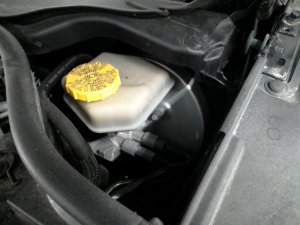
- Brake Booster Pressure Sensor Connector — The sensor is typically a small, black plastic component pushed into a rubber grommet directly on the brake booster housing in the engine bay, on the driver's side firewall.. This 3-pin connector is a common point of failure due to corrosion, loose pins, or harness damage from engine vibration and heat. Verifying power, ground, and signal at this connector is a primary diagnostic step.
"I Checked Everything" — The Actual Cause
- In some cases, a standard smoke test of the vacuum lines will show no leaks, but the code persists. The actual cause was found to be a leaking O-ring seal between the master cylinder and the brake booster. This allows vacuum to escape from the booster itself, but is often missed as technicians focus only on the vacuum supply hoses.
- A vehicle that passed a vacuum hose inspection was later found to have a bent flange on the brake booster where the master cylinder mounts, caused by a previous collision. This created a slow, intermittent vacuum leak that only became apparent under specific load conditions (like driving up a long hill) and was only found by introducing smoke directly into the booster itself, not just the supply lines.
Diagnostic Flowchart
Other Known Issues on This Vehicle
Issues unrelated to this code that are worth knowing about as an owner of this generation:
- 3.6L V6 Oil Filter Housing/Cooler Leaks 🔴 High — Extremely common. The plastic housing is prone to cracking and warping from heat cycles, causing significant oil and/or coolant leaks, often pooling in the engine valley. Can occur at any mileage, but frequently reported from 60,000 miles onward.
- 5.7L V8 HEMI Lifter/Camshaft Failure ('Hemi Tick') 🔴 High — A widely known issue. A ticking noise, especially when the engine is warm at idle, often signals a failing lifter roller. If not addressed, this can destroy the camshaft, requiring a costly repair. Causes are debated but often linked to oil lubrication issues. (Ref: TSB 9100229 notes not to replace lifters for a misaligned pin, but does not address the primary failure mode.)
- Uconnect 8.4-inch Screen Delamination 🟠 Medium — Very common on models from roughly 2017-2022. The screen's top layer bubbles and separates, causing 'ghost touches' and making the infotainment system unusable. This affects climate, audio, and navigation controls. (Ref: No recall, but manufacturer communication NHTSA #10223465 acknowledges the issue. Owners report Dodge has a dedicated customer service department for this issue but often denies out-of-warranty claims.)
- Rear Air Conditioning Line Corrosion 🟡 Low — Common on Durangos with rear A/C. The aluminum lines running to the rear evaporator are susceptible to corrosion, especially in regions with road salt, leading to refrigerant leaks and loss of A/C function.
- Alternator Failure (2011-2014) 🔴 High — Primarily affects 2011-2014 models. Sudden alternator failure can cause the vehicle to stall while driving, losing power steering and brakes assist. While the recall doesn't cover later years, sudden failure remains a reported concern. (Ref: NHTSA Campaign #17V435000 (Recall T36))
Used vs. New Parts: Buying Guide for This Vehicle
When a used part is the smart pick: A used brake booster pressure sensor from a reputable salvage yard with a low-mileage donor vehicle can be a cost-effective option, as the part is relatively simple and new aftermarket versions are also inexpensive.
Donor-vehicle mileage cap: roughly under 60000 miles for the part to have meaningful remaining life.
What to inspect on the donor part:
- Check for a donor vehicle with no front-end or driver-side engine bay damage.
- Inspect the connector pins on the used sensor for any signs of corrosion or damage before purchasing.
- Ensure the plastic housing of the sensor is not cracked or showing signs of extreme heat stress.
OEM-only on this vehicle (don't cheap out):
- While not strictly 'OEM-only', replacing the entire brake booster assembly with a new or professionally remanufactured unit is strongly recommended over a used one. The internal rubber diaphragm perishes over time, and a used booster carries a high risk of premature failure.
Aftermarket brands forum-validated for this vehicle:
- Standard Motor Products (SMP)
- Duralast
Brands owners have reported issues with on this vehicle:
- No specific brands are consistently reported as problematic, but ultra-low-cost unbranded parts from online marketplaces may have questionable quality control and are best avoided for a critical safety system.
Related OBD-II Codes
Frequently Asked Questions
I have a 2017 Dodge Durango with a P0556 code. Is this the known software issue I've heard about?
Does the P0556 software TSB for the Durango also apply to the Jeep Grand Cherokee?
My brake pedal suddenly feels very hard to push and the check engine light is on. Is this a symptom of P0556?
What is the very first thing I should check for a P0556 code on my 2016 Durango?
My Durango isn't a 2016-2017 model. What's the most likely cause of P0556 if it's not the software bug?
Can a vacuum leak cause my engine to run poorly in addition to the P0556 code?
Used OEM Parts in Stock
New Aftermarket Parts Available


The information in this article is provided for general reference and educational purposes only. Vehicle specifications, procedures, and part compatibility can vary by production date, trim level, and region. Always consult your vehicle's factory service manual and verify part numbers before purchasing or performing repairs. Safety-critical components such as airbags, seat belts, and braking systems should be installed by a qualified professional.
- Dodge Durango:
- 🧭 Diagnostic Flowchart
- 🛍️ Shop This Part
- What's Unique About the 2011-2024 Dodge Durango
- Symptoms You May Notice
- Most Likely Causes
- Rare But Worth Checking
- Diagnosis Steps
- Parts You'll Likely Need
- Related Codes That Often Appear With This One
- Technical Service Bulletins (TSBs) & Recalls
- Platform-Specific Known Issues
- Mechanic-Grade Diagnostic Values
- Scan Tool Commands That Help
- Wiring & Ground Locations
- "I Checked Everything" — The Actual Cause
- Other Known Issues on This Vehicle
- Used vs. New Parts: Buying Guide for This Vehicle
- Related OBD-II Codes
- Frequently Asked Questions
- 🎟️ Get 5% Off