

P0557 on 2016-2022 Honda Pilot: Brake Booster Pressure Sensor Circuit Low Causes and Fixes
This code indicates low voltage from the brake booster pressure sensor, usually causing a hard brake pedal and a warning light. The most common fix is replacing the brake booster vacuum hose assembly which includes the sensor, or repairing a damaged wire or poor connection.
- P0557 on a 2016-2022 Pilot is a critical safety code that should be addressed immediately.
- Do not drive the vehicle with this code active, as power brake assist can fail unexpectedly.
- The most common fix is replacing the 'Master Power Tube Assembly' which contains the sensor, but always check wiring and connectors first.
- Verify the correct part number for your vehicle, as it differs between 6-speed and 9-speed transmission models.
What's Unique About the 2016-2022 Honda Pilot
On the 2016-2022 Honda Pilot, the P0557 code is frequently traced back to simple electrical issues rather than a major component failure. Intermittent faults due to poor connections or loose terminals at the sensor or PCM are noted as common culprits for this specific platform. Unlike some other vehicles where the sensor is the immediate point of failure, on the Pilot, a thorough inspection of the wiring and connectors is a critical first step before replacing parts.
Symptoms You May Notice
- Brake system warning light illuminated on the dashboard
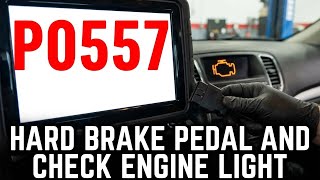
- Brake pedal is noticeably harder to press than usual 🎬 See how to solve the hard brake pedal problem on a Pilot.
- Increased stopping distance required to slow the vehicle
- Inconsistent or spongy brake pedal feel
- Hissing noise coming from the area of the brake pedal or booster
- Engine may stall when braking
- Replacing the brake booster before testing the sensor, wiring, and vacuum lines. The booster is more expensive and less likely to be the cause of a purely electrical code like P0557.
- Replacing the brake booster pressure sensor without first checking for 5V reference and ground at the connector. A wiring problem will prevent a new sensor from working correctly.
Most Likely Causes
- Faulty Brake Booster Pressure Sensor 🔴 High Probability → Shop Power Brake Booster The sensor is integrated into a plastic vacuum tube assembly exposed to engine heat and vibration, which can lead to failure over time. On this vehicle, it is sold as part of the 'Master Power Tube Assembly'.
How to confirm: After confirming the wiring is intact (has 5V reference, good ground, and no shorts), the sensor is the remaining point of failure. With the engine running at idle, the sensor's signal voltage should be around 0.5-1.0V. A reading consistently below 0.43V points to a faulty sensor.
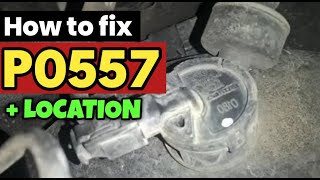
Typical fix: Replace the entire Master Power Tube Assembly, which includes the sensor and vacuum line. The sensor itself is press-fit into a rubber grommet on the tube. 🎬 Watch: How to fix the brake booster pressure sensor circuit.
Est. part cost: $40-$70 - Poor Electrical Connection or Damaged Wiring 🟡 Medium Probability Sources specifically mention that loose terminals at the sensor connector or the PCM connector are a common issue on 2016-2022 Pilots. Wires can also be damaged from heat, vibration, or rubbing against other components in the crowded engine bay.
How to confirm: Visually inspect the wiring harness for any signs of damage. Use a multimeter to check for continuity on the signal wire and ground wire between the sensor connector and the PCM connector. Check for a stable 5-volt reference at the sensor connector with the key on.
Typical fix: Repair the damaged section of wire or clean/tighten the terminals at the connector. Ensure the connector clip is not broken and is securely fastened.
Est. part cost: $1-$20 - Vacuum Leak ⚪ Low Probability
How to confirm: Visually inspect all vacuum hoses connected to the brake booster for cracks, brittleness, or loose connections. Listen for a hissing sound with the engine running. Use a vacuum gauge on the booster supply hose; a healthy system should hold a steady 18-21 inHg at idle.
Typical fix: Replace the cracked or leaking vacuum hose.
Est. part cost: $20-$50
Rare But Worth Checking
- Failed Brake Booster: → Shop Power Brake Booster While not the most common cause for a purely electrical code like P0557, a booster that cannot hold a vacuum due to an internal diaphragm leak can cause this code. This is usually accompanied by a loud hissing sound when the brake pedal is pressed or a pedal that is hard at all times.
- Failed Powertrain Control Module (PCM): This is the least likely cause. The PCM should only be considered if all other possibilities, including the sensor, wiring, and vacuum system, have been thoroughly tested and ruled out.
Diagnosis Steps
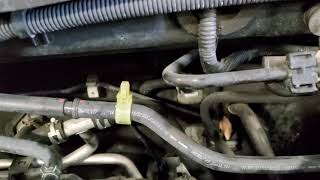
- Verify the code with an OBD-II scanner. 🎬 Watch: A detailed breakdown of the P0557 code on this Pilot. Using a Honda-specific tool (HDS) is recommended to read detailed sensor data.
- Perform a visual inspection of the brake booster, all connected vacuum lines, and the wiring harness leading to the pressure sensor. Look for obvious cracks, disconnections, or damage.
- Perform a functional test of the brake booster. With the engine off, pump the brake pedal 5-10 times to deplete any stored vacuum. The pedal should feel firm.
- Hold firm pressure on the brake pedal and start the engine. The pedal should drop slightly as the engine creates vacuum. If it does not, suspect a major vacuum supply issue or a failed booster.
- Disconnect the brake booster pressure sensor's 3-pin electrical connector. Inspect for corrosion or bent pins.
- Turn the ignition to the 'ON' position (engine off). Use a multimeter to test the terminals on the harness-side connector. You should find a 5-volt reference wire, a ground wire (close to 0 volts), and a signal wire.
- If the 5V reference or ground is missing, there is a wiring issue between the connector and the PCM that must be repaired. Check continuity on the VCC6 (5V) wire between sensor connector pin 3 and PCM connector A, pin 19.
- If 5V and ground are present, connect a scanner and monitor the sensor voltage. With the engine at idle, the voltage should be low (approx. 0.5-1.0V). If the voltage reads below 0.43V, the sensor is likely faulty.
- If the issue persists after replacing the sensor, perform a continuity test on the signal wire (MPMON) between the sensor connector pin 2 and PCM connector A, pin 36 to rule out a hidden break or short in the wire.
- After repairs, clear the code with the scanner and perform a test drive with several braking events to ensure the problem is resolved and the light does not return.
Parts You'll Likely Need
- Master Power Tube Assembly (Brake Booster Vacuum Hose)
(OEM #46402-TZ5-A11 (for 9-speed transmission models) or 46402-TZ5-A02 (for 6-speed transmission models))— This assembly includes the brake booster pressure sensor, which is the most common part to fail. The specific part number depends on the vehicle's transmission.
Trusted brands: Honda (Genuine OEM)
OEM price range: $40-$70
Aftermarket price range: $30-$60
Related Codes That Often Appear With This One
- P0556 — P0556 indicates a 'Range/Performance' issue with the same sensor. It can appear if the sensor signal is erratic or not changing when expected, which can be caused by similar wiring or sensor faults.
- P0558 — P0558 indicates 'Circuit High' voltage, the opposite of P0557. Seeing them together could suggest an intermittent short to power or a failing sensor with erratic output.
- P15C7 — This is a Honda-specific code for 'Brake Booster Pressure Sensor A Characteristic High Voltage'. It points to a similar fault within the same system, and its diagnostic path may overlap.
Technical Service Bulletins (TSBs) & Recalls
- TSB 19-053: While not for P0557, this TSB addresses a high-pitched brake squeal at low speeds in cold weather on related Honda/Acura models. It's a relevant issue for owners inspecting their brake system.
Platform-Specific Known Issues
- Sensor Location: The sensor is located on the driver's side of the engine bay, on the vacuum line running to the brake booster. It can be somewhat difficult to access as it is positioned low and may be obstructed by other brake lines.
- Intermittent Failures: Owners on forums report that this code can appear intermittently at first, with the warning lights clearing on their own, only to return later. This often points to a poor electrical connection or a sensor that is beginning to fail.
Mechanic-Grade Diagnostic Values
- Brake Booster Pressure Sensor Signal Voltage (at sensor or PCM) — expected: Approx. 4.5-5.0V (Key On, Engine Off); Approx. 0.5-1.0V (Engine at idle). Failure: Consistently below 0.43V for more than 2 seconds.
- Brake Booster Vacuum (at booster supply hose) — expected: Steady 18-21 inHg at idle.. Failure: Below 18 inHg, or a loss of more than 0.98 inHg (3.3 kPa) within 15 seconds after engine shutdown.
- Sensor Connector Voltage (harness side, sensor disconnected) — expected: Approx. 5.0V between Pin 1 (Signal) and Pin 3 (Ground) with key on.. Failure: Significantly lower or no voltage, indicating a wiring issue from the PCM.
Scan Tool Commands That Help
- Honda Diagnostic System (HDS): Jump SCS Line — This service function is required before performing continuity checks on the wiring between the sensor harness and the disconnected PCM connector to ensure the system is properly prepared for the test.
- Honda Diagnostic System (HDS): Read Brake Booster Pressure Sensor Voltage — Used as the primary method to confirm the fault condition. The HDS can display the live voltage data from the sensor, which can be compared against the specified failure threshold of 0.43V.
Wiring & Ground Locations
- Brake Booster Pressure Sensor 3P Connector — On the sensor itself, which is mounted on the vacuum tube running from the intake manifold to the brake booster on the driver's side of the engine bay.. This is the primary connection point to test for power, ground, and signal. Poor terminal tension or corrosion here is a common cause of P0557.
- PCM Connector A (51P) — At the Powertrain Control Module (PCM).. This connector is the termination point for the sensor's wiring. Specific pins must be tested for continuity back to the sensor connector to rule out a broken wire.
- Sensor Pin 3 to PCM Pin A19 (VCC6) — This is the 5V reference power wire running between the sensor and the PCM.. A continuity check on this wire is necessary if the 5V reference is missing at the sensor connector.
- Sensor Pin 2 to PCM Pin A36 (MPMON) — This is the signal wire running between the sensor and the PCM.. A continuity check on this wire is necessary if the sensor has been replaced but the code returns, to check for an open or shorted signal wire.
OEM Part Supersession History
46402-TZ5-A01→46402-TZ5-A02— Part revision or supplier change.
Heads up: 46402-TZ5-A02 is the correct replacement for vehicles originally equipped with 46402-TZ5-A01.
Model Year Variations Within This Range
- 2016-2020: Models equipped with the 6-speed automatic transmission require the Master Power Tube Assembly part number 46402-TZ5-A02.
- 2016-2022: Models equipped with the 9-speed automatic transmission (common on Touring and Elite trims) require the Master Power Tube Assembly part number 46402-TZ5-A11.
- 2019-2022: A mid-generation refresh occurred in 2019, introducing revised styling and making the Honda Sensing suite standard. However, the core braking system and engine remained the same, so causes and fixes for P0557 are consistent with pre-refresh models, with the transmission type being the key differentiator.
Diagnostic Flowchart
Other Known Issues on This Vehicle
Issues unrelated to this code that are worth knowing about as an owner of this generation:
- Transmission Judder / Shudder (6-Speed and 9-Speed) 🟠 Medium — Common issue, particularly on 2016-2018 models. Often occurs between 20-60 mph under light acceleration. Can be caused by degraded fluid or torque converter issues. (Ref: Honda issued warranty extensions and TSBs (e.g., 17-040, 23-078) to address torque converter problems and recommend software updates or fluid changes.)
- Fuel Injector Failure 🔴 High — A widely reported problem, especially in 2016-2017 models, sometimes occurring as early as 60,000 miles. Can cause misfires, rough idle, and stalling. (Ref: Honda extended the warranty on fuel injectors for certain model years due to the high failure rate.)
- Infotainment System Glitches (Black Screen, Popping/Crackling) 🟡 Low — Very common across the generation. Owners report the screen going black, unresponsiveness, and popping noises from the speakers. Often related to a faulty MOST bus network connector. (Ref: TSB 23-047 was issued to address issues with the rearview camera and audio system.)
- Auto Start/Stop System Failure 🟠 Medium — Frequently reported issue where the system fails to restart the engine after a stop, sometimes requiring a full power cycle. Can be caused by a weak battery or other electrical faults.
- Hood Fluttering at Highway Speeds 🟡 Low — Affects 2016-2019 models. The hood appears to vibrate or flutter while driving at higher speeds. (Ref: TSB 17-083 addresses this by having the dealer adjust the hood edge cushions.)
Used vs. New Parts: Buying Guide for This Vehicle
When a used part is the smart pick: For this specific part, a used component is generally not recommended. The part is a combination of plastic exposed to high engine bay heat and a sensitive electronic sensor. The risk of the used part failing soon after installation is high.
Donor-vehicle mileage cap: roughly under 50000 miles for the part to have meaningful remaining life.
What to inspect on the donor part:
- Inspect for any cracks, brittleness, or discoloration in the plastic tube.
- Ensure the rubber grommet holding the sensor is pliable and not dried out.
- Check the electrical connector for any signs of corrosion, bent pins, or a broken locking tab.
OEM-only on this vehicle (don't cheap out):
- Master Power Tube Assembly (Brake Booster Pressure Sensor)
Aftermarket brands forum-validated for this vehicle:
- Denso (if available, as they are often an OEM supplier for Honda)
Brands owners have reported issues with on this vehicle:
- Unbranded or 'white-box' parts from online marketplaces are strongly discouraged by forum communities for critical electronic sensors due to high rates of out-of-box failure and incorrect readings.
Related OBD-II Codes
Frequently Asked Questions
Where is the brake booster pressure sensor located on my 2016-2022 Pilot?
Can I buy just the sensor for the P0557 code, or do I have to replace a larger part?
My brake warning light comes on and off intermittently. What could cause this?
What are the most common reasons for a P0557 code on this specific Honda Pilot?
How can I test the brake booster pressure sensor to confirm it's bad?
My brake pedal feels very hard to press. Is this related to the P0557 code?
Are other Honda or Acura models known to have this same P0557 issue?
Helpful Videos
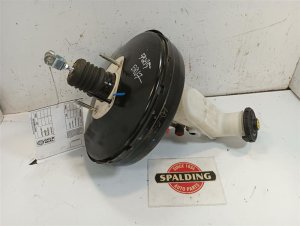
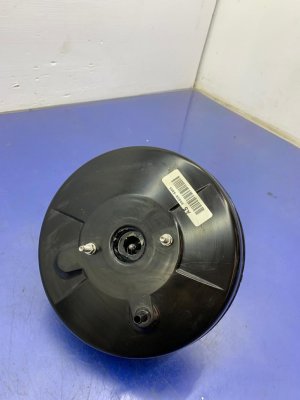
Used OEM Parts in Stock
New Aftermarket Parts Available


The information in this article is provided for general reference and educational purposes only. Vehicle specifications, procedures, and part compatibility can vary by production date, trim level, and region. Always consult your vehicle's factory service manual and verify part numbers before purchasing or performing repairs. Safety-critical components such as airbags, seat belts, and braking systems should be installed by a qualified professional.
- Honda Pilot:
- 🧭 Diagnostic Flowchart
- 🎬 Helpful Videos
- 🛍️ Shop This Part
- What's Unique About the 2016-2022 Honda Pilot
- Symptoms You May Notice
- Most Likely Causes
- Rare But Worth Checking
- Diagnosis Steps
- Parts You'll Likely Need
- Related Codes That Often Appear With This One
- Technical Service Bulletins (TSBs) & Recalls
- Platform-Specific Known Issues
- Mechanic-Grade Diagnostic Values
- Scan Tool Commands That Help
- Wiring & Ground Locations
- OEM Part Supersession History
- Model Year Variations Within This Range
- Other Known Issues on This Vehicle
- Used vs. New Parts: Buying Guide for This Vehicle
- Related OBD-II Codes
- Frequently Asked Questions
- 🎟️ Get 5% Off