

P0563 on 2011-2016 Honda CR-V: High System Voltage Causes and Fixes
On a 2011-2016 Honda CR-V, code P0563 almost always means the alternator's internal voltage regulator has failed, causing it to overcharge the system. The fix is to replace the alternator. Confirm by testing voltage at the battery with the engine running; a reading consistently over 15.0V points to a failed alternator. Expect to pay $200-$650 for a quality part.
- P0563 on a 2011-2016 CR-V indicates a serious overcharging condition, with system voltage exceeding 15.0V.
- The cause is almost certainly a failed internal voltage regulator, which requires replacing the entire alternator assembly.
- Confirm the diagnosis with a multimeter at the battery terminals while the engine is running. A reading over 15.0V confirms the fault.
- Do not drive the vehicle. An overcharging alternator can quickly destroy the battery and other expensive electronic modules.
- When replacing the alternator, it is wise to have the battery load tested, as it may have been damaged by the high voltage.
What's Unique About the 2011-2016 Honda CR-V
The 2011-2016 CR-V's charging system is controlled by the PCM, which uses an Electronic Load Detector (ELD) and a battery current sensor to switch the alternator between high and low output modes for better fuel efficiency. When the alternator's internal voltage regulator fails, it defaults to a maximum, unregulated output, ignoring commands from the PCM. This results in the high voltage condition that triggers the P0563 code.
Generation note: This range covers the end of the third generation (2011) and the entire fourth generation (2012-2016) of the Honda CR-V. While the underlying cause (failed alternator) is the same for both, be sure to source the correct alternator for your specific model year, as part numbers differ. The 2012-2014 models, for example, often use a different part than the 2015-2016 models.
Symptoms You May Notice
- Check Engine Light is on
- Battery or charging system warning light is on
- Headlights and interior lights are unusually bright or flickering
- Erratic behavior from electronic accessories (radio, navigation, climate control)
- A bulging or swollen battery case from overheating
- A burning smell or sulfur-like (rotten egg) smell from the battery boiling
- Unstable electronics, occasional stalling, or limp mode activation
- Gauges on the dashboard are not powered or behave erratically
- Replacing the battery without checking the alternator. A new battery will also be damaged by an overcharging alternator.
- Replacing the PCM without first definitively ruling out a faulty alternator and wiring issues.
Most Likely Causes
- Failing Alternator / Internal Voltage Regulator 🔴 High Probability → Shop Voltage Regulator The voltage regulator is integrated into the alternator and is not a separately serviceable part. When it fails, it typically defaults to a full-field state, causing maximum, unregulated voltage output, a common failure mode for modern alternators.
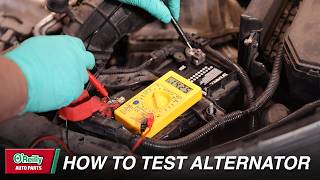
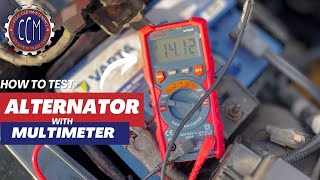
How to confirm: With the engine running, use a multimeter to measure the DC voltage at the battery terminals. A reading that is consistently above 15.0 volts (often climbing to 16V+) confirms an overcharging condition. Normal charging voltage should be between 13.2 and 14.8 volts. Perform this test with accessories (headlights, A/C) both on and off. 🎬 Watch: How to test your alternator with a multimeter
Typical fix: Replace the alternator assembly. 🎬 See this step-by-step 2012-2016 CR-V alternator replacement walkthrough It is also highly recommended to have the battery tested, as overcharging can permanently damage it by boiling the electrolyte.
Est. part cost: $200-$650
Rare But Worth Checking
- Poor Electrical Connections: While less common than a failed alternator, check for loose or corroded battery terminals, ground straps, or the main alternator B+ terminal connection before replacing parts. A poor connection can cause erratic voltage readings and, in some cases, trigger a high voltage code.
- Faulty Powertrain Control Module (PCM): → Shop Engine Control Module (ECM) This is extremely rare. The PCM could theoretically misinterpret voltage readings or fail internally, but the alternator should be ruled out with 100% certainty before considering the PCM as the cause.
- Short in Wiring Harness: A short to ground in the wiring between the PCM and the PGM-FI main relay can cause the relay to stick on, keeping the PCM powered even when the key is off. This can trigger a P0563 code after a 5-second delay.
Diagnosis Steps
- Verify the P0563 code is present using an OBD-II scanner and check for any other stored codes.
- With the engine off, check the battery voltage with a multimeter. A healthy, fully charged battery should read approximately 12.6 volts.
- Start the engine. Measure the DC voltage at the battery terminals again. Turn on accessories like headlights and the A/C blower to apply an electrical load.
- Observe the multimeter reading. If the voltage climbs and stays above 15.0 volts (often reaching 15.5V-17V), the alternator's voltage regulator has failed and the alternator needs to be replaced.
- If the voltage is normal (13.2-14.8V), the issue may be intermittent or related to wiring. Inspect all charging system wiring, including the main cable from the alternator to the battery, the alternator's 4-pin connector, and all major ground connections for corrosion, damage, or looseness.
- Check the PGM-FI main relay and its associated wiring for shorts or faults, as this is a rare but possible cause.
Parts You'll Likely Need
- Alternator
(OEM #31100-RX0-A01 (fits many 2012-2014 CR-V and 2012-2015 Civic Si models))— This is the primary cause of P0563, as the internal voltage regulator fails and causes the system to overcharge.
Trusted brands: Denso (OEM supplier), Bosch
OEM price range: $650-$970
Aftermarket price range: $200-$400 - Serpentine Belt
(OEM #31110-R5A-A01 (for 2012-2014 CR-V))— It is recommended to replace the serpentine belt whenever the alternator is replaced.
Trusted brands: Bando (OEM supplier), Gates, Continental
OEM price range: $40-$55
Aftermarket price range: $20-$35
Mechanic-Grade Diagnostic Values
- Charging system voltage under heavy load (High Output Mode) — expected: 13.5V - 14.9V. Failure: A reading consistently above 15.0V indicates a failed voltage regulator, triggering P0563. A reading below 13.2V would indicate a charging deficit (different issue).
- Charging system voltage under light load (Low Output Mode) — expected: 12.4V - 12.9V. Failure: A technician may misdiagnose this normal low voltage as a fault. However, for P0563, the voltage will be stuck high, not in this range.
- Battery Current Sensor Fuse — expected: Fuse #14 (10A) in the under-hood fuse box should have continuity.. Failure: A blown fuse will disrupt the PCM's ability to monitor the battery state, potentially causing incorrect charging commands. 🎬 Watch: Diagnosing a Honda CR-V that isn't charging correctly
Wiring & Ground Locations
- G101 — Main engine ground, typically located on the left rear of the engine block or on the thermostat housing.. This is a critical power and logic ground for the ECU/PCM. A poor connection here can cause a wide range of electrical issues, including erratic sensor readings and improper module function, although it's more commonly associated with no-start conditions.
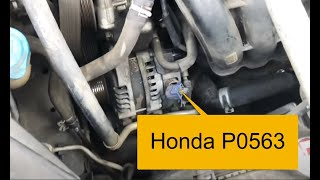
- Battery Current Sensor — Integrated into the negative battery terminal clamp.. This sensor provides crucial data to the PCM about the battery's state of charge. A faulty sensor can lead the PCM to command an incorrect charge rate. A 'Check Battery Sensor' message may also appear.
- Electrical Load Detector (ELD) — Typically located within the under-hood fuse/relay box.. The ELD measures the vehicle's total electrical draw, signaling the PCM to switch between high and low alternator output modes. A fault here (which may set its own codes like P1297/P1298) can disrupt proper charging control.
Real Owner Repair Stories
- Reddit user in r/Honda (Honda CR-V (model year unspecified, but relevant to platform)) — Battery light on, charging system fault.
❌ Tried (didn't work) Installing a cheap alternator purchased from eBay.
✅ What actually fixed it The user reported that the eBay alternator, while new, caused the battery light to remain on because it was stuck in low output mode and did not communicate correctly with the vehicle's computer. The implicit fix is to use a quality, compatible alternator. - Honda-Tech forum user (Honda (unspecified model, but with modern 'smart' alternator)) — Persistent battery light after alternator replacement.
❌ Tried (didn't work) Replacing the original alternator with a remanufactured unit from AutoZone.
✅ What actually fixed it After the remanufactured part failed to solve the issue, the user replaced it with a new alternator from the same parts store, which finally resolved the problem. The experience highlights the high failure/incompatibility rate of non-OEM remanufactured alternators on these systems.
OEM Part Supersession History
31100-5X6-J01RM→06311-5X6-505RM— Standard part number update for remanufactured alternator.
Heads up: This part is for 2015-2016 CR-V models and is not compatible with 2011-2014 models.
Model Year Variations Within This Range
- 2011-2014: These models (2011 3rd Gen, 2012-2014 4th Gen) primarily use the K24Z series engine. The correct alternator is OEM part number 31100-RX0-A01.
- 2015-2016: These facelifted 4th Gen models use the direct-injection K24W9 'Earth Dreams' engine with a CVT. The charging system was updated, and they require a different alternator, OEM part number 31100-5X6-J01. Using the alternator from an earlier model will not work.
Diagnostic Flowchart
Other Known Issues on This Vehicle
Issues unrelated to this code that are worth knowing about as an owner of this generation:
- VTC Actuator Rattle on Cold Start 🟠 Medium — Very common, especially on 2012-2014 models. A loud rattle for ~2 seconds on cold starts when temps are below 40°F. (Ref: Honda TSB 09-010 and TSB 16-012 address this issue. A class action lawsuit was also filed regarding this defect.)
- Excessive Oil Consumption 🔴 High — Common across this generation, attributed to low-tension piston rings. Some owners report adding a quart of oil every 1000-3000 miles. (Ref: Honda extended the warranty for this issue on some models due to sticking piston rings (related to TSB 12-087).)
- Intermittent No-Start / Failing Starter Motor 🟠 Medium — Frequently reported, especially on 2015-2016 models. Symptoms include a click with no crank, or requiring multiple pushes of the start button.
- Harsh Shifting (5-Speed Automatic) 🟡 Low — Affects 2011-2014 models with the 5-speed automatic. A noticeable harsh shift from 1st to 2nd gear is common. Often mitigated by regular transmission fluid changes.
- Failing Air Conditioning Compressor 🟠 Medium — A common failure point where the compressor clutch fails or internal components disintegrate, sending metal through the system and requiring expensive repairs.
Used vs. New Parts: Buying Guide for This Vehicle
When a used part is the smart pick: A used OEM Denso alternator from a low-mileage, documented donor vehicle can be a more reliable and cost-effective choice than a new, non-OEM aftermarket or 'white-box' remanufactured alternator from a chain parts store.
Donor-vehicle mileage cap: roughly under 80000 miles for the part to have meaningful remaining life.
What to inspect on the donor part:
- Ensure the donor vehicle was not in a severe front-end collision.
- Check for smooth, quiet rotation of the alternator pulley by hand (no grinding or roughness).
- Inspect the alternator housing for any signs of oil saturation from engine leaks, which is a common cause of premature failure.
- Verify the electrical connector pins are clean, straight, and free of corrosion.
OEM-only on this vehicle (don't cheap out):
- Alternator: Due to the PCM-controlled 'smart charging' system, forum consensus strongly recommends using only OEM (Denso) new or Denso-remanufactured alternators to ensure proper communication and avoid persistent issues.
Aftermarket brands forum-validated for this vehicle:
- Denso (New or Remanufactured)
- Bosch (New or Remanufactured)
Brands owners have reported issues with on this vehicle:
- Unbranded or generic 'value' alternators from chain auto parts stores or online marketplaces like eBay/Amazon have a high reported rate of out-of-box failure or incompatibility with Honda's charging system.
Real Owner Stories
Aggregated from forums and TSBs cited above. Mileages and costs reflect what owners reported in those sources.
2011-2016 Honda CR-V
Symptoms: Multiple threads discuss P0563 and similar charging system warnings.
What fixed it: Alternator replacement was the definitive fix.
Source hint: crvownersclub.com: Multiple threads discuss P0563 and similar charging system warnings, with owners confirming that alternator replacement was the definitive fix.
2015 Honda CR-V
Symptoms: Intermittent no-start issues.
What fixed it: Replacing the starter.
Source hint: reddit.com/r/crv: A user with a 2015 CR-V experienced intermittent no-start issues that were ultimately resolved by replacing the starter
Related OBD-II Codes
Frequently Asked Questions
Is there a TSB for the P0563 code on my 2011-2016 Honda CR-V?
Can I just replace the voltage regulator to fix the overcharging issue?
What is the recommended replacement alternator for a 2012-2014 CR-V?
Will a generic aftermarket alternator work to clear the P0563 code?
Could my 2015 CR-V's intermittent no-start issue be related to P0563?
What voltage reading confirms the alternator is failing on my CR-V?
Helpful Videos


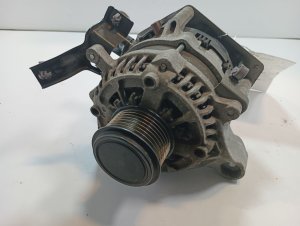
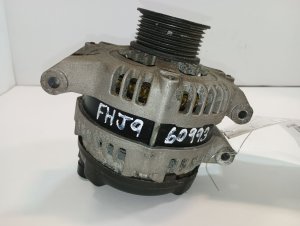
We Have This Part in Stock

The information in this article is provided for general reference and educational purposes only. Vehicle specifications, procedures, and part compatibility can vary by production date, trim level, and region. Always consult your vehicle's factory service manual and verify part numbers before purchasing or performing repairs. Safety-critical components such as airbags, seat belts, and braking systems should be installed by a qualified professional.
- Honda CR-V:
- 🧭 Diagnostic Flowchart
- 🎬 Helpful Videos
- 🛍️ Shop This Part
- What's Unique About the 2011-2016 Honda CR-V
- Symptoms You May Notice
- Most Likely Causes
- Rare But Worth Checking
- Diagnosis Steps
- Parts You'll Likely Need
- Mechanic-Grade Diagnostic Values
- Wiring & Ground Locations
- Real Owner Repair Stories
- OEM Part Supersession History
- Model Year Variations Within This Range
- Other Known Issues on This Vehicle
- Used vs. New Parts: Buying Guide for This Vehicle
- Real Owner Stories
- 2011-2016 Honda CR-V
- 2015 Honda CR-V
- Related OBD-II Codes
- Frequently Asked Questions
- 🎟️ Get 5% Off