

P0575 on 2006-2011 Cadillac STS: Cruise Circuit Fault and Network Issues Explained
On a 2006-2011 Cadillac STS, P0575 usually indicates a complex electrical or network problem, not just a bad cruise control switch. The issue is often linked to a wiring harness problem as described in GM Technical Service Bulletin #PIC4740E, which can cause multiple seemingly unrelated symptoms like cycling door locks and loss of communication with various modules.
- On the 2006-2011 STS, P0575 is a serious code that often signals a network-wide communication problem, not just a cruise control issue.
- Always perform a full-system scan for other codes. The presence of 'U' codes (communication codes) is a key indicator that the problem is not the cruise control switch.
- Refer to GM Technical Service Bulletin #PIC4740E, as it directly addresses the most likely cause: a fault in a main wiring harness.
- Due to the complexity of network diagnostics, this issue is best left to a professional technician with the proper tools and access to service information.
- Do not replace the cruise control switch or BCM without first performing a thorough diagnosis of the vehicle's wiring harnesses.
What's Unique About the 2006-2011 Cadillac STS
Unlike many vehicles where P0575 points directly to a faulty switch or clock spring, on the 2006-2011 STS it's a strong indicator of a deeper electrical issue. GM issued a Technical Service Bulletin (PIC4740E) that ties this code to a wide array of other communication codes across various modules like the TCM and ABS. The TSB specifically points to potential chafing of the wiring harness at a securing bracket or unseated pins in the transmission connector as the root cause. This disrupts the entire vehicle's communication network, leading to strange symptoms beyond just inoperative cruise control.
Diagnostic Flowchart
Tap your situation to follow the diagnostic path that matches what you're seeing on this vehicle.
Symptoms You May Notice
- Cruise control is inoperative or disengages randomly.
- Check Engine Light is illuminated.
- ABS or StabiliTrak/Traction Control warning lights may appear.
- Door locks may cycle on their own while driving.
- Scan tools may fail to communicate with the Transmission Control Module (TCM) or Engine Control Module (ECM).
- Vehicle may exhibit a no-crank condition. 🎬 Watch: Troubleshooting a no-crank and communication failure on an STS.
- Transmission may exhibit hard or erratic shifts.
- Replacing the cruise control switch without checking for other diagnostic codes. If multiple communication codes are present, the switch is almost never the root cause.
- Replacing the BCM without first thoroughly inspecting the wiring harness as detailed in TSB PIC4740E. The harness issue is more common and much cheaper to fix.
Most Likely Causes
- Wiring Harness Fault 🔴 High Probability As identified in TSB #PIC4740E, a specific wiring harness issue can cause widespread communication failures. The bulletin points to two primary failure points: unseated pins in the transmission connector (X1) or the harness chafing against a securing bracket. GM vehicles of this era can be prone to grounding issues and wiring faults due to corrosion or vibration.
How to confirm: A technician will perform a full vehicle code scan. If multiple 'U' codes are present with P0575, they will follow TSB PIC4740E. This involves disconnecting the transmission connector, carefully tugging each wire to ensure pins are seated, and inspecting the harness for chafing where it's secured by brackets.
Typical fix: Repairing the damaged section of the wiring harness or re-seating the pins in the transmission connector. This involves isolating the faulty wire(s), cutting out the damaged section, and splicing in new wire with sealed connectors, or using a terminal tool to properly seat loose pins.
Est. part cost: $10-$50 - Faulty Body Control Module (BCM) 🟡 Medium Probability → Shop Body Control Module The BCM is the central hub for body electronics, including cruise control signals. An internal failure can disrupt network communication or fail to process switch inputs, generating P0575. After ruling out the more common wiring issues, the BCM becomes a primary suspect.
How to confirm: After confirming the wiring harness and connectors are intact per the TSB, a technician will use a high-level scan tool to check for internal BCM faults and monitor its communication status on the CAN bus. They will also verify stable power and ground to the BCM.
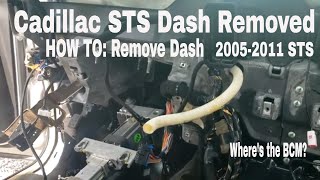
Typical fix: Replacement of the Body Control Module, which is located on the right-hand side of the dash. 🎬 See this walkthrough on how to access the BCM. The new module must be programmed by a dealer or qualified shop with the vehicle's VIN and specific options.
Est. part cost: $250-$500 - Faulty Cruise Control Switch ⚪ Low Probability → Shop Cruise Control Switch While a common cause on other vehicles, it's less likely on the STS when P0575 is accompanied by other network codes. Spilled liquids are a frequent reason for switch failure, causing the internal contacts to short out.
How to confirm: A technician can use a scan tool to monitor the switch status in the BCM's live data stream while pressing the buttons. If the status doesn't change and no other network codes are present, the switch or its direct wiring (including the clock spring) is likely faulty.
Typical fix: Replacement of the cruise control switch assembly on the steering wheel.
Est. part cost: $50-$150
Diagnosis Steps
- Perform a full vehicle scan with a professional-grade scan tool capable of reading codes from all modules (BCM, TCM, ABS, etc.).
- Record all stored Diagnostic Trouble Codes (DTCs).
- If P0575 is present along with multiple 'U' codes (e.g., U0073, U0100, U0121) and other module codes as listed in TSB #PIC4740E, prioritize diagnosing the network fault.
- Follow the diagnostic procedure outlined in TSB #PIC4740E. Disconnect the transmission connector X1 and carefully tug on each wire to ensure the pins are fully seated. Inspect the wiring harness for any signs of chafing, pinching, or corrosion, especially where it is held by securing brackets.
- If the harness and connectors are in good condition, check for stable power and ground connections at the BCM and TCM.
- If no other codes are present besides P0575, use the scan tool to monitor the live data for the cruise control switch inputs in the BCM. Verify that the BCM sees the signal change as you press each cruise control button.
- If the switch signals are not seen by the BCM, inspect the wiring between the switch (including the clock spring) and the BCM.
- If switch signals are correct, but the code persists, further diagnosis of the Body Control Module (BCM) itself is required.
Parts You'll Likely Need
- Wiring Repair Supplies — The most probable cause is a damaged wiring harness or loose connector pins, which are typically repaired rather than replaced.
Trusted brands: 3M
OEM price range: $10-$50
Aftermarket price range: $10-$50 - Body Control Module (BCM)
(OEM #25857315 (part number may vary by year and options, confirm with VIN))— If the wiring is intact, the BCM itself may have failed internally, causing the network disruption or inability to process the cruise signal.
Trusted brands: ACDelco, Dorman
OEM price range: $300-$500
Aftermarket price range: $200-$400 - Cruise Control Switch — A less common cause, but possible if P0575 appears alone. Failure is often due to contamination from spills.
Trusted brands: ACDelco, Duralast
OEM price range: $70-$150
Aftermarket price range: $50-$100
Related Codes That Often Appear With This One
- U0073 — Indicates Control Module Communication Bus 'A' Off, a general network failure often linked to the wiring issue in TSB PIC4740E.
- U0100 — Indicates Lost Communication With ECM/PCM, pointing to the network problem.
- U0121 — Indicates Lost Communication With Anti-Lock Brake System (ABS) Control Module, another symptom of the shared network fault.
- P0700 — Indicates a Transmission Control System Malfunction, often logged when the TCM loses communication with the ECM.
- C0561 — Relates to the StabiliTrak system being disabled, which can happen when communication is lost with necessary modules.
- U0140 — Indicates Lost Communication With Body Control Module, directly related to the network disruption.
Technical Service Bulletins (TSBs) & Recalls
- PIC4740E: Addresses a condition with multiple communication DTCs (including P0575), door locks cycling, and loss of module communication. Instructs technicians to inspect the transmission connector pins and check the harness for chafing at its securing bracket.
Platform-Specific Known Issues
- TSB PIC4740E - The Primary Culprit: TSB #PIC4740E is the most critical document for this issue. It explicitly states that a combination of communication DTCs (including P0575), cycling door locks, and no-start conditions can be caused by unseated pins in the transmission connector or a chafed harness. The fix is to inspect and repair these specific areas rather than replacing modules.
- Owner Experience: Chafed Harness Near Transmission: Multiple owners on forums report experiencing the exact cluster of symptoms from TSB PIC4740E. A common repair story involves a technician finding the main harness rubbing against a bracket near the transmission or engine block, causing wires to short. Repairing the chafed wires resolves the P0575 code and all associated communication errors.
Mechanic-Grade Diagnostic Values
- Cruise Control Switch State (Scan Tool Live Data) — expected: The GM cruise control switch uses a resistor ladder. A scan tool should display a unique state or voltage for each button press (On, Off, Set/Coast, Resume/Accel). For example, 'On' might be 5250 ohms, 'Resume/Accel' 2400 ohms, and 'Set/Coast' 1167 ohms. The key is seeing a distinct and correct change for each button function.. Failure: The value on the scan tool does not change when a button is pressed, or it shows an 'Invalid' or 'Fault' status. This indicates an open or short in the switch, clock spring, or wiring.
Scan Tool Commands That Help
- GM Tech 2 / GDS2: BCM Data Display -> Cruise Control Switch Status — This is the primary method to confirm if the BCM is receiving inputs from the steering wheel switches. It quickly isolates the problem to either the switch side (switch, clock spring, wiring) or the module/network side.
- GM Tech 2 / GDS2 with SPS: BCM Programming/Setup — Required after replacing the Body Control Module. The new BCM must be programmed with the vehicle's VIN, RPO codes (options), and security information to function. A setup procedure to sync with the airbag module (SDM) may also be necessary.
Wiring & Ground Locations
- BCM (Body Control Module) — Located in the passenger compartment, behind the right side of the instrument panel (behind the glove box).. The BCM is the module that directly interprets the cruise control switch signals before sending commands over the CAN bus. Its power, ground, and network connections are critical.
- Connector X1 (Transmission) — The main 16-pin round connector on the side of the transmission case.. This is the specific connector called out in TSB PIC4740E. Unseated pins or chafed wires leading to this connector can disrupt the high-speed CAN bus, causing P0575 and numerous other communication codes.
- G201 — A primary interior ground point located in the passenger compartment, behind the right-hand kick panel.. This ground serves multiple components in the right side of the dash, including the BCM. A poor connection here can cause erratic BCM behavior and network communication faults.
- G105 / G106 — Engine compartment grounds, typically on the frame rail or engine block, providing ground paths for the ECM and TCM.. A compromised engine/transmission ground can introduce electrical noise and voltage differentials, disrupting CAN bus communication between the critical powertrain modules and triggering network codes like U0100 and U0101.
Real Owner Repair Stories
- CadillacForums.com user report (2006 Cadillac STS) — Vehicle would not start, displayed multiple warnings including 'Service Stability System', 'Service Theft System', and numerous DTCs including P0575, U0100, U0101, U0121, and U0140.
❌ Tried (didn't work) Initial diagnosis was inconclusive, pointing to a general communication failure.
✅ What actually fixed it Following the guidance of TSB PIC4740E, the technician inspected the wiring harness near the transmission. They found a wire that had chafed through its insulation where it was rubbing against a metal bracket. Repairing the single damaged wire resolved all communication codes, including P0575, and the vehicle returned to normal operation.
OEM Part Supersession History
15262719, 15816761, 15934903→25857315— Part consolidation and revision by the manufacturer.
Heads up: This part was later discontinued by GM. When sourcing a replacement BCM, it is critical to match the part number or have it programmed to the vehicle's specific VIN and RPO codes to ensure all features work correctly.
Model Year Variations Within This Range
- 2008-2011: The 2008 model year received a significant refresh, including a new, more powerful direct-injection 3.6L V6 engine (LLT), a new six-speed automatic transmission, and revised exterior and interior styling. While the core electrical architecture and the relevance of TSB PIC4740E remained, these changes could lead to minor differences in harness routing, connector types, and module locations compared to the 2006-2007 models.
Helpful Videos


We Have This Part in Stock

The information in this article is provided for general reference and educational purposes only. Vehicle specifications, procedures, and part compatibility can vary by production date, trim level, and region. Always consult your vehicle's factory service manual and verify part numbers before purchasing or performing repairs. Safety-critical components such as airbags, seat belts, and braking systems should be installed by a qualified professional.
- Cadillac STS:
- 🧭 Diagnostic Flowchart
- 🎬 Helpful Videos
- 🛍️ Shop This Part
- What's Unique About the 2006-2011 Cadillac STS
- Symptoms You May Notice
- Most Likely Causes
- Diagnosis Steps
- Parts You'll Likely Need
- Related Codes That Often Appear With This One
- Technical Service Bulletins (TSBs) & Recalls
- Platform-Specific Known Issues
- Mechanic-Grade Diagnostic Values
- Scan Tool Commands That Help
- Wiring & Ground Locations
- Real Owner Repair Stories
- OEM Part Supersession History
- Model Year Variations Within This Range
- 🎟️ Get 5% Off