

P0601 on 2007-2014 Mercedes-Benz C-Class: ECU Memory Error Causes and Fixes
The P0601 code on a 2007-2014 Mercedes-Benz C-Class almost always means the Engine Control Module (ECM/ECU) has failed internally. The most common fix is to replace or repair the ECM, which is a costly procedure requiring professional programming.
- P0601 is a critical code indicating a fatal error within the Engine Control Module (ECM).
- Do not continue to drive the vehicle, as it is unsafe due to the risk of sudden engine stalling.
- While checking the battery and connections is a valid first step, the ultimate fix is almost always replacing or repairing the ECM.
- ECM replacement is an expensive repair that requires professional-level tools for programming the new unit to the car.
What's Unique About the 2007-2014 Mercedes-Benz C-Class
The 2007-2014 C-Class (W204 generation) uses sophisticated Bosch and Siemens engine control units, such as the Bosch ME9.7 in V6 models and the Siemens SIM271DE2.0 in 4-cylinder models. While generally reliable, a P0601 code on this platform is a serious indicator of an internal hardware or software failure within the module itself. Unlike some vehicles where this code can be triggered by simple issues, on a modern Mercedes-Benz, it strongly points to a definitive ECU fault that cannot be ignored.
Symptoms You May Notice
- Check Engine Light is on.
- Engine will not start, or is very difficult to start.
- Engine stalls intermittently or shuts down while driving.
- Vehicle enters 'limp mode,' with drastically reduced engine power.
- Poor or erratic engine performance and hesitation.
- ABS, ESP, and Traction Control warning lights may also illuminate simultaneously.
- Multiple, seemingly unrelated warning lights on the dashboard, such as for SRS, cruise control, or hood open.
- Replacing sensors or other engine components. The P0601 code is very specific to the control module itself. While other issues can cause similar drivability symptoms, the presence of P0601 strongly points to the ECM as the root cause.
Most Likely Causes
- Internal ECM Failure 🔴 High Probability Complex electronics can develop internal faults over time due to heat cycles, vibration, or component aging, leading to corruption of the non-volatile flash memory (EEPROM). The Bosch ME9.7 ECU, mounted directly on the V6 engines, is particularly susceptible to failure from engine heat.
How to confirm: After ruling out all other possibilities (power, ground, external wiring), the diagnosis points to the ECM. A professional may attempt to re-flash the software, but if it fails or the code returns, the module is confirmed bad.
Typical fix: The ECM must be replaced with a new or remanufactured unit and programmed to the vehicle. Alternatively, specialized services may be able to repair the original unit, often by cloning the data to a refurbished ECU.
Est. part cost: $800-$2000 - Low Battery Voltage or Charging System Fault 🟡 Medium Probability → Shop Vehicle Battery Modern Mercedes-Benz vehicles are highly sensitive to voltage. A weak battery or failing alternator can cause voltage spikes or drops during startup or operation that may corrupt the ECM's memory or trigger a false P0601 code.
How to confirm: Test the battery with a digital tester to check its state of health and cranking amps. With the engine running, measure alternator output; it should be between 13.5 and 14.5 volts.
Typical fix: Replace the weak battery or faulty alternator. Clear codes and see if P0601 returns.
Est. part cost: $200-$800 - Poor ECM Power/Ground Connections ⚪ Low Probability Corrosion or loose connections at the ECM, battery terminals, or chassis ground points can interrupt power to the module, causing internal errors.
How to confirm: Visually inspect the ECM connectors for corrosion or damage. Perform a voltage drop test on the ECM's power and ground circuits to ensure they are within specification (<0.1V on grounds, <0.5V on power feeds).
Typical fix: Clean or repair the corroded/loose connections. This may involve cleaning terminals or replacing a faulty wiring harness section or ground strap.
Est. part cost: $5-$300
Rare But Worth Checking
- Failed Software Re-flash: If the code appeared immediately after a failed attempt to update or tune the ECM software, the programming was likely interrupted or corrupted, causing the checksum error.
- Water Intrusion: If the vehicle has been in a flood or if water has leaked into the area where the ECM is located (often in the engine bay or plenum area), it can short-circuit the module and cause this code. On the W204, a common water entry point is a degraded wiper cowl grommet, allowing water to drip onto the main body harness and into the Front SAM/fuse box area.
Diagnosis Steps
- Verify the battery is fully charged (12.6V+) and the charging system is working correctly (13.5-14.5V when running). Use a battery support unit during diagnostics.
- Scan for any other trouble codes using a Mercedes-specific scanner (STAR/Xentry). Address any communication (U-codes) or power-related codes first.
- Inspect all power and ground connections to the ECM. Check for any signs of corrosion, damage, or looseness on the connectors and wiring harness.
- Check all relevant fuses for the ECM/powertrain system.
- If all external factors check out, the fault is internal to the ECM. A professional shop can attempt to re-flash the ECM with the latest manufacturer software, but this is often unsuccessful for P0601.
- If re-flashing is unsuccessful or the code returns immediately, the ECM is faulty and requires replacement or repair.
Parts You'll Likely Need
- Engine Control Module (ECM/ECU)
(OEM #Varies greatly by engine/year (e.g., A2721535691 for some M272 V6). Must be matched by VIN.)— This is the component that has failed internally, as indicated by the P0601 code. Replacement is the definitive fix.
Trusted brands: Bosch (e.g., ME9.7 for M272 V6), Siemens/Continental (e.g., SIM271DE2.0 for M271 I4), Genuine Mercedes-Benz
OEM price range: $1500-$2200
Aftermarket price range: $700-$1200 (Remanufactured/Repair Service)
Related Codes That Often Appear With This One
- P0600 — P0600 indicates a Serial Communication Link Malfunction. If the ECM is failing internally, it can disrupt its ability to communicate with other modules on the CAN bus network, triggering both codes.
- P0606 — P0606 indicates a more general ECM/PCM Processor Fault. These codes are closely related and both point to a catastrophic internal failure of the engine computer.
Platform-Specific Known Issues
- Recurring Multi-System Warning Lights: A failing ECU on a W204 can manifest as a cascade of seemingly unrelated warning lights, such as 'EBD, ABS, ESP inoperative' and 'Power steering malfunction'. One owner on MBWorld.org reported this exact issue, which would temporarily resolve after scanning the codes, only to return weeks or months later. This intermittent behavior, which eventually became permanent, was diagnosed as a faulty ECU requiring replacement.
Mechanic-Grade Diagnostic Values
- ECM/PCM Power Feed Voltage Drop — expected: < 0.5 Volts. Failure: A voltage drop greater than 0.5V indicates excessive resistance in the power supply circuit, which can starve the module of power.
- ECM/PCM Ground Circuit Resistance — expected: < 0.1 Ohms. Failure: Resistance greater than 0.1 Ohms points to a poor ground connection, which can cause floating voltages and logic errors within the ECU.
- Bosch ME9.7 Bench Test Power Supply — expected: Pin 2 (Ground), Pins 15 & 16 (+12V). Failure: No power or incorrect pin connection during bench testing will prevent communication.
- Bosch ME9.7 Bench Test CAN Bus Connection — expected: Pin 54 (CAN Low), Pin 41 (CAN High), with a 120-ohm resistor between them.. Failure: Incorrect CAN connections or a missing terminating resistor will prevent the ECU from communicating with diagnostic tools on the bench.
Scan Tool Commands That Help
- Mercedes Xentry/DAS: Initial Startup / SCN Coding — This is a mandatory procedure when installing a new or 'virginized' used ECU. It downloads vehicle-specific software from Mercedes servers and codes the ECU to the car's VIN and options.
- Specialized ECU Programmers (e.g., VVDI MB, Abrites, CGDI): Virginize / Renew — This function is used on a donor (used) ECU to erase its original VIN and security data, making it 'like new'. Once virginized, the ECU can be programmed to a different vehicle using Xentry's Initial Startup procedure.
- Specialized ECU Cloning Tools: ECU Cloning (Read/Write) — Used when the original ECU is faulty but still able to communicate. This process reads all data (VIN, immobilizer, software, coding) from the original ECU and writes it to a matching donor ECU, creating a plug-and-play replacement without the need for SCN coding.
- Mercedes Xentry/DAS: Control Unit Version — This function is used to identify the exact part number and software version of the installed ECU, which is critical information needed to source a compatible replacement or generate an SCN code.
Wiring & Ground Locations
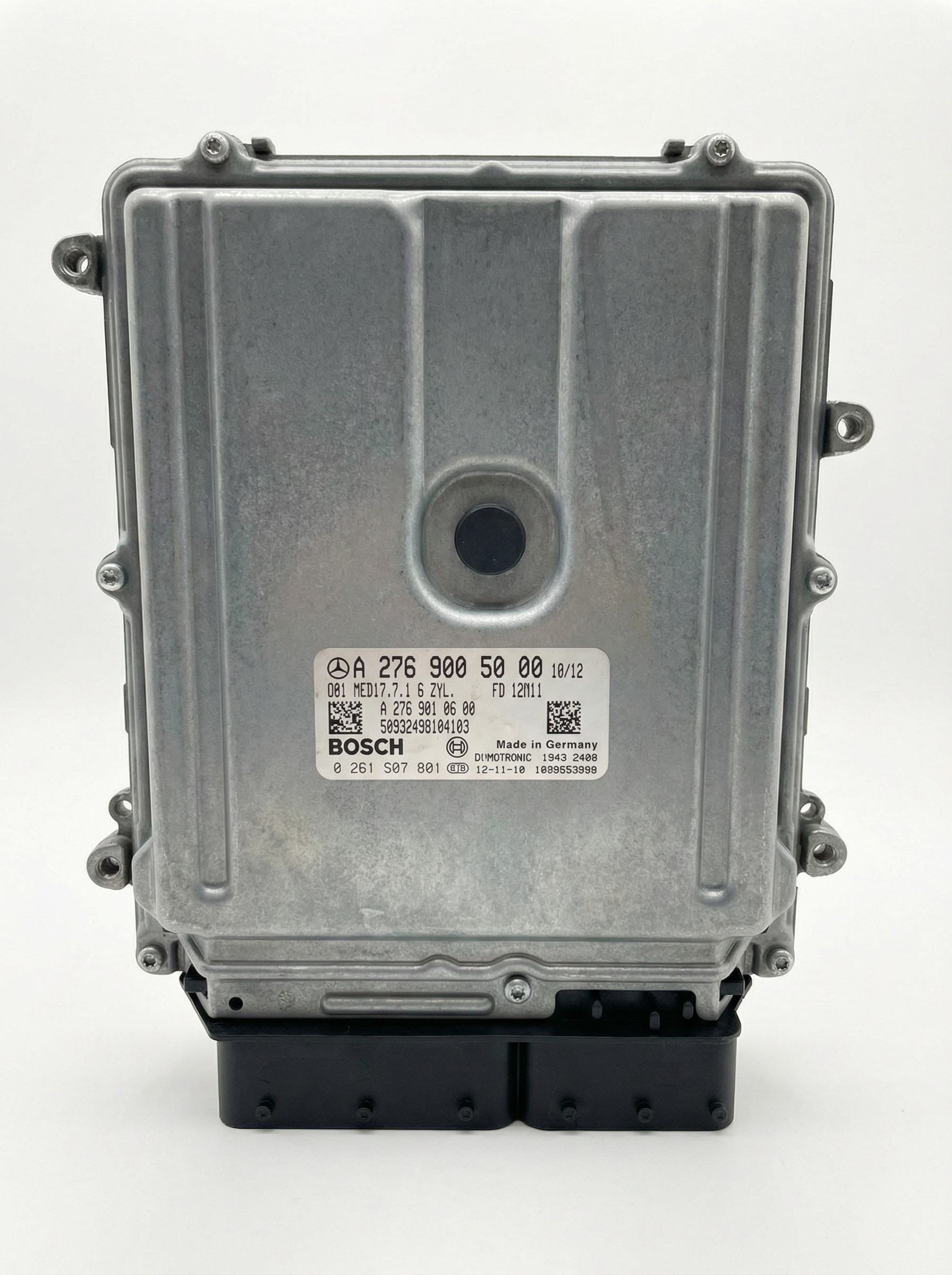
- ECU Location (V6 Engines) — Mounted directly on top of the engine, visible in a cutout of the plastic engine cover.. This location exposes the Bosch ME9.7 ECU to significant heat and vibration, a primary contributor to its eventual internal failure.
- Main Engine Ground Strap — Typically a braided cable running from the engine block/bell housing area to the chassis.. A corroded or loose main engine ground can cause unstable voltage supply to all engine electronics, including the ECU, potentially triggering a P0601.
- Main Chassis Ground Points — Key ground distribution points are located in the driver and passenger footwells, in the trunk near the rear SAM, and in the engine bay.. Water ingress in the cabin, a known W204 issue, can corrode these footwell ground points, leading to widespread electrical problems that can mimic or contribute to ECU failure.
- Front SAM (Signal Acquisition Module) — Located in the main fuse box in the engine compartment on the driver's side.. The Front SAM is a central hub for many electrical circuits. Water damage to the SAM, often from a leaking cowl, can cause erratic behavior and voltage issues that may affect the ECU.
Real Owner Repair Stories
- MBWorld.org Forums (Mercedes-Benz C63 AMG (W204)) — Car was dead, ECU was not communicating.
❌ Tried (didn't work) Attempting to order a new ECU from a discount dealer (was told it must be shipped to an authorized agent for a full-price service job)., Considering dealer replacement (estimated cost over $3,000).
✅ What actually fixed it The owner purchased a used ECU for ~$350 and paid a specialized service ~$200 to clone the data from the original (but dead) ECU. The cloned unit was plug-and-play and resolved the issue. The original ECU had a visible burnt spot from a failed capacitor.
Model Year Variations Within This Range
- 2007-2011 (Primarily V6 Models M272/M273): These years predominantly use the Bosch ME9.7 ECU, which is mounted directly on the engine. Its location makes it prone to heat-related failures, and the repair often involves cloning or virginizing a used unit.
- 2012-2014 (Primarily 4-Cylinder M271 EVO Turbo): Facelift models with the M271 engine use a Siemens SIM271DE2.0 ECU. While the P0601 code has the same meaning, the physical ECU and internal architecture are different, requiring specific cloning services or replacement parts for that module type.
Diagnostic Flowchart
Other Known Issues on This Vehicle
Issues unrelated to this code that are worth knowing about as an owner of this generation:
- Electronic Steering Lock (ESL) Failure 🔴 High — Extremely common on W204 models, often occurs after 80,000 km. Failure can be intermittent at first but will eventually lead to a permanent no-start condition. (Ref: No official recall, but a widely known failure. Repair involves replacing the lock mechanism or using an emulator.)
- Rear Subframe Corrosion/Failure 🔴 High — A significant number of W204 vehicles are affected, particularly in regions with road salt. Corrosion can occur from the inside out, leading to cracks or structural failure of the subframe. (Ref: Mercedes-Benz USA issued a warranty extension to 20 years/unlimited miles for replacement if perforation is found.)
- M272 V6 Balance Shaft Sprocket Wear 🔴 High — Affects early M272 V6 engines (approx. before 2008). The gear on the balance shaft wears prematurely, causing timing issues. Failure typically occurs between 100,000 and 150,000 km. (Ref: Subject of a class-action lawsuit. Repair is labor-intensive, requiring engine removal.)
- M271 I4 Engine Timing Chain Stretch 🟠 Medium — Common on the 1.8L Kompressor and early CGI (turbo) engines. The timing chain can stretch over time, causing rattling noises on startup and potential engine timing faults. Often noticed around 120,000-150,000 km.
- 7G-Tronic (722.9) Transmission Conductor Plate Failure 🟠 Medium → Shop Transmission Assembly — Common on pre-facelift models with the 7-speed automatic transmission. The conductor plate (which houses speed sensors and solenoids) fails, leading to harsh shifting, getting stuck in gear, or limp mode. Typically occurs between 100,000 and 180,000 km.
Used vs. New Parts: Buying Guide for This Vehicle
When a used part is the smart pick: A used ECU is a very smart and cost-effective choice for a P0601 repair, but ONLY if you use a cloning or virginizing service. A used ECU is NOT plug-and-play. If your original ECU is still readable, cloning its data to a matching used unit is the cheapest and easiest path. If the original is dead, a used ECU can be 'virginized' and then programmed to the car by a specialist with dealer-level tools.
Donor-vehicle mileage cap: roughly under 120000 miles for the part to have meaningful remaining life.
What to inspect on the donor part:
- Part numbers MUST match your original ECU exactly, or be a known compatible replacement.
- Source the donor ECU from a reputable recycler that guarantees it is a working, tested part.
- Avoid ECUs from flood-damaged or heavily wrecked vehicles.
- Inspect the connectors for any bent or corroded pins before purchase.
OEM-only on this vehicle (don't cheap out):
- For this repair, a NEW OEM ECU is the most expensive but most straightforward option if done at a dealership. However, a properly cloned used OEM ECU is a highly reliable alternative. There are no 'new aftermarket' ECUs for this application, only remanufactured OEM units.
Aftermarket brands forum-validated for this vehicle:
- ECU Cloning/Repair Services: Many online services (e.g., ECU Saver, Bimmerscan, DUDMD Tuning) have a strong reputation on forums for successfully cloning or repairing these specific Mercedes ECUs.
Brands owners have reported issues with on this vehicle:
- Avoid any service that cannot explicitly confirm compatibility with your specific ECU part number (e.g., Bosch ME9.7 or Siemens SIM271DE2.0).
Real Owner Stories
Aggregated from forums and TSBs cited above. Mileages and costs reflect what owners reported in those sources.
2009 Mercedes-Benz C180 (W204)
Symptoms: Recurring and simultaneous ABS, ESP, and power steering malfunction warnings. The issues would temporarily disappear after a diagnostic scan but would always return weeks or months later.
What fixed it: Replacement of the ECU as recommended by mechanics after the intermittent behavior became permanent.
Source hint: MBWorld.org Forums thread titled 'ECU Replacement ???'
2007-2014 Mercedes-Benz C-Class
Symptoms: Engine stalling issues and a P0601 code.
What fixed it: ECM replacement.
Cost: $1300-$1300
Source hint: Reddit r/MechanicAdvice thread titled 'ECM replacement, mechanic quoted me over $1300 , does that sound right?'
Related OBD-II Codes
Frequently Asked Questions
Is the Bosch ME9.7 ECU on my V6 C-Class known for failing due to heat?
Can a weak battery cause a P0601 code on my W204 Mercedes?
I'm seeing 'EBD, ABS, and ESP inoperative' along with P0601; are these related?
Is there a warranty extension for the rear subframe corrosion mentioned in the common issues?
Can I just re-flash my ECM to fix the P0601 internal checksum error?
Does the 2007-2014 C-Class share this ECU issue with other Mercedes models?
Helpful Videos
We Have This Part in Stock

The information in this article is provided for general reference and educational purposes only. Vehicle specifications, procedures, and part compatibility can vary by production date, trim level, and region. Always consult your vehicle's factory service manual and verify part numbers before purchasing or performing repairs. Safety-critical components such as airbags, seat belts, and braking systems should be installed by a qualified professional.
- Mercedes-Benz C-Class:
- 🧭 Diagnostic Flowchart
- 🎬 Helpful Videos
- 🛍️ Shop This Part
- What's Unique About the 2007-2014 Mercedes-Benz C-Class
- Symptoms You May Notice
- Most Likely Causes
- Rare But Worth Checking
- Diagnosis Steps
- Parts You'll Likely Need
- Related Codes That Often Appear With This One
- Platform-Specific Known Issues
- Mechanic-Grade Diagnostic Values
- Scan Tool Commands That Help
- Wiring & Ground Locations
- Real Owner Repair Stories
- Model Year Variations Within This Range
- Other Known Issues on This Vehicle
- Used vs. New Parts: Buying Guide for This Vehicle
- Real Owner Stories
- 2009 Mercedes-Benz C180 (W204)
- 2007-2014 Mercedes-Benz C-Class
- Related OBD-II Codes
- Frequently Asked Questions
- 🎟️ Get 5% Off