

P0601 on 2007-2009 Pontiac Torrent: Internal Control Module Failure Causes and Fixes
P0601 on a 2007-2009 Pontiac Torrent indicates a critical internal memory failure in a control module, most commonly the Engine Control Module (ECM) or Transmission Control Module (TCM). This is a serious fault that almost always requires replacing the faulty module and having it professionally programmed. Expect costs to range from $500 to over $1,200. It is crucial to determine which module is at fault before replacement.
- P0601 is a critical fault indicating the failure of a control module's internal memory.
- On a Pontiac Torrent, the fault could be in the Engine Control Module (ECM) or the Transmission Control Module (TCM); diagnosis is key.
- This is not a DIY repair; the fix requires replacing the faulty module and professional programming.
- Do not continue to drive the vehicle, as sudden stalling or unpredictable behavior is a major safety risk.
- Always check the battery, charging system, and all related power/ground connections first before condemning an expensive module.
What's Unique About the 2007-2009 Pontiac TORRENT
For the Pontiac Torrent and its GM Theta platform mates like the Chevrolet Equinox, P0601 is not just limited to the main engine computer (ECM). GM issued a specific Technical Service Bulletin (TSB #PIP4653E) advising technicians that this code could be stored in the Transmission Control Module (TCM). This is a crucial detail, as it means diagnostic efforts must include checking both the ECM and TCM to identify which module has failed. Forum discussions on the Chevrolet Equinox confirm that P0601 is frequently associated with TCM failure, sometimes appearing with code P0700 (Transmission Control System).
Diagnostic Flowchart
Tap your situation to follow the diagnostic path that matches what you're seeing on this vehicle.
Symptoms You May Notice
- Check Engine Light is on
- Service Stability System message may appear
- Engine may be hard to start or not start at all.
- Sudden engine stalling, sometimes while driving at highway speeds.
- Rough or erratic engine idling
- Harsh or unpredictable transmission shifting.
- Vehicle enters a reduced power "limp mode"
- Flashing gear selector indicator (e.g., 'D' flashes) on the instrument panel.
- Very slow or sluggish acceleration.
- Replacing sensors (like oxygen sensors or throttle position sensors) when the drivability issues are actually caused by the failing control module.
- Replacing the battery without also testing the alternator, which may be the root cause of voltage spikes that damaged the module.
- Immediately replacing the ECM without using a scan tool to verify if the code originated in the TCM instead.
Most Likely Causes
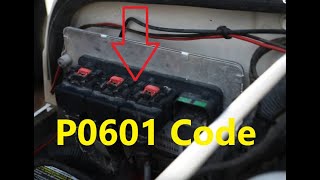
- Failed Engine Control Module (ECM) 🔴 High Probability → Shop Engine Control Module (ECM) Internal hardware failure due to age, heat cycles, and vibration is the most common cause for a P0601 code. Over time, components on the circuit board can fail, leading to memory checksum errors. 🎬 See this breakdown of common P0601 causes and fixes
How to confirm: After ruling out power/ground issues, a professional scan tool is used to confirm the P0601 code is originating from the ECM. If an attempt to reflash the software fails or the code returns immediately, the hardware is condemned. Sometimes a burnt smell near the ECM is an indicator of failure.
Typical fix: Replace the ECM and have the new unit professionally programmed to the vehicle's VIN. Several online retailers offer pre-programmed ECMs.
Est. part cost: $250-$600 - Failed Transmission Control Module (TCM) 🟡 Medium Probability → Shop Transmission Assembly GM TSB #PIP4653E specifically identifies the TCM as a possible source for the P0601 code on this vehicle platform. On the platform-mate Chevrolet Equinox, forum users frequently report P0601 in conjunction with transmission-related symptoms, pointing to the TCM as the culprit.
How to confirm: A professional scan tool is needed to check the TCM for fault codes. If P0601 is stored in the TCM (sometimes accompanied by P0700), it is the source of the problem.
Typical fix: Replace the TCM and have it programmed by a qualified technician. On some models, the TCM is part of the control solenoid valve assembly inside the transmission.
Est. part cost: $200-$500 - Low Battery Voltage or Charging System Issue ⚪ Low Probability → Shop Vehicle Battery GM vehicles of this era are known to be sensitive to voltage fluctuations. A weak battery or failing alternator can cause voltage spikes or drops that may corrupt a module's memory during startup, triggering a false P0601. TSB #05-06-04-060A notes that low voltage can set these types of codes.
How to confirm: Test the battery's health and voltage with a multimeter or load tester. With the engine running, check the alternator output, which should typically be between 13.5 and 14.5 volts.
Typical fix: Recharge or replace the weak battery. Replace the faulty alternator if voltage is out of range.
Est. part cost: $150-$400
Rare But Worth Checking
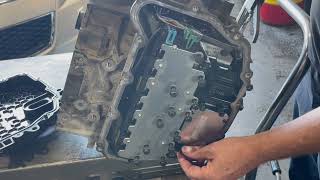
- Wiring Harness Issues: Poor power or ground connections to the ECM or TCM can sometimes mimic an internal module failure. It's worth inspecting the module connectors and main ground straps for corrosion or damage before replacing an expensive computer. A video for a platform-mate Equinox showed a P0601 was ultimately traced to a wiring problem at the TCM connector. 🎬 Watch: How to diagnose P0601 on a platform-mate Equinox
- Aftermarket Performance Tunes: Improperly installed or unauthorized aftermarket engine software (tunes/reflashes) can sometimes cause checksum errors and trigger a P0601 code.
Diagnosis Steps
- Check and confirm battery voltage is stable and above 12.4V with the engine off. Load test the battery to ensure it's healthy.
- Start the engine and verify the charging system is operating correctly (typically 13.5-14.5V).
- Inspect all power and ground connections to the ECM and TCM. Check the main battery terminals, chassis grounds, and the module connectors for cleanliness, tightness, and freedom from corrosion. Pay special attention to grounds G103, G107, G108, G109, and G111.
- Check all fuses related to the ECM and TCM. For a 2008/2009 Torrent, this includes the 'ECM BATT' fuse (33) in the underhood fuse block.
- Using a professional-grade scan tool (like a GM Tech 2 or GDS2), determine which module (ECM or TCM) has stored the P0601 code. This is the most critical step.
- If possible, attempt to have a professional reflash the software on the affected module. This is rarely a permanent fix for a P0601 but can rule out simple software corruption.
- If the code returns immediately after clearing or if the reflash fails, the module hardware is faulty.
- Replace the failed control module (ECM or TCM).
- The new module must be professionally programmed to your vehicle's specific VIN and configuration using appropriate tools and software.
- If the ECM was replaced, perform a 'Crankshaft Position Variation Relearn' (also known as CASE relearn) to prevent a P1336 code.
Parts You'll Likely Need
- Engine Control Module (ECM)
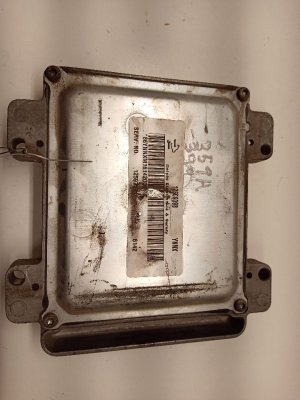
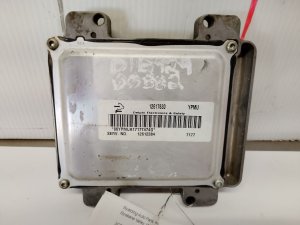
(OEM #12617568, 12612384, 12603892 (for 3.4L V6, numbers may be superseded))— This is the primary engine computer and the most common cause of a P0601 code.
Trusted brands: ACDelco (GM Original Equipment)
OEM price range: $400-$600
Aftermarket price range: $250-$450 - Transmission Control Module (TCM)
(OEM #24252114 (for Aisin 5-speed, may supersede older numbers))— A known cause for P0601 on this specific vehicle, as documented in GM TSB #PIP4653E and confirmed by owner experiences on platform-mates.
Trusted brands: ACDelco (GM Original Equipment)
OEM price range: $350-$500
Aftermarket price range: $200-$400
Related Codes That Often Appear With This One
- C0561 — An owner complaint (NHTSA ODI #10587134) shows this code appearing with P0601. C0561 on GM vehicles often means the ABS/Traction Control system has been disabled because it received invalid data from another module (like a failing ECM).
- P0700 — This is a generic code indicating the Transmission Control Module (TCM) has requested the Check Engine Light be turned on. It's a strong indicator that the P0601 code is stored in the TCM, not the ECM. This pairing is frequently reported on forums for the Chevrolet Equinox.
- P0603, P0604, P062F, P1621 — These are other internal module-related fault codes. TSBs #PIP4653E and #05-06-04-060A note that these codes can appear alongside P0601, all pointing toward a control unit problem.
- P1336 — This code for 'Crankshaft Position System Variation Not Learned' can appear after replacing the ECM. It indicates that a specific scan tool procedure, the 'CASE Relearn,' must be performed to synchronize the new ECM with the crankshaft position sensor.
Technical Service Bulletins (TSBs) & Recalls
- PIP4653E - Notes that P0601 may be stored in the Transmission Control Module.
- 05-06-04-060A - Communicates that P0601 can be a shared code among multiple modules and can be caused by low voltage.
Platform-Specific Known Issues
- TSB #PIP4653E: This bulletin informs technicians that P0601 can be set in the Transmission Control Module (TCM), causing the Malfunction Indicator Lamp to turn on.
- TSB #05-06-04-060A: This informational bulletin notes that P0601 is one of several DTCs that can be shared across multiple control modules and can be triggered by low voltage conditions.
- NHTSA ODI #10587134: A 2007 Torrent owner reported experiencing codes P0601 and C0561 simultaneously, indicating a failure of the main computer that also disabled the stability control system.
Mechanic-Grade Diagnostic Values
- Battery Voltage (Engine Off) — expected: >12.4 Volts. Failure: Voltage below 12.4V indicates a weak or discharged battery that can cause false module codes.
- Charging System Voltage (Engine Running) — expected: 13.5 - 14.5 Volts. Failure: Voltage outside this range indicates a faulty alternator or regulator, which can damage control modules.
- TCM Power Pin Voltage — expected: ~12 Volts (matches battery voltage). Failure: Low or no voltage indicates a wiring issue, blown fuse, or bad connection, not necessarily a bad TCM.
- TCM Ground Pin to Chassis Ground — expected: Continuity (near 0 Ohms resistance). Failure: High resistance or no continuity indicates a bad ground connection, a common cause of module communication errors.
Scan Tool Commands That Help
- GM Tech 2 / GDS2: Read DTCs from specific module (ECM, TCM) — This is the first and most critical diagnostic step. TSB #PIP4653E explicitly states to verify if P0601 is in the ECM or TCM before proceeding, as diagnostics differ.
- GM Tech 2 / GDS2: Crankshaft Position Variation Learn (CASE Relearn) — This procedure is required after replacing the Engine Control Module (ECM). Failure to perform it will often result in a P1336 DTC and may cause incorrect misfire detection.
- GM Tech 2 / GDS2: Module Reprogramming — Used to install the correct software and VIN into a new ECM or TCM. A new, unprogrammed module will not function correctly and can cause a no-start or no-throttle-response condition.
Wiring & Ground Locations
- ECM Location — Mounted on top of the battery cover in the engine compartment.. This is the physical location of the Engine Control Module. Its proximity to the battery makes checking for corrosion on terminals and connectors essential.
- TCM Location — At the left rear corner of the engine compartment.. This is the location of the Transmission Control Module. Knowing its location is necessary for inspecting its connectors and wiring harness for damage or corrosion.
- G111 (3.4L V6) — On the rear of the engine, near the crankshaft position sensor.. This is a primary engine ground. A poor connection here can cause a wide range of electrical issues, including module communication problems that could potentially trigger a P0601.
- G107 / G108 / G109 (3.6L V6) — Located on the upper left side (G107), upper right rear (G108), and upper right front (G109) of the engine.. These are the main engine ground points for the 3.6L V6. Verifying they are clean and tight is a critical step before condemning an expensive control module.
- G103 — At the left side of the engine compartment, below the coolant and washer reservoirs.. This is a major chassis ground point in the engine bay. Corrosion or looseness here can affect multiple systems, including the ECM and TCM.
- Underhood Fuse Block — Located on the left side of the engine compartment.. This block contains fuses that supply power to the ECM and TCM, such as the 'ECM BATT' fuse. A blown fuse will cause a no-communication or no-power situation that must be ruled out.
Real Owner Repair Stories
- Chevy Equinox Forum (2011 Chevrolet Equinox (platform mate)) — Vehicle enters limp mode after 20 minutes of driving. Codes P0700 and P0601 present.
❌ Tried (didn't work) Replacing the TCM with a new, unprogrammed unit.
✅ What actually fixed it The owner discovered that a new TCM must be professionally programmed to the vehicle's VIN using a dealer-level scan tool. The part replacement alone was not enough and resulted in a no-throttle-response condition until programming was completed. - Codemansauto on YouTube (Chevrolet Equinox (platform mate)) — P0601 code present.
❌ Tried (didn't work) Initially suspecting the TCM itself had failed.
✅ What actually fixed it The issue was a damaged electrical connector plug at the TCM. After repairing the plug and ensuring all pins were making good contact, the code was resolved without replacing the module.
OEM Part Supersession History
12612384, 12603892→12617568— Standard part revision and consolidation by the manufacturer. Newer part numbers often contain updated software or hardware to address known issues.
Heads up: Part number 12617568 is listed as a direct replacement for 12612384. However, it must be programmed with the vehicle's specific VIN and software to function.24234503, 24239224→24252114— Part revision by the manufacturer for the Transmission Control Module.
Heads up: This part requires professional programming and/or special setup procedures after installation, as described in GM Service Information. It is not a plug-and-play part.
Model Year Variations Within This Range
- 2007-2009: The primary difference affecting this code is the engine (3.4L V6 vs 3.6L V6), which use different ECMs and have different engine ground point locations (G111 for 3.4L vs G107/108/109 for 3.6L). Diagnostic procedures must account for the specific engine installed.
Helpful Videos
Used OEM Parts in Stock
New Aftermarket Parts Available



The information in this article is provided for general reference and educational purposes only. Vehicle specifications, procedures, and part compatibility can vary by production date, trim level, and region. Always consult your vehicle's factory service manual and verify part numbers before purchasing or performing repairs. Safety-critical components such as airbags, seat belts, and braking systems should be installed by a qualified professional.
- Pontiac TORRENT:
- 🧭 Diagnostic Flowchart
- 🎬 Helpful Videos
- 🛍️ Shop This Part
- What's Unique About the 2007-2009 Pontiac TORRENT
- Symptoms You May Notice
- Most Likely Causes
- Rare But Worth Checking
- Diagnosis Steps
- Parts You'll Likely Need
- Related Codes That Often Appear With This One
- Technical Service Bulletins (TSBs) & Recalls
- Platform-Specific Known Issues
- Mechanic-Grade Diagnostic Values
- Scan Tool Commands That Help
- Wiring & Ground Locations
- Real Owner Repair Stories
- OEM Part Supersession History
- Model Year Variations Within This Range
- 🎟️ Get 5% Off