

P0602 on 2007-2010 Saturn Outlook: Control Module Programming Error Causes and Fixes
P0602 on a 2007-2010 Saturn Outlook indicates a programming error within the Engine Control Module (ECM). This is a serious fault that often requires professional diagnosis. The most common fix is reprogramming the ECM, but a weak battery or poor electrical connections should be checked first. If reprogramming fails, the ECM must be replaced.
- P0602 is a critical error in the Engine Control Module's software; do not continue to drive the vehicle.
- This is not a DIY repair. The fix requires professional-level tools to reprogram or replace the ECM.
- Before paying for a new ECM, insist that your mechanic thoroughly tests the battery, alternator, and all main power/ground connections, as electrical issues are a common trigger for this code on the Lambda platform.
- If the ECM needs replacement, ensure the new unit is programmed with your vehicle's specific VIN and that a CASE relearn procedure is performed.
What's Unique About the 2007-2010 Saturn Outlook
The Saturn Outlook is part of the GM Lambda platform, sharing its core electronics and the E38 ECM with the 2007-2010 Buick Enclave, GMC Acadia, and Chevrolet Traverse. The control modules on this platform are known to be extremely sensitive to voltage fluctuations. A P0602 code is often a secondary symptom caused by an underlying electrical issue, such as a weak battery, failing alternator, or a poor ground connection, which can corrupt the ECM's memory during startup or a failed update attempt. Specific ground points known to cause issues on this platform when corroded or loose include G101 (driver's side frame rail), G103 (cowl near brake booster), and G113 (engine-to-transmission stud).
Symptoms You May Notice
- Check Engine Light is on
- Engine will not start, but may crank
- Engine stalls or idles roughly
- Reduced engine performance or 'limp mode'
- Harsh or erratic automatic transmission shifting
- Decrease in fuel economy
- "Engine Hot, A/C Off" message on dash despite a cold engine (often related to water intrusion)
- Intermittent loss of communication with other modules, leading to various warning lights
- Replacing sensors or other components without first verifying the ECM's integrity and its power/ground supply. The code points directly to a module programming issue, not a sensor fault.
- Immediately replacing the ECM without first performing a thorough battery/charging system test and a voltage drop test on the ECM power and ground circuits. Unstable voltage is the leading cause of this code on GM platforms.
Most Likely Causes
- Weak or Failing Battery 🔴 High Probability → Shop Vehicle Battery GM control modules of this era, particularly the E38 ECM, are highly sensitive to low voltage. A weak battery can cause data corruption in the ECM during the high current draw of engine cranking. This is the most common and cheapest potential fix and should always be the first check.
How to confirm: Test the battery with a digital multimeter or a professional load tester. A healthy, fully charged battery should read approximately 12.6 volts with the engine off and 13.7-14.7 volts with the engine running. Any reading below 12.4V engine-off suggests a weak battery that needs charging and re-testing.
Typical fix: Replace the vehicle's battery. Ensure the new battery is fully charged before installation.
Est. part cost: $150-$250 - Corrupted ECM Software 🟡 Medium Probability Can be caused by an interrupted software update (e.g., at a dealership), a failed aftermarket tune, or voltage drops during a flash. Attempting to flash an incompatible operating system (e.g., from a different model year) can also 'brick' the ECM.
How to confirm: This is diagnosed by attempting to re-flash the ECM with the correct factory software. If the procedure completes successfully and the code does not return, the software was the issue.
Typical fix: Reprogram the ECM using a GM-specific scan tool (MDI/MDI2) and a subscription to their Service Programming System (SPS). This must be done by a qualified shop or dealer. A stable power supply (battery maintainer) must be connected during this process.
Est. part cost: $0 (Labor cost only, typically $150-$300) - Internal ECM Failure 🟡 Medium Probability The E38 ECM is mounted in the engine bay, where it is subject to heat and vibration that can cause internal solder joints to fracture over time, leading to intermittent failures.
How to confirm: If reprogramming the ECM fails repeatedly or the code returns immediately, and all power/ground circuits test good with a voltage drop test, the ECM itself has failed internally. This is a diagnosis of exclusion.
Typical fix: Replace the Engine Control Module. The new module must be programmed to the vehicle's VIN.
Est. part cost: $200-$500 - Poor Power or Ground Connections ⚪ Low Probability Corrosion on the Lambda platform is common. Key grounds like G101 (frame rail) or engine-to-chassis straps can degrade, causing unstable voltage to the ECM and other modules. In one documented case on a Traverse, a corroded ground at the B-pillar (G302) caused bizarre electrical issues that were resolved by cleaning the connection.
How to confirm: Visually inspect and test the main battery cables, ground straps from the engine to the chassis, and the wiring harness connectors at the ECM for corrosion, damage, or looseness. Perform a voltage drop test on the power and ground circuits to the ECM to confirm their integrity under load.
Typical fix: Clean the contact points to bare metal, tighten, or replace the faulty cables, connectors, or ground straps.
Est. part cost: $20-$100
Rare But Worth Checking
- Water Intrusion from Clogged Sunroof Drains:
Diagnosis Steps
- Scan the vehicle for all DTCs in all modules. Note any other codes present, especially U-codes or other P060x codes.
- Check the battery. Perform a full battery health test, including a load test. Ensure voltage is stable (above 12.4V engine off, 13.7-14.7V engine on). A battery maintainer should be used for all further diagnostics and programming.
- Inspect all power and ground connections. Check the battery terminals for corrosion and tightness. Visually inspect and physically tug on the main engine and chassis ground straps for integrity. Key locations are G101, G103, and G113.
- Verify ECM power and ground. Using a wiring diagram, check for proper voltage and clean grounds directly at the ECM connector pins. Perform a voltage drop test on these circuits to ensure they can carry a load.
- Check for water intrusion. Inspect the passenger-side floor and fuse block area for any signs of moisture from clogged sunroof drains.
- Attempt to reprogram the ECM. If all power and grounds are good, the next step is to have a qualified technician attempt to re-flash the ECM with the latest GM software using an SPS subscription and a J2534 device.
- If reprogramming fails or the code immediately returns, the ECM is faulty and must be replaced. The new ECM will also require programming to the vehicle's VIN and a subsequent CASE relearn.
Parts You'll Likely Need
- Engine Control Module (ECM)
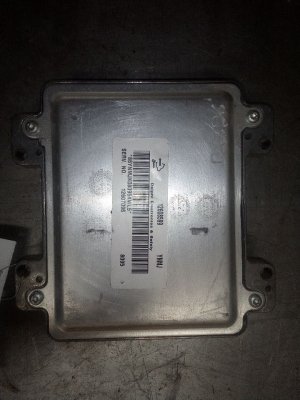
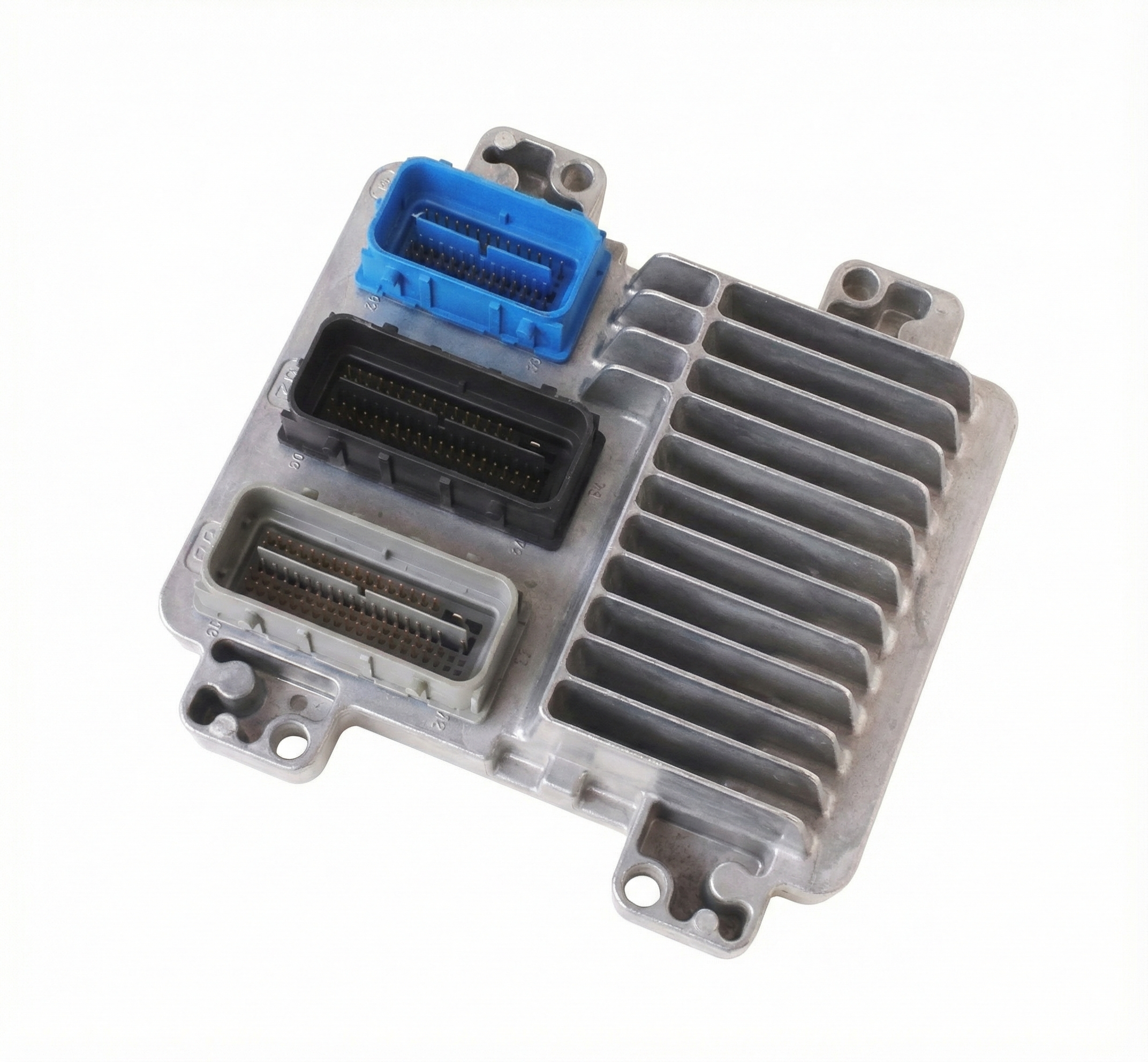
(OEM #12635019, 12623325 (superseded))— This is the part that stores the vehicle's operating software. If it fails internally or cannot be reprogrammed, it must be replaced. This is an ACDelco E38 type module.
Trusted brands: ACDelco (OEM), Cardone (Remanufactured), BSE, FS1 (Flashmasters)
OEM price range: $350-$500
Aftermarket price range: $200-$350
Related Codes That Often Appear With This One
- P0601 — This code means 'Internal Control Module Memory Check Sum Error' and, like P0602, indicates a critical internal failure of the ECM.
- U0100 — This code for 'Lost Communication With ECM/PCM' is often set in other modules (like the TCM or BCM) when the ECM fails internally and stops communicating on the vehicle's data network.
- P0606 — This code indicates an 'ECM/PCM Processor Fault' and points to a similar internal hardware failure within the main computer.
Technical Service Bulletins (TSBs) & Recalls
- TSB #05-06-04-060A: This is a general GM bulletin that acknowledges that codes like P0601, P0602, etc., can be set across multiple modules (ECM, TCM, FPCM). It advises technicians to be cautious and use proper diagnostics to identify which module has set the code before replacing any parts.
- TSB #21-NA-106: While newer, this TSB highlights an issue on Lambda platforms where a P0602 in the TCM may not appear to clear. This is because the module needs to enter a 'sleep' state, which requires turning the ignition off and keeping the key fob at least 10 feet away for a minimum of 10 minutes. This illustrates the platform's electrical sensitivity.
- Bulletin #05-06-04-060A: This manufacturer informational bulletin communicates information to technicians on control module Diagnostic Trouble Code(s) (DTC)(s) P0601, P0602, P0603, P0604, P0606, P062F, P06F3, and P1621 which can be shared in multiple modules.
Platform-Specific Known Issues
- Fuse Block Power Feed Interruption: On some Lambda platform vehicles, poor terminal tension in the underhood fuse block can cause an intermittent power supply to the ECM. This can corrupt the software and trigger a P0602 code, leading to failed reprogramming attempts and misdiagnosis of a bad ECM. The fix is to repair the fuse block connection, not replace the computer.
- Water Leak Causing Electrical Havoc: An owner of a related Lambda platform vehicle reported that clogged sunroof drains led to water damaging the in-cabin fuse block, causing a cascade of electrical problems that mimicked a primary ECM failure.
Mechanic-Grade Diagnostic Values
- ECM Power and Ground Verification via Voltage Drop Test — expected: Less than 0.2 volts (200mV) drop on power and ground circuits between the source (battery) and the ECM connector pin while the circuit is under load (e.g., key on).. Failure: A voltage drop greater than 0.2-0.3 volts indicates high resistance in the wiring or connections, which can cause the ECM to malfunction and set a P0602.
- ECM Connector X1, Pin 20 (Battery Positive Voltage) — expected: Should match battery voltage (approx. 12.6V with key off).. Failure: Low or no voltage indicates a problem with the main power feed to the ECM, potentially a fuse, relay, or wiring issue.
- ECM Connector X1, Pin 19 (Ignition 1 Voltage) — expected: Should show battery voltage only when the ignition key is in the 'ON' or 'RUN' position.. Failure: No voltage when the key is on indicates a fault in the ignition switch circuit supplying power to the ECM.
Hidden / Shadow Codes Worth Checking
- Symptom Bytes: GM often appends a two-character hexadecimal code (e.g., P0602 00) to the primary DTC. This 'symptom byte' provides more specific detail about the nature of the fault (e.g., component failure, signal invalid, etc.). While a specific byte for P0602 isn't universally documented, its presence can guide a technician toward a more precise diagnosis. (see via These codes are not visible on basic OBD-II scanners. They require a professional-level tool like a GM Tech 2 or a modern equivalent running GDS2 (Global Diagnostic System 2) software.)
Scan Tool Commands That Help
- GM Tech 2 / GDS2: Service Programming System (SPS) — This is the primary function used to fix a P0602. It allows a technician to connect to GM's servers and flash the ECM with the correct, VIN-specific factory software. This is required after installing a new or used ECM, or to fix software corruption on the existing one.
- GM Tech 2 / GDS2: CASE Relearn (Crankshaft Position System Variation Learn) — This procedure must be performed after the ECM has been reprogrammed or replaced. It calibrates the ECM to the minor variations in the crankshaft position sensor reluctor wheel, ensuring accurate misfire detection. Failure to perform this will often result in a separate trouble code.
- GM Tech 2 / GDS2: Immobilizer Relearn / Add Key — When a replacement (especially used) ECM is installed, it may not recognize the vehicle's anti-theft key data stored in the Body Control Module (BCM). Performing a key relearn or security relearn procedure syncs the modules, allowing the vehicle to start.
Wiring & Ground Locations
- G101 — Located on the left (driver's side) frame rail in the engine compartment.. This is a primary chassis ground. Corrosion here can cause unstable voltage to multiple components, including the ECM, leading to data corruption.
- G103 — Located on the cowl/firewall in the left rear of the engine compartment, often near or above the brake booster.. This ground serves numerous modules, including the BCM and Instrument Panel Cluster (IPC). A fault here can cause widespread communication errors that can be mistaken for a primary ECM failure.
- G113 — Located on the left side of the engine, at a stud where the engine and transmission are joined.. This is a critical engine-to-transmission ground point. A poor connection here can directly impact ECM and TCM operation.
- ECM Connector X1 — The E38 ECM is located in the engine bay. X1 is one of the two main connectors (the other being X2).. This is where to perform direct pin-to-pin testing for power and ground. Key pins include Pin 19 (Ignition Voltage), Pin 20 (Battery Voltage), and various ground pins which can be found on a pinout chart.
Real Owner Repair Stories
- Paraphrased from a detailed YouTube repair on a 2011 Chevy Equinox (similar GM architecture) (2011 Chevrolet Equinox) — Intermittent no-start, no-crank condition. When the fault occurred, there was a 'Lost Communication with ECM' code and the ECM was completely unresponsive on the data network.
❌ Tried (didn't work) Initial diagnosis of powers and grounds to the ECM showed no issues; the wiring was fine.
✅ What actually fixed it The intermittent nature pointed to an internal ECM failure. The ECM was replaced with a used, pre-programmed unit from Flagship One (FS1). After installation, an immobilizer relearn (by performing an 'Add Key' function with an Autel scanner) and a CASE relearn were required to sync the new ECM with the vehicle and allow it to start. The problem was resolved.
OEM Part Supersession History
Various (e.g., 12623325)→Various (e.g., 12635019)— Standard part updates for hardware revisions and reliability improvements by ACDelco.
Heads up: The critical incompatibility is not between part numbers, but between a used ECM and a new vehicle. A used E38 ECM is locked to the donor vehicle's VIN and security environment. Installing it in another vehicle without 'virginizing' or correctly reprogramming it with GM's SPS software will result in a no-start condition and may set additional anti-theft codes.
Model Year Variations Within This Range
- 2007-2008: These models use the 3.6L LY7 V6 engine with traditional Port Fuel Injection (PFI). The E38 ECM calibration is specific to this fuel system.
- 2009-2010: These models switched to the 3.6L LLT V6 engine with Gasoline Direct Injection (GDI). While it still uses an E38 ECM, the software is entirely different to control the high-pressure fuel pump, direct injectors, and other unique engine parameters. A P0602 fault on a 2009+ model relates to a GDI calibration, and the ECMs are not interchangeable with earlier years.
Diagnostic Flowchart
Other Known Issues on This Vehicle
Issues unrelated to this code that are worth knowing about as an owner of this generation:
- Premature Timing Chain Stretch 🔴 High — Very common, often occurs between 60,000 and 100,000 miles. Exacerbated by original long oil change intervals. (Ref: Special Coverage Adjustment #11340C (now expired); TSB #12-06-01-009F.)
- 6T75 Transmission 3-5-R Wave Plate Failure 🔴 High → Shop Transmission Assembly — Common failure leading to loss of 3rd, 5th, and Reverse gears. Can occur as early as 30,000 miles but more common around 70,000-120,000 miles. (Ref: Special Coverage Adjustment #14404B (now expired).)
- Sunroof Drain Leaks 🟠 Medium — Widespread issue where drain tubes clog or detach, causing water to leak into the cabin, often damaging the fuse block, BCM, or causing mold. (Ref: Multiple TSBs exist for diagnosis and repair, such as correcting hose routing.)
- Power Steering Pump/Rack Failure 🟠 Medium — Failures of the power steering pump (whining noise) or steering rack (leaks, binding) are frequently reported by owners.
- Cracked Engine Block (2010 models) 🔴 High — A subset of 2010 models with the LLT engine experienced porous engine block castings, leading to coolant loss and potential engine failure. Less common than timing chain issues but catastrophic.
Used vs. New Parts: Buying Guide for This Vehicle
When a used part is the smart pick: A used ECM is a viable and cost-effective option ONLY if purchased from a reputable rebuilder or service (like Flashmasters/FS1, PCMofNC) that can either clone your original ECM's data or pre-program the used unit with your vehicle's specific VIN and software calibration before shipping. A simple junkyard swap will not work.
Donor-vehicle mileage cap: roughly under 150000 miles for the part to have meaningful remaining life.
What to inspect on the donor part:
- No physical damage to the case or connectors.
- No signs of water damage or corrosion on the pins.
- Ensure the part number is compatible with your model year (LY7 vs. LLT engine).
OEM-only on this vehicle (don't cheap out):
- ECM Programming: The software flash itself MUST be done with genuine GM Service Programming System (SPS) software. There is no reliable aftermarket alternative for the core operating system flash.
Aftermarket brands forum-validated for this vehicle:
- Cardone (Remanufactured)
- FS1 / Flashmasters (Remanufactured, Pre-programmed)
- PCM of NC (Programming Service)
Brands owners have reported issues with on this vehicle:
- Unbranded, non-programmed 'used' modules from marketplaces like eBay or Amazon without a clear programming service and warranty. These are likely to be locked to the donor car and will not function.
Real Owner Stories
Aggregated from forums and TSBs cited above. Mileages and costs reflect what owners reported in those sources.
2008 Saturn Outlook
Symptoms: Clogged or poorly designed sunroof drains led to water leaking into the cabin and dripping on the fuse box, causing a host of bizarre electrical problems.
What fixed it: Clearing clogged sunroof drains and addressing water intrusion at the fuse box.
Source hint: Edmunds Forum: Sunroof leak on my Saturn Outlook
2008 Buick Enclave 3.6L
Symptoms: P0602 code appeared immediately after installing a new PCM.
What fixed it: Using specialized shop equipment to flash the VIN and program the module, as the code indicated the unit was 'not programmed'.
Source hint: Mechanics Stack Exchange: Programming error Buick Enclave 2008
2007-2010 Saturn Outlook
Symptoms: Intermittent power supply to the ECM and failed reprogramming attempts, leading to a potential misdiagnosis of a bad ECM.
What fixed it: Repairing poor terminal tension in the underhood fuse block power feed rather than replacing the computer.
Source hint: vehicle_specific_issues: Fuse Block Power Feed Interruption
Related OBD-II Codes
Frequently Asked Questions
Can I fix the P0602 code on my Saturn Outlook by just swapping in a used ECM from a junkyard?
Why does my Outlook show an 'Engine Hot, A/C Off' message when the engine is actually cold?
Is there a specific TSB for the Saturn Outlook regarding modules that won't clear the P0602 code?
Could a weak battery really be the cause of a P0602 control module error?
I heard water leaks can cause ECM codes on the Outlook; where should I check?
What is the risk of using an aftermarket tune on my 2007-2010 Outlook?
Helpful Videos
We Have This Part in Stock

The information in this article is provided for general reference and educational purposes only. Vehicle specifications, procedures, and part compatibility can vary by production date, trim level, and region. Always consult your vehicle's factory service manual and verify part numbers before purchasing or performing repairs. Safety-critical components such as airbags, seat belts, and braking systems should be installed by a qualified professional.
- Saturn Outlook:
- 🧭 Diagnostic Flowchart
- 🎬 Helpful Videos
- 🛍️ Shop This Part
- What's Unique About the 2007-2010 Saturn Outlook
- Symptoms You May Notice
- Most Likely Causes
- Rare But Worth Checking
- Diagnosis Steps
- Parts You'll Likely Need
- Related Codes That Often Appear With This One
- Technical Service Bulletins (TSBs) & Recalls
- Platform-Specific Known Issues
- Mechanic-Grade Diagnostic Values
- Hidden / Shadow Codes Worth Checking
- Scan Tool Commands That Help
- Wiring & Ground Locations
- Real Owner Repair Stories
- OEM Part Supersession History
- Model Year Variations Within This Range
- Other Known Issues on This Vehicle
- Used vs. New Parts: Buying Guide for This Vehicle
- Real Owner Stories
- 2008 Saturn Outlook
- 2008 Buick Enclave 3.6L
- 2007-2010 Saturn Outlook
- Related OBD-II Codes
- Frequently Asked Questions
- 🎟️ Get 5% Off