

P0603 on 2007-2011 Buick Lucerne: Keep Alive Memory (KAM) Error Causes and Fixes
On a 2007-2011 Buick Lucerne, code P0603 almost always indicates a power supply interruption to the engine's computer, most commonly from a weak battery or after a battery replacement. The battery is located under the rear seat, making it difficult to inspect. Before suspecting a faulty computer, test the battery and check its connections. A new battery costs around $150-$250.
- P0603 on a Buick Lucerne is almost always caused by a power supply issue, not a faulty computer.
- Always test the battery, clean the terminals, and check ground connections before considering any other repairs. Remember the battery is under the rear seat.
- If you recently disconnected or replaced the battery, the code is normal. Clear it with a scanner and drive the car to let the computer relearn.
- Do not replace the PCM unless all other possibilities have been completely ruled out by proper diagnosis.
What's Unique About the 2007-2011 Buick LUCERNE
For this generation of Buick Lucerne and its platform-mate, the Cadillac DTS, P0603 is often considered an informational code rather than a sign of a hard fault. It frequently appears after the battery has been disconnected for service, has gone dead, or after an alternator replacement. The provided Technical Service Bulletin (TSB) #05-06-04-060A, which covers this code for all 2015 and prior GM vehicles, supports the idea that it can be a transient electrical event rather than a component failure.
Diagnostic Flowchart
Tap your situation to follow the diagnostic path that matches what you're seeing on this vehicle.
Symptoms You May Notice
- Check Engine Light is on
- Rough or unstable idle
- Hesitation during acceleration
- Erratic or harsh transmission shifting
- Reduced fuel economy
- Difficulty starting the engine
- Engine may stall intermittently
- Replacing the Powertrain Control Module (PCM) before thoroughly testing the battery and charging system. This is an expensive and usually unnecessary repair for this specific code. 🎬 See this explanation of how KAM errors affect your ECU.
Most Likely Causes
- Weak, failing, or recently disconnected battery 🔴 High Probability → Shop Vehicle Battery This is the most common trigger for a KAM error code on virtually all modern vehicles. The PCM's volatile memory is erased if battery voltage drops too low during cranking or is disconnected entirely. The Lucerne's battery is located under the rear passenger seat, which can make it easy to forget but also difficult to service, potentially leading to overlooked issues.
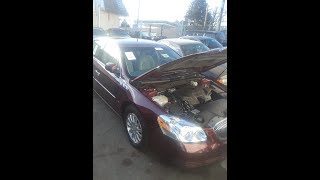
How to confirm: Test the battery with a multimeter. It should read above 12.4 volts with the engine off and 13.5-14.5 volts while running. If the battery was just replaced, this code is expected and can simply be cleared. A YouTube video on replacing the Lucerne battery shows the process and the check engine light that can result.
Typical fix: Replace the battery if it fails a load test. Ensure the replacement is a vented type, as the under-seat location requires fumes to be routed outside the vehicle. If the battery was just serviced, clear the code with a scanner and perform a drive cycle to allow the system to relearn.
Est. part cost: $150-$250 - Loose or corroded battery terminals/ground straps 🟡 Medium Probability → Shop Engine Ground Strap Corrosion on the terminals or a loose ground can interrupt the power supply to the modules, mimicking a dead battery and causing memory loss. Because the battery is under the rear seat, connections can be disturbed by items stored in the back or go uninspected for long periods.
How to confirm: Visually inspect the battery terminals for white or blueish powder (corrosion). Physically check that the terminal clamps and main body/engine ground straps are tight. A voltage drop test across the ground connections can confirm a bad ground.
Typical fix: Clean the battery terminals and cable ends with a wire brush. Tighten all loose connections. Inspect and clean the main engine-to-chassis ground straps.
Est. part cost: $1-$10 - Failing alternator ⚪ Low Probability → Shop Alternator An alternator that provides unstable or insufficient voltage will fail to properly charge the battery, leading to low voltage conditions that trigger P0603. This is a common failure point on many vehicles, not specific to the Lucerne.
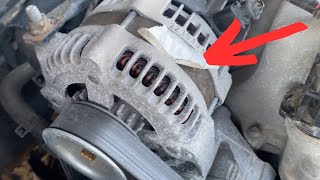
How to confirm: With the engine running, test the battery voltage. If it's below 13.2 volts or fluctuates wildly, the alternator is likely failing. Many auto parts stores can perform a charging system test for free. 🎬 Watch: Step-by-step guide to replacing the Lucerne alternator.
Typical fix: Replace the alternator.
Est. part cost: $200-$450
Rare But Worth Checking
- Faulty Powertrain Control Module (PCM): → Shop Engine Control Module (ECM) This is the least likely cause. The PCM should only be suspected after all power supply, connection, and grounding issues have been definitively ruled out. A user on a Buick Forum replaced their ECM for a similar issue after a battery drain, but it did not solve the problem, highlighting the rarity of actual PCM failure.
- Blown fuse or wiring issue: A blown fuse for the PCM's memory circuit or a damaged wire can cut power to the KAM, causing the code. This could be caused by chafing or water intrusion.
- Aftermarket performance tuners/programmers: Using an aftermarket device to alter the PCM's programming can sometimes cause a P0603 code to be set. If you have such a device installed, returning the vehicle to the stock tune may resolve the issue.
Diagnosis Steps
- Read the code with an OBD-II scanner. Note if any other codes are present, especially other P06xx codes.
- Ask if the battery was recently replaced or disconnected. If so, clear the code, drive the vehicle for 15-20 minutes, and see if it returns.
- Access the battery under the rear seat by pulling up firmly on the front of the seat cushion. 🎬 Watch: How to find and remove the under-seat battery.
- Visually inspect the battery terminals and cables for corrosion or damage. Clean and tighten as needed. The terminal nuts are typically 8mm.
- Test the battery voltage with the engine off (should be >12.4V) and with the engine running (should be 13.5V-14.5V).
- Perform a load test on the battery. Most auto parts stores can do this for free.
- If the battery and connections are good, test the alternator output under load (headlights, A/C on).
- Inspect the main engine and body ground straps for tightness and corrosion.
- Inspect the fuses related to the PCM/ECM in the underhood and interior fuse panels.
- If an aftermarket tuner is installed, remove it and return the PCM to its stock calibration.
- If all power and ground sources are confirmed to be good and the code persists after being cleared, then investigate the PCM itself as the potential point of failure.
Parts You'll Likely Need
- Car Battery
(OEM #ACDelco Gold 94RAGM (or similar Group 48/H6 battery))— A weak or failing battery is the number one cause of a P0603 code, as it cannot maintain the constant voltage required for the PCM's Keep Alive Memory. The original battery is an ACDelco, and a Group 48 (also called H6) size is a common fitment.
Trusted brands: ACDelco, DieHard, Duralast, Optima
OEM price range: $200-$300
Aftermarket price range: $150-$250
Technical Service Bulletins (TSBs) & Recalls
- 05-06-04-060A: This informational bulletin communicates Information to technicians on control module Diagnostic Trouble Code(s) (DTC)(s) P0601, P0602, P0603, P0604, P0606, P062F, P06F3, P1621 which can be shared in multiple modules. It applies to all 2015 and prior GM passenger cars and light trucks.
Platform-Specific Known Issues
- Under-Seat Battery Location: → Shop Vehicle Battery The battery in the Buick Lucerne is located under the rear passenger seat. This makes access for testing or replacement more difficult than a typical under-hood location. It requires removing the rear seat cushion and using tools like an 8mm socket for the terminals and a 13mm socket for the hold-down bracket. This location also necessitates a special vented battery to safely route gases outside the passenger compartment.
- Informational TSB: GM issued TSB #05-06-04-060A, an informational bulletin for technicians covering P0603 and other module codes. It advises that these codes can be set without a hard fault, often due to general electrical events like a battery replacement or jump-start, and cautions against immediate module replacement.
- Parasitic Drains: Some owners have reported issues with parasitic battery drains on 2006-2008 models, where the battery goes dead after sitting for a few days. While not directly causing P0603, a recurring dead battery from a parasitic drain will repeatedly trigger the code upon jump-starting or battery replacement.
Mechanic-Grade Diagnostic Values
- Keep Alive Memory (KAM) Power at PCM Connector — expected: Constant Battery Voltage (approx. 12.6V) with key off. Failure: 0V or fluctuating voltage indicates a problem with the power feed wire or fuse.
- Voltage Drop Test on Negative Battery Cable — expected: Less than 200 mV (0.2V) while an assistant cranks the engine (fuel pump relay removed). Failure: A reading above 200 mV indicates high resistance in the negative cable or its connection points to the chassis/engine block.
- Voltage Drop Test on Positive Battery Cable to Underhood Fuse Block — expected: Less than 100 mV (0.1V) while an assistant cranks the engine (fuel pump relay removed). Failure: A reading above 100 mV indicates high resistance in the positive cable or its connections.
Scan Tool Commands That Help
- Manual Procedure (No Scan Tool Required): Idle Learn / Throttle Relearn Procedure — After the battery has been disconnected or replaced, or after clearing a P0603 code. This procedure is necessary to recalibrate the idle speed and prevent rough idling or stalling. The general process involves letting the engine idle in Park with all accessories off for 3 minutes, turning the engine off for 60 seconds, and then idling again for 3 minutes.
Wiring & Ground Locations
- G101 / G106 — G101 is on the lower front of the engine block. It jumpers to G106 on the center of the frame cross rail under the crank pulley.. This is a primary ground point for the Engine Control Module (ECM) and Transmission Control Module (TCM). A poor connection here can directly cause power interruptions and communication faults for the main computers.
- G103 — Located on the cowl in the left rear of the engine compartment, above the brake booster.. This ground serves the Body Control Module (BCM) and the Data Link Connector (DLC), among other components. A fault here can cause a wide range of electrical issues and prevent proper communication with a scan tool.
- Underhood Fuse Block — On the passenger side of the engine compartment.. Contains primary fuses for the ECM/PCM. For 2008+ models, fuse #9 (10A) is labeled for the ECM/PCM. This block receives main power from the battery and is a critical point for voltage testing.
- Rear Underseat Fuse Block — Located under the rear seat cushion, next to the battery.. Contains the main ECM/TCM power fuse. For 2006-2007 models, this is fuse #28 (15A). For 2008-2011 models, it is fuse #5 (15A). A poor connection or corrosion in this fuse block is a common source of power loss.
Real Owner Repair Stories
- buickforums.com user (2008 Buick Lucerne) — Car would not start, multiple communication codes (U-codes) present along with P0603.
❌ Tried (didn't work) Replacing the battery., Checking individual fuses.
✅ What actually fixed it The ground connection for the underhood fuse block was found to be corroded. Additionally, the negative battery cable was loose at the terminal. Cleaning the fuse block ground and tightening the battery terminal resolved all codes and the no-start condition. - Reddit r/Buick (2008 Buick Lucerne CX) — Car would not crank or start intermittently. Sometimes diagnosed as a bad fuel pump.
❌ Tried (didn't work) Replacing the fuel pump., Replacing fuel pump fuses and relays.
✅ What actually fixed it The metal seat bracket on the underside of the rear seat cushion was physically contacting the rear fuse block, causing a short that melted the fuel pump relay socket. The final fix was to replace the damaged fuse block and cut off the offending metal bracket from the seat cushion to prevent recurrence.
Model Year Variations Within This Range
- 2007-2008: Primarily used the 3.8L V6 engine (L26) and the 4.6L Northstar V8 (LD8). The V6 models use a different PCM (e.g., part #12613144) than the V8 models.
- 2009-2011: The 3.8L V6 was replaced by the 3.9L V6 (LZ9/LGD) as the standard engine. This engine uses a different PCM (often an ACDelco E67) than the earlier 3.8L V6. The 4.6L V8 continued in the Super trim. Using a PCM from a 3.8L on a 3.9L or vice-versa will not work.
- 2006-2007 vs 2008-2011: The layout and numbering of the rear (underseat) fuse block changed. For example, the ECM/TCM fuse moved from position F28 in 2007 to position 5 in 2008.
Helpful Videos



We Have This Part in Stock


The information in this article is provided for general reference and educational purposes only. Vehicle specifications, procedures, and part compatibility can vary by production date, trim level, and region. Always consult your vehicle's factory service manual and verify part numbers before purchasing or performing repairs. Safety-critical components such as airbags, seat belts, and braking systems should be installed by a qualified professional.
- Buick LUCERNE:
- 🧭 Diagnostic Flowchart
- 🎬 Helpful Videos
- 🛍️ Shop This Part
- What's Unique About the 2007-2011 Buick LUCERNE
- Symptoms You May Notice
- Most Likely Causes
- Rare But Worth Checking
- Diagnosis Steps
- Parts You'll Likely Need
- Technical Service Bulletins (TSBs) & Recalls
- Platform-Specific Known Issues
- Mechanic-Grade Diagnostic Values
- Scan Tool Commands That Help
- Wiring & Ground Locations
- Real Owner Repair Stories
- Model Year Variations Within This Range
- 🎟️ Get 5% Off