

P0604 on 2012-2014 Chevrolet Captiva: Internal Memory Error Causes and Fixes
P0604 on a 2012-2014 Captiva indicates an internal memory (RAM) error in a control module, most commonly the Transmission Control Module (TCM). This is a known issue referenced in GM TSBs. The TCM, located inside the transmission, is prone to failure from heat. The fix requires professional replacement and programming of the TCM, as simple repairs are unlikely to solve it.
- P0604 is a serious code indicating an internal failure in a control module's memory.
- On the 2012-2014 Captiva, the Transmission Control Module (TCM), located inside the transmission, is the most likely culprit, as documented in a GM TSB.
- Always check the battery and charging system first, as low voltage can sometimes trigger this code falsely.
- Repair is not DIY-friendly; the replacement module must be professionally installed and programmed to the vehicle.
- Symptoms are often severe and transmission-related, such as harsh shifting or getting stuck in gear.
What's Unique About the 2012-2014 Chevrolet CAPTIVA
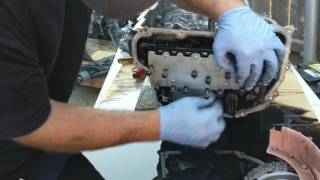
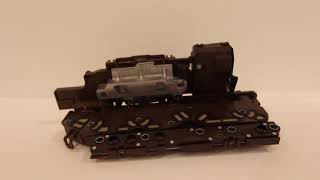
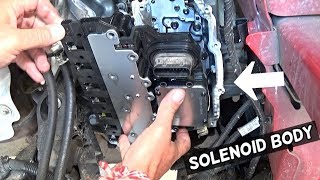
The 2012-2014 Chevrolet Captiva (sold in the US as the Captiva Sport, primarily for fleet sales) shares its platform and 6-speed automatic transmission (6T40/6T45) with vehicles like the Chevrolet Equinox and GMC Terrain. On this platform, the Transmission Control Module (TCM) is not a separate external box but is integrated with the valve body and solenoids into a single unit called a TEHCM (Transmission Electro-Hydraulic Control Module). This TEHCM is located inside the transmission oil pan, where it is constantly subjected to heat and vibration, leading to a high rate of failure. GM issued Technical Service Bulletin #PIP4653E specifically because codes like P0604 were appearing, pointing technicians directly toward a potential TEHCM fault rather than a more general engine computer problem.
Diagnostic Flowchart
Tap your situation to follow the diagnostic path that matches what you're seeing on this vehicle.
Symptoms You May Notice
- Check Engine Light is on
- Harsh or erratic transmission shifting
- Vehicle gets stuck in one gear (limp mode), sometimes defaulting to 5th gear
- Inability to shift gears
- PRNDL display may go blank or show incorrect information
- Engine may stall, crank but not start, or not crank at all
- Reduced fuel economy
- Loss of communication with the TCM via a scan tool
- Replacing the battery without properly testing it and the charging system first.
- Replacing the entire transmission when only the internal TCM/TEHCM has failed.
- Replacing the PCM/ECM when the code was actually set by the TCM.
Most Likely Causes
- Failing Transmission Control Module (TCM/TEHCM) 🔴 High Probability → Shop Transmission Assembly This is a documented issue for this GM platform, as noted in TSB #PIP4653E. The TCM is part of the TEHCM, located inside the hot transmission, where heat and vibration cause internal solder joints and electronic components to fail over time.
How to confirm: A professional technician will use a GM-compatible scan tool (like a Tech 2 or MDI with GDS2 software) to confirm the P0604 code is stored in the TCM, not the ECM. If power and ground to the module are good and the code returns immediately after clearing, the module is faulty. Loss of communication with the TCM is also a strong indicator.
Typical fix: Replacement of the Control Solenoid Valve and Transmission Control Module Assembly (TEHCM). The new module must be programmed to the vehicle using GM's Service Programming System (SPS).
Est. part cost: $300-$800 - Low or Unstable Battery Voltage 🟡 Medium Probability → Shop Vehicle Battery All modern control modules are sensitive to voltage. The Captiva platform has owner complaints of various electrical issues that are sometimes traced back to failing batteries or poor ground connections, which can falsely trigger module error codes like P0604.
How to confirm: Test the battery with a multimeter or digital battery tester. It should read above 12.4 volts at rest and not drop below 9.5-10 volts during cranking. The alternator output should be between 13.7 and 14.7 volts with the engine running. Inspect battery terminals and main chassis grounds for corrosion or looseness.
Typical fix: Charge or replace the battery. Inspect and clean all battery terminals and main power/ground connections to the engine and chassis.
Est. part cost: $150-$300 - Software Glitch / Outdated Calibration ⚪ Low Probability
How to confirm: A dealer or qualified shop can use a scan tool to check if a software update (reflash) is available for the TCM or PCM. TSB #PIP4653E specifically instructs technicians to check which module set the code before attempting to reprogram.
Typical fix: Reprogramming the affected module with the latest manufacturer software. This is often attempted before module replacement.
Est. part cost: $100-$250 (Labor Cost) - Wiring or Connection Issues ⚪ Low Probability
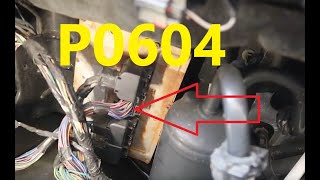
How to confirm: Visually inspect the main wiring harness connector at the transmission case for any signs of corrosion, damage, or pushed-out pins. A poor connection at this plug can mimic a failed internal TCM.
Typical fix: Repairing the damaged section of the harness or cleaning/securing the connector. In one documented case, a technician disassembled the plug, adjusted the pin contacts, and resolved the issue.
Est. part cost: $50-$300
Rare But Worth Checking
- Faulty Powertrain Control Module (PCM): → Shop Engine Control Module (ECM) While the TCM is the most common culprit on this vehicle for P0604, the PCM can also fail its internal RAM test and set this code. A professional scan tool is required to determine which module actually stored the fault code.
Diagnosis Steps
- Scan for all stored DTCs with a professional scan tool to see which module (TCM or PCM) stored the P0604 code. Note any accompanying codes like P0700.
- Check and record the battery voltage at rest (should be >12.4V), during cranking (>9.5V), and with the engine running (13.7-14.7V) to rule out power supply issues.
- Thoroughly inspect all battery connections, main engine/body grounds, and fuses related to the PCM and TCM for corrosion or looseness.
- Clear the DTCs. If P0604 returns immediately, even without starting the engine, it strongly indicates a hard internal module fault.
- Visually inspect the main round connector on the outside of the transmission case for any obvious damage, corrosion, or loose pins.
- If a GM-specific scan tool is available, check for available software updates for the Transmission Control Module. This is a required step before condemning the module.
- If all external factors (power, ground, connections, software) are ruled out, the evidence points to an internal failure of the control module, most likely the TCM/TEHCM.
Parts You'll Likely Need
- Transmission Control Module (TCM/TEHCM)
(OEM #24256797 (example, must verify with VIN))— This is the most frequent point of failure for a P0604 code on this platform, as confirmed by owner experiences and manufacturer TSBs. It is an integrated unit containing the TCM, solenoids, and valve body.
Trusted brands: ACDelco (OEM), Dorman (Aftermarket)
OEM price range: $450-$800
Aftermarket price range: $300-$500
Related Codes That Often Appear With This One
- P0700 — P0700 is a generic code indicating the Transmission Control Module has requested the check engine light to be turned on. It is a universal signpost that a specific transmission-related code, like P0604, is stored in the TCM. 🎬 Watch: How to diagnose the P0700 code and transmission malfunctions.
- U-series codes (e.g., U0101) — Communication codes may appear if the failing TCM is intermittently losing its connection to the rest of the vehicle's CAN bus network.
- P0601, P0603, P062F, P1621 — These are all internal control module memory or performance codes. TSB #PIP4653E groups them with P0604 as codes that point to a faulty TCM.
Technical Service Bulletins (TSBs) & Recalls
- PIP4653E: Addresses a Malfunction Indicator Lamp with DTCs like P0604 stored in the Transmission Control Module.
- 05-06-04-060A: An informational bulletin about a family of control module DTCs (including P0604) that can be set in multiple modules, often due to voltage issues.
Platform-Specific Known Issues
- TSB #PIP4653E specifically notes that DTCs P0601, P0603, P0604, P062F or P1621 may be found stored in the Transmission Control Module, and crucially advises technicians to verify which module set the code before starting diagnosis.
- TSB #05-06-04-060A is a broader bulletin that includes P0604 as one of several internal control module fault codes that can appear in various modules, often triggered by electrical issues like low voltage.
- The internal location of the TCM (as part of the TEHCM) inside the 6T40/6T45 transmission is the primary design factor leading to this common failure. Heat from the transmission fluid degrades the electronics over time.
Mechanic-Grade Diagnostic Values
- Pressure Control Solenoid (PCS) Resistance — expected: 3-5 Ohms at 70°F (21°C). Failure: A reading outside this range indicates a faulty solenoid.
- Shift Solenoid Resistance — expected: 16-20 Ohms at 70°F (21°C). Failure: A reading outside this range indicates a faulty solenoid.
- TCM Ground Pin Resistance — expected: Less than 0.5 Ohms. Failure: Higher resistance indicates a poor ground connection, which can cause module errors.
- TCM Power Pin Voltage — expected: Stable 12V+ supply. Failure: Low or unstable voltage points to a power supply issue, not necessarily a bad TCM.
Hidden / Shadow Codes Worth Checking
- Symptom Byte (e.g., P0604 71): GM uses a two-digit hexadecimal symptom byte to add detail to a DTC. For example, a '71' often means 'Invalid Serial Data Received,' pointing to a software or communication problem rather than a hardware failure. Other bytes can indicate voltage or temperature issues. (see via Visible only with dealer-level scan tools like a GM Tech 2 or a more modern tool running GDS2 (Global Diagnostic System 2).)
Scan Tool Commands That Help
- GDS2 / Tech 2: Solenoid Cleaning Process — Before condemning a TEHCM for shift quality issues or some solenoid codes, this automated function cycles all solenoids with the system pressurized to dislodge debris. It can sometimes resolve issues without part replacement.
- GDS2 / Techline Connect: SPS (Service Programming System) — This is required after installing a new TEHCM. The 'Replace and Reprogram' function downloads the correct vehicle-specific calibration and writes the VIN to the new module.
- Specialty Bench-Top Tools (e.g., IO Terminal): TCM Cloning — If the original TEHCM can still communicate, its data (including VIN, programming, and adaptive learn data) can be read and written to a used or remanufactured TEHCM. This avoids the need for online SPS programming, creating a plug-and-play replacement.
Wiring & Ground Locations
- X101 — A 36-pin black connector located behind the engine fuse block, connecting the engine harness to the body harness.. This is a major pass-through connector for signals between the ECM, TCM, and the rest of the vehicle. Corrosion or pin damage here can cause a wide range of communication and module errors.
- G109 — Located on the center of the engine bay bulkhead, related to electric power steering.. While primarily for steering, it is a major chassis ground point in the engine bay. A loose or corroded G109 can introduce electrical noise and voltage stability problems for multiple control modules.
- G110 — Located on the right front corner of the engine (3.0L V6 model).. This is a primary engine ground. A poor connection here can directly impact the stability of the ECM and other engine-mounted sensors and modules.
OEM Part Supersession History
24256797→24264683, 24287422, among others.— GM frequently updates part numbers to reflect manufacturing improvements, supplier changes, or software calibration updates.
Heads up: The 6T40/6T45 TEHCM has Gen 1 and Gen 2 versions. While they may physically fit, their internal circuitry and programming are different. Using the wrong generation will result in communication failures or a no-start condition. Always verify the correct part number using the vehicle's VIN.
Model Year Variations Within This Range
- 2013-2015: Around 2013, GM began phasing in the Generation 2 version of the 6T40/6T45 TEHCM. While the 2012-2014 Captiva range primarily uses the Gen 1 module, later 2013 and 2014 models could potentially have a Gen 2. The solenoids and internal logic are not interchangeable between generations.
Helpful Videos

We Have This Part in Stock

The information in this article is provided for general reference and educational purposes only. Vehicle specifications, procedures, and part compatibility can vary by production date, trim level, and region. Always consult your vehicle's factory service manual and verify part numbers before purchasing or performing repairs. Safety-critical components such as airbags, seat belts, and braking systems should be installed by a qualified professional.
- Chevrolet CAPTIVA:
- 🧭 Diagnostic Flowchart
- 🎬 Helpful Videos
- 🛍️ Shop This Part
- What's Unique About the 2012-2014 Chevrolet CAPTIVA
- Symptoms You May Notice
- Most Likely Causes
- Rare But Worth Checking
- Diagnosis Steps
- Parts You'll Likely Need
- Related Codes That Often Appear With This One
- Technical Service Bulletins (TSBs) & Recalls
- Platform-Specific Known Issues
- Mechanic-Grade Diagnostic Values
- Hidden / Shadow Codes Worth Checking
- Scan Tool Commands That Help
- Wiring & Ground Locations
- OEM Part Supersession History
- Model Year Variations Within This Range
- 🎟️ Get 5% Off