

P0604 on 2007-2010 Saturn Outlook: Internal Memory Error Causes and Fixes
On a 2007-2010 Saturn Outlook, code P0604 almost always points to an internal failure of the Transmission Control Module (TCM). The most common fix is replacing the TCM, which is located inside the transmission and often requires professional programming.
- P0604 on a Saturn Outlook is a specific code pointing to an internal memory failure, most often in the Transmission Control Module (TCM), not the main engine computer.
- Symptoms are primarily related to transmission performance, such as harsh shifting, hesitation, and potential limp mode.
- Before condemning the module, always check the battery and charging system, as low or unstable voltage can trigger false memory codes.
- The most common fix is replacing the entire Transmission Electro-Hydraulic Control Module (TEHCM), which is located inside the transmission pan and requires professional programming with specialized tools.
What's Unique About the 2007-2010 Saturn OUTLOOK
The Saturn Outlook and its GM Lambda platform siblings (GMC Acadia, Buick Enclave, Chevrolet Traverse) are specifically called out in Technical Service Bulletins (TSBs) for this issue. Unlike a generic P0604 which could point to the main engine computer (ECM/PCM), on these vehicles, the fault is most frequently isolated to the Transmission Control Module (TCM). This manufacturer-specific guidance is crucial for accurate diagnosis and avoids unnecessary replacement of the wrong module. The TCM in these vehicles is an integrated unit with the valve body and solenoids, called a Transmission Electro-Hydraulic Control Module (TEHCM), which is physically located inside the transmission.
Diagnostic Flowchart
Tap your situation to follow the diagnostic path that matches what you're seeing on this vehicle.
Symptoms You May Notice
- Check Engine Light (Malfunction Indicator Lamp) is on
- Harsh or erratic transmission shifting
- Transmission may enter "limp mode" (stuck in one gear) 🎬 See a real-world example of this vehicle in limp mode
- Vehicle may stall or have difficulty starting
- Reduced fuel economy
- Hesitation or jerking during acceleration, especially uphill
- Replacing the Powertrain Control Module (PCM) when the fault is in the Transmission Control Module (TCM).
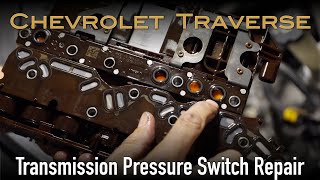
- Replacing transmission solenoids individually when the fault is in the integrated control module logic 🎬 Watch: How to replace the pressure switch membranes of the TEHCM.
- Assuming the transmission has a major mechanical failure without first diagnosing the electronics, especially when P0604 is present.
Most Likely Causes
- Faulty Transmission Control Module (TCM/TEHCM) 🔴 High Probability → Shop Transmission Assembly As identified in GM Technical Service Bulletin #PIP4653E, the TCM is the specific module prone to storing this code on this platform. Forum discussions for the Outlook and its platform mates consistently point to TCM/TEHCM failure as the root cause.
How to confirm: A professional technician will use a high-end scan tool to confirm the code is stored by the TCM. They will check power and ground to the module before condemning it. A memory integrity test may also be performed. The module is located inside the transmission oil pan, attached to the valve body.
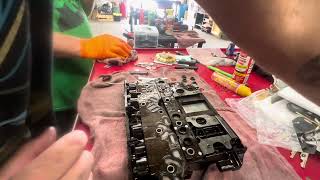
Typical fix: The TCM, which is integrated with the valve body solenoids (known as a TEHCM), is replaced and programmed to the vehicle's VIN. This involves draining the transmission fluid, removing the pan, and replacing the entire TEHCM unit.
Est. part cost: $300-$800 - Low Battery Voltage or Poor Connections ⚪ Low Probability → Shop Vehicle Battery All modern vehicles are sensitive to voltage fluctuations. A weak battery or poor ground can cause temporary memory corruption in control modules, sometimes triggering a P0604 code, especially after a battery replacement or jump-start.
How to confirm: Test the battery voltage; it should be above 12.4V with the engine off and maintain above 9.6V during cranking. Test the charging system; alternator output should be between 13.5V and 14.5V with the engine running. Inspect battery terminals and main power/ground connections for corrosion or looseness.
Typical fix: Charge or replace the battery. Clean and tighten all battery and ground connections. Clear codes and test drive; if the code does not return, the issue was likely voltage-related.
Est. part cost: $0-$250
Rare But Worth Checking
- Software Corruption: Sometimes, a software glitch can cause the P0604 code. A dealer or qualified shop can check if a software update or reflash is available before replacing the module. This is less common than outright hardware failure but should be considered.
- Faulty Powertrain Control Module (PCM): → Shop Engine Control Module (ECM) While the TSBs point to the TCM, it is theoretically possible for the main engine computer (PCM) to set this code. This is much less likely on this specific vehicle and should only be considered after the TCM, wiring, and voltage have been ruled out.
- Wiring Harness Issues: Damage to the wiring harness leading to the transmission can cause communication and power supply issues for the TCM, potentially triggering this code. A visual inspection for chafed, burnt, or corroded wires is a valid diagnostic step.
Diagnosis Steps
- Scan the vehicle for all diagnostic trouble codes. Note if P0604 is accompanied by other codes and which module stored it (likely the TCM).
- Check the battery. Ensure it has a full charge (12.4V+ engine off) and that the terminals are clean and tight. Perform a load test on the battery.
- With the engine running, check alternator output voltage to ensure it's stable and within the 13.5V-14.5V range.
- Inspect the main engine and body ground connections for corrosion and tightness.
- Clear the codes and test drive the vehicle to see if the code returns. If it does not, it may have been a temporary glitch caused by low voltage.
- If the code returns, inspect the wiring harness and connector at the transmission for any signs of damage, corrosion, or fluid intrusion.
- Using an advanced scan tool, verify that the TCM is the module logging the fault and that power and ground signals at the module are within spec.
- If wiring and power/ground supplies are good, the TEHCM (TCM) is highly suspect. Replacement and programming by a professional is the final step.
Parts You'll Likely Need
- Transmission Control Module (TCM/TEHCM)
(OEM #24261875)— This is the component that GM TSBs identify as the source of the P0604 code on the Saturn Outlook. It is an integrated module containing the computer, solenoids, and sensors, located inside the transmission pan.
Trusted brands: ACDelco (GM OE), Dorman
OEM price range: $400-$850
Aftermarket price range: $300-$600
Related Codes That Often Appear With This One
- P0601 — This is another internal control module memory error (Read Only Memory - ROM), often appearing with other module integrity codes. [Bulletin #05-06-04-060A, Bulletin #PIP4653E]
- P0603 — This code relates to a Keep Alive Memory (KAM) error, which can be triggered by similar voltage or internal module faults. [Bulletin #05-06-04-060A, Bulletin #PIP4653E]
- P062F — This code relates to an internal control module EEPROM error, indicating a deeper memory fault within the module. [Bulletin #05-06-04-060A, Bulletin #PIP4653E]
- P1621 — This is a manufacturer-specific code for Control Module Long Term Memory Performance, directly related to the family of internal memory faults. [Bulletin #05-06-04-060A, Bulletin #PIP4653E]
Technical Service Bulletins (TSBs) & Recalls
- 05-06-04-060A: Information on control module internal memory DTCs.
- PIP4653E: Diagnostic information for Malfunction Indicator Lamp with P0604 and other codes stored in the Transmission Control Module.
Platform-Specific Known Issues
- Bulletin #PIP4653E: This TSB specifically addresses finding codes like P0604 in the Transmission Control Module on vehicles experiencing a Malfunction Indicator Lamp. It directs technicians to confirm the code is set in the TCM and implies TCM replacement if diagnostics lead there.
- Bulletin #05-06-04-060A: This informational bulletin groups P0604 with a family of other internal control module memory codes (P0601, P0602, P0603, etc.) that can be set by various modules, reinforcing that it's an internal integrity fault.
- Owner Experience: TCM Failure After Wave Plate Repair: A common narrative in owner forums is the failure of the 3-5-R wave plate, a well-known mechanical issue with this transmission. Some owners report that after the wave plate is repaired, the TCM/TEHCM fails shortly thereafter, throwing codes like P0604. Dealers often quote around $1500 for the TCM replacement.
Mechanic-Grade Diagnostic Values
- Module Ground Resistance — expected: Below 0.1 Ω. Failure: A reading higher than 0.1 Ω indicates a poor ground connection, which can cause voltage instability and module errors.
- Battery Voltage at Module (during cranking) — expected: Above 9.0 V. Failure: Voltage dropping below 9.0 V during engine crank can cause modules to reset or corrupt memory, potentially logging a P0604.
- Alternator Output Voltage (engine running) — expected: 13.5 V to 14.5 V. Failure: Voltage that is too low or too high (spiking) can cause RAM corruption in control modules.
- TEHCM Shift Solenoid Resistance (On/Off type) — expected: 20-40 Ω. Failure: Readings outside this range indicate a faulty solenoid coil within the TEHCM assembly.
- TEHCM Pressure Control Solenoid Resistance (PWM type) — expected: 3-8 Ω. Failure: Readings outside this range suggest a failure in a pressure control solenoid within the TEHCM.
Scan Tool Commands That Help
- GM Techline Connect (formerly TIS2Web/SPS): Service Programming System (SPS) — This function is required after replacing the TEHCM. It downloads the correct VIN-specific calibration file from GM's servers and flashes it onto the new module. Without this step, the vehicle will not operate correctly.
- GM Scan Tool (Tech2/GDS2): Service Cleaning Procedure — Before condemning a TEHCM for certain performance issues, a technician can run this automated routine. It cycles all the solenoids with the transmission fluid pressurized to dislodge small debris that may be causing a solenoid to stick. This is a diagnostic step, not a guaranteed fix for a P0604.
- GM Scan Tool (Tech2/GDS2): Service Fast Learn Adapts — After TEHCM replacement and programming, this procedure must be run to allow the new module to quickly learn the clutch volume indexes and shift timing, ensuring smooth operation.
Wiring & Ground Locations
- TEHCM Main Connector — On the outside of the transmission case, where the main vehicle harness connects to the internal TEHCM. It is a 20-pin connector.. This is the single point of failure for all power, ground, and communication signals going to the Transmission Control Module. Corrosion or damage here can directly cause a P0604.
- G112 — On the rear of the engine, mounted to the rear cylinder head.. This is a primary engine ground. A poor connection here can affect multiple systems, including creating electrical noise or voltage drops that could impact control module stability.
- G114 / G115 — G114 is on the left rear of the engine; G115 is in the engine compartment on the left inner fender panel.. These are key engine compartment grounds. Verifying they are clean and tight is a crucial step when diagnosing any module communication or power-related fault code like P0604.
Real Owner Repair Stories
- SaturnFans.com forum user (2007 Saturn Outlook) — Check Engine Light on with code P0604, harsh shifting, and a feeling of being 'stuck in 3rd gear' (limp mode).
❌ Tried (didn't work) The user first suspected a voltage issue but did not report testing the battery or alternator.
✅ What actually fixed it The user took the vehicle to a dealer, who diagnosed a bad Transmission Control Module (TCM). The TCM was replaced, which resolved all symptoms and cleared the P0604 code.
OEM Part Supersession History
24261875, 24041871, 24264346→24275870— GM consolidates part numbers and often makes internal revisions to improve reliability. The later part numbers represent updated versions of the TEHCM.
Heads up: While physically interchangeable, a new TEHCM must be programmed with vehicle-specific software via GM's Service Programming System (SPS) to function. Some aftermarket suppliers offer a cloning service where they transfer the data from the old module to the new one, creating a 'plug-and-play' unit.
Model Year Variations Within This Range
- 2007-2009: Early production 6T70/6T75 transmissions in this range were susceptible to a failure of the 3-5-R wave plate. This is a mechanical failure inside the transmission. While not directly causing P0604, the resulting debris or erratic operation could potentially stress the TEHCM, and owners often report TEHCM failure occurring sometime after a wave plate repair.
Helpful Videos

We Have This Part in Stock




The information in this article is provided for general reference and educational purposes only. Vehicle specifications, procedures, and part compatibility can vary by production date, trim level, and region. Always consult your vehicle's factory service manual and verify part numbers before purchasing or performing repairs. Safety-critical components such as airbags, seat belts, and braking systems should be installed by a qualified professional.
- Saturn OUTLOOK:
- 🧭 Diagnostic Flowchart
- 🎬 Helpful Videos
- 🛍️ Shop This Part
- What's Unique About the 2007-2010 Saturn OUTLOOK
- Symptoms You May Notice
- Most Likely Causes
- Rare But Worth Checking
- Diagnosis Steps
- Parts You'll Likely Need
- Related Codes That Often Appear With This One
- Technical Service Bulletins (TSBs) & Recalls
- Platform-Specific Known Issues
- Mechanic-Grade Diagnostic Values
- Scan Tool Commands That Help
- Wiring & Ground Locations
- Real Owner Repair Stories
- OEM Part Supersession History
- Model Year Variations Within This Range
- 🎟️ Get 5% Off