

P0605 on 1995-2001 Ford Explorer: Internal Computer Error Causes and Fixes
P0605 on a second-generation Ford Explorer indicates a fatal internal error in the main engine computer (PCM). This usually requires replacing the PCM. Before replacement, always check battery voltage and all power/ground connections to the PCM, as electrical issues can sometimes trigger this code. On these older models, internal capacitor failure is a known issue.
- P0605 is a critical code indicating the engine computer (PCM) has failed an internal self-test.
- Do not drive the vehicle, as it may stall at any time or fail to start.
- Before condemning the expensive PCM, thoroughly test the battery, alternator, and all power/ground connections to the module.
- Replacing the PCM is not a simple plug-and-play job; it requires professional programming to match your Explorer's VIN and features.
- The most common fix for this code, after verifying the electrical system is healthy, is a remanufactured PCM.
What's Unique About the 1995-2001 Ford Explorer
For the second-generation Ford Explorer (1995-2001), the PCM is a central component controlling both the 4.0L V6 engine and the automatic transmission. While PCM failure isn't exceptionally common, these vehicles are now old enough that age-related electronic failure is a primary cause for a code like P0605. A specific known failure mode for this era of Ford PCM is the leakage of internal electrolytic capacitors, which corrodes the circuit board and causes a host of intermittent electrical problems before final failure. Unlike newer vehicles, aftermarket tuning is not a frequent cause on this platform; failure is more likely due to age, vibration, or electrical system faults.
Generation note: This guide covers the second generation of the Ford Explorer (1995-2001). The causes and fixes are generally consistent across this generation for the 4.0L V6 engine. The PCM is typically located on the passenger side firewall, either in the engine bay or inside the cabin near the footwell. The Passive Anti-Theft System (PATS) was introduced in 1998 models, which may require key programming when swapping a PCM on 1998-2001 vehicles.
🎬 Watch: How to program your keys after a PCM swapSymptoms You May Notice
- Check Engine Light is on.
- Engine will not start, or has a 'crank-no-start' condition.
- Engine stalling intermittently or running very rough.
- Erratic or harsh automatic transmission shifting.
- Noticeable decrease in fuel economy.
- Failure to pass an emissions test.
- Fuel pump may run continuously with the key off, draining the battery.
- Replacing sensors like the Crankshaft Position Sensor or Throttle Position Sensor. While a bad PCM can cause symptoms related to these sensors, the P0605 code specifically points to an internal computer fault, not a sensor input fault.
- Replacing the PCM without first testing the battery and alternator. Low or unstable voltage is a very common trigger for this code and is much cheaper to fix.
Most Likely Causes
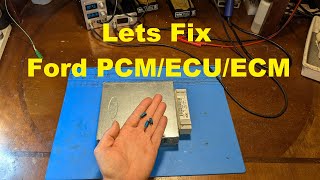
- Powertrain Control Module (PCM) Failure 🔴 High Probability → Shop Engine Control Module (ECM) As the vehicle ages, internal electronic components within the PCM can fail. A common point of failure on these specific PCMs is leaking electrolytic capacitors 🎬 Watch: How to repair leaking capacitors on a Ford PCM, which corrode the circuit board and lead to memory errors. Heat cycles and vibration over 20+ years also contribute to solder joint failure.
How to confirm: After confirming all power and ground circuits to the PCM are intact and have correct voltage, the diagnosis points to an internal PCM fault. This is a process of elimination. Sometimes, a visual inspection of the circuit board (if opened) will reveal burnt components or leaking capacitor residue.
Typical fix: Replace the Powertrain Control Module (PCM). The replacement unit must be programmed to the vehicle's VIN. For this generation, it is crucial to match the hardware part number exactly.
Est. part cost: $250-$600 for a remanufactured unit - Low Battery Voltage or Charging System Fault 🟡 Medium Probability → Shop Vehicle Battery A weak battery or failing alternator can provide insufficient or unstable voltage to the PCM during its startup self-test, causing it to fail and incorrectly set a P0605 code. This is the most common misdiagnosis for a bad PCM.
How to confirm: Test the battery with a load tester. It should read above 12.4 volts at rest. With the engine running, check the alternator output; it should be between 13.7 and 14.7 volts.
Typical fix: Replace the battery and/or alternator.
Est. part cost: $100-$250 for a battery, $150-$350 for an alternator - Poor PCM Power or Ground Connections ⚪ Low Probability Over decades, the main ground straps and power connections to the PCM can corrode or loosen. This can cause intermittent power loss or voltage drops to the module, especially during high-vibration conditions.
How to confirm: Locate the PCM and its connectors. Visually inspect for corrosion or damage. Use a multimeter to perform a voltage drop test on the main power and ground wires to ensure there is minimal resistance (ideally less than 0.1 ohms).
Typical fix: Clean the ground connection points to bare metal, tighten loose terminals, or repair the corroded section of the wiring harness.
Est. part cost: $5-$50 for cleaning supplies or wiring repair
Rare But Worth Checking
- Water Intrusion: A leak from a degraded windshield cowl seal or a blocked cowl drain can allow rainwater to drip directly onto the PCM or its connectors, causing a short circuit. Always check for signs of moisture or rust stains on the firewall in the engine bay near the PCM's location.
- Aftermarket Performance Chip: While less common on this platform now, a poorly seated or faulty aftermarket performance chip that plugs into the PCM can cause communication errors and trigger a P0605 code. In one documented case, the code appeared with a specific chip installed but disappeared when the chip was removed or a different one was used.
Diagnosis Steps
- Verify the code with a scanner. Check for any other codes present, especially U-codes or P0562/P0603.
- Crucial First Step: Check the battery and charging system. Ensure the battery has a full charge (12.4V+ resting) and that the alternator is charging correctly (13.7-14.7V running). A simple voltage issue is a common trigger.
- Inspect all battery cables and primary engine/chassis ground straps for corrosion and tightness. Clean or tighten as necessary. These are often located on the frame rail near the battery and from the engine block to the firewall. Key grounds are G100/G101 and G104 in the engine compartment.
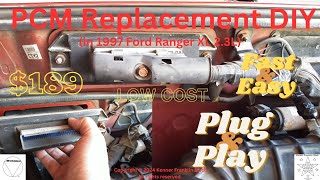
- Locate the PCM. On the 1995-2001 Explorer, it is typically on the passenger-side firewall, accessible from the engine bay. 🎬 See this step-by-step guide for removing and replacing the PCM Disconnect the battery.
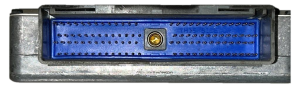
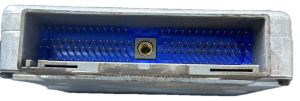
- Disconnect the large 104-pin PCM connector (may require unbolting a 10mm bolt in the center). Inspect the connector and the PCM pins for any signs of corrosion, moisture, or bent pins. Look for water trails on the firewall above the PCM.
- If connections look clean, use a wiring diagram to identify the main power (Key-On and Keep-Alive power) and ground pins for the PCM. Reconnect the battery and PCM, and with the key on, verify that the PCM is receiving full battery voltage at its power pins (e.g., Pin 55 for KAPWR) and has a solid ground on its ground pins (e.g., Pins 24, 25, 51, 76, 77, 103).
- If all external power, grounds, and connections are good, the fault is internal to the PCM.
- The final step is to replace the PCM. Source a replacement unit by matching the part number on the original PCM's sticker exactly. For many vehicles in this generation, this is a plug-and-play replacement not requiring dealer programming, especially on pre-1998 models.
Parts You'll Likely Need
- Powertrain Control Module (PCM)
(OEM #Varies by VIN (e.g., F57F-12A650-ZB, F87F-12A650-ATE). Must match original part number.)— This code directly indicates an internal failure of the PCM's read-only memory. After ruling out external electrical issues, the module itself is the faulty component.
Trusted brands: Motorcraft (OEM Remanufactured), Cardone, Blue Streak Electronics, Flagship One
OEM price range: $400-$700 (Remanufactured)
Aftermarket price range: $250-$500 (Remanufactured)
Related Codes That Often Appear With This One
- U0100 — This code means 'Lost Communication With ECM/PCM'. It often appears alongside P0605 if the PCM has failed completely and can no longer communicate on the vehicle's data network.
- P0562 — This code for 'System Voltage Low' can be a direct cause for P0605. If the battery or alternator is failing, the low voltage can disrupt the PCM's self-test and trigger the internal memory error code.
- P0603 — This code for 'Internal Control Module Keep Alive Memory (KAM) Error' is often seen after a battery has been disconnected or has died. While P0605 points to a more serious ROM error, seeing P0603 can be an indicator of underlying power supply issues that could also trigger P0605.
Platform-Specific Known Issues
- A common failure point on these older Ford PCMs is leaking internal capacitors, which can be visually identified by bulging tops or brown corrosive residue on the circuit board upon disassembly.
- The PCM is located on the engine-bay side of the passenger firewall, making it susceptible to water intrusion from a leaking windshield cowl seal. Check for water stains in this area.
Mechanic-Grade Diagnostic Values
- PCM Keep Alive Memory (KAM) Power — expected: 12.0V+ (Battery Voltage) at all times. Failure: Voltage below 12.0V or intermittent loss of voltage indicates a wiring or fuse issue.
- PCM Power (Key On, Engine Off) — expected: 12.0V+ (Battery Voltage). Failure: Low or no voltage indicates an issue with the PCM power relay or ignition switch circuit.
- PCM Ground Circuit Voltage Drop — expected: Less than 0.1V (100mV). Failure: Voltage reading higher than 0.1V between the PCM ground pin and the negative battery terminal indicates high resistance in the ground circuit.
Hidden / Shadow Codes Worth Checking
- P0605 during KOEO test: On some Ford vehicles, particularly those with aftermarket tunes or chips, a P0605 or P0603 may appear only when a Key-On-Engine-Off (KOEO) self-test is run with a scan tool, even if the Check Engine Light is not on during normal driving. This indicates the aftermarket programming is interfering with the PCM's self-test checksum verification but may not represent a true hardware failure. (see via Using a scan tool like a Snap-on Verdict or AutoEnginuity to initiate the KOEO self-test.)
Scan Tool Commands That Help
- Ford IDS / Professional Scan Tool: PCM Self-Test (KOEO/KOER) — To force the PCM to run its internal diagnostic routine and verify if the P0605 code is immediately flagged, which can help differentiate a hard fault from an intermittent one.
- Ford IDS / J2534 Pass-Thru Device: Module Reprogramming — This is required after installing a new or remanufactured PCM to load the correct vehicle-specific software and, on 1998+ models, to perform a parameter reset or key relearn for the PATS anti-theft system.
- Scan Tool or Battery Disconnect: → Shop Vehicle Battery Reset Keep Alive Memory (KAM) — If a P0603 code is present alongside P0605, performing a KAM reset can clear adaptive learning values. This is sometimes done after fixing a power supply issue to see if the ROM error (P0605) returns, helping to confirm if the cause was transient low voltage.
Wiring & Ground Locations
- G100 / G101 — Left front corner of the engine compartment, near the battery and fender apron.. These are primary chassis and battery grounds. A poor connection here can cause unstable voltage and electrical noise, affecting the PCM's self-test and potentially triggering a P0605.
- G104 — Right front corner of the engine compartment.. This is a critical engine-to-chassis ground point. The PCM and its sensors rely on this ground path. Corrosion or looseness can lead to incorrect voltage references and internal module errors.
- PCM Connector Pin 55 — At the 104-pin PCM connector on the passenger firewall.. This is the Keep Alive Power (KAPWR) pin. It must have constant battery voltage at all times for the PCM to retain its memory. A loss of power here can cause memory-related codes like P0603 and may contribute to a P0605.
- PCM Connector Pins 24, 25, 51, 76, 77, 103 — At the 104-pin PCM connector on the passenger firewall.. These are the primary power and signal ground pins for the PCM. High resistance on any of these circuits can cause the module to malfunction and set internal fault codes.
Real Owner Repair Stories
- Ford Truck Enthusiasts Forums (2001 Ford F-350 (Similar EEC-V PCM architecture)) — P0605 code appears instantly during KOEO self-test, but Check Engine Light is not on. Truck runs okay but feels sluggish.
❌ Tried (didn't work) Clearing the code (it came back immediately on the next test).
✅ What actually fixed it The issue was determined to be caused by an aftermarket performance chip/tuner. A representative from a tuning company confirmed that P0603 and P0605 are considered normal artifacts when running a KOEO test on a tuned PCM and do not indicate a faulty PCM. The user proceeded with getting new tunes without replacing the PCM. - NHTSA ODI #763013 — In a similar Ford powertrain application, an owner reported receiving a P0605 code and being told the PCM needed replacing, even though the unit had been replaced just over a year prior.
Model Year Variations Within This Range
- 1995-1997: These models do not have the PATS anti-theft system integrated with the PCM. Replacing the PCM is typically a direct plug-and-play swap, provided the part number matches exactly for the engine, transmission, and emissions calibration.
- 1998-2001: These models use a Type B PATS system where the PCM must receive a valid signal from a separate PATS module to allow the engine to run. When replacing the PCM, a 'parameter reset' or 'key relearn' procedure is often required using a dealer-level scan tool (like Ford IDS) to introduce the new PCM to the existing PATS module and keys.
- 1998: The PCM wiring and pinout for 1998 models are reported by forum users to be unique compared to both the 1996-1997 and 1999-2001 models, making it critical to use a 1998-specific wiring diagram for diagnostics.
Diagnostic Flowchart
Other Known Issues on This Vehicle
Issues unrelated to this code that are worth knowing about as an owner of this generation:
- 4.0L SOHC Timing Chain Cassette Failure 🔴 High — Very common, especially on earlier SOHC engines (pre-2004). Often presents as a 'rattle' on cold startup that progresses to guide failure. Can occur anywhere from 80,000 to 150,000+ miles. (Ref: Ford issued TSBs in the late 90s/early 2000s for improved tensioners, but no major recall.)
- Cracked Plastic Thermostat Housing 🔴 High — Extremely common across all 4.0L SOHC engines. The plastic housing develops cracks over time, leading to significant coolant leaks.
- 5R55E Automatic Transmission Failures 🟠 Medium — Common issues include worn servo bores leading to harsh or failed shifts, and solenoid pack failures. Problems can arise after 100,000 miles.
- Leaking Intake Manifold Gaskets 🟠 Medium — The O-ring style gaskets for the intake manifold are known to degrade over time, causing vacuum leaks (lean codes, rough idle) or coolant leaks.
Used vs. New Parts: Buying Guide for This Vehicle
When a used part is the smart pick: A used PCM from a junkyard can be a cost-effective option for this generation of Explorer, especially for pre-1998 models without PATS. The key is to match the hardware part number from the sticker on the original PCM *exactly*. A mismatch can lead to shifting problems, engine performance issues, or a no-start condition.
Donor-vehicle mileage cap: roughly under 150000 miles for the part to have meaningful remaining life.
What to inspect on the donor part:
- Match the Ford hardware part number and calibration code sticker precisely.
- Inspect the 104-pin connector for any corrosion, bent pins, or signs of water damage.
- Ask for the VIN of the donor vehicle to cross-reference its options (engine, transmission, 4x4, emissions).
- If possible, check the donor vehicle for signs of water leaks around the passenger-side firewall/cowl area.
OEM-only on this vehicle (don't cheap out):
- While remanufactured units are common, a known-good used OEM (Motorcraft) unit is often considered more reliable than a poorly rebuilt aftermarket one.
Aftermarket brands forum-validated for this vehicle:
- Cardone (A1 Cardone) is a long-standing remanufacturer with wide availability, though quality can be inconsistent.
- Blue Streak Electronics (BSE) is generally considered a reputable remanufacturer.
- Specialty repair services like Circuit Board Medics can repair your original unit, which avoids all compatibility and programming issues.
Brands owners have reported issues with on this vehicle:
- Flagship One (FS1) has numerous negative reviews from both DIY and professional technicians citing units that were dead-on-arrival, incorrectly programmed, or poor customer service.
- Car Computer Exchange has similar negative reviews regarding long delays, incorrect parts, and difficulty with returns.
Real Owner Stories
Aggregated from forums and TSBs cited above. Mileages and costs reflect what owners reported in those sources.
Ford Explorer 4.0L V6
Symptoms: The engine would not start on cold mornings (no-start condition).
What fixed it: The owner was advised to check grounds and power first, as the code can be caused by battery disconnects or a rare PCM problem.
Source hint: Ford Truck Enthusiasts Forums - 'what would cause a code PO605?'
Ford Explorer 4.0L V6
Symptoms: The vehicle threw a P0605 code while using an aftermarket performance chip.
What fixed it: The problem was isolated to the specific aftermarket part; the PCM tested good without the chip installed.
Source hint: Ford Truck Enthusiasts Forums - 'P0605 code question'
Related OBD-II Codes
Frequently Asked Questions
Where is the PCM located on my 1995-2001 Ford Explorer?
Can a bad battery cause a P0605 code on my Explorer?
Do I need to have a replacement PCM programmed by a dealer for my 1996 Explorer?
Is there a specific physical sign I should look for if I open my PCM to check for damage?
Could my aftermarket performance chip be causing the P0605 code?
Are there specific ground points I should check on my Explorer for this issue?
Helpful Videos
Used OEM Parts in Stock
New Aftermarket Parts Available


The information in this article is provided for general reference and educational purposes only. Vehicle specifications, procedures, and part compatibility can vary by production date, trim level, and region. Always consult your vehicle's factory service manual and verify part numbers before purchasing or performing repairs. Safety-critical components such as airbags, seat belts, and braking systems should be installed by a qualified professional.
- Ford Explorer:
- 🧭 Diagnostic Flowchart
- 🎬 Helpful Videos
- 🛍️ Shop This Part
- What's Unique About the 1995-2001 Ford Explorer
- Symptoms You May Notice
- Most Likely Causes
- Rare But Worth Checking
- Diagnosis Steps
- Parts You'll Likely Need
- Related Codes That Often Appear With This One
- Platform-Specific Known Issues
- Mechanic-Grade Diagnostic Values
- Hidden / Shadow Codes Worth Checking
- Scan Tool Commands That Help
- Wiring & Ground Locations
- Real Owner Repair Stories
- Model Year Variations Within This Range
- Other Known Issues on This Vehicle
- Used vs. New Parts: Buying Guide for This Vehicle
- Real Owner Stories
- Ford Explorer 4.0L V6
- Ford Explorer 4.0L V6
- Related OBD-II Codes
- Frequently Asked Questions
- 🎟️ Get 5% Off