

P0605 on 2007-2013 GMC Sierra: Internal Control Module ROM Error Causes and Fixes
Code P0605 on a GMC Sierra almost always indicates a fatal internal failure of the Engine Control Module (ECM/PCM). The only reliable fix is to replace the ECM and have it professionally programmed to your truck's VIN, costing between $500 and $1500. Before replacement, it is critical to verify all power and ground connections to the ECM are clean, tight, and providing stable voltage.
- P0605 is a critical code indicating the engine's main computer has failed an internal self-test.
- Do not continue to drive the vehicle, as it is unreliable and could stall at any time.
- Before condemning the expensive ECM, always verify the battery, alternator, and all power/ground connections to the module are in perfect condition, as poor grounds are a known GMT900 issue.
- This is not a DIY-friendly repair, as the replacement ECM must be professionally programmed to your truck's VIN.
What's Unique About the 2007-2013 GMC Sierra
For the GMT900 generation Sierra (and its platform mates like the Chevy Silverado), the P0605 code is a straightforward, albeit serious, diagnosis. These trucks primarily use the ACDelco E38 ECM, a generally robust unit that can nonetheless fail after years of heat cycles and vibration in the engine bay. Unlike some codes with many vehicle-specific causes, P0605 on this platform almost always points directly to the computer itself or, more commonly, the power and ground circuits that support it. Poor grounds are a known issue on GMT900 trucks and can cause voltage fluctuations that trigger this ROM error.
Generation note: The 2007-2013 model years primarily cover the second-generation Sierra (GMT900). However, a 'Classic' version from the previous generation (GMT800) was also sold in 2007. This guide focuses on the GMT900 platform, but the diagnostic principles for a P0605 code are nearly identical for both generations as they both point to an ECM or wiring fault.
Symptoms You May Notice
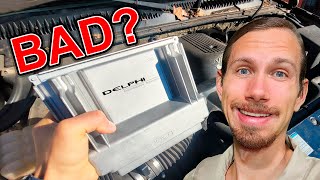
🎬 Watch: 11 common symptoms of a failing engine control module.- Check Engine Light is on
- Engine will not start (cranks but won't fire)
- Engine stalls intermittently or immediately after starting
- Reduced engine power or 'limp mode'
- Transmission shifting issues
- ABS or Traction Control lights may also illuminate
- Erratic gauge behavior or flickering dashboard lights
- Loss of communication with the scan tool
- Replacing sensors like the crankshaft or camshaft position sensor. While a bad ECM can cause symptoms that mimic other failures, the P0605 code specifically points to an internal module fault, not an external sensor.
Most Likely Causes
- Internal Failure of the Engine Control Module (ECM/PCM) 🔴 High Probability → Shop Engine Control Module (ECM) After many years and thousands of heat cycles in the engine bay, the internal electronic components and solder joints of the E38 ECM can degrade and fail. Voltage spikes from jump starts or a failing alternator can also cause permanent damage to the ROM chip.
How to confirm: After confirming all power, ground, and data lines to the ECM are intact and providing correct voltage, the ECM itself is condemned. This is a process of elimination. A professional may attempt a reflash first, but if it fails or the code returns, the module is bad.
Typical fix: Replace the Engine Control Module and program the new unit to the vehicle.
Est. part cost: $300-$800 - Poor Power or Ground Supply to the ECM 🟡 Medium Probability GMT900 trucks are known to develop corrosion on key ground points over time. The main ECM grounds are on the engine block/cylinder heads, and body-to-frame grounds can also become weak, leading to unstable voltage that can corrupt the ECM's memory or trigger a false code.
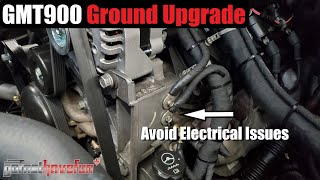
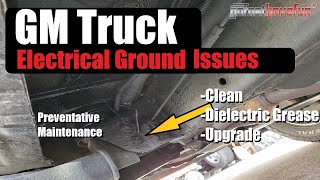
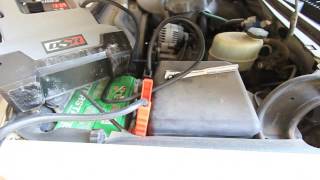
How to confirm: Test battery voltage (~12.6V off, ~14V+ running). Perform a voltage drop test on the ECM's main power and ground circuits. Check and clean the primary ground locations: battery to engine block, firewall straps, and the specific ECM grounds on the front/rear of the cylinder heads. 🎬 See how to upgrade your GMT900 grounds to prevent electrical issues.
Typical fix: Clean battery terminals and all major ground connection points with a wire brush and apply dielectric grease. Replace a weak battery or failing alternator. Some owners add redundant ground straps to improve reliability.
Est. part cost: $20-$600 - Damaged Wiring or Connectors ⚪ Low Probability While less common, engine bay vibrations, heat, or rodent damage can compromise the wiring harness leading to the ECM. The large connectors on the ECM can also accumulate moisture or corrosion if the weather seals fail.
How to confirm: Visually inspect the ECM connectors (unplug them with the battery disconnected) and associated wiring for any signs of corrosion, moisture, pin damage, or physical damage like chafing.
Typical fix: Repair the damaged section of the wiring harness or clean/replace the affected connector.
Est. part cost: $10-$200
Rare But Worth Checking
- Failed Aftermarket Tune or Programming: If the ECM was recently reprogrammed with an aftermarket tune and this code appeared, the flash may have been corrupted, was incompatible, or a low battery during the flash caused an incomplete write, triggering the ROM error.
Diagnosis Steps
- Scan for all diagnostic trouble codes. Note any other codes present, but prioritize P0605 as it can cause other codes to set.
- Check the battery. Ensure it is fully charged (approx. 12.6 volts) and the terminals are clean and tight. A weak battery can cause various electrical faults.
- With the engine running, check the alternator output. It should be stable, between 13.7 and 14.7 volts. Unstable voltage or excessive AC ripple can damage electronics.
- Thoroughly inspect, clean, and tighten all major ground connections. Key locations on a GMT900 include the negative battery cable to the engine block, the braided straps from the firewall to the cylinder heads, and the frame grounds.
- Disconnect the battery. Unplug the ECM connectors and inspect for corrosion, bent pins, or moisture intrusion. Clean with electrical contact cleaner if necessary.
- Visually inspect the wiring harness leading to the ECM for any signs of chafing, melting, or rodent damage.
- If all wiring, power, and grounds are confirmed to be good, a professional may attempt to reflash the ECM with the latest factory software. This can sometimes fix a software glitch.
- If a reflash is unsuccessful or the code immediately returns, the ECM is faulty and must be replaced and programmed.
Parts You'll Likely Need
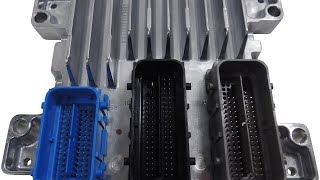
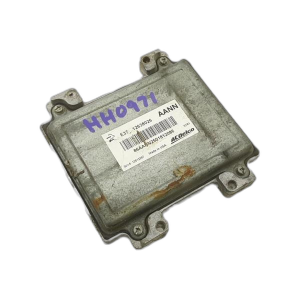
- Engine Control Module (ECM)
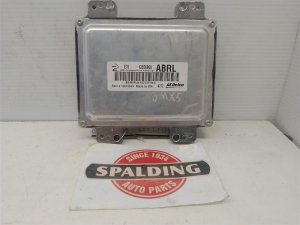
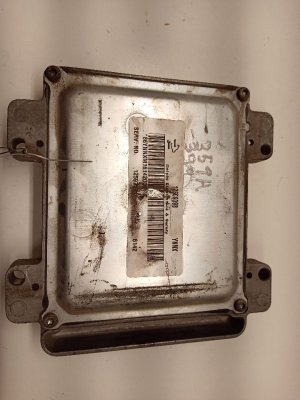
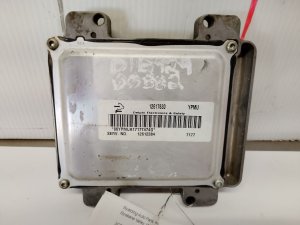
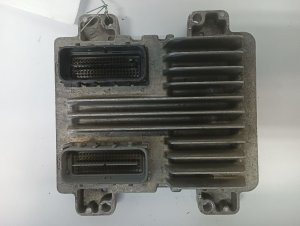
(OEM #12612384, 12625455, 12630500 (Service numbers vary by year/engine, always match to original))— This code most often indicates an internal, unrecoverable hardware or software failure within the ECM itself, making replacement the only viable solution after ruling out external factors.
Trusted brands: ACDelco (OEM Remanufactured), Dorman (Remanufactured), Cardone (Remanufactured)
OEM price range: $400-$800
Aftermarket price range: $300-$600
Related Codes That Often Appear With This One
- P0604 — This code indicates a RAM (Random Access Memory) error, another type of internal memory fault within the control module.
- P0606 — This code indicates a general ECM/PCM Processor Fault, which is closely related to the P0605 ROM error.
- U-series codes (e.g., U0100) — If the ECM is failing, it may lose communication with other modules on the vehicle's data network (CAN bus), triggering communication loss codes.
Technical Service Bulletins (TSBs) & Recalls
- No specific TSBs for P0605 were found, as this code typically leads to a standard diagnostic procedure ending in ECM replacement. However, numerous TSBs exist for related issues like ECM reprogramming and for the common platform problems listed below.
Platform-Specific Known Issues
- A user on a Reddit forum r/MechanicAdvice noted that after getting a P0605 code, they were advised that if the code does not clear with a scan tool after a battery disconnect, the computer needs replacement.
- Forum discussions for GM trucks emphasize that before replacing the ECM, checking all ground points is crucial. A video by AnthonyJ350 on YouTube demonstrates adding redundant grounds to the GMT900 platform to prevent electrical issues that could lead to codes like P0605.
Mechanic-Grade Diagnostic Values
- ECM Power Supply Voltage (Closed Circuit) — expected: 12.0 - 14.8 V. Failure: A reading less than 12.6V (or battery voltage) indicates a voltage drop on the power or ground side of the circuit. A reading of 0V with the key on points to an open circuit or a complete short to ground.
- ECM Ground Circuit Resistance — expected: ≤ 1.0 Ω to a known good chassis ground. Failure: High resistance (anything over 1.0 ohm) indicates a corroded or loose ground connection, which can cause intermittent and strange electrical behavior.
- Voltage Drop Test (Power or Ground Side) — expected: < 0.5 V. Failure: A voltage drop of more than 0.5V between the battery post and the corresponding ECM pin (while the circuit is under load) indicates excessive resistance in the wiring or connections.
Scan Tool Commands That Help
- GM GDS2/Tech2: SPS (Service Programming System) — This is required to flash a new or used replacement ECM. It downloads the correct VIN-specific calibration from GM's servers and programs it to the module. An aftermarket tool cannot overwrite all necessary calibration segments on a used module.
- Professional Scan Tool (e.g., iCarsoft CR MAX): Control Unit Reset / Module Reboot — In cases where a temporary software glitch or low voltage event caused the P0605, a module reboot command can sometimes restore functionality without a full reflash. This is a low-probability fix but is worth attempting before replacement.
- Professional Scan Tool (e.g., iCarsoft CR MAX): ROM Data Verification — This function compares the checksum of the software on the module to the expected OEM value. A mismatch confirms the P0605 diagnosis of corrupted ROM.
Wiring & Ground Locations
- E38 ECM Connector X1 (J1) and X2 (J2) — Typically mounted on the driver's side of the engine bay, near the firewall or inner fender.. These are the main connectors for the ECM. Power and ground pins must be tested here. Key pins for testing include X1 Pin 19 & 20 (Battery Voltage), X1 Pin 47 (Ignition Voltage), and X2 Pin 73 (Ground).
- G103 — On the front of the passenger side (right) cylinder head.. This is a primary engine ground point. Corrosion or looseness here can cause unstable voltage to the ECM and other critical components, potentially triggering a P0605.
- G102 / G104 — Located on the rear of the driver's side (left) cylinder head.. This is another critical engine-to-chassis ground point. It grounds multiple systems, and a poor connection can lead to widespread electrical issues, including ECM faults.
- G100 / G101 — Located on the lower left and lower right of the radiator core support, respectively.. These are primary forward body grounds. While less directly tied to the ECM than engine grounds, poor connections here can contribute to overall electrical instability in the vehicle.
Real Owner Repair Stories
- EFILive Forum user (2007 5.3L V8 (standalone harness build)) — No communication with scan tool ('ERROR-VEHICLE NOT DETECTED'), no throttle pedal response, but fuel pump primed and throttle body cycled at key-on.
❌ Tried (didn't work) Checked continuity on all harness wires 10 times., Verified power at ECM pins 19, 20, and 47., Verified ground at ECM pin 73., Checked GMLAN data bus wires (pins 27, 28) for continuity., Attempted to clear DTCs on a bench harness, but they would not clear.
✅ What actually fixed it The user discovered that the ECM requires *two* separate ground connections to function correctly in a standalone setup. After adding a second ground wire from the harness to the ECM body itself, the scan tool connected, and the throttle pedal began working. This highlights the critical nature of having all specified grounds connected and clean.
OEM Part Supersession History
Varies (e.g., 12612384)→Varies (e.g., 12630500, 12633238)— Hardware and internal logic updates by GM over the production run.
Heads up: You cannot flash a calibration from a newer year (e.g., 2010) onto an older hardware ECM (e.g., 2008). Attempting to do so will 'brick' the module, making it unusable. The service number (SERV #) on the replacement ECM must be compatible with the vehicle's model year and original calibration.
Model Year Variations Within This Range
- 2007-2008 vs 2009+ : The 4-speed 4L60-E transmission was used in 2007-2008 models, while the 6-speed 6L80 was introduced in 2009. This affects the ECM calibration related to the transmission. While the P0605 diagnostic is the same, ensuring the replacement ECM is programmed for the correct transmission is critical.
- 2007-2009 vs 2010+: The E38 ECM underwent hardware revisions. An ECM from a 2010 or newer truck is physically different and not backward-compatible with a 2007-2009 truck, even with programming. You cannot simply flash an older OS onto a newer ECM or vice-versa.
Diagnostic Flowchart
Other Known Issues on This Vehicle
Issues unrelated to this code that are worth knowing about as an owner of this generation:
- Active Fuel Management (AFM/DOD) Lifter Failure 🔴 High — Very common, especially on 5.3L and 6.2L V8s, typically appearing after 80,000 miles. Can lead to misfires, engine noise (ticking), and eventually camshaft damage. (Ref: Multiple TSBs have been issued by GM regarding oil consumption and lifter noise, often recommending updated parts or oil deflectors.)
- Cracked Upper Dashboard 🟠 Medium — Extremely common across all GMT900 trucks and SUVs. Cracks typically form near the passenger airbag and over the instrument cluster due to material defects. (Ref: No recall was ever issued. A class-action lawsuit was dismissed, leaving owners to pay for repairs, which often involve a replacement dash or a less expensive dash cover.)
- Excessive Oil Consumption 🟠 Medium — Common on 2007-2011 models with the 5.3L V8, often linked to the AFM system and piston ring design. Owners report consuming 1-2 quarts of oil between changes. (Ref: GM issued TSBs (like #10-06-01-008G) that involved installing an updated valve cover and, in some cases, performing a piston soak or piston/ring replacement.)
Used vs. New Parts: Buying Guide for This Vehicle
When a used part is the smart pick: A used ECM from a reputable salvage yard or recycler can be a cost-effective option, but ONLY if you have access to a professional with a GM SPS (Service Programming System) subscription. A used ECM is VIN-locked and will not start the vehicle until it is completely reprogrammed to the new vehicle's VIN and security information.
Donor-vehicle mileage cap: roughly under 150000 miles for the part to have meaningful remaining life.
What to inspect on the donor part:
- Match the 'Service Number' (SERV #) on the donor ECM case exactly to your original unit.
- Inspect the connectors for any signs of corrosion, moisture damage, or bent pins.
- Source the part from a vehicle that was not involved in a flood or fire.
- Ensure the donor vehicle has a similar powertrain (engine and transmission) to yours.
OEM-only on this vehicle (don't cheap out):
- Engine Control Module (ECM) - While remanufactured units from brands like Cardone or Dorman exist, the most reliable path is an ACDelco remanufactured unit or a used OEM unit that is professionally reprogrammed. Programming compatibility is the biggest hurdle.
Aftermarket brands forum-validated for this vehicle:
- Flagship One (FS1)
- SPS-programmed ACDelco (Remanufactured)
Brands owners have reported issues with on this vehicle:
- Untested eBay or Amazon sellers offering 'plug and play' units without requiring a VIN. These often fail or cause other issues.
Real Owner Stories
Aggregated from forums and TSBs cited above. Mileages and costs reflect what owners reported in those sources.
2011 GMC Sierra
Symptoms: The owner experienced a no-start condition along with the P0605 trouble code.
What fixed it: The issue was ultimately resolved by replacing the ECM.
Source hint: silveradosierra.com thread titled 'p0605-ecm-rom-error.731301/'
Related OBD-II Codes
Frequently Asked Questions
Where are the most important ground locations to check for a P0605 code on my 2007-2013 Sierra?
My truck cranks but won't start and is showing a P0605. Does this mean I need a new ECM for sure?
Can a bad alternator or a jump-start cause the P0605 ROM error on this truck?
Along with the Check Engine Light for P0605, my ABS and Traction Control lights are also on. Are these problems related?
A mechanic suggested 'reflashing' the ECM to fix the P0605. Is this a reliable fix?
Does this P0605 issue also affect the Chevy Silverado or Tahoe from the same years?
Helpful Videos
Used OEM Parts in Stock
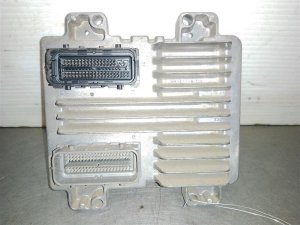
New Aftermarket Parts Available



The information in this article is provided for general reference and educational purposes only. Vehicle specifications, procedures, and part compatibility can vary by production date, trim level, and region. Always consult your vehicle's factory service manual and verify part numbers before purchasing or performing repairs. Safety-critical components such as airbags, seat belts, and braking systems should be installed by a qualified professional.
- GMC Sierra:
- 🧭 Diagnostic Flowchart
- 🎬 Helpful Videos
- 🛍️ Shop This Part
- What's Unique About the 2007-2013 GMC Sierra
- Symptoms You May Notice
- Most Likely Causes
- Rare But Worth Checking
- Diagnosis Steps
- Parts You'll Likely Need
- Related Codes That Often Appear With This One
- Technical Service Bulletins (TSBs) & Recalls
- Platform-Specific Known Issues
- Mechanic-Grade Diagnostic Values
- Scan Tool Commands That Help
- Wiring & Ground Locations
- Real Owner Repair Stories
- OEM Part Supersession History
- Model Year Variations Within This Range
- Other Known Issues on This Vehicle
- Used vs. New Parts: Buying Guide for This Vehicle
- Real Owner Stories
- 2011 GMC Sierra
- Related OBD-II Codes
- Frequently Asked Questions
- 🎟️ Get 5% Off