

P0605 on 2002-2007 Jeep Liberty: Internal PCM Failure Causes and Fixes
On a 2002-2007 Jeep Liberty, P0605 almost always means the Powertrain Control Module (PCM) has failed its internal self-test and needs to be replaced. Before replacing it, always check the battery, charging system, and all power/ground wiring to the PCM first, as voltage irregularities can sometimes trigger this code.
- P0605 is a critical code indicating an internal failure of the Jeep Liberty's main computer (PCM).
- The most common symptoms are severe: engine stalling or a complete no-start condition, making the vehicle unsafe to drive.
- While you should always rule out simple issues like a bad battery or corroded ground wires first, the ultimate fix is almost always replacing the PCM.
- PCM replacement requires special programming to match your vehicle's VIN, so it is often a job for a professional shop or a specialist who can provide a pre-programmed unit.
What's Unique About the 2002-2007 Jeep Liberty
For the first-generation (KJ) Jeep Liberty, the P0605 code is a straightforward but serious issue. The PCM is located on the driver's side inner fender, between the battery and the firewall, where it is susceptible to heat and potential moisture. Unlike some vehicles where this code can be triggered by complex software or network issues, on the Liberty it typically points directly to a hardware problem within the module itself. Owners often report sudden no-start or stalling conditions with this code, confirming the severity of the internal failure. The issue is not unique to a specific engine, affecting the 3.7L V6, 2.4L I4, and 2.8L CRD models.
Symptoms You May Notice
- Engine will not start or has a no-crank condition. 🎬 Watch: Step-by-step diagnosis for a no-start engine
- Engine stalls unexpectedly while driving.
- Check Engine Light is on and may be blinking.
- Vehicle enters "limp mode," with reduced power and erratic shifting.
- Rough idling or engine misfires.
- Problems with shifting or transmission function.
- Loss of communication with the PCM, which may trigger other codes like U0100.
- ABS or Traction Control lights may illuminate.
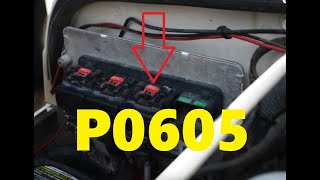
- Replacing sensors or ignition components. While a failing PCM can cause symptoms like misfires, the P0605 code specifically points to an internal computer fault, not an external sensor. 🎬 Watch: Understanding the P0605 ROM error code Always diagnose the P0605 code first before chasing other symptoms.
Most Likely Causes
- Failed Powertrain Control Module (PCM) 🔴 High Probability → Shop Engine Control Module (ECM) Internal hardware failure from age, heat cycles, or voltage stress is the most common reason for this code on older vehicles like the Liberty. The PCM's location on the inner fender exposes it to significant under-hood heat.
How to confirm: After verifying all power, ground, and network circuits to the PCM are intact and functioning correctly, the P0605 code itself condemns the PCM. A professional scan tool may have a module self-test or checksum verification that will fail.
Typical fix: Replace the Powertrain Control Module. The new or remanufactured unit must be programmed to the vehicle's VIN and SKIM (Sentry Key Immobilizer Module) information.
Est. part cost: $250-$800 - Low Battery Voltage or Charging System Fault 🟡 Medium Probability → Shop Vehicle Battery A weak battery or failing alternator can cause voltage spikes or drops that may disrupt the PCM's self-test during startup, triggering a P0605 code even if the PCM is not permanently damaged. There are owner reports of this code appearing immediately after a battery failure.
How to confirm: Test the battery with a load tester. It should read above 12.4V at rest. With the engine running, check the alternator output at the battery terminals; it should be between 13.5V and 14.8V. Ensure battery terminals are clean and tight.
Typical fix: Replace the battery and/or alternator if they fail testing. Clean or tighten battery connections.
Est. part cost: $150-$400 - Poor Power or Ground Connection to PCM ⚪ Low Probability Over time, ground straps can corrode and wiring connections can become loose, causing intermittent voltage supply to the PCM. The main PCM ground circuits are critical for stable operation.
How to confirm: Visually inspect all PCM connectors for corrosion, moisture, or damage. Use a multimeter to perform a voltage drop test on the PCM's main power and ground wires to ensure there is minimal resistance. Check for solid ground at the PCM mounting bolts and at key chassis ground points like G100 and the straps from the cylinder heads to the firewall.
Typical fix: Clean corroded ground points (including the PCM case mounting points), repair damaged wires, and re-seat or replace faulty connectors.
Est. part cost: $10-$50
Rare But Worth Checking
- Failed Software Update (Reflash): If the code appeared immediately after a failed attempt to update or reprogram the PCM, the software may be corrupted. In some cases, a successful reflash can fix it, but often it indicates the module is not accepting the new software and is faulty.
Diagnosis Steps
- Verify the code: Use an OBD-II scanner to confirm that P0605 is the active code. Note any other codes that are present, especially U-series (communication) or P0700 (transmission) codes.
- Check the battery and charging system: This is a critical first step. Load test the battery and verify its health. Start the engine (if possible) and verify the alternator is charging correctly (13.5V-14.8V). Clean and tighten battery terminals. A low or unstable voltage source is a known cause of false module errors.
- Inspect PCM connections: Disconnect the battery. Locate the PCM on the driver's side inner fender. Carefully inspect its four electrical connectors (one may be unused) for any signs of corrosion, moisture, or bent/damaged pins.
- Verify Power and Grounds: Using a multimeter and the vehicle's wiring diagram, check for proper battery voltage at the PCM's power input pins and for a solid ground connection (less than 0.1 ohms of resistance) at the ground pins. Also confirm the PCM case itself is well-grounded via its mounting bolts. Pay special attention to ground points G100 (below PCM) and the two straps from the cylinder heads to the firewall.
- Attempt a Hard Reset: Disconnect both battery terminals and touch them together for 30 seconds to drain any residual power from the modules. Reconnect and see if the code returns. This rarely fixes a true ROM error but is an easy and quick step to rule out a temporary glitch.
- Condemn the PCM: If the battery, charging system, and all power/ground connections to the PCM are confirmed to be good, the P0605 code confirms that the PCM itself has an internal, non-serviceable fault and must be replaced.
Parts You'll Likely Need
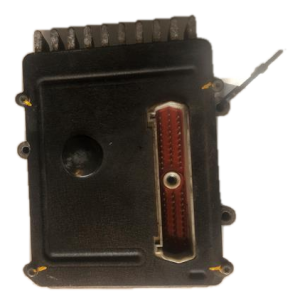
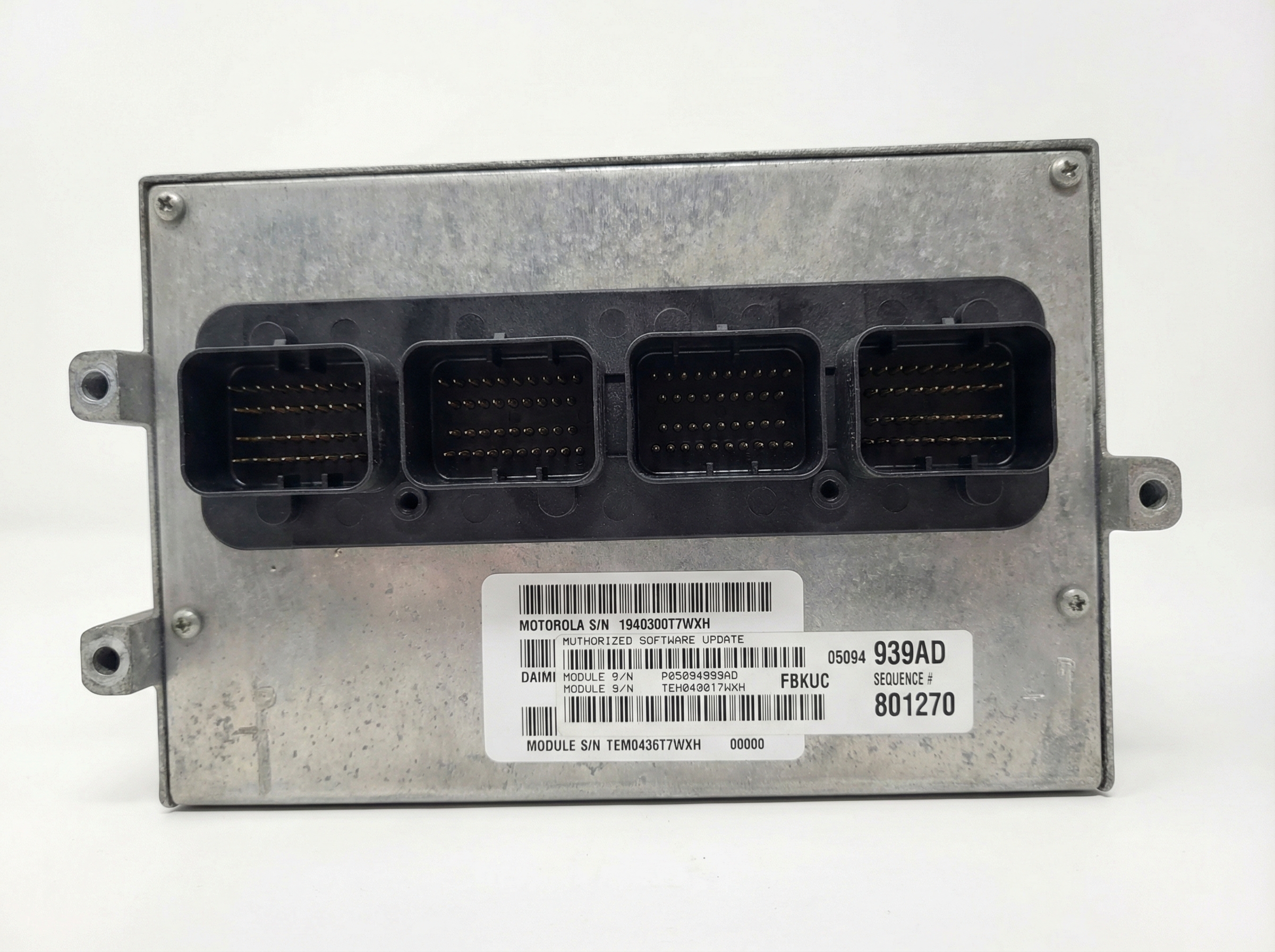
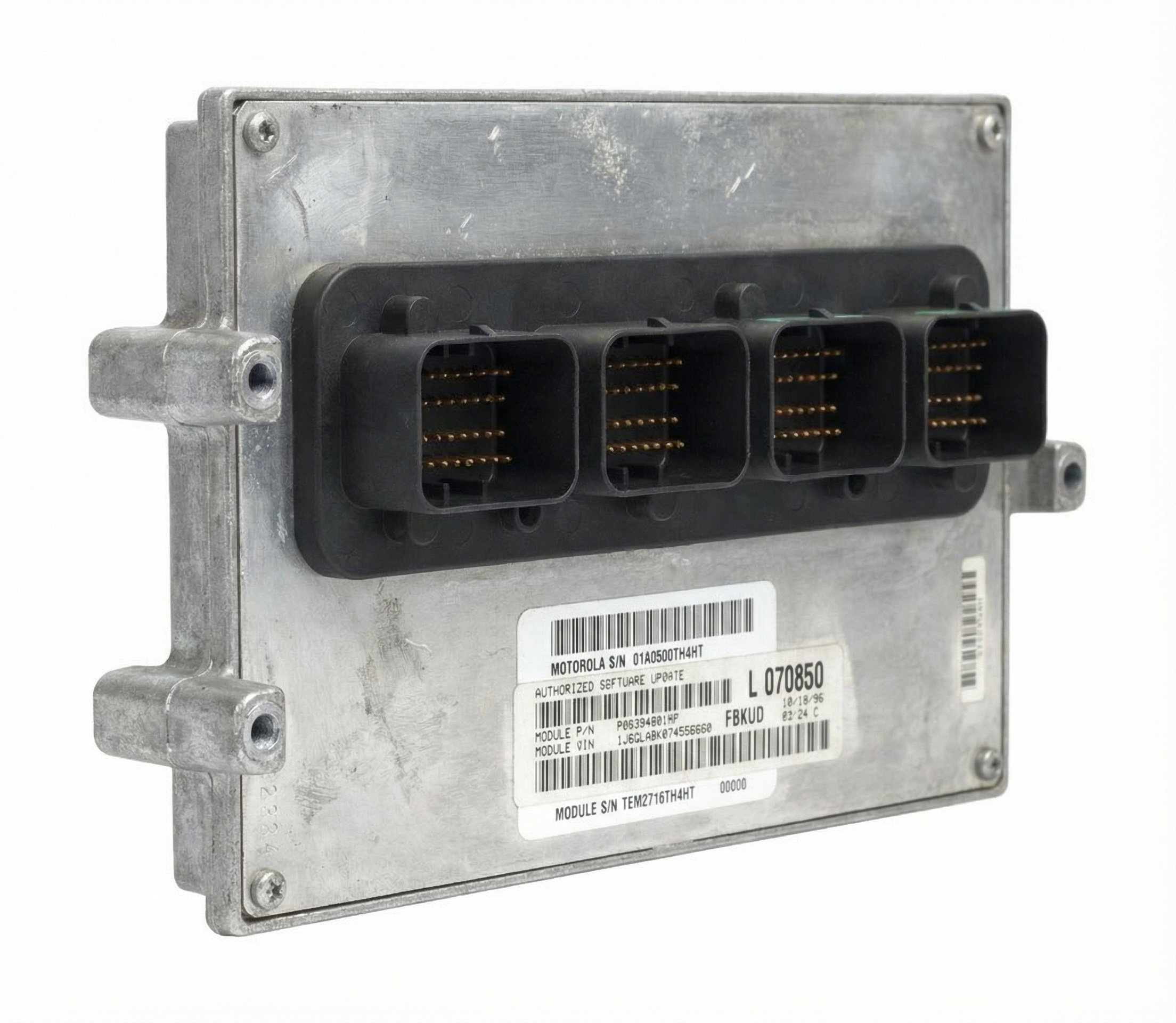
- Powertrain Control Module (PCM)
(OEM #Example PNs: 56044568AE, 56044560AF, R6044704AI (Part numbers are highly specific to year, engine, transmission, and emissions. Always verify with VIN).)— This is the most common cause of a P0605 code, indicating a fatal internal error.
Trusted brands: Mopar (OEM/Remanufactured), Cardone (Remanufactured), Flagship One, Solo Auto Electronics
OEM price range: $600-$1000
Aftermarket price range: $250-$500
Related Codes That Often Appear With This One
- P0700 — This code is set by the engine controller (PCM) when the Transmission Control Module (TCM) has requested the Check Engine Light to be turned on. On some Liberty models like the 2.8L CRD, the TCM is a separate module, and an internal TCM fault can also log a P0605, which then triggers the P0700 in the PCM.
- U0100 — This code means 'Lost Communication With ECM/PCM.' If the PCM is failing internally, it may stop communicating with other modules on the vehicle's data network, causing them to report this code.
- P0606 — This code for 'ECM/PCM Processor Fault' is very similar to P0605 and points to a severe internal hardware failure. They can sometimes appear together when the PCM is failing.
Technical Service Bulletins (TSBs) & Recalls
- 18-042-14 - Generic Powertrain Control Module (PCM) Procedure. This TSB outlines the process for programming a generic replacement PCM, which is relevant to the fix for P0605.
- TSB 18-03-05 - While not directly for P0605, this TSB for flashing the PCM to address other issues highlights the importance of proper programming procedures. A failed flash can cause a P0605 error.
Platform-Specific Known Issues
- The PCM is located on the driver's side inner fender, a location that experiences significant heat from the engine and exhaust manifold, which can contribute to premature failure over time.
- On 2.8L CRD (diesel) models, the P0605 code can originate in the Transmission Control Module (TCM) rather than the PCM, but will still cause the check engine light to come on via a P0700 code stored in the PCM.
Mechanic-Grade Diagnostic Values
- PCM Ground Circuit Voltage Drop — expected: ≤ 0.1 Volts. Failure: A reading greater than 0.3V indicates unacceptable resistance from corrosion or a faulty wire.
- Alternator Output Voltage at Battery — expected: 13.5V - 14.8V with engine running. Failure: Voltage below 13.5V may indicate a weak alternator; voltage above 14.8V can damage electronic modules.
- Battery Voltage at Rest — expected: ≥ 12.4 Volts. Failure: A reading below 12.4V indicates a discharged or failing battery that cannot provide stable voltage for the PCM's self-test.
Scan Tool Commands That Help
- Chrysler DRB III: PCM Replacement / Initialize VIN — This function is required after installing a new or used PCM. It transfers the vehicle's unique Secret Key data from the Sentry Key Immobilizer Module (SKIM) to the new PCM and programs the VIN. Without this step, the vehicle will not start.
- Chrysler DRB III: Module Scan — After performing a PCM flash or replacement, a DTC may be set in other modules (TCM, BCM, SKIM). This function scans all modules for codes, which should be recorded and then erased to prevent false diagnostics.
- Chrysler DRB III: Vehicle Flash — Used to download updated calibration software from the DRB III tool to the vehicle's control module. This is the procedure that, if it fails, can cause a P0605 code.
Wiring & Ground Locations
- PCM — Driver's side inner fender, between the battery and the firewall.. This is the module that has failed. Its location exposes it to heat and potential moisture, which are contributing factors to failure. Its connectors and case grounding must be perfect.
- G100 — On the chassis, just below the PCM on the driver's side inner fender.. This is a primary chassis ground point. Corrosion or looseness here can cause unstable voltage to the PCM and other critical components, potentially triggering a false P0605 or contributing to PCM failure.
- Cylinder Head Ground Straps — Two braided straps running from the rear of the cylinder heads to the firewall.. These are critical engine-to-chassis grounds. If they are corroded, broken, or loose, the PCM and its sensors can experience erratic ground paths, leading to a host of electrical issues including module damage.
Real Owner Repair Stories
- Reddit user Just_Protection_9206 (Jeep Liberty (year not specified, but within KJ generation)) — Hesitation on start, then a no-start, no-crank condition with a single click. Blinking check engine light with code P0605.
❌ Tried (didn't work) Replacing the battery. The vehicle started once with the new battery but then failed to start again shortly after.
✅ What actually fixed it The thread concluded with the diagnosis pointing toward a failed PCM, likely damaged by the preceding battery/charging system issues. The final fix, though not explicitly posted by the original user, is the replacement of the PCM, as the new battery did not resolve the no-crank and P0605 code.
Model Year Variations Within This Range
- 2005-2007: The 2005 model year introduced a refresh for the Liberty KJ. While the core P0605 diagnosis remains the same, there were wiring and module changes. For example, the 2.8L CRD diesel engine was introduced, bringing with it a separate TCM that can set its own P0605. Always use a wiring diagram specific to the vehicle's exact year.
- 2002-2004 vs 2005-2007: The Sentry Key Immobilizer System (SKIS) is present across the generation, but programming procedures and interactions between the SKIM, PCM, and keys can have subtle differences. The dealer-level DRB III scan tool is required for programming throughout the generation, but the software version and specific steps may vary.
Diagnostic Flowchart
Other Known Issues on This Vehicle
Issues unrelated to this code that are worth knowing about as an owner of this generation:
- Power Window Regulator Failure 🔴 High — Extremely common; the plastic clips and drive mechanism are known to break frequently, causing the window to drop into the door.
- Front Lower Ball Joint Failure 🔴 High — Subject to multiple safety recalls (e.g., NHTSA 03V460000, F23). The ball joints can wear prematurely, leading to separation and a loss of steering control. (Ref: Recalls: 03V460000, F23, U38)
- 3.7L Engine Dropped Valve Seats 🔴 High — A known issue, particularly if the engine overheats. The valve seats can dislodge from the cylinder head, causing a severe misfire and catastrophic engine damage.
- 42RLE Automatic Transmission Problems 🟠 Medium — Common issues include entering 'limp mode' (stuck in 2nd gear), delayed shifts, and solenoid pack failure.
- Cracked Exhaust Manifolds 🟠 Medium — The cast iron manifolds are prone to cracking from heat cycles, causing an exhaust leak and a ticking noise, especially when cold.
- Rear Suspension Lower Control Arm Corrosion 🔴 High — Affects 2004-2007 models, especially in salt-belt regions. The control arms can rust and fracture, leading to a loss of vehicle control. Subject to safety recall U38 / NHTSA 18V-278. (Ref: Recall: U38 / NHTSA 18V-278)
Used vs. New Parts: Buying Guide for This Vehicle
When a used part is the smart pick: A used PCM from a junkyard is a risky but potentially budget-friendly option ONLY IF you have access to a Chrysler DRB III scan tool or a shop that can perform the SKIM/VIN programming. Without programming, a used PCM is a paperweight. Some services can perform a 'SKIM delete' on your existing PCM or a donor, which is another route for using non-new parts.
Donor-vehicle mileage cap: roughly under 150000 miles for the part to have meaningful remaining life.
What to inspect on the donor part:
- Match the part number EXACTLY. There are dozens of variations for year, engine, transmission, and emissions.
- Inspect the connectors for any signs of corrosion, bent pins, or water damage.
- If possible, get the VIN of the donor vehicle to aid in programming.
- Ask for the original keys from the donor vehicle; sometimes the transponder information can be useful, though not always required if reprogramming.
- Avoid modules from vehicles with flood or fire damage.
OEM-only on this vehicle (don't cheap out):
- Powertrain Control Module (PCM). While aftermarket 'remanufactured' units are available, their quality is highly variable. Many are simply used units from junkyards that have been cleaned and tested, not truly rebuilt. For a critical, hard-to-diagnose part like the PCM, a Mopar remanufactured unit or a new unit from the dealer (if available) offers the highest chance of success.
Aftermarket brands forum-validated for this vehicle:
- Mopar (Remanufactured)
- Cardone (Mixed reviews, but a long-standing option)
- Flashmasters (Mentioned positively in forum contexts for other Jeep models)
Brands owners have reported issues with on this vehicle:
- Flagship One (FS1): Widely reported issues with long shipping times, receiving incorrect or non-programmed units, poor customer service, and difficulty with warranty claims.
- Car Computer Exchange: Some users report positive experiences, but others cite receiving non-working parts and difficulty with returns.
Real Owner Stories
Aggregated from forums and TSBs cited above. Mileages and costs reflect what owners reported in those sources.
2002-2007 Jeep Liberty
Symptoms: The vehicle experienced a no-crank condition and the P0605 code appeared immediately after dealing with a bad battery.
What fixed it: The source suggests the voltage issue from the bad battery either damaged the PCM or triggered a persistent false code requiring PCM evaluation.
Source hint: Reddit r/JeepLiberty - https://www.reddit.com/r/JeepLiberty/comments/wocq6i/p0605_code/
2.8L Diesel Jeep Liberty
Symptoms: The Check Engine Light (MIL) was on and the vehicle had trouble shifting.
What fixed it: The P0605 error was located in the Transmission Control Module (TCM), accompanied by a P0700 code in the PCM.
Source hint: Jeep KJ and KK Liberty Forum - https://www.jeepkj.com/threads/p0605-mil-on-and-trouble-shifting.77667/
2002-2007 Jeep Liberty
Symptoms: The owner experienced confusion as the code would return immediately after clearing, indicating a hard fault rather than a temporary glitch.
What fixed it: The internal ROM error (P0605) typically requires replacement of the PCM, programmed to the vehicle's VIN and SKIM.
Source hint: Jeep KJ and KK Liberty Forum - https://www.jeepkj.com/threads/p0605-internal-control-module-rom-pcm-or-tcm.79093/
Related OBD-II Codes
Frequently Asked Questions
Where is the PCM located on my 2002-2007 Jeep Liberty, and why does it fail?
Can a bad battery really cause a P0605 code on my Jeep?
I have a 2.8L CRD diesel Liberty with P0605 and P0700; do I need a new engine computer?
Does TSB 18-042-14 apply to the P0605 fix?
What ground points should I check on my Liberty before replacing the PCM?
Will a simple 'hard reset' fix the P0605 internal ROM error?
Helpful Videos
We Have This Part in Stock

The information in this article is provided for general reference and educational purposes only. Vehicle specifications, procedures, and part compatibility can vary by production date, trim level, and region. Always consult your vehicle's factory service manual and verify part numbers before purchasing or performing repairs. Safety-critical components such as airbags, seat belts, and braking systems should be installed by a qualified professional.
- Jeep Liberty:
- 🧭 Diagnostic Flowchart
- 🎬 Helpful Videos
- 🛍️ Shop This Part
- What's Unique About the 2002-2007 Jeep Liberty
- Symptoms You May Notice
- Most Likely Causes
- Rare But Worth Checking
- Diagnosis Steps
- Parts You'll Likely Need
- Related Codes That Often Appear With This One
- Technical Service Bulletins (TSBs) & Recalls
- Platform-Specific Known Issues
- Mechanic-Grade Diagnostic Values
- Scan Tool Commands That Help
- Wiring & Ground Locations
- Real Owner Repair Stories
- Model Year Variations Within This Range
- Other Known Issues on This Vehicle
- Used vs. New Parts: Buying Guide for This Vehicle
- Real Owner Stories
- 2002-2007 Jeep Liberty
- 2.8L Diesel Jeep Liberty
- 2002-2007 Jeep Liberty
- Related OBD-II Codes
- Frequently Asked Questions
- 🎟️ Get 5% Off