

P0605 on 2009-2013 Nissan Maxima: ECM Failure or Simple Brake Switch Fix?
On a 2009-2013 Nissan Maxima, the P0605 code is often not a catastrophic ECM failure, but rather a misadjusted or faulty cruise control (ASCD) brake switch. This is a very inexpensive part and a simple fix that can be done at home, a fact corroborated by numerous owner experiences and a specific Nissan TSB.
- Do not assume P0605 means you need a new ECM on your 2009-2013 Maxima.
- The most likely cause is a simple, inexpensive ASCD brake switch that is either out of adjustment or has failed.
- Always check Nissan TSB NTB13039 before authorizing any expensive repairs for this code.
- Symptoms include a non-functional cruise control, stalling, or a no-start condition.
- Adjusting or replacing the brake switch is a DIY-friendly job that can save you hundreds of dollars. Proper adjustment is critical.
What's Unique About the 2009-2013 Nissan MAXIMA
For the 7th generation Nissan Maxima and its platform mates, the vehicle's diagnostic logic is particularly sensitive. It can interpret a simple, inexpensive mechanical switch problem at the brake pedal as a catastrophic internal computer failure. This leads many to mistakenly diagnose a bad ECM, which is a very expensive repair, when the actual solution is often a simple switch adjustment or replacement as outlined by Nissan's own service bulletin, NTB13039.
Diagnostic Flowchart
Tap your situation to follow the diagnostic path that matches what you're seeing on this vehicle.
Symptoms You May Notice
- Check Engine Light is on
- Cruise control does not work or will not set
- "CRUISE" indicator may stay on while the "SET" indicator flashes
- Engine may stall or hesitate, sometimes randomly while driving
- Vehicle may not start intermittently (push-button start fails to engage 🎬 Watch: Troubleshooting a no-start and key FOB indicator issue)
- Inability to shift the vehicle out of Park
- Extended engine cranking before starting
- Replacing the Engine Control Module (ECM) before inspecting and adjusting the ASCD brake switch. The TSB from Nissan explicitly advises checking the switch first to avoid this costly and unnecessary repair.
Most Likely Causes
- Improperly Adjusted or Faulty ASCD Brake Switch 🔴 High Probability → Shop Combination Switch Nissan issued TSB NTB13039 specifically to address this common issue, indicating a known sensitivity in the system's design across all 2009+ models.
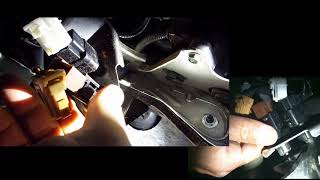
How to confirm: Inspect the brake switch located at the top of the brake pedal arm. Check for proper clearance and that it operates correctly. The adjustment is critical; if threaded in too far or not far enough, it can cause issues.
Typical fix: Adjust the switch's position or replace it. A detailed adjustment procedure is: turn the switch 45 degrees counterclockwise to unlock, pull the brake pedal back while pushing the switch into its bracket until the threaded portion touches its stop, and then turn the switch 45 degrees clockwise to secure it. Often, simply cleaning the internal contacts can also resolve the issue.
Est. part cost: $15-$60 - Faulty Engine Control Module (ECM) ⚪ Low Probability → Shop Engine Control Module (ECM)
How to confirm: This should only be considered after the ASCD brake switch and its wiring have been thoroughly checked and confirmed to be working correctly. Diagnosis requires advanced scan tools to perform a module self-test. In some rare cases, even after trying a replacement switch, the P0605 code can return, pointing to a legitimate ECM failure.
Typical fix: The ECM must be replaced and programmed specifically for the vehicle's VIN. This is typically done by a dealership or a specialized repair shop. Companies also offer pre-programmed modules.
Est. part cost: $500-$1200 - Low Battery Voltage or Charging System Issues ⚪ Low Probability → Shop Vehicle Battery
How to confirm: Test the battery voltage with a multimeter; it should be above 12.4V with the engine off. With the engine running, the alternator should be charging between 13.5V and 14.5V. Voltage spikes or low voltage can cause a control module to fail its self-test and trigger a P0605 code.
Typical fix: Charge or replace the battery. If the charging voltage is incorrect, diagnose and replace the alternator.
Est. part cost: $150-$400
Rare But Worth Checking
- Wiring or Connector Issues: A poor connection or damaged wire between the ASCD brake switch and the ECM, or in the ECM's main power/ground circuits, can also trigger this code. Water intrusion from a clogged drain can also cause corrosion on PCM connectors. Always inspect the harness for corrosion or damage before replacing expensive components.
Diagnosis Steps
- Read the trouble codes with an OBD-II scanner to confirm P0605 is present. 🎬 See this breakdown of the P0605 internal ROM error code
- Immediately consult Nissan TSB NTB13039, which states this code is likely caused by the ASCD brake switch.
- Locate the ASCD brake switch on the brake pedal assembly. There are two switches; it is the one more towards the driver's side door.
- Inspect the switch for physical damage and ensure it is securely mounted.
- Check the adjustment of the switch. An incorrect installation depth is a common failure point. Per a Nissan parts dealer Q&A, the adjustment involves turning the switch to unlock it, setting the depth against the pedal stop, and turning it again to lock it.
- Test the switch's electrical function with a multimeter to ensure it opens and closes the circuit correctly when the pedal is pressed.
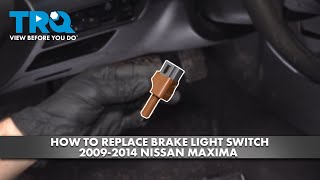
- If the switch is faulty or adjustment doesn't help, replace it. The OEM part is inexpensive. 🎬 Watch: Step-by-step guide to replacing the brake light switch
- If the switch and its adjustment are correct, inspect the wiring and connectors between the switch and the ECM for any signs of damage, corrosion, or looseness.
- Check battery voltage and alternator output to rule out power supply issues.
- As a final step, if all other possibilities have been exhausted, suspect a faulty ECM.
Parts You'll Likely Need
- ASCD Brake Switch / Stop Lamp Switch
(OEM #25320-3JA0A (may be superseded by 25320-3JA0B))— This is the most common cause of code P0605 on this specific vehicle, as identified in Nissan's TSB NTB13039.
Trusted brands: Nissan OE, Hitachi, Standard Motor Products
OEM price range: $25-$60
Aftermarket price range: $15-$45
Technical Service Bulletins (TSBs) & Recalls
- NTB13039: States that improper adjustment or operation of the ASCD brake switch can cause DTC P0605 to store and advises checking it before replacing the ECM. Applies to all 2009+ Nissan models.
Platform-Specific Known Issues
- Nissan TSB NTB13039: Issued for all 2009 and newer Nissan models, this bulletin explicitly states that DTC P0605 can be stored due to an improper adjustment or operation of the ASCD brake switch. It warns that if a malfunction is detected, the 'CRUISE' indicator may stay on and the 'SET' indicator may flash. It strongly advises checking the switch before replacing the ECM.
- Real Forum Story: Intermittent Start & Brake Drag: A user on Maxima Forums with a 2016 model (8th gen, but same principle) detailed a long battle with intermittent starting. Initially suspecting the battery, they found cleaning the brake switch contacts provided a temporary fix. However, improper re-installation (threading the switch in too far) led to a new problem where the car's brakes would seem to seize while driving. The final solution was purchasing a new switch and adjusting it to the correct height, which solved both the starting and brake drag issues. This highlights the critical importance of proper adjustment.
Mechanic-Grade Diagnostic Values
- ECM Power Supply Voltage — expected: 12.0V - 14.8V. Failure: Voltage below 12.0V or spikes above 14.8V can corrupt the ECM's self-test.
- ECM Ground Circuit Resistance — expected: ≤ 0.1 Ω (close to 0). Failure: Higher resistance indicates a poor ground, which can cause erratic ECM behavior.
- ASCD Brake Switch Circuit Continuity — expected: Continuity should exist between ECM terminal 108 and ASCD brake switch terminal 2.. Failure: No continuity indicates an open circuit in the harness.
- ASCD Brake Switch Operation — expected: The switch is ON (circuit closed) when the pedal is released and OFF (circuit open) when the pedal is depressed. This is opposite to the stop lamp switch.. Failure: Switch does not change state, or its logic is reversed, indicating a faulty switch.
Scan Tool Commands That Help
- Nissan CONSULT-III Plus: Data Monitor (Work Support) — To diagnose a potential ASCD switch issue, a technician can use the Data Monitor to select and view all cruise control related inputs (ASCD BRAKE SW, STOP LAMP SW, vehicle speed, etc.) on one screen. This allows for real-time observation of switch states as the pedal is operated to confirm correct function without manual electrical tests.
- Nissan CONSULT-III Plus: ECM Reprogramming — If the P0605 code is caused by a software glitch rather than a hardware failure, the ECM can be reflashed. This function is used to load updated manufacturer firmware onto the module. This should only be performed after ruling out all hardware faults like the ASCD switch and wiring.
- Professional Scan Tools (e.g., iCarsoft, Autel): Module Self-Test / ROM Test — Many high-end scan tools have a function to command the ECM to perform an internal self-test. This test verifies the ROM checksum. A failure of this commanded test strongly indicates an internal ECM fault, justifying replacement.
Wiring & Ground Locations
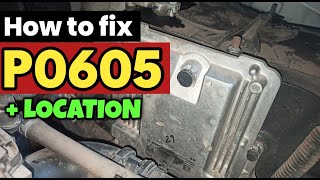
- ECM (Engine Control Module) — Located in the engine compartment, on the left front side, next to the battery.. This is the module reporting the internal fault. Its connectors and grounds are primary points of inspection.
- IPDM E/R (Intelligent Power Distribution Module Engine Room) — Located on the left side of the engine compartment.. The IPDM E/R contains the ECM relay and fuses that supply power to the ECM. A fault here can cause the low voltage that triggers a P0605.
- BCM (Body Control Module) — Located behind the instrument cluster/glove box area.. The BCM communicates with the ECM and controls various body functions. While not a primary cause, communication errors originating here can sometimes create network-wide issues.
- ECM Terminal 108 — A specific pin on the ECM's main harness connector.. This is the terminal that receives the signal from the ASCD brake switch. A continuity test from this pin to the switch connector is a key diagnostic step to verify the wiring harness is intact.
- Ground Connections — Multiple engine and chassis ground points are located throughout the engine bay, often designated in factory service manuals (e.g., F28, F31 on older models).. A poor or corroded ground connection for the ECM is a common cause of intermittent and difficult-to-diagnose electrical problems, including internal module faults.
Real Owner Repair Stories
- YouTube - 'Fixing my friends car for free' (2010 Nissan Maxima) — Vehicle would not start, battery was dead. After jump starting, the owner saw smoke from the left side of the engine bay.
❌ Tried (didn't work) Charging/replacing the battery was only a temporary measure as a dead short was draining it.
✅ What actually fixed it The alternator had an internal short to ground. A technician confirmed the short by checking for continuity between the positive and negative battery terminals (with the battery disconnected). The short disappeared only when the main power feed wire was disconnected from the alternator stud. Replacing the faulty alternator resolved the dead short and all associated electrical issues.
OEM Part Supersession History
25320-3JA0A→25320-3JA0B (unconfirmed, but common)— Standard part revision or manufacturer change.
Heads up: A critical, often-overlooked detail is the switch adjustment. A parts retailer Q&A provides a specific procedure: 1) Turn the switch 45 degrees counterclockwise to unlock it. 2) Pull the brake pedal fully back. 3) Push the switch into its bracket until the threaded body touches the pedal stop. 4) Turn the switch 45 degrees clockwise to lock it in place. Improper adjustment can cause the P0605 code to persist even with a new part.
Model Year Variations Within This Range
- 2009-2011: Detailed wiring diagrams and component locations (ECM, BCM, IPDM E/R) have been explicitly verified for the 2009, 2010, and 2011 model years. While the 2012-2013 models are mechanically and electrically very similar, and the TSB applies to them, specific connector pinouts should always be double-checked.
Helpful Videos

The information in this article is provided for general reference and educational purposes only. Vehicle specifications, procedures, and part compatibility can vary by production date, trim level, and region. Always consult your vehicle's factory service manual and verify part numbers before purchasing or performing repairs. Safety-critical components such as airbags, seat belts, and braking systems should be installed by a qualified professional.
- Nissan MAXIMA:
- 🧭 Diagnostic Flowchart
- 🎬 Helpful Videos
- What's Unique About the 2009-2013 Nissan MAXIMA
- Symptoms You May Notice
- Most Likely Causes
- Rare But Worth Checking
- Diagnosis Steps
- Parts You'll Likely Need
- Technical Service Bulletins (TSBs) & Recalls
- Platform-Specific Known Issues
- Mechanic-Grade Diagnostic Values
- Scan Tool Commands That Help
- Wiring & Ground Locations
- Real Owner Repair Stories
- OEM Part Supersession History
- Model Year Variations Within This Range
- 🎟️ Get 5% Off