

P0606 on 2011-2019 Ford Fiesta: Decoding the PCM/TCM Fault and Fixes
On a 2011-2019 Ford Fiesta with the DPS6 automatic, P0606 almost always points to a failing Transmission Control Module (TCM), not the main engine computer (PCM). This is a very common and well-documented issue. The fix is a TCM replacement and programming, which is not a DIY job. Ford even created a software update to intentionally trigger this code as an early warning of TCM failure.
- P0606 on a DPS6 Fiesta is a 'special case' and almost always means the Transmission Control Module (TCM) is failing.
- Do not drive the vehicle, as it is unsafe and can stall at any time.
- Check for warranty coverage under Ford's program 14M02, which has a final deadline of June 30, 2025 for a one-time replacement.
- Always check battery health and ground connections before condemning the TCM, as voltage issues can trigger this code.
- This is not a DIY repair; the replacement TCM requires professional programming.
What's Unique About the 2011-2019 Ford Fiesta
The Ford Fiesta of this era is notorious for issues with its DPS6 'PowerShift' dual-clutch automatic transmission. The Transmission Control Module (TCM) is the most common failure point. Ford even released a software update under TSB 15-0121 to intentionally trigger the P0606 code earlier, serving as an advanced warning that the TCM is failing. Therefore, unlike on most other vehicles where P0606 points to the main computer, on a DPS6-equipped Fiesta it is a strong, specific indicator of a TCM problem.
Symptoms You May Notice
- Check Engine Light is on
- Wrench light or 'Transmission Malfunction Service Now' message on the dash
- Sudden loss of power or entering 'limp mode'
- Vehicle stalls while driving
- Harsh, erratic, or failed gear shifts
- Transmission fails to engage in Drive or Reverse
- Intermittent no-start condition
- Warning messages on the dash, such as 'Hill Start Assist Not Available'
- Replacing the PCM when the true fault lies with the TCM.
- Performing a transmission rebuild or replacing clutches when the issue is purely electronic.
- Replacing fuel or ignition components to address stalling symptoms without first diagnosing the trouble codes.
Most Likely Causes
- Failing Transmission Control Module (TCM) 🔴 High Probability → Shop Transmission Assembly The DPS6 transmission's TCM has a known design flaw where internal circuit board connections crack from heat and vibration. Ford issued extended warranty 14M02 for this part due to the high failure rate.
How to confirm: A professional scan tool can check for communication with the TCM. Codes like U0101 (Lost Communication with TCM) or U0100 alongside P0606 are a strong confirmation. Diagnosis should follow TSB 16-0129 or similar bulletins. Manufacturer Bulletin #16-0044 specifically links P0606 with symptoms like a no-start condition, loss of power, or issues with transmission engagement.
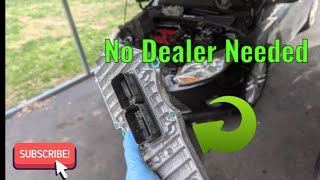
Typical fix: Replace the Transmission Control Module. The new module must be programmed to the vehicle using Ford's diagnostic software (IDS) and an adaptive learning procedure must be performed. 🎬 Watch: How to program your new TCM at home using Forscan.
Est. part cost: $500-$900 - Poor Battery Health or Bad Grounds 🟡 Medium Probability → Shop Vehicle Battery Low or unstable system voltage can cause communication errors between modules, incorrectly triggering a processor fault code. Many owners report the P0606 code appearing for the first time after a dead battery or jump-start event.
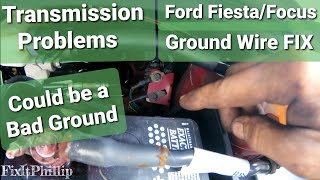
How to confirm: Test the battery's voltage and load capacity. A healthy battery should be above 12.4V at rest and hold a load. Inspect and clean the main battery terminals, the chassis ground point under the air filter box, and the ground strap to the transmission case. 🎬 Watch: How to clean and fix these critical ground connections. A key ground point is G108, located on the right side of the engine compartment.
Typical fix: Replace the weak battery and/or clean all ground connections to bare metal.
Est. part cost: $150-$250 - Faulty Powertrain Control Module (PCM) ⚪ Low Probability → Shop Engine Control Module (ECM) While less common than the TCM failure on this specific platform, any vehicle's PCM can fail internally.
How to confirm: This is a diagnosis of exclusion. If the TCM, wiring, and power/ground circuits are all confirmed to be good, the PCM itself is the likely culprit. A dealership would be required to make this final determination.
Typical fix: Replace the PCM. The new unit must be programmed with the vehicle's specific information (VIN, key data, etc.).
Est. part cost: $600-$1100
Rare But Worth Checking
- Damaged Wiring Harness: The harness between the PCM and TCM can rub through and short circuit, causing communication faults that mimic a module failure. A thorough visual inspection is warranted before replacing expensive modules.
- Shorting Component on a Shared Circuit: In rare cases, another component can short a circuit and pull down the voltage supplied by the PCM/ECU, causing it to set a P0606. One documented instance on a diesel Fiesta was caused by a faulty fuel injector.
Diagnosis Steps
- Scan for all diagnostic trouble codes. Pay close attention to any 'U' (network) codes, especially U0101, and other module-specific codes like P06B8. Manufacturer Bulletin #TSB160044 notes that P0606 often appears alongside U0100, U0101, U1013, and U3003.
- Check battery voltage and perform a load test. Ensure the battery is fully charged and healthy (above 12.4V at rest, 13.5V-14.5V running). A weak battery is a known trigger.
- Inspect and clean all primary ground connections. Key locations include the main battery-to-chassis ground, the ground strap to the transmission, and the grounds located under the air filter box. Specifically check ground points G108 and G109 in the engine compartment.
- If U-codes related to the TCM are present, focus diagnosis there. The TCM is the most likely failure point.
- Visually inspect the wiring harness between the PCM and TCM for any signs of rubbing, chafing, or corrosion, as this can mimic module failure.
- Consult a Ford dealer with your VIN to check the status of Customer Satisfaction Program 14M02. A one-time replacement may be available through June 30, 2025, even if the original warranty is expired.
- If all other possibilities are exhausted, the fault lies with either the TCM or the PCM, with the TCM being the statistically probable culprit on this vehicle.
Parts You'll Likely Need
- Transmission Control Module (TCM)
(OEM #AE8Z-7Z369-F (supercedes AE8Z-7Z369-B, -D, -E))— This is the most common cause of P0606 on a Ford Fiesta with the DPS6 transmission due to a well-known high failure rate.
Trusted brands: Motorcraft (OEM), Dorman (Remanufactured)
OEM price range: $600-$900
Aftermarket price range: $400-$600
Related Codes That Often Appear With This One
- U0101 — Lost Communication with TCM. This code is a very strong indicator that the Transmission Control Module is the root cause of the problem.
- U0100 — Lost Communication With ECM/PCM. This indicates a major network communication breakdown, often triggered by the failing control module.
- P090C — Clutch 'B' Actuator Control Circuit Low/High. This and other actuator codes can appear when the failing TCM is unable to properly control the clutch motors.
- P06B8 — Internal Control Module Non-Volatile Random Access Memory (NVRAM) Error. This code often appears with P0606 and points to an internal memory/processor fault within the control module, further strengthening the TCM failure diagnosis.
- U1013 — Invalid Internal Control Module Monitoring Data. As noted in TSB 16-0129, this code frequently accompanies P0606 when a module requires reprogramming or replacement.
Technical Service Bulletins (TSBs) & Recalls
- TSB 15-0121: Describes a software update to enable DTC P0606 for early detection of a failing TCM.
- Customer Satisfaction Program 14M02: Extends the warranty on the TCM to 10 years/150,000 miles and offers a final replacement program until June 30, 2025.
- TSB 16-0129: Instructs technicians to reprogram the PCM/TCM to the latest calibration, which installs the P0606 DTC as a specific failure code for the TCM; it may also cause the PRNDL/S gear selector to flash.
- Bulletin #16-0044: Addresses concerns of intermittent loss of transmission engagement or power accompanied by P0606 and communication codes.
Platform-Specific Known Issues
- The DPS6 transmission's TCM is subject to Customer Satisfaction Program 14M02, which extended the warranty to 10 years or 150,000 miles. A final, one-time replacement program was offered for out-of-warranty vehicles, valid until June 30, 2025.
- Ford TSB 15-0121 introduced a software update specifically to enable the P0606 code as an early warning for TCM failure.
Mechanic-Grade Diagnostic Values
- Battery Voltage (Engine Off) — expected: 12.4V to 12.6V. Failure: Below 12.0V, or a reading that is a multiple of 2.1V less than 12.6V (e.g., 10.5V), indicates a weak or dead cell.
- Charging System Voltage (Engine Running) — expected: 13.5V to 14.5V. Failure: Voltage below 13.5V (undercharging) or above 14.5V (overcharging) can trigger module communication faults.
- TCM Power Supply Pins (at TCM connector) — expected: 12V+ (Battery Voltage). Failure: Low or no voltage indicates a wiring or fuse issue, not necessarily a bad TCM. A user confirmed testing pins 1 & 10 for power.
- TCM Ground Pins (at TCM connector) — expected: Near 0 Ohms resistance to chassis ground. Failure: High resistance indicates a bad ground connection, a common cause of communication issues. A user confirmed testing pins 4 & 5 for ground.
Scan Tool Commands That Help
- Ford IDS (Integrated Diagnostic System): Reset KAM (Keep Alive Memory) for TCM — This is a critical step after installing a new or reprogrammed TCM. It clears all learned adaptive values. Unhooking the battery does NOT clear TCM KAM.
- Ford IDS (or high-level scan tool like FORScan): TCM Adaptive Strategy Learn — After replacing the TCM and resetting KAM, a specific drive cycle must be performed to allow the module to learn clutch engagement points and shift patterns. Failure to do this will result in harsh or erratic shifting.
- Ford IDS: Module Programming — When installing a new TCM, it must be programmed to the vehicle's VIN and loaded with the latest calibration software.
Wiring & Ground Locations
- G108 — Right side of the engine compartment.. This is a primary engine compartment ground. A poor connection here can cause voltage drops and communication errors between the PCM and TCM, mimicking a module failure.
- G109 — Left rear of the engine compartment.. Another critical engine bay ground point. Corrosion or looseness can lead to intermittent electronic issues, including the P0606 code.
- Ground under air intake filter box — Located on the chassis frame rail, underneath the plastic air filter housing.. This is a frequently cited location for a problematic ground that directly affects the transmission and its control module. It is exposed to the elements and prone to corrosion.
- Transmission Case Ground Strap — A braided metal strap connecting the transmission housing to the vehicle's chassis/frame.. Provides the main ground path for the transmission assembly. A corroded or broken strap will cause the TCM and other transmission electronics to malfunction, often triggering P0606 and U-codes.
Real Owner Repair Stories
- Reddit user /u/AshamedAtmosphere679 (2014 Ford Fiesta, 50,000 miles) — Transmission Fault Service Now message, Check Engine light, wrench light, loss of power, poor braking feel, car shut off while driving, shaking on acceleration.
❌ Tried (didn't work) Contacting Ford for warranty (VIN was no longer covered).
✅ What actually fixed it The confirmed diagnosis from a mechanic was a failed TCM requiring replacement, with a secondary recommendation to replace the dual-clutch assembly due to the shaking symptom. The user was advised by the community that P0606 is the 'death code' for the TCM and should be the first part replaced. - NHTSA ODI #11337198 — An owner reported that the computer malfunctioned and the vehicle stopped at a light, almost causing an accident, while displaying code P0606.
- NHTSA ODI #10790513 — One driver experienced high RPMs even when traveling slowly and the car continued to sputter; an OBD2 scan revealed P0606, which was identified as an ECM/PCM processor problem.
OEM Part Supersession History
AE8Z-7Z369-B, AE8Z-7Z369-D, AE8Z-7Z369-E→AE8Z-7Z369-F— Revisions to improve reliability and address the known internal circuit board failures.
Heads up: The latest 'F' revision is the recommended replacement for all prior versions. A new module requires programming with Ford's IDS software to function.
Model Year Variations Within This Range
- 2012-2014 vs 2015-2018: The factory TCM software calibration changed around 2015. While any 2012-2018 TCM can physically be used, installing a used module from a different year group without reprogramming it to the correct calibration for your vehicle may result in harsh shifting or other performance issues. For a plug-and-play (no programming) used swap, it is best to match a 2012-2014 TCM with a 2012-2014 vehicle.
Diagnostic Flowchart
Other Known Issues on This Vehicle
Issues unrelated to this code that are worth knowing about as an owner of this generation:
- PowerShift Transmission Mechanical Failure 🔴 High → Shop Transmission Assembly — Extremely common. Issues include shuddering, slipping, and hesitation due to faulty clutches and seals, separate from the electronic TCM failure. (Ref: Multiple lawsuits and warranty extensions (e.g., 14M01 for clutches) have been issued.)
- Faulty Door Latches 🔴 High — Widespread on 2011-2014 models, leading to doors not latching or opening while driving. (Ref: Ford Safety Recalls 15S16, 16S30, and 20S30)
- HVAC Blend Door Actuator Failure 🟡 Low — Very common across many Ford models of this era. Results in a repetitive clicking or ticking sound from the dashboard upon startup.
- Engine Stalling / Overheating 🟠 Medium — Reported on various models, sometimes linked to a faulty electronic throttle body (ETB) or cooling system issues like failing thermostats or coolant pipes on early EcoBoost models. (Ref: Recalls issued for specific engine-related issues, like 14V597000 for cylinder head cracks on 1.6L GTDI engines.)
- Parasitic Battery Drain 🟠 Medium → Shop Vehicle Battery — Owners report batteries dying unexpectedly. Can be caused by faulty wiring, software glitches, or components not shutting down properly.
Used vs. New Parts: Buying Guide for This Vehicle
When a used part is the smart pick: A used TCM is a cost-effective option, especially since new OEM parts have become very expensive. However, it is only a smart choice if you have access to a high-level scan tool like FORScan or a professional willing to work with used parts, as a clutch adaptive relearn procedure is mandatory.
Donor-vehicle mileage cap: roughly under 80000 miles for the part to have meaningful remaining life.
What to inspect on the donor part:
- Match the part number exactly if possible, or at least stay within the correct year-group (2011-2014 or 2015-2019) to minimize programming issues.
- Inspect the connectors for any signs of oil leakage, which can indicate internal seal failure.
- Ask the seller if the donor vehicle had any transmission-related trouble codes before being dismantled.
- Prefer sellers who offer a short-term warranty or return policy.
OEM-only on this vehicle (don't cheap out):
- Transmission Control Module (TCM) - While remanufactured units exist, the safest bet outside of a new OEM part is a used OEM part or a professional cloning service. The complexity and programming requirements make unverified aftermarket clones risky.
Aftermarket brands forum-validated for this vehicle:
- Dorman (Remanufactured): Dorman offers a remanufactured TCM (e.g., part #609-232) that claims to fix the original flaw by soldering critical connections.
- Module Cloning Services: Services like 'Plug N Play Auto Parts' offer to clone your original module's data onto a working used unit, creating a true plug-and-play solution without needing dealer programming.
Brands owners have reported issues with on this vehicle:
- Unknown/no-name brands from online marketplaces without significant positive reviews specific to the DPS6 transmission should be avoided due to the high risk of programming and compatibility issues.
Real Owner Stories
Aggregated from forums and TSBs cited above. Mileages and costs reflect what owners reported in those sources.
2011-2019 Ford Fiesta DPS6 Automatic
Symptoms: Transmission Malfunction error appeared immediately after the battery died and the vehicle was jump-started.
What fixed it: Checking battery health and system voltage, as low voltage can incorrectly trigger this processor fault code.
Source hint: Reddit r/FordFiesta - Transmission Malfunction Error After Dead Battery
2012 Ford Fiesta SE
Symptoms: Vehicle threw a P0606 code; owner was seeking clarification on what the code meant for this specific model.
What fixed it: TCM replacement under Ford's extended warranty program.
Source hint: Reddit r/MechanicAdvice - 2012 Fiesta SE what codes are these for?
2011-2019 Ford Fiesta
Symptoms: Transmission Service Now error and P0606 code.
What fixed it: Cleaning ground points to resolve electrical issues and checking for coverage under Customer Satisfaction Program 14M02.
Source hint: Ford Fiesta Forum - Transmission Service Now error 'P0606'
Related OBD-II Codes
Frequently Asked Questions
Is my 2011-2019 Ford Fiesta covered by a warranty extension for the P0606 code?
My Fiesta shows 'Transmission Malfunction Service Now' and P0606 after a jump-start. Is the TCM definitely dead?
What does TSB 15-0121 say about the P0606 code on the Fiesta?
Where are the main ground points I should check on my Fiesta to rule out electrical ghosts?
If I replace the TCM myself to fix P0606, will the car start immediately?
Does the P0606 code mean I need a new engine computer (PCM)?
Helpful Videos

We Have This Part in Stock


The information in this article is provided for general reference and educational purposes only. Vehicle specifications, procedures, and part compatibility can vary by production date, trim level, and region. Always consult your vehicle's factory service manual and verify part numbers before purchasing or performing repairs. Safety-critical components such as airbags, seat belts, and braking systems should be installed by a qualified professional.
- Ford Fiesta:
- 🧭 Diagnostic Flowchart
- 🎬 Helpful Videos
- 🛍️ Shop This Part
- What's Unique About the 2011-2019 Ford Fiesta
- Symptoms You May Notice
- Most Likely Causes
- Rare But Worth Checking
- Diagnosis Steps
- Parts You'll Likely Need
- Related Codes That Often Appear With This One
- Technical Service Bulletins (TSBs) & Recalls
- Platform-Specific Known Issues
- Mechanic-Grade Diagnostic Values
- Scan Tool Commands That Help
- Wiring & Ground Locations
- Real Owner Repair Stories
- OEM Part Supersession History
- Model Year Variations Within This Range
- Other Known Issues on This Vehicle
- Used vs. New Parts: Buying Guide for This Vehicle
- Real Owner Stories
- 2011-2019 Ford Fiesta DPS6 Automatic
- 2012 Ford Fiesta SE
- 2011-2019 Ford Fiesta
- Related OBD-II Codes
- Frequently Asked Questions
- 🎟️ Get 5% Off