

P0606 on 2003-2004 Honda Element: PCM Processor Fault Causes and Fixes
On a 2003-2004 Honda Element, code P0606 is most often caused by a software glitch where the vehicle's computer mistakes low battery voltage for a processor failure. The most common fix is a simple software update from a Honda dealer, not an expensive computer replacement. This issue also affects 2003-2004 Honda Accords.
- Do not immediately replace the PCM. The most likely cause for a P0606 on a 2003-2004 Element is a software issue.
- The official fix from Honda is a software update (reflash) documented in TSB 04-048, which also applies to the 2003-04 Accord.
- Ensure your battery is healthy and all power/ground connections are clean and tight, as low voltage is the trigger for this false code.
- A trip to the dealer or a qualified shop is necessary for the software update, which typically costs one hour of labor or less.
What's Unique About the 2003-2004 Honda Element
What's unique to the 2003-2004 Element (and Accord of the same years) is the well-documented software sensitivity. While P0606 on many other vehicles often points to a failed computer, on this specific platform, it's frequently a false alarm. Honda identified that a temporary drop in battery voltage, such as during a cold start with an aging battery, could trick the original PCM software into flagging an internal fault. This makes checking for the software update specified in TSB 04-048 the absolute first step, potentially saving hundreds of dollars by avoiding an unnecessary PCM replacement.
Symptoms You May Notice
- Check Engine Light is on
- Engine may stall unexpectedly
- Automatic transmission may shift erratically or harshly
- Engine may crank but fail to start
- Reduced fuel economy
- Vehicle may enter 'limp mode' with reduced power
- Replacing the PCM before checking for the software update specified in TSB 04-048.
- Replacing the alternator without confirming a charging system fault, when the root cause is a weak battery or software glitch.
Most Likely Causes
- Outdated PCM Software 🔴 High Probability A known issue documented in Honda Service Bulletin 04-048 where low battery voltage is misinterpreted as a PCM failure. This bulletin explicitly applies to all 2003-04 Element and 2003-04 Accord L4 models.
How to confirm: A Honda dealer or a qualified shop with a Honda Diagnostic System (HDS) can check the current software version and see if the update has been applied. If the update has already been performed, the TSB directs technicians to troubleshoot per the service manual.
Typical fix: Update the PCM software using the Honda Interface Module (HIM). This is often referred to as 'reflashing' the computer. The dealer labor time is typically listed as 0.3 hours.
Est. part cost: $0 - Weak or Failing Battery 🟡 Medium Probability → Shop Vehicle Battery This is the direct trigger for the software glitch described in the TSB. An aging battery that drops voltage during startup, especially in cold weather, can cause the code to appear. 🎬 See this guide on locating and cleaning engine ground points Forum users frequently report this code appearing after a dead battery or a jump start.
How to confirm: Test the battery with a digital multimeter or an electronic battery tester. A healthy, resting battery should be at approximately 12.6 volts. Check the voltage during cranking; if it drops below 9.6 volts, the battery is weak and should be replaced.
Typical fix: Replace the vehicle's 12V battery.
Est. part cost: $100-$250 - Poor Power or Ground Connections ⚪ Low Probability Corrosion on battery terminals, main engine grounds, or the PCM's own ground straps can cause voltage drops, mimicking a failing battery and triggering the code. This is a common failure point on older vehicles in general.
How to confirm: Visually inspect all main ground straps from the engine to the chassis and the battery terminals for looseness or corrosion. Perform a voltage drop test on the main power and ground circuits to the PCM. A Reddit user resolved a no-start issue by cleaning dirty and loose battery connections.
Typical fix: Clean all corroded connections with a wire brush and ensure they are tight. Replace any corroded or damaged cables.
Est. part cost: $5-$50
Rare But Worth Checking
- Failed Powertrain Control Module (PCM): → Shop Engine Control Module (ECM) While this is the literal definition of the code, it is less common on this vehicle than the software issue. This should only be considered after the TSB has been addressed and all power/ground circuits have been verified. 🎬 Watch: Step-by-step Honda Element ECM replacement walkthrough If replacement is needed, it will require programming to the vehicle.
- Electrical Interference: While documented on other Honda models, TSB Bulletin #A15120C notes that aftermarket spark plugs with built-in capacitors can cause electrical interference that may trigger DTC P0606.
Diagnosis Steps
- Check Battery Health: Test the 12V battery's state of charge and health. A weak battery that drops below 9.6V during cranking is a known trigger and should be replaced.
- Verify TSB Compliance: Contact a Honda dealer or use a professional scan tool to determine if the software update from TSB 04-048 has been performed. If not, this is the most likely fix. The labor for this reflash is often around one hour of shop time.
- Inspect Power and Grounds: Check the battery terminals, engine-to-chassis ground straps, and PCM connections for corrosion or looseness. Clean and tighten as necessary. Don't overlook the PCM's specific ground wires, especially G101.
- Clear Code and Test Drive: After performing the above steps, clear the code using an OBD-II scanner. The TSB also specifies a procedure of turning the ignition on then off, and waiting more than one minute before turning it on again to allow the system to properly reset.
- Perform Idle Relearn Procedure: After clearing codes or updating software, perform the Honda idle relearn procedure as specified in the service bulletin. This involves warming the engine to operating temperature and then letting it idle with all accessories off for 10 minutes.
- Consider PCM Replacement: If the software is up to date, the battery is good, all connections are clean, and the code still returns, the PCM may have an internal hardware fault and require replacement. A used PCM must be programmed to the vehicle's immobilizer system.
Parts You'll Likely Need
- Powertrain Control Module (PCM/ECM)
(OEM #37820-PZD-A6x (4WD/AWD AT), 37820-PZD-A5x (2WD/FWD AT), 37820-PZD-A0x (MT))— This is only needed if the software update and electrical checks do not resolve the issue. Part number varies by transmission and drivetrain. For example, 37820-PZD-A64 and 37820-PZD-A65 were used for 2003-2004 AWD AT models. Many part numbers supersede to later versions (e.g., 37820-PZD-A01 was replaced by A02, A03, A04, and A05).
Trusted brands: Honda (Genuine OE), Flagship One (Remanufactured), Solo Auto Electronics (Remanufactured)
OEM price range: $1000-$1450
Aftermarket price range: $250-$500 (Remanufactured)
Technical Service Bulletins (TSBs) & Recalls
- Honda TSB 04-048: MIL Comes On With DTC P0606. States the probable cause is the ECM/PCM incorrectly interpreting a low battery voltage condition and the fix is a software update. It applies to all 2003-04 Accord L4 and 2003-04 Element models.
- TSB Bulletin #A15120C: A manufacturer service bulletin for other Honda models notes that P0606 can be caused by electrical interference from aftermarket spark plugs that include built-in capacitors.
Platform-Specific Known Issues
- Honda Technical Service Bulletin 04-048 was issued to address this specific code on 2003-2004 Elements, indicating a software reflash is the primary corrective action.
- Owner forums are filled with examples of this code appearing after a battery dies or is replaced, with the reflash or simply clearing the code (after confirming battery health) resolving the issue.
Mechanic-Grade Diagnostic Values
- Alternator Output Voltage at Battery Terminals (Engine Running) — expected: 13.5V to 14.5V, stable. Failure: Voltage below 13.5V (undercharging) or above 14.5V (overcharging), or fluctuating wildly, indicates a faulty alternator or voltage regulator which can trigger P0606.
- Battery Voltage at Rest (Engine Off) — expected: ~12.6V. Failure: Voltage below 12.4V indicates a discharged or failing battery, a known trigger for the software glitch per TSB 04-048.
- Battery Voltage During Cranking — expected: Above 9.6V. Failure: Dropping below 9.6V indicates a weak battery that cannot provide sufficient voltage, a primary cause for the false P0606 code on this platform.
- PCM Power/Ground Circuit Voltage Drop — expected: Less than 0.1V on power side, less than 0.1V on ground side. Failure: Voltage drop exceeding these values indicates high resistance in the wiring or connections, which can starve the PCM of stable power and trigger internal fault codes.
Scan Tool Commands That Help
- Honda HDS (Honda Diagnostic System) or compatible advanced scanner (e.g., Autel MaxiSys): Replace ECM/PCM — This function is required after physically installing a new or used PCM. It registers the new module with the vehicle's immobilizer system, allowing the engine to start. Without this step, the car will not start due to the anti-theft system.
- Honda HDS (Honda Diagnostic System): PCM Software Update — This is the primary fix for the false P0606 code as specified in TSB 04-048. It is used to reflash the PCM with the corrected software that is less sensitive to temporary voltage drops.
Wiring & Ground Locations
- G101 — On the engine, typically bolted to the thermostat housing or the water pipe side of the housing.. This is a critical ground termination point for the PCM's power and logic circuits. A loose or corroded G101 connection can cause unstable PCM operation, mimicking an internal failure and directly causing a P0606 code. It is a primary suspect after checking the battery.
- G102 — On the left side of the engine.. This is another main engine ground. While not the primary PCM ground, poor contact here can contribute to overall electrical noise and voltage stability issues that affect the PCM.
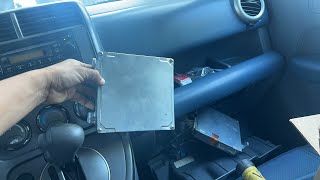
- PCM Location — Behind the glove box.. Technicians need to access the PCM connectors to perform pin-out tests for power and ground integrity if the main grounds (G101) are confirmed to be good.
- G501 — Under the left side of the dash, behind the kick panel.. This is a primary interior/chassis ground. While less likely to be the sole cause, a poor connection here can affect various systems that communicate with the PCM.
- Main Transmission Ground — A thick wire running from the negative battery terminal area down to a bolt on the transmission case.. This is a major ground path for the entire powertrain. On older Elements, this wire is known to fray or corrode, causing a host of electrical issues, including erratic PCM behavior.
Real Owner Repair Stories
- Reddit r/HondaElement user (2004 Honda Element) — No-start condition, multiple trouble codes present.
❌ Tried (didn't work) Initial diagnosis pointed towards a major component failure.
✅ What actually fixed it The final fix was simply cleaning dirty and loose battery connections. This highlights that the root cause of P0606 is often a simple voltage supply issue, not a failed PCM. - Honda-Tech forum user (Honda (model not specified, but G101 is common across models)) — Engine would randomly die and not restart.
❌ Tried (didn't work) Checking the connection at the thermostat housing appeared fine initially.
✅ What actually fixed it The G101 ground wire was frayed inside the loom, not at the terminal. Running a temporary bypass ground wire from the ECU pin to the chassis immediately solved the problem, confirming the bad ground wire was the root cause.
OEM Part Supersession History
37820-PZD-A61, A62, A63, A64→37820-PZD-A65, A66, A67— Later part numbers often contain hardware and software revisions to address known issues. For example, a later revision may be less susceptible to the voltage glitch that triggers P0606.
Heads up: While many are interchangeable for 2003-2006 AWD AT models, it is critical to match the part number to the vehicle's VIN, transmission type (AT/MT), and drivetrain (AWD/FWD). Using the wrong PCM can result in a no-start or incorrect transmission operation.
Diagnostic Flowchart
Other Known Issues on This Vehicle
Issues unrelated to this code that are worth knowing about as an owner of this generation:
- Cracked Front Lower Control Arm Compliance Bushings 🟠 Medium — Very common. Causes clunking/knocking from the front suspension over bumps. Often noticeable by 100,000 miles. (Ref: Honda TSB 09-023 addresses this for 2003-2008 models. The OEM part number for the bushing is 51391-SCV-A03.)
- Faulty Starter Motor / Solenoid 🟠 Medium — Common failure item. Symptoms include a single loud 'thunk' or click with no crank, or slow cranking despite a good battery. Often occurs around 100,000-150,000 miles.
- Worn/Sticking Door Lock Tumblers 🟡 Low — Extremely common on 2003-2006 models. The key becomes difficult or impossible to insert into the door lock. TSB A03-068 was issued for this. (Ref: Honda TSB A03-068)
- Groaning Noise from Rear Differential (4WD models) 🟡 Low — Common on 4WD models, especially when turning at low speeds. Caused by fluid breakdown. (Ref: Honda TSB A07-024 recommends servicing the differential with new fluid to fix the issue.)
- Driver's Seat Rocks 🟡 Low — A common annoyance where the driver's seat develops a slight rocking motion. (Ref: Honda TSB A03-032 was released to address this problem.)
Used vs. New Parts: Buying Guide for This Vehicle
When a used part is the smart pick: A used PCM from a reputable salvage yard is a viable and cost-effective option, especially for an older vehicle like the Element. It makes sense ONLY if the TSB reflash has been performed or ruled out, and all power/ground circuits have been thoroughly tested first.
Donor-vehicle mileage cap: roughly under 150000 miles for the part to have meaningful remaining life.
What to inspect on the donor part:
- Ensure the donor vehicle matches your exact year, engine, transmission (AT/MT), and drivetrain (AWD/FWD).
- Inspect the PCM connectors for any signs of corrosion, bent pins, or water intrusion.
- Ask for the VIN of the donor car to help with potential immobilizer programming.
- Buy from a seller that offers a warranty or guarantee.
OEM-only on this vehicle (don't cheap out):
- Powertrain Control Module (PCM): While remanufactured units exist, a used OEM unit or a new OEM unit are the most reliable choices. The critical factor is the required immobilizer programming, not necessarily the hardware source.
Aftermarket brands forum-validated for this vehicle:
- Flagship One (Remanufactured)
- Solo Auto Electronics (Remanufactured)
Brands owners have reported issues with on this vehicle:
- Unknown, no-name brands from online marketplaces without a warranty or programming support should be avoided, as they may not be correctly configured for the vehicle's immobilizer system.
Real Owner Stories
Aggregated from forums and TSBs cited above. Mileages and costs reflect what owners reported in those sources.
2003 Honda Element KA24
Symptoms: Cranks but will not start. Instrument cluster (RPMs and speedo) jump erratically during cranking. The vehicle will start and run only when a scan tool is plugged into the OBD-II port, and dies immediately once the connector is pulled.
What fixed it: The owner replaced the ECM, but the issue persisted; the context suggests the root cause involved the OBD-II port connection providing a ground or path that allowed the vehicle to run.
Source hint: r/MechanicAdvice
2004 Honda Element
Symptoms: Starting issues and potential precursor to P0606 code.
What fixed it: Cleaning dirty and loose battery connections.
Source hint: Reddit r/HondaElement
2003-2004 Honda Element
Symptoms: Check Engine Light (MIL) comes on with DTC P0606; PCM incorrectly interprets low battery voltage as a failure.
What fixed it: Update the PCM software using the Honda Interface Module (HIM) as per TSB 04-048.
Source hint: Honda TSB 04-048
Related OBD-II Codes
Frequently Asked Questions
Does Honda TSB 04-048 apply to my 2003-2004 Element?
How much does it cost to have a dealer perform the software reflash for P0606?
Can a weak battery really trigger a P0606 'PCM Processor Failure' code on this car?
What is the 'Idle Relearn Procedure' I need to do after fixing the P0606 code?
Is there a specific ground wire I should check if I have P0606 and starting issues?
My 2003 Element won't start and the RPM/Speedo needles are jumping; is this related to P0606?
Helpful Videos

We Have This Part in Stock


The information in this article is provided for general reference and educational purposes only. Vehicle specifications, procedures, and part compatibility can vary by production date, trim level, and region. Always consult your vehicle's factory service manual and verify part numbers before purchasing or performing repairs. Safety-critical components such as airbags, seat belts, and braking systems should be installed by a qualified professional.
- Honda Element:
- 🧭 Diagnostic Flowchart
- 🎬 Helpful Videos
- 🛍️ Shop This Part
- What's Unique About the 2003-2004 Honda Element
- Symptoms You May Notice
- Most Likely Causes
- Rare But Worth Checking
- Diagnosis Steps
- Parts You'll Likely Need
- Technical Service Bulletins (TSBs) & Recalls
- Platform-Specific Known Issues
- Mechanic-Grade Diagnostic Values
- Scan Tool Commands That Help
- Wiring & Ground Locations
- Real Owner Repair Stories
- OEM Part Supersession History
- Other Known Issues on This Vehicle
- Used vs. New Parts: Buying Guide for This Vehicle
- Real Owner Stories
- 2003 Honda Element KA24
- 2004 Honda Element
- 2003-2004 Honda Element
- Related OBD-II Codes
- Frequently Asked Questions
- 🎟️ Get 5% Off