

P0606 on 2011-2016 Hyundai Elantra: ECM/PCM Processor Fault Causes and Fixes
P0606 on a 2011-2016 Hyundai Elantra indicates a critical internal failure of the Engine Control Module (ECM/PCM). While the most common cause is a failed ECM requiring replacement and programming, it's essential to first rule out simpler issues like a weak battery, bad grounds, or a failing alternator before condemning the expensive computer.
- P0606 is a critical fault indicating the Engine Control Module (ECM) has likely failed.
- Do not drive the vehicle, as it can stall at any time, posing a serious safety risk.
- Before replacing the expensive ECM, you must rule out simpler issues: a bad battery, failing alternator, and poor ground connections.
- ECM replacement is not a DIY job for most people, as the new module must be professionally programmed to your car's VIN.
What's Unique About the 2011-2016 Hyundai Elantra
For the 2011-2016 Elantra (fifth generation, MD/UD), the P0606 code is a straightforward, albeit serious, processor fault code. While there are no widespread recalls for the ECM itself for this specific fault, Hyundai has issued several software updates and campaigns for this ECM to address other issues like knock sensor logic and fuel control. This history of software revisions suggests that ensuring the ECM has the latest software from a dealer is a valid, though not guaranteed, first step before condemning the hardware. The 1.8L Nu engine in these cars is also known for significant internal mechanical issues which can sometimes be misdiagnosed, making proper electrical diagnostics for P0606 even more critical.
Symptoms You May Notice
- Engine will not start, or cranks but fails to start 🎬 See how to troubleshoot a no-crank or no-start condition
- Sudden or intermittent engine stalling
- Check Engine Light is on
- ABS light may also be illuminated
- Erratic or harsh automatic transmission shifting
- Noticeable loss of power and acceleration
- Reduced fuel economy
- Rough or unstable idling
- Replacing fuel system or ignition components (like spark plugs or coils) when symptoms like misfiring or stalling appear, without first checking for a foundational code like P0606.
- Immediately condemning the ECM without performing a thorough battery/charging system test and checking for bad ground connections.
Most Likely Causes
- Failed Engine Control Module (ECM/PCM) 🔴 High Probability → Shop Engine Control Module (ECM) Internal component failure is the most common reason for a processor-specific fault code like P0606 after all other possibilities are exhausted.
How to confirm: After exhaustively verifying all other possible causes (power, ground, wiring, software), the ECM is condemned. A professional shop will use a scan tool to check for communication and run diagnostic tests. A visual inspection of the board for burnt spots or corrosion is a final, rare confirmation.
Typical fix: Replace the Engine Control Module and program the new unit to the vehicle's VIN. Mail-in repair services are also an option if you can handle the downtime.
Est. part cost: $300-$900 - Poor Power or Ground Supply to ECM 🟡 Medium Probability Voltage fluctuations or high resistance can cause the ECM's processor to malfunction and incorrectly report an internal fault. Corrosion on terminals is common.
How to confirm: Use a multimeter to test battery voltage (should be ~12.6V off, ~14.0V running). Check and clean the battery terminals. Inspect the main engine and chassis ground straps for corrosion or looseness. On the Elantra, a key ground point is from the battery to the strut tower. Test the ECM's specific power and ground pins at the connector using a wiring diagram and look for voltage drop.
Typical fix: Clean or tighten battery terminals and ground connections. Replace a weak battery (Group H5 for the 1.8L). Replace a failing alternator. A common ground wire part number is 91861-A5040.
Est. part cost: $0-$400 - Corrupted or Outdated ECM Software ⚪ Low Probability Software glitches can sometimes cause processor errors. Hyundai has issued updates for these ECMs for other reasons, indicating a history of software revisions.
How to confirm: A Hyundai dealership or a qualified shop with a J2534 passthrough device can check the current software version against the latest available version from Hyundai's servers.
Typical fix: Update or 'reflash' the ECM with the latest manufacturer software. This is a labor-only charge.
Est. part cost: $100-$250 (Labor)
Rare But Worth Checking
- Damaged Wiring Harness: Physical damage to the wires leading to the ECM from heat, vibration, or rodents can cause a short or open circuit that triggers a P0606 code. This should be visually inspected before replacing the ECM.
- Aftermarket Performance Tuning: Improperly applied aftermarket tunes or performance chips can corrupt the ECM's software, leading to processor faults and a P0606 code.
- Shorted Sensor or Actuator: In rare cases, a sensor on the 5V reference circuit can short internally, disrupting the ECM's operation and causing it to falsely report an internal processor error. Unplugging sensors one by one can sometimes isolate such a fault.
Diagnosis Steps
- Scan for all diagnostic trouble codes. Note any other codes besides P0606, especially communication (U-series) or other module faults.
- Perform a full vehicle battery and charging system test. A weak battery (below 12.4V) or faulty alternator (charging outside 13.5-14.5V) can trigger this code.
- Inspect and clean all battery terminals, main power cables, and chassis/engine ground straps. Ensure they are tight and free of corrosion. A key ground strap is located from the battery negative terminal to the driver's side strut tower.
- Check all fuses in both the engine bay and interior fuse panels, especially those labeled 'ECU', 'ECM', or 'Power'. A fuse with high resistance can cause issues under load.
- Using a factory wiring diagram, locate the power and ground pins for the ECM. With the key on, verify the ECM is receiving proper voltage and has a solid ground by performing a voltage drop test.
- Visually inspect the ECM connectors and the wiring harness leading to it for any signs of damage, corrosion, or moisture intrusion. Wiggle the harness with the engine running to see if symptoms change.
- Check with a Hyundai dealer to see if any ECM software updates (like Service Campaign 966) are available for your vehicle's VIN.
- If all power, ground, and wiring checks pass and the software is up to date, the ECM is highly likely to be faulty and requires replacement.
Parts You'll Likely Need
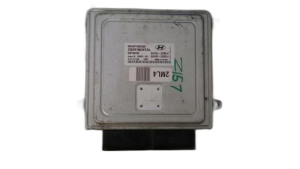
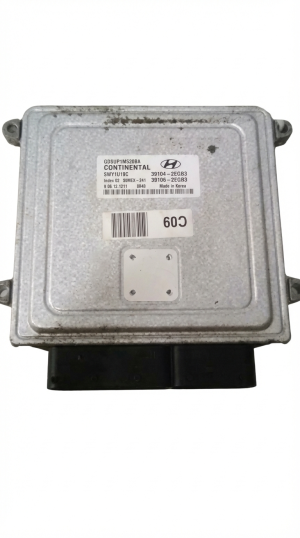
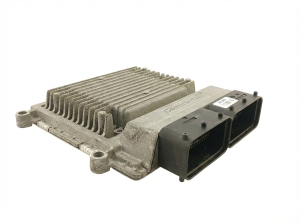
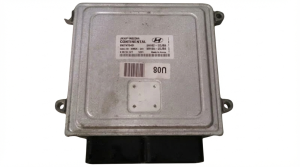
- Engine Control Module (ECM)
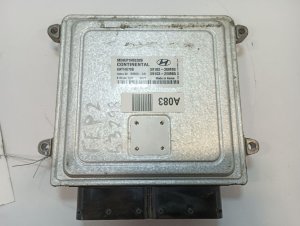
(OEM #39103-2EML4 (example for 2014-16 Auto Trans, Federal Emissions, w/o smart key, verify by VIN))— This is the component that has failed internally when a P0606 code is confirmed.
Trusted brands: Hyundai (OEM), Bosch (OEM supplier), Cardone (Remanufactured), Flagship One (Remanufactured)
OEM price range: $700-$1200
Aftermarket price range: $300-$600 (Remanufactured)
Related Codes That Often Appear With This One
- U-codes (e.g., U0100) — Communication codes often appear with P0606 because if the ECM is failing, it cannot communicate properly with other modules on the vehicle's CAN bus network.
- P0601-P0605 — These are all internal control module fault codes. Seeing them together strongly indicates a hardware failure within the ECM.
- P1326 — This is a Hyundai-specific code related to the Knock Sensor Detection System. Service Campaign 966 updated the ECM logic to monitor for engine bearing noise and set this code. While not directly a cause, its presence points to the importance of having the latest ECM software.
Technical Service Bulletins (TSBs) & Recalls
- TSB 17-01-052
- TSB 21-01-023H-4 (Service Campaign 966)
- TSB 17-ST-002 (Related to steering, but shows commonality of electronic issues)
Platform-Specific Known Issues
- Service Campaign 966 (TSB 21-01-023H-4) involved an ECM software update to improve knock sensor detection logic. While not a direct fix for P0606, it shows that ECM re-flashing is a common and important procedure for this vehicle. This update puts the car in a limp mode (Engine Protection Mode) if bearing noise is detected, setting code P1326.
- TSB 17-01-052 provided an ECM update for SULEV models to revise fuel volume control logic.
- A forum user on hyundai-forums.com reported a P0606 code on their 2013 Elantra that was ultimately resolved by replacing the ECM after the dealer first tried (and failed with) a software reflash. This highlights the common diagnostic path for this issue.
Mechanic-Grade Diagnostic Values
- ECM Ground Circuit Resistance — expected: 1Ω or less. Failure: A reading higher than 1Ω, such as 10MΩ found in one case, indicates a poor ground connection causing voltage issues.
- ECM Power and Ground Pins (Voltage Drop Test) — expected: Less than 0.5V drop on both power and ground sides of the circuit under load.. Failure: A voltage drop greater than 0.5V indicates high resistance in the wiring or connections, which can starve the ECM of power and trigger a P0606.
- ECM Power Supply (Open Circuit Voltage) — expected: Approximately 12.6V (Battery Voltage) with Key On, Engine Off.. Failure: A reading of 0V indicates an open circuit on the power or ground side. A reading significantly less than battery voltage indicates high resistance.
- Sensor Power Supply (from ECM) — expected: +5V. Failure: Incorrect voltage can indicate an internal ECM fault or a short in a sensor/wiring pulling the voltage down.
Scan Tool Commands That Help
- Hyundai GDS (Global Diagnostic System) or equivalent J2534 tool: VIN WRITING — This function is mandatory after installing a new or used 'virgin' ECM. It programs the vehicle's VIN into the module. The VIN cannot be changed once written. Failure to perform this step will set a DTC P0630.
- Hyundai GDS (Global Diagnostic System) or equivalent J2534 tool: ECU Upgrade (Software Reflash) — Used to update the ECM's software to the latest version. This should be attempted before condemning the ECM, as software glitches can sometimes trigger a P0606. The tool compares the current ROM ID to the latest available on Hyundai's servers.
- Hyundai GDS (Global Diagnostic System) or equivalent J2534 tool: Immobilizer Key Teaching — After replacing and programming the VIN into a new ECM, the vehicle's keys must be synchronized with the new module. Without this step, the anti-theft system will prevent the engine from starting.
Wiring & Ground Locations
- ECM Power Ground Pins — On the 2011-2013 Elantra with A/T, pins 1, 2, and 3 of the main 94-pin connector [CGGA-K] are power grounds connected to the chassis. On other models, pins 3 and 4 of the main connector are listed as power grounds.. These specific pins must have near-zero resistance to the chassis ground. High resistance here directly causes ECM malfunction and can trigger P0606.
- Main Battery Ground — The primary ground strap from the negative battery terminal connects to the driver's side strut tower in the engine bay.. Corrosion or looseness at this primary point can cause system-wide electrical issues, including intermittent power loss to the ECM, leading to a P0606 code.
- ECM Power Supply Pins — On the 2011-2013 Elantra with A/T, pin 6 of the main connector [CGGA-K] receives battery voltage from the main relay. On other models, pins 5 and 6 are listed as the power supply from the main relay.. These pins must receive stable battery voltage when the key is on. A voltage drop test at these specific pins is crucial to rule out wiring issues before replacing the ECM.
Real Owner Repair Stories
- Motor Vehicle Stack Exchange (2013 Hyundai Elantra) — No crank, no start. After a few attempts, the car would lose all electrical power for about an hour. Dash lights would fade before going dark.
❌ Tried (didn't work) Replacing the battery.
✅ What actually fixed it The root cause was a bad ground connection from the battery to the chassis. The owner measured the resistance from the battery ground terminal to another ground point on the transmission and found it was ~10MΩ (extremely high). After cleaning the threads and bolts on the battery's main ground connection, the resistance dropped to 0.9Ω and the car started normally.
OEM Part Supersession History
39103-2EML4→39103-2EML5, 39103-2EML6— Standard part revision and update by the manufacturer over subsequent model years.
Heads up: These part numbers are generally interchangeable for US-built, 1.8L, AT, Federal emissions vehicles from 2014-2016. However, it is critical to match the part number exactly or confirm supersession with a dealer, as build location (US vs. Korea) and emissions type (Federal vs. SULEV) use different, non-interchangeable ECMs.
Model Year Variations Within This Range
- 2011-2013 vs 2014-2016: The Elantra received a facelift for the 2014 model year, which included changes to electronics. ECM part numbers are different between the pre-facelift (2011-2013) and post-facelift (2014-2016) models. For example, a 2013 may use P/N 39102-2EMP3, while a 2014+ uses P/Ns like 39103-2EML#.
- 2011-2016: ECMs vary based on the vehicle's build location. US-built models (Alabama plant) use different part numbers (e.g., 39101-2EML#) than Korea-built models (e.g., 39101-2EMB#). The build location is on the driver's door jamb sticker and must be matched when sourcing a replacement ECM.
- 2011-2016: Vehicles with Federal emissions use different ECMs than those with California/SULEV emissions. This must be matched when replacing the module.
- 2011-2016: Vehicles with a standard ignition key use a different ECM than those with a push-to-start 'Smart Key' system.
Diagnostic Flowchart
Other Known Issues on This Vehicle
Issues unrelated to this code that are worth knowing about as an owner of this generation:
- Engine Knocking / Piston Slap (1.8L Nu Engine) 🔴 High — Widespread issue, often appearing between 60,000-100,000 miles. Can lead to excessive oil consumption and eventual engine failure. (Ref: Subject of a class-action lawsuit (Brown v. Hyundai) which resulted in an extended powertrain warranty (10 years/120,000 miles) for the engine short block.)
- Worn Steering Coupler 🟠 Medium — Very common. Causes a clicking or thudding noise in the steering column when turning the wheel. Typically occurs after 50,000 miles. (Ref: TSB #17-ST-002; Hyundai extended the warranty for this specific part to 10 years/100,000 miles.)
- ABS Module Internal Short 🔴 High → Shop ABS Control Module — Less common than engine/steering issues, but critical. Can cause an electrical short, leading to a risk of engine compartment fire, even when parked. (Ref: NHTSA Recall 20V393000.)
Used vs. New Parts: Buying Guide for This Vehicle
When a used part is the smart pick: A used ECM is a very cost-effective choice for this repair, provided several critical conditions are met. Since the primary failure mode is internal, a used unit from a lower-mileage, accident-damaged vehicle is a viable option. Some sellers also offer pre-programming services, which can make it a 'plug-and-play' repair.
Donor-vehicle mileage cap: roughly under 100000 miles for the part to have meaningful remaining life.
What to inspect on the donor part:
- CRITICAL: The OEM part number on the sticker MUST be an exact match or a confirmed superseded number for your original unit.
- CRITICAL: The donor vehicle must match your car's build location (US vs. Korea), emissions type (Federal vs. SULEV), and ignition type (key vs. push-start).
- Inspect the connector pins for any signs of corrosion, moisture, or physical damage. Water intrusion is a common failure cause.
- Check the casing for cracks or signs of being opened.
- Purchase from a reputable seller that offers a warranty and guarantees the unit is programmable.
OEM-only on this vehicle (don't cheap out):
- Engine Control Module (ECM) - While remanufactured units from brands like Cardone or Flagship One exist, using a genuine used OEM Hyundai part is often the most reliable path, as it guarantees compatibility if the part numbers are matched correctly.
Aftermarket brands forum-validated for this vehicle:
- Flagship One (Remanufactured, often offered with pre-programming)
- Cardone (Remanufactured)
Brands owners have reported issues with on this vehicle:
- Unbranded, no-name modules from online marketplaces with no warranty or return policy.
Real Owner Stories
Aggregated from forums and TSBs cited above. Mileages and costs reflect what owners reported in those sources.
2013 Hyundai Elantra
Symptoms: The vehicle triggered a P0606 code. The owner took it to a dealer who first attempted a software reflash, but the issue persisted.
What fixed it: Replacing the Engine Control Module (ECM).
Source hint: hyundai-forums.com
2013 Hyundai Elantra
Symptoms: P0606 code present.
What fixed it: The dealer replaced the ECM.
Cost: $1100-$1100
Source hint: hyundai-forums.com
Related OBD-II Codes
Frequently Asked Questions
Does Service Campaign 966 (TSB 21-01-023H-4) fix the P0606 code on my Elantra?
I have a 2013 Elantra SULEV model; is there a specific software update for my ECM?
Where is the main ground point I should check on my 2011-2016 Elantra to rule out power issues?
Can I use a used ECM from a different Elantra to fix P0606?
Is there a specific ground wire part number if mine is corroded?
What battery should I use for my 1.8L Elantra to ensure the ECM gets proper voltage?
Helpful Videos

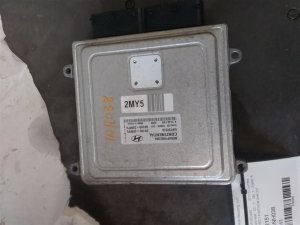
We Have This Part in Stock

The information in this article is provided for general reference and educational purposes only. Vehicle specifications, procedures, and part compatibility can vary by production date, trim level, and region. Always consult your vehicle's factory service manual and verify part numbers before purchasing or performing repairs. Safety-critical components such as airbags, seat belts, and braking systems should be installed by a qualified professional.
- Hyundai Elantra:
- 🧭 Diagnostic Flowchart
- 🎬 Helpful Videos
- 🛍️ Shop This Part
- What's Unique About the 2011-2016 Hyundai Elantra
- Symptoms You May Notice
- Most Likely Causes
- Rare But Worth Checking
- Diagnosis Steps
- Parts You'll Likely Need
- Related Codes That Often Appear With This One
- Technical Service Bulletins (TSBs) & Recalls
- Platform-Specific Known Issues
- Mechanic-Grade Diagnostic Values
- Scan Tool Commands That Help
- Wiring & Ground Locations
- Real Owner Repair Stories
- OEM Part Supersession History
- Model Year Variations Within This Range
- Other Known Issues on This Vehicle
- Used vs. New Parts: Buying Guide for This Vehicle
- Real Owner Stories
- 2013 Hyundai Elantra
- 2013 Hyundai Elantra
- Related OBD-II Codes
- Frequently Asked Questions
- 🎟️ Get 5% Off