

P0607 on 2017-2018 Chrysler Pacifica: Control Module Performance Issues and Fixes
On a 2017-2018 Chrysler Pacifica, code P0607 often points to a weak or failing battery, not a bad main computer. Before replacing expensive electronics, fully test the dual-battery system and check all power and ground connections, as this is the most common and cheapest fix confirmed by owner experiences and Chrysler's own service bulletins.
- P0607 on a 2017-2018 Pacifica is most likely caused by a weak battery, not a bad computer.
- Always perform a professional load test on both the main and auxiliary batteries before considering any other repairs.
- Check for other codes, especially P00FD or P1C8C-16, as they are known to trigger P0607.
- Inspect and clean all battery terminals and ground connections as a primary diagnostic step.
What's Unique About the 2017-2018 Chrysler PACIFICA
Unlike the generic definition that often leads to condemning the main computer (PCM), on the 2017-2018 Pacifica, this code has a very specific history. Chrysler Technical Service Bulletin #9003799 explicitly states that battery-related issues, which set codes like P00FD or P1C8C-16, will trigger P0607-00. This means the complex electronics, particularly the Engine Stop/Start (ESS) system and its associated dual-battery setup, are highly sensitive to voltage. The P0607 code is often a secondary, or 'ghost', code caused by a simple power supply problem, a fact corroborated by numerous owner experiences.
Diagnostic Flowchart
Tap your situation to follow the diagnostic path that matches what you're seeing on this vehicle.
Symptoms You May Notice
- Check Engine Light is on
- Auto Start/Stop system is disabled or malfunctioning
- Vehicle may hesitate or stall, especially during low-speed maneuvers or at a stop.
- No-start or intermittent starting issues
- Warning messages related to the shifter, transmission, or start/stop system may appear
- Vehicle may enter 'limp mode,' limiting speed and performance
- Complete shutdown of electronics, including dashboard screens and flashers.
- Replacing the Powertrain Control Module (PCM) before thoroughly testing the battery and charging system. The provided TSBs and extensive owner reports strongly indicate that P0607 is most often a symptom of a power supply issue, not a failed PCM.
Most Likely Causes
- Weak or Failing Battery (Main or Auxiliary) 🔴 High Probability → Shop Vehicle Battery TSB #9003799 directly links P0607 to battery state-of-charge codes (P00FD). The Pacifica's complex electronics and dual-battery system for Engine Stop/Start are very sensitive to low voltage. Owners report these batteries often fail within 2-3 years, making this the most common cause.
How to confirm: Perform a load test on both the main and auxiliary batteries. A simple voltage check with a multimeter is not sufficient to determine battery health. Many auto parts stores can perform a proper load test for free.
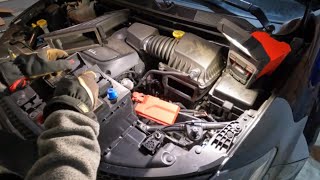
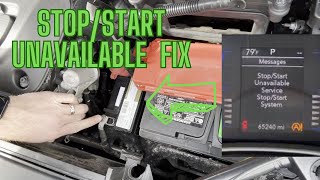
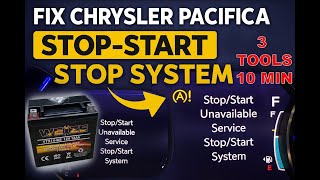
Typical fix: Replace the weak or failing battery. 🎬 See how to replace the auxiliary battery in 10 minutes. It is highly recommended to replace both the main and auxiliary batteries at the same time, as a failure in one can quickly damage the other.
Est. part cost: $250-$500 for both batteries - Loose or Corroded Battery Terminals/Grounds 🟡 Medium Probability → Shop Vehicle Battery Multiple ground points and complex wiring provide more opportunities for a poor connection to develop, causing voltage drops that trigger the code. A key ground to inspect is the main chassis ground from the negative battery terminal.
How to confirm: Visually inspect and physically check the main battery terminals, auxiliary battery terminals, and major chassis/engine ground straps for tightness and corrosion. Follow the main negative cable from the battery to the chassis to find the primary ground point.
Typical fix: Disconnect the battery, then remove, clean all corrosion from terminals, posts, and ground contact points with a wire brush, and ensure all connections are tight upon reassembly.
Est. part cost: $1-$10 - Failing Alternator ⚪ Low Probability → Shop Alternator
How to confirm: With the engine running, use a multimeter to check the voltage at the battery terminals. A healthy alternator should output a stable voltage between 13.5 and 14.5 volts. An unstable or low reading indicates a charging system problem.
Typical fix: Replace the alternator if it is not charging the battery system correctly.
Est. part cost: $300-$600 - Faulty Powertrain Control Module (PCM) Very Low Probability → Shop Engine Control Module (ECM)
How to confirm: This should be the last resort after confirming the batteries, alternator, and all related wiring are in perfect condition. Requires advanced diagnostics with a dealer-level scan tool to run internal self-tests.
Typical fix: Replace and reprogram the PCM. This must be done by a dealer or a specialized shop.
Est. part cost: $800-$1500
Rare But Worth Checking
- Faulty Electronic Shifter Module (ESM): The code definition from TSBs #18-001-19 REV B and #18-002-19 REV A specifically mentions 'ECU Internal Performance - ESM'. If all power supply issues are ruled out, the ESM itself could be the source of the fault, though this is uncommon.
- PCM Software Update Needed: In some cases, the logic for monitoring module performance can be overly sensitive. A dealer can check if a software reflash is available for the vehicle's VIN, which can resolve false P0607 codes. This is a common fix for other Chrysler/Ram vehicles with the same code.
Diagnosis Steps
- Scan for all diagnostic trouble codes. Pay close attention to any battery voltage (P00FD, P1C8C-16) or communication codes (U-codes) as they are the likely root cause.
- Begin with the electrical system. Perform a professional load test on BOTH the main (Group H6/L3/48 or H7) and auxiliary (Group 400/AUX14) batteries.
- Inspect the battery terminals, positive and negative cables, and all major ground straps for any signs of corrosion, damage, or looseness. Key grounds are from the battery to the chassis and from the engine block to the firewall. Clean and tighten as necessary.
- With the engine running, test the alternator's output voltage with a multimeter. It should be stable and within the 13.5V-14.5V range.
- If P0607 is accompanied by codes P00FD or P1C8C-16, the battery system is the confirmed culprit, as per TSB #9003799.
- If a battery was recently replaced or disconnected, the code may be stored in memory. Clear the codes and perform a drive cycle to see if it returns.
- If the batteries, connections, and alternator are all confirmed to be good, contact a Chrysler dealer to check if a PCM software update is available for your VIN.
- As a final step, if all other possibilities have been exhausted, the wiring to the ESM and PCM should be inspected before condemning a control module.
Parts You'll Likely Need
- AGM Auxiliary Battery
(OEM #BBAUX101AB)— The auxiliary battery for the start/stop system is a very common failure point and a primary cause of P0607. Its failure often precedes the main battery's failure.
Trusted brands: Mopar, Odyssey ODS-AGM14, Bosch S6590B
OEM price range: $130-$250
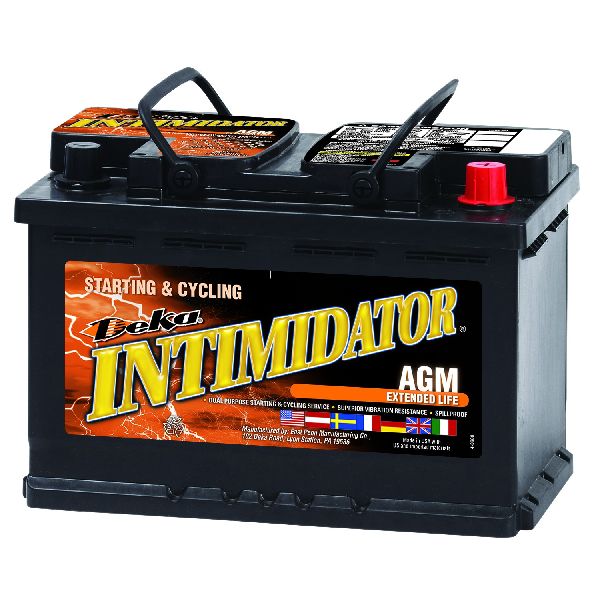
Aftermarket price range: $135-$185 - AGM Main Battery
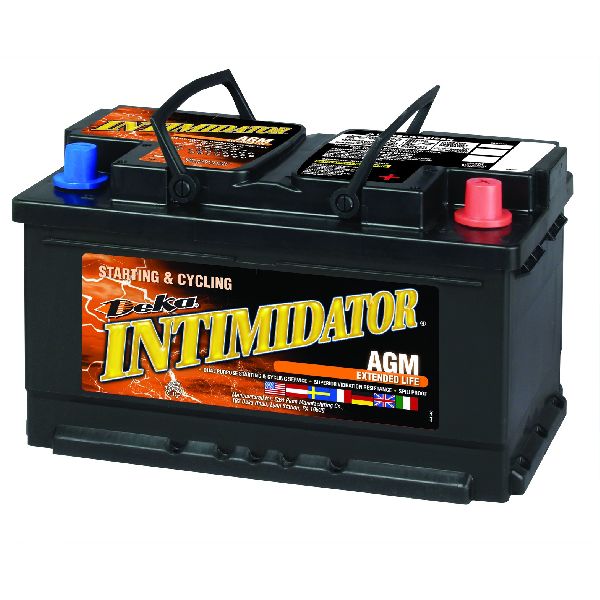
(OEM #BBH6A001AA (replaces BBAH6650AA))— The main battery can also be the cause, or can be damaged by a failing auxiliary battery. It is best practice to replace both at once. 🎬 Watch: Step-by-step guide to replacing both main and auxiliary batteries.
Trusted brands: Mopar, ACDelco 48AGM, Deka 9A48
OEM price range: $250-$400
Aftermarket price range: $175-$250
Related Codes That Often Appear With This One
- P00FD — This code for 'Battery B State Of Charge Performance' is explicitly mentioned in TSB #9003799 as a trigger for P0607.
- P1C8C-16 — This code for 'System Voltage-Circuit Voltage Below Threshold' is also cited in TSB #9003799 as a direct cause for P0607 to be set.
- U145D-00 — This communication code ('Implausible Data Received From TCM On D-PT') is listed alongside P0607 in multiple TSBs, indicating it's triggered by the same underlying voltage issue.
- C2222-68 — This code for 'Improper Powerdown' is also listed in TSBs #18-001-19 REV B and #18-002-19 REV A, suggesting a system-wide electrical anomaly.
Technical Service Bulletins (TSBs) & Recalls
- 9003799: Notes that battery state of charge codes (P00FD, P1C8C-16) will trigger P0607-00 and U145D-00 ESM failures.
- 18-001-19 REV B: Lists P0607-00 - ECU Internal Performance - ESM as part of a group of codes related to a software update to reduce engine crank time.
- 18-002-19 REV A: Also lists P0607-00 - ECU Internal Performance - ESM in a group of potential codes related to an Occupant Restraint Controller (ORC) software update.
Platform-Specific Known Issues
- TSB #9003799 confirms that battery-related issues with DTCs P00FD or P1C8C-16 will directly trigger P0607-00 and U145D-00 ESM failures.
- A Reddit user with a 2018 Pacifica reported the P0607 code appeared after the vehicle sat for a month at a body shop, with symptoms related to the auto start/stop system and an aging auxiliary battery. The user disconnected the battery to clear the code, suspecting the low-voltage event was the cause.
- On PacificaForums.com and Reddit, multiple owners report frequent battery failures (both main and auxiliary) every 2-3 years, leading to various electrical gremlins including stalling and start/stop system failure.
Mechanic-Grade Diagnostic Values
- ECU/PCM Power Pins Voltage (Key On) — expected: 12.2 V ± 0.5 V. Failure: Voltage below this range indicates a power supply issue upstream of the module.
- ECU/PCM Ground Circuit Resistance — expected: Below 0.1 Ω. Failure: Higher resistance indicates a poor ground connection, which can cause floating voltages and module errors.
- Intelligent Battery Sensor (IBS) Power Supply Voltage — expected: Greater than 11.8V. Failure: Voltage lower than 11.8V at the IBS connector (pin 2, 'RD' wire) points to a battery or fuse issue.
Scan Tool Commands That Help
- wiTECH or advanced aftermarket scan tool: ECU Self-Diagnostic Routine — After verifying power and ground are good, this command asks the module to test its own internal hardware. A failure strongly suggests the module itself is faulty.
- N/A - Manual Procedure: Intelligent Battery Sensor (IBS) Reset/Recalibration — After replacing either battery, the IBS must be reset and allowed to recalibrate. A hard reset involves disconnecting the negative terminals on BOTH batteries for 10-20 minutes. The system then needs 3-5 drive cycles with 8-hour key-off periods to fully adapt to the new battery's state of charge.
- N/A - Manual Procedure: Service Shifter Message Reset — If a 'Service Shifter' message appears after a battery replacement, turn the ignition to 'RUN' (without starting), press the accelerator pedal to the floor for 10 seconds, release, turn ignition off, and wait 2 minutes.
Wiring & Ground Locations
- Security Gateway Module (SGM) — On 2018+ models, it is located behind the climate control / shifter knob panel in the center dash.. This module blocks advanced diagnostic commands from aftermarket scan tools. A 12+8 bypass adapter must be connected to this module to perform functions like module self-tests or resets.
- CAN Bus Star Connector (C-Bus) — Located under the glove box area. It is a block where multiple CAN bus wire pairs converge.. Poor pin retention in this connector can cause intermittent data corruption on the CAN bus, leading to numerous communication codes and erratic module behavior that can be misdiagnosed as a faulty PCM or ESM. This issue is best diagnosed with an oscilloscope, not a multimeter.
- Engine Bay Grounds — Key grounds are located from the engine top to the manifold, and from the motor mount to the engine block.. As P0607 is often triggered by voltage irregularities, ensuring all primary engine and chassis grounds are clean and tight is a fundamental diagnostic step.
- ESM Ground Circuit (Z921) — This ground circuit is part of the Electronic Shifter Module (ESIM) Switch harness connector.. Since the code is specified as 'ECU Internal Performance - ESM', a fault in the ESM's dedicated ground circuit could be a direct cause.
Real Owner Repair Stories
- Reddit user 'steven2357' in r/ChryslerPacifica (2018 Chrysler Pacifica) — P0607 fault appeared after the van sat at a body shop for a month. The auto start/stop system was acting up, and the auxiliary battery was over 2 years old. No other drivability issues were present.
❌ Tried (didn't work) Initially just driving the vehicle with the code present.
✅ What actually fixed it The user disconnected the auxiliary and main batteries long enough for the system to reset. The code cleared and did not return, strongly suggesting the extended period of sitting caused a low-voltage condition that confused a control module.
OEM Part Supersession History
BBAUA180AA, BBAUA200AA, BBAUA200AC, BBAUA200AD, BBAUX101AA→BBAUX101AB— Standard part evolution and consolidation for the auxiliary battery.
Heads up: The original Mopar battery may have a male post terminal that some aftermarket replacements lack. If the replacement has two female threaded terminals, an M6x20 bolt may be needed to secure the eyelet connector.
Model Year Variations Within This Range
- 2018+: Introduction of the Security Gateway Module (SGM). On 2018 and newer Pacificas, this module is located behind the center dash panel and prevents aftermarket scan tools from performing bidirectional controls or special functions. A 12+8 bypass cable connected directly to the SGM is required for in-depth diagnosis with non-dealer tools.
Helpful Videos


We Have This Part in Stock


The information in this article is provided for general reference and educational purposes only. Vehicle specifications, procedures, and part compatibility can vary by production date, trim level, and region. Always consult your vehicle's factory service manual and verify part numbers before purchasing or performing repairs. Safety-critical components such as airbags, seat belts, and braking systems should be installed by a qualified professional.
- Chrysler PACIFICA:
- 🧭 Diagnostic Flowchart
- 🎬 Helpful Videos
- 🛍️ Shop This Part
- What's Unique About the 2017-2018 Chrysler PACIFICA
- Symptoms You May Notice
- Most Likely Causes
- Rare But Worth Checking
- Diagnosis Steps
- Parts You'll Likely Need
- Related Codes That Often Appear With This One
- Technical Service Bulletins (TSBs) & Recalls
- Platform-Specific Known Issues
- Mechanic-Grade Diagnostic Values
- Scan Tool Commands That Help
- Wiring & Ground Locations
- Real Owner Repair Stories
- OEM Part Supersession History
- Model Year Variations Within This Range
- 🎟️ Get 5% Off